Page 264 of 414

The security system automatically
sets 15 seconds after you lock the
doors, hood, and the tailgate. For the
system to activate, you must lock the
doorsandthetailgatefromthe
outside with the key, the lock tab,
the door lock switch, or the remote
transmitter. The security system
indicator in the instrument panel
starts blinking immediately to show
you the system is setting itself .Once the security system is set,
opening any door, the tailgate, or the
hood without using the key or the
remote transmitter, will cause it to
alarm. It also alarms if the radio is
removed f rom the dashboard or the
wiring is cut.The security system will not set if
the hood, tailgate, or any door is not
f ully closed. If the system will not set,
check the Door and Tailgate Open
Monitor on the instrument panel
(see page ), to see if the doors
and the tailgate are f ully closed.
Since it is not part of the monitor
display, manually check the hood.
Do not attempt to alter this system
or add other devices to it.
The security system helps to protect
your vehicle and valuables f rom thef t.
The horn sounds and a combination
of headlights, parking lights, side
marker lights and taillights f lashes if
someone attempts to break into your
vehicleorremovetheradio.This
alarm continues f or 2 minutes, then
the alarm stops. To reset an
alarming system bef ore the 2
minutes have elapsed, unlock either
f ront door with the key or the
remote transmitter.
67
On EX and Touring models
Security System
Features
263
SECURITY SYSTEM
INDICATOR
Page 276 of 414
�Ý�Û
When in reverse, the touch screen
and Navi ‘‘hard’’ buttons are locked
out, except the ‘‘ZOOM’’ button.
Touching the ‘‘ ’’ or ‘‘ ’’ button
allows you to adjust the brightness of
the rear view camera image.
Whenever you shif t to R (Reverse)
with the ignition switch in the ON
(II) position, the rear view is shown
on the navigation system screen.
For the best picture, always keep the
rear view camera clean, and do not
cover the camera lens. Since the rear view camera display
area is limited, you should always
back up slowly and caref ully, and
look behind you f or obstacles.
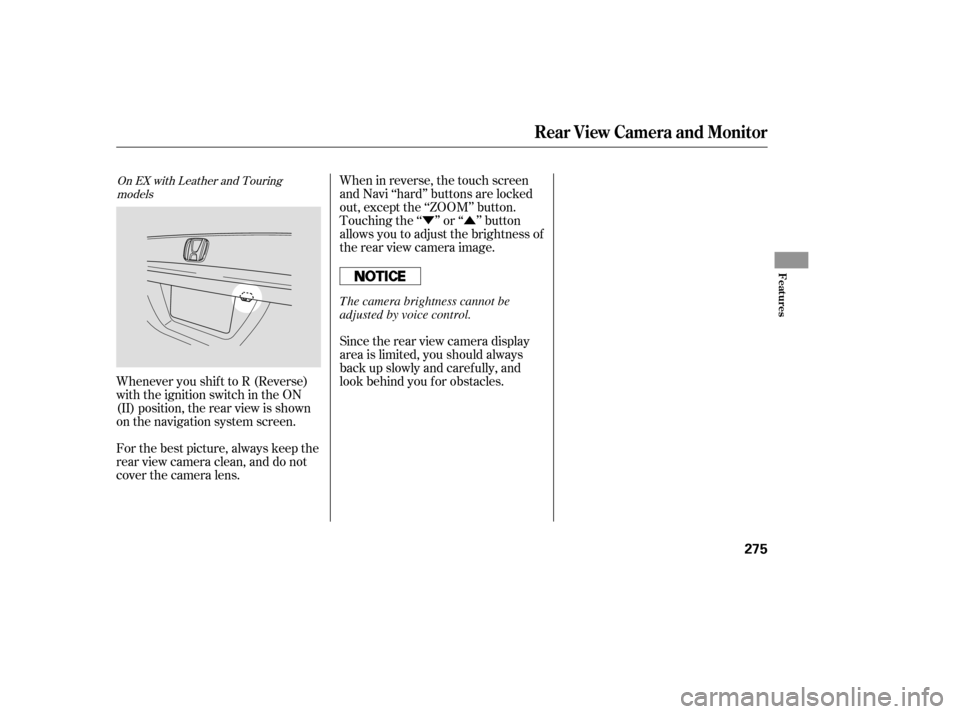
On EX with Leather and Touring
models
Rear View Camera and Monitor
Features
275
The camera brightness cannot be
adjusted by voice control.
Page 292 of 414
This section gives you tips on
starting the engine under various
conditions, and how to operate the
automatic transmission. It also
includes important inf ormation on
parking your vehicle, the braking
system, the vehicle stability assist
system, the tire pressure monitoring
system, and f acts you need if you are
planning to tow a trailer.........................
Preparing to Drive .292
.......................
Starting the Engine .293
..............
Automatic Transmission . 294
..................................
Parking Tips .298
.............................
Braking System .299
...............
Anti-lock Brakes (ABS) . 300
Vehicle Stability Assist (VSA) ........................................
System .301
Tire Pressure Monitoring System ......................................
(TPMS) .303
...........................
Towing a Trailer .306
Driving
Driving
291
Page 304 of 414
Your vehicle is equipped with a tire
pressure monitoring system (TPMS)
that turns on every time you start the
engine and monitors the pressure in
your tires while driving.
You will see the above display on the
multi-inf ormation display when you
turn the ignition switch to ON (II)
andpresstheINFObuttononthe
steering wheel six times.To see the inf lation pressures of all
f our tires, press the SEL/RESET
buttononthesteeringwheel.The
display changes as shown above.
Each tire has its own pressure
sensor. If the air pressure of a tire
becomes signif icantly low, the
sensor in that tire immediately sends
a signal that causes the low tire
pressure indicator in the instrument
panel to come on. If this happens,
you will see which tire is losing the
pressure in the multi-information
display along with a ‘‘CHECK TIRE
PRESSURE’’ message.
CONT INUED
On U.S. Touring model only
Tire Pressure Monitoring System (TPMS)
Driving
303
Page 305 of 414

If a f lat tire is causing the low tire
pressure indicator to come on, you
will see the above message in the
multi-inf ormation display.
It is possible that the pressures
shown in the multi-inf ormation
display and the pressures you
manually measure are slightly
dif f erent.
If the dif f erence is signif icant and
you cannot make the low tire
pressure indicator and message in
the multi-inf ormation display go out
after inflating the tires to the
specified values, have your dealer
check the system as soon as possible.
When the low tire pressure indicator
is on, one or more of your tires is
signif icantly under-inf lated. You
should stop and check your tires as
soon as possible, and inflate them to
the proper pressure as indicated on
the vehicle’s tire inf ormation placard.
Driving on a signif icantly under-
inf lated tire causes the tire to
overheat and can lead to tire failure.
Under-inf lation also reduces f uel
efficiency and tire tread life, and may
af f ect the vehicle’s handling and
stopping ability. Each tire, including
the spare should be checked
monthly when cold, and set to the
recommended inf lation pressure as
specif ied in the vehicle placard and
owner’s manual (see page ).
346
Tire Pressure Monitoring System (TPMS)
Low Tire Pressure
Indicator
304
Page 306 of 414

The tires on your vehicles are PAX
tires, and you cannot replace or
repair a f lat tire. Replacement or
repair of tires must be perf ormed by
a Honda dealer or an authorized
Michelin PAX system dealer. If the low tire pressure indicator
comes on, or the multi-information
display shows a ‘‘CHECK TPMS
SYSTEM’’ message, the VSA system
automatically turns on even when
the VSA system is turned of f by
pressing the VSA OFF button (see
page ). If this happens, you
cannot turn the VSA system of f by
pressing the VSA OFF button again.
If there is a problem with the TPMS,
you will see the above message in
the multi-information display.
If you see this message, the system
is of f and is not monitoring the tire
pressures. Have the system checked
by your dealer as soon as possible.
For more inf ormation on the
Michelin PAX system, ref er to page
.
Because your vehicle is equipped
with the Michelin PAX system, you
can continue to drive up to about 125
miles (200 km). If you have a f lat tire,
take your vehicle to the nearest
Honda dealer or authorized Michelin
PAX system dealer.
301
356
Tire Pressure Monitoring System (TPMS)
Changing a T ire with T PMS
TPMS System FailureDriving
305
Page 347 of 414
To saf ely operate your vehicle, your
tires must be the proper type and
size, in good condition with adequate
tread, and correctly inf lated.
The f ollowing pages give more
detailed inf ormation on how to take
care of your tires and what to do
when they need to be replaced.Keeping the tires properly inf lated
provides the best combination of
handling, tread lif e, and riding
comf ort.
Underinf lated tires wear unevenly,
adversely affect handling and fuel
economy, and are more likely to
fail from being overheated.
Overinf lated tires can make your
vehicleridemoreharshly,are
more prone to damage f rom road
hazards, and wear unevenly.
The tire pressure monitoring system
(TPMS) warns you when a tire
pressure is low. See page f or
more inf ormation.
We recommend that you visually
check your tires every day. If you
think a tire might be low, check it
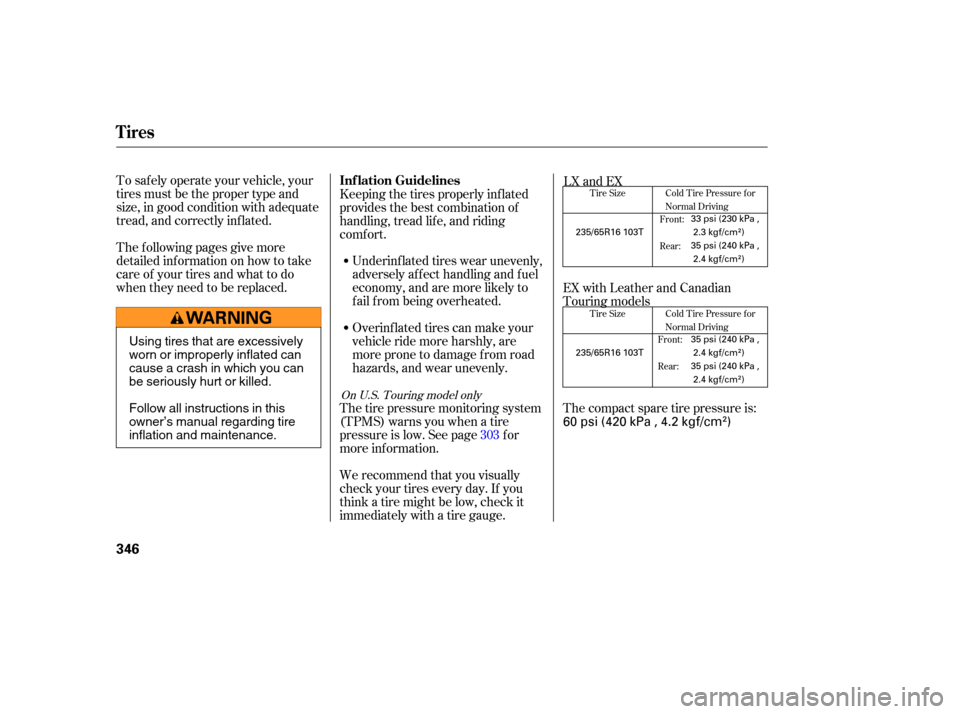
immediately with a tire gauge. Thecompactsparetirepressureis:
303 LX and EX
EX with Leather and Canadian
Touring modelsTire Size
Tire Size Cold Tire Pressure for
Normal Driving
Front:
Rear:
Cold Tire Pressure for
Normal Driving
Front:
Rear:
On U.S. Touring model only
Tires
Inf lation Guidelines
346
235/65R16 103T 33 psi (230 kPa ,
2.3 kgf/cm)
35 psi (240 kPa , 2.4 kgf/cm
)
235/65R16 103T 35 psi (240 kPa ,
2.4 kgf/cm
)
35 psi (240 kPa , 2.4 kgf/cm
)
60 psi (420 kPa , 4.2 kgf/cm)
Using tires that are excessively
worn or improperly inflated can
cause a crash in which you can
be seriously hurt or killed.
Follow all instructions in this
owner’s manual regarding tire
inflation and maintenance.
Page 352 of 414

Your vehicle is equipped with the
Michelin PAX System which,
together with the Tire Pressure
Monitoring System (TPMS), enables
you to continue driving even if one or
more of your tires loses its pressure.
The tires and wheels on your vehicle
are specially designed f or the PAX
system, and the PAX system is
specif ically designed and f ine-tuned
foryourvehicle.
Because of these reasons, use only
the wheels and tires designated in
this owner’s manual. Never mix PAX
system wheels or tires with
conventional wheels or tires.There are no snow tires compatible
with the PAX system, and not all tire
chains are suitable f or use on the
PAX system tires. To prevent tire
chain damage to your PAX system
tire or wheel, ensure that no part of
the chain contacts the PAX system.
Never use a tire repair agent in a
PAX system tire, and never repair
a PAX system tire by yourself .
Repair or replacement must be
done a Honda dealer or an
authorized Michelin PAX system
dealer.
Do not replace the PAX system tires
and wheels with conventional tires
andwheels.Doingsowoulddisable
the PAX system and the tire
pressure monitoring system (TPMS),
and may void your new vehicle
warranty. If you must continue driving with a
f lat tire, f ollow all the procedures
and precautions described on page
.
356
On U.S. Touring model only
Tires
Michelin PA X SystemImport ant Precaut ions
Maint enance
351