Page 138 of 226

If your vehicle has an automatic
transmission, set the parking brake
bef ore you put the transmission in
Park. This keeps the vehicle f rom
moving and putting pressure on the
parking mechanism in the
transmission.If the vehicle is f acing uphill, turn
the f ront wheels away f rom the
curb. If you have a manual
transmission, put it in f irst gear.
If the vehicle is f acing downhill,
turn the front wheels toward the
curb. If you have a manual
transmission, put it in reverse gear.
Make sure the parking brake is
f ully released bef ore driving away.
Driving with the parking brake
partially set can overheat or
damage the rear brakes.
Always use the parking brake when
you park your vehicle. Make sure
the parking brake is set f irmly or
your vehicle may roll if it is parked
on an incline.
Make sure the moonroof (if
equipped) and the windows are
closed.
Never park over dry leaves, tall
grass, or other f lammable
materials. The hot three way
catalytic converter could cause
these materials to catch on fire.
Lock the doors.
Place any packages, valuables, etc.,
in the trunk or take them with you.
Turn of f the lights.
Parking T ips
Parking
Driving
145
�����—�����—�����y�
�������������y���
�(���%�������y���
�����y
Page 140 of 226
CONT INUED
The anti-lock brake system (ABS)
helps prevent the brakes f rom
locking up, and helps you retain
steering control by pumping the
brakes rapidly, much f aster than a
person can do it.
Let the ABS work f or you by always
keeping f irm, steady pressure on the
brake pedal. This is sometimes
ref erred to as ‘‘stomp and steer.’’
The ABS also balances the f ront-to-
rear braking distribution according
to vehicle loading.
You will f eel a pulsation in the brake
pedal when the ABS activates, and
you may hear some noise. This is
normal: it is the ABS rapidly
pumpingthebrakes.Ondry
pavement, you will need to press on
thebrakepedalveryhardbeforethe
ABS activates. However, you may feel the ABS activate immediately if
you are trying to stop on snow or ice.
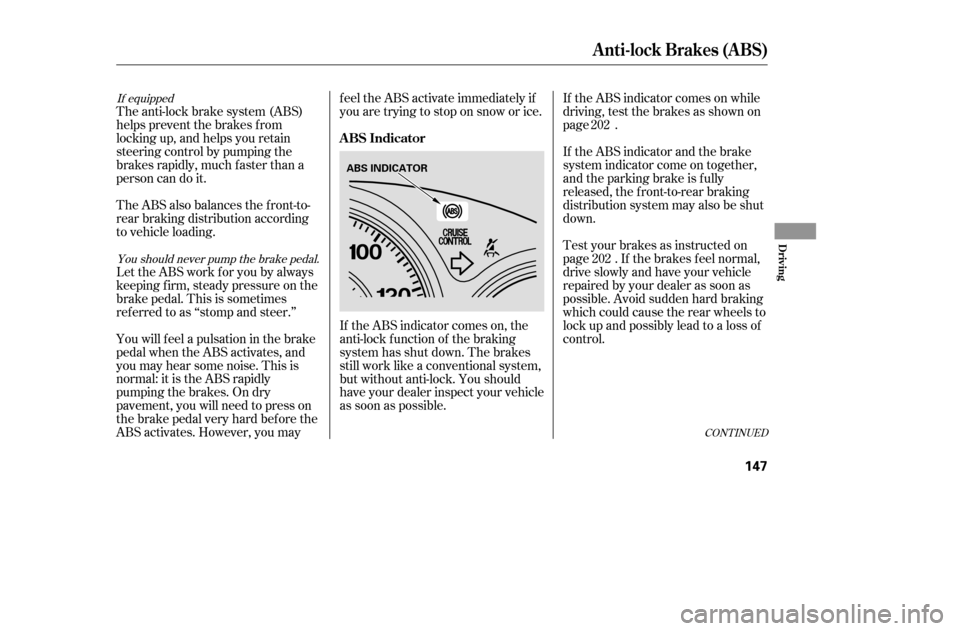
If the ABS indicator comes on, the
anti-lock f unction of the braking
system has shut down. The brakes
still work like a conventional system,
but without anti-lock. You should
have your dealer inspect your vehicle
as soon as possible.
If the ABS indicator comes on while
driving, test the brakes as shown on
page .
If the ABS indicator and the brake
system indicator come on together,
and the parking brake is f ully
released, the front-to-rear braking
distribution system may also be shut
down.
Test your brakes as instructed on
page . If the brakes f eel normal,
drive slowly and have your vehicle
repaired by your dealer as soon as
possible. Avoid sudden hard braking
which could cause the rear wheels to
lock up and possibly lead to a loss of
control.
202
202
If equipped
You should never pump the brake pedal.
Anti-lock Brakes (ABS)
ABS Indicator
Driving
147
ABS INDICATOR
�����—�����—�����y�
�������������y���
�(���%�������y���
�����y
Page 141 of 226

It only helps with the
steering control during braking.
such as trying to take a
corner too f ast or making a sudden
lane change. Always drive at a safe
speed f or the road and weather
conditions.
Always steer moderately
when you are braking hard. Severe
or sharp steering wheel movement
can still cause your vehicle to veer
into oncoming traffic or off the road. on loose or
uneven surf aces, such as gravel or
snow, than a vehicle without anti-
lock. Slow down and allow a greater
distance between vehicles under
those conditions. Your vehicle is not designed to tow a
trailer, attempting to do so can void
your warranties.
A BS does not reduce the time or
distance it takes to stop the
vehicle.
A BS will not prevent a skid that
results f rom changing direction
abruptly,
A BS cannot prevent a loss of
stability. A vehicle with A BS may require a
longer distance to stop
Important Saf ety Reminders
Towing a Trailer
Anti-Lock Brakes (ABS), Towing a Trailer
148
�����—�����—�����y�
�������������y���
�(���%�������y���
���
�y
Page 146 of 226

�Ì
�Î �Î�Î�Î �Ì�Ì
�Î
�Î
�Î �Ì�Î
154
Service the items listed at the indicated distance (or time, if given). miles x 1,000
km x 1,000 101620323048 40645080 70
112 80
128 130208
Check oil and coolant at each fuel stop
Check inflation and condition once a month
Every 5,000 miles (8,000 km) or every 6 months, whichever comes first Every 10,000 miles (16,000 km)
Every 10,000 miles (16,000 km) or every 1 year, whichever comes first
Every 20,000 miles (32,000 km) or every 1 year, whichever comes first
Every 30,000 miles (48,000 km) or every 2 years, whichever comes first
Every 15,000 miles (24,000 km) (Use normal schedule except in dusty conditions)
Inspect every 110,000 miles (176,000 km), otherwise adjust only if noisy
Every 3 years (independent of mileage)
At 120,000 miles (192,000 km) or 10 years, then every 60,000 miles (96,000 km) or 5 years Every 110,000 miles (176,000 km) or every 7 years, whichever comes first
See information on maintenance and emissions warranty, middle column, page .
See dust and pollen filter on page for replacement information under special driving conditions.
Replace at 60,000 miles (96,000 km) or 3 years, then every 30,000 miles (48,000 km) or 2 years.
Replace at 60,000 miles (96,000 km) or 3 years, then every 40,000 miles (64,000 km) or 2 years.
See timing belt on page for replacement information under special driving conditions. Every 60,000 miles (96,000 km) or every 3 years, whichever comes first90
144 120192 150240
110176 140224
100160
6096
Check engine oil and coolant
Check tires
Replace engine oil
Rotate tires (follow pattern on page 181 )
Replace engine oil filter
Check front and rear brakes
Lubricate all hinges, locks and latches
Inspect the following items: Tie-rod ends, steering gearbox, and boots
Suspension components, Driveshaft boots
Check parking brake adjustment
Inspect the following items: Brake hoses and lines (including ABS)
All fluid levels and condition of fluids
Exhaust system , Fuel lines and connections
Lights and controls/vehicle underbody
Inspect and adjust drive belts
Replace dust and pollen filter
Replace air cleaner element
Replace spark plugs
Inspect valve clearance
Replace automatic transmission fluid
Replace manual transmission fluid
Replace CVT fluid
Inspect idle speed
Replace timing belt , inspect auto-tensioner and water pump
Replace engine coolant
Replace brake fluid
:
1:2:3:4: 152
176
169 1
2
3
,4
Maintenance Schedule for Severe Conditions
�����—�����—�����y�
�����������
�y���
�(���%�������y���
�����y
Page 155 of 226
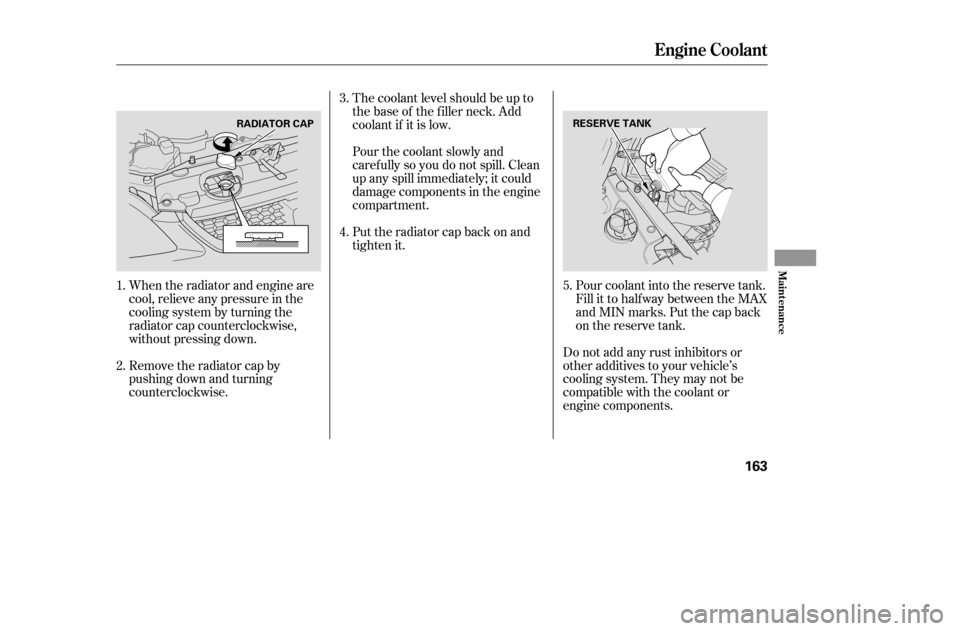
When the radiator and engine are
cool, relieve any pressure in the
cooling system by turning the
radiator cap counterclockwise,
without pressing down.The coolant level should be up to
the base of the f iller neck. Add
coolant if it is low.
Pourthecoolantslowlyand
caref ully so you do not spill. Clean
up any spill immediately; it could
damage components in the engine
compartment.
Put the radiator cap back on and
tighten it.
Remove the radiator cap by
pushing down and turning
counterclockwise. Pour coolant into the reserve tank.
Fill it to half way between the MAX
and MIN marks. Put the cap back
on the reserve tank.
Do not add any rust inhibitors or
other additives to your vehicle’s
cooling system. They may not be
compatible with the coolant or
engine components.
1. 2. 3. 4.
5.
Engine Coolant
Maint enance
163
RADIATOR CAP RESERVE TANK
�����—�����—�����y�
�������������y���
�(���%�������y���
�����y
Page 161 of 226
�µ�µ
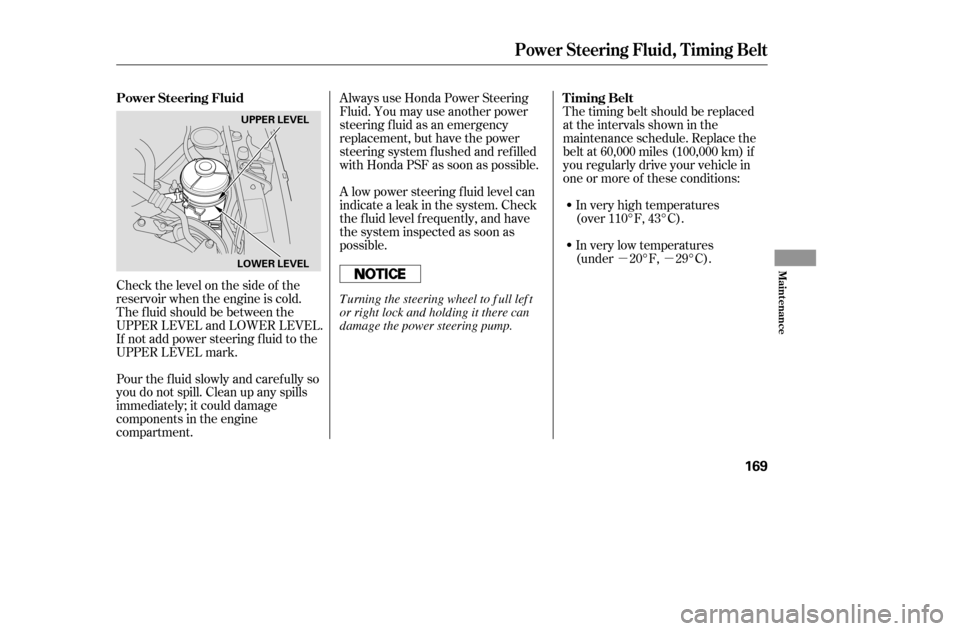
Check the level on the side of the
reservoir when the engine is cold.
The f luid should be between the
UPPER LEVEL and LOWER LEVEL.
If not add power steering f luid to the
UPPER LEVEL mark. Always use Honda Power Steering
Fluid. You may use another power
steering f luid as an emergency
replacement, but have the power
steering system f lushed and ref illed
with Honda PSF as soon as possible.
A low power steering f luid level can
indicate a leak in the system. Check
the f luid level f requently, and have
the system inspected as soon as
possible.
The timing belt should be replaced
at the intervals shown in the
maintenance schedule. Replace the
belt at 60,000 miles (100,000 km) if
you regularly drive your vehicle in
one or more of these conditions:
In very high temperatures
(over 110°F, 43°C).
In very low temperatures
(under 20°F, 29°C).
Pour the f luid slowly and caref ully so
you do not spill. Clean up any spills
immediately; it could damage
components in the engine
compartment.
Power Steering Fluid
T iming Belt
Power Steering Fluid, Timing Belt
Maint enance
169
UPPER LEVEL
LOWER LEVEL
T urning the steering wheel to f ull lef t
or right lock and holding it there can
damage the power steering pump.
�����—�����—�����y�
�������������y���
�(���%�������y���
�����y
Page 163 of 226
If you need to change a headlight
bulb on the passenger’s side, remove
the bolt from the stay and push the
battery toward windshield to obtain
enough working space.Remove the electrical connector
f rom the bulb by pushing on the
tab and pulling the connector
down.
Remove the bulb by turning it one-
quarter turn counterclockwise.Push the electrical connector back
onto the bulb. Make sure it is on
all the way.
Turn on the headlights to test the
new bulb.
Put the battery back to its original
position, reinstall the bolt in the
stay and tighten it securely.
Reinstall the power steering
reservoir.
(Passenger’s side)
(Driver’s side)
Insert the new bulb into the hole
and turn it one-quarter turn clock-
wise to lock it in place.
2. 3. 4. 5.6. 7.
Lights
Maint enance
171
STAY
TAB
BULB
CONNECTOR
�����—�����—�����y�
���������
���y���
�(���%�������y���
�����y
Page 164 of 226

If you are changing the bulb on
the driver’s side, start the engine,
turn the steering wheel all the way
to the right, and turn off the
engine. If you are changing the
bulb on the passenger’s side, turn
the steering wheel to the left.Use a f lat-tipped screwdriver to
remove the holding clip f rom the
inner f ender, and pull the inner
f ender cover back.
Remove the socket from the
headlight assembly by turning it
one-quarter turn counterclockwise.Remove the bulb f rom the socket
bypushingitinandturningthe
bulb counterclockwise until it
unlocks.
Install the new bulb in the socket.
Turn it clockwise to lock it in place.
Insert the socket back into the
headlight assembly. Turn it
clockwise to lock it in place.
Put the inner f ender cover in place.
Install the holding clip. Lock it in
place by pushing on the center.
2.
1.
3.4. 5. 6. 7.
Lights
Replacing the Front Side Marker/
Turn Signal and Parking L ightBulb
172
BULB
SOCKET
�����—�����—�����y�
�������������y���
�(���%�������y���
�����y