Page 233 of 289

To help increase tire lif e and
distribute wear more evenly, rotate
the tires every 10,000 miles
(16,000 km) on 4-cylinder models
and 7,500 miles (12,000 km) on
6-cylinder models. Move the tires to
the positions shown in the chart each
time they are rotated. If you
purchase directional tires, rotate
only f ront-to-back.It is best to replace all f our tires at
thesametime.If thatisnotpossible
or necessary, replace the two f ront
tires or two rear tires as a pair.
Replacing just one tire can seriously
af f ect your vehicle’s handling.
Replace your tires with radial tires of
the same size, load range, speed
rating, and maximum cold tire
pressure rating (as shown on the
tire’s sidewall).
Mixing radial and bias-ply tires on
your vehicle can reduce braking
ability, traction, and steering
accuracy. Using tires of a dif f erent
size or construction can cause the
ABS to work inconsistently.
TheABSworksbycomparingthe
speed of the wheels. When replacing
tires, use the same size originally
supplied with the vehicle. Tire size
and construction can affect wheel
speed and may cause the system to
work. If you ever replace a wheel, make
sure that the wheel’s specif ications
match those of the original wheels.
Replacement wheels are available at
your dealer.
T ire Rotation Replacing T ires and Wheels
Tires
Maint enance
241
(For Non-directional
Tires and Wheels)
Front
(For Directional
Tires and Wheels)Front
Installing improper tires on your
vehicle can affect handling and
stability. This can cause a crash
in which you can be seriously
hurt or killed.
Always use the size and type of
tires recommended in this
owner’s manual.
�����—�����—�����y�
�
��
��������y���
�(���%�������y���������y
Page 234 of 289

�´If you mount snow tires on your
vehicle, make sure they are radial
tires of the same size and load range
as original tires. Mount snow tires on
all f our wheels. The traction
provided by snow tires on dry roads
maybelowerthanyouroriginaltires.
Check with the tire dealer f or
maximum speed recommendations.
Tires marked ‘‘M S’’ or ‘‘All
Season’’ on the sidewall have an all-
weather tread design suitable for
most winter driving conditions.
For the best perf ormance in snowy
or icy conditions, you should install
snow tires or tire chains. They may
be required by local laws under
certain conditions.
Wheels:
Tires:
See page f or inf ormation about
DOT Tire Quality Grading, and page
f or tire size and labeling
inf ormation. 278
280
LX model
LX model
EX, LX-V6 and EX-V6 with A/T models
EX-V6 with M/T model
EX, LX-V6 and EX-V6 with A/T modelsEX-V6 with M/T model
Tires
Snow T iresWinter Driving
Wheel and T ire Specif ications
242
15x61/2JJ
16x61/2JJ
17x7JJ
P205/65R15 92H
P215/50R17 93V
P205/60R16 91V
�����—�����—�����y�
�
��
����
���y���
�(���%�������y���������y
Page 238 of 289

Leave the parking brake off. Put
the transmission in Reverse
(manual) or Park (automatic).
Block the rear wheels.
If the vehicle is to be stored f or a
longer period, it should be
supported on jackstands so the
tires are of f the ground.
Leave one window open slightly (if
the vehicle is being stored
indoors).
Disconnect the battery.
Support the f ront wiper blade
arms with a f olded towel or rag so
they do not touch the windshield.To minimize sticking, apply a
silicone spray lubricant to all door
and trunk seals. Also, apply a
vehiclebodywaxtothepainted
surfaces that mate with the door
and trunk seals.
Cover the vehicle with a
‘‘breathable’’ cover, one made
f rom a porous material such as
cotton. Non-porous materials, such
as plastic sheeting, trap moisture,
which can damage the paint.
If possible, periodically run the
engine until it reaches f ull
operating temperature (the
cooling f an cycles twice).
Pref erably, do this once a month.
If you store your vehicle f or 1 year or
longer, have your dealer perf orm the
maintenance inspections as soon as
youtakeitoutof storage(seepages
and ). The 6-cylinder model
needs the inspections called f or in
the 2 years/30,000 miles (48,000 km)
maintenance schedule (normal
conditions) and the 4-cylinder model
needs the inspections called f or in
the 2 years/40,000 miles (64,000 km)
maintenance schedule (normal
nonditions). The replacements called
f or in the maintenance schedule are
not needed unless the vehicle has
actually reached that time or mileage. 201 206
Vehicle Storage
Maint enance246
�����—�����—�����y�
�
��
��������y���
�(���%�������y���������y
Page 239 of 289

Use the compact spare tire as a
temporary replacement only. Get
your regular tire repaired or replaced,
and put it back on your vehicle as
soon as you can.Follow these precautions:
Do not use your compact spare
tire on another vehicle unless it is
thesamemakeandmodel.
Do not use the compact spare tire
if you are towing a trailer.
Turn off the TCS (see page ).
Driving with the compact spare
tiremayactivatetheTCS. Replace the tire when you can see
the tread wear indicator bars. The
replacement should be the same size
and design tire, mounted on the
same wheel. The spare tire is not
designed to be mounted on a regular
wheel, and the spare wheel is not
designed f or mounting a regular tire.
Check the inf lation pressure of the
compact spare tire every time you
check the other tires. It should be
inf lated to:
Never exceed 50 mph (80 km/h).
This tire gives a harsher ride and
less traction on some road sur-
f aces. Use greater caution while
driving.
Do not mount snow chains on the
compact spare tire.
187
On all V6 models
Compact Spare Tire
248
INDICATOR LOCATION MARK
TREAD WEAR INDICATOR BAR
60 psi (420 kPa , 4.2 kgf/cm)
�����—�����—�����y�
�
��
����
���y���
�(���%�������y�������
�y
Page 241 of 289
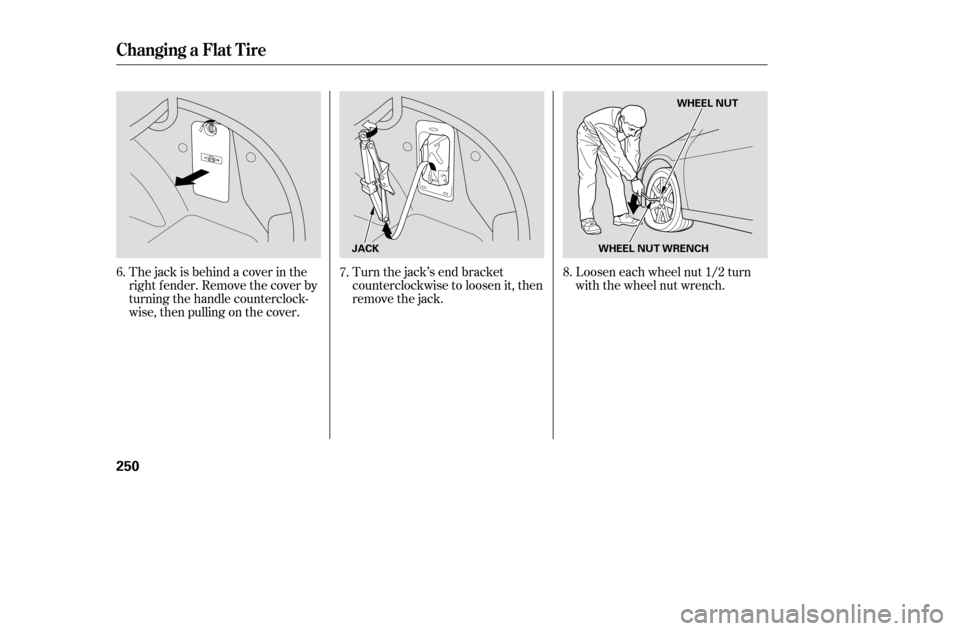
The jack is behind a cover in the
right f ender. Remove the cover by
turning the handle counterclock-
wise, then pulling on the cover.Turn the jack’s end bracket
counterclockwise to loosen it, then
remove the jack.
Loosen each wheel nut 1/2 turn
with the wheel nut wrench.
6.
7.8.
Changing a Flat T ire
250
JACK WHEEL NUT
WHEEL NUT WRENCH
�����—�����—�����y�
�
��
��������y���
�(���%�������y���������y
Page 242 of 289
CONT INUED
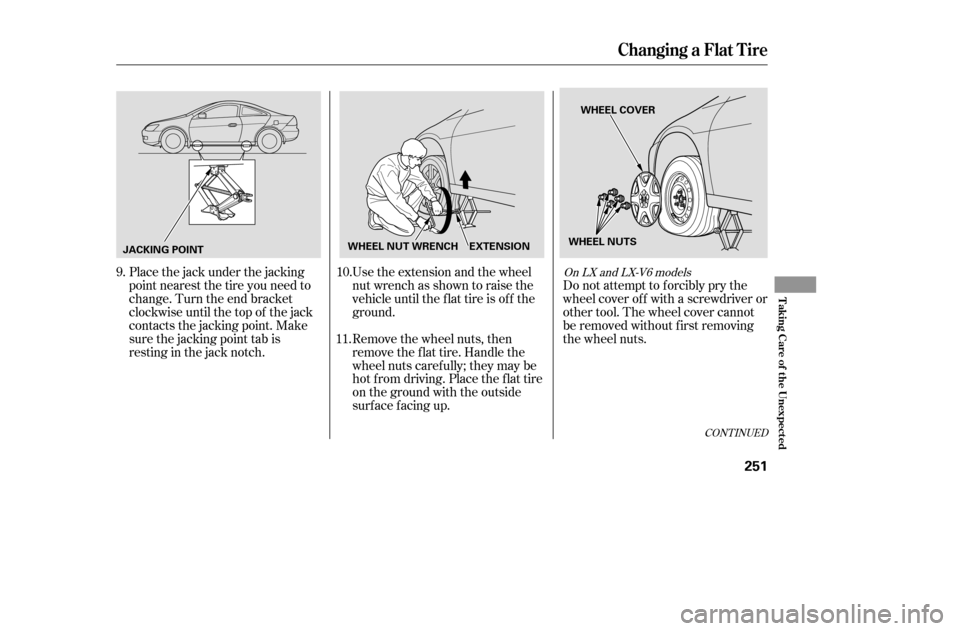
Place the jack under the jacking
point nearest the tire you need to
change. Turn the end bracket
clockwise until the top of the jack
contacts the jacking point. Make
sure the jacking point tab is
restinginthejacknotch.Remove the wheel nuts, then
remove the f lat tire. Handle the
wheel nuts caref ully; they may be
hot f rom driving. Place the f lat tire
on the ground with the outside
surface facing up.Do not attempt to forcibly pry the
wheel cover of f with a screwdriver or
other tool. The wheel cover cannot
be removed without f irst removing
the wheel nuts.
Use the extension and the wheel
nut wrench as shown to raise the
vehicle until the f lat tire is of f the
ground.
9.
10.
11.On LX and LX-V6 models
Changing a Flat T ire
T aking Care of t he Unexpect ed
251
JACKING POINT WHEEL COVER
WHEEL NUTS
WHEEL NUT WRENCH EXTENSION
�����—�����—�����y�
�
��
��������y���
�(���%�������y���������y
Page 243 of 289
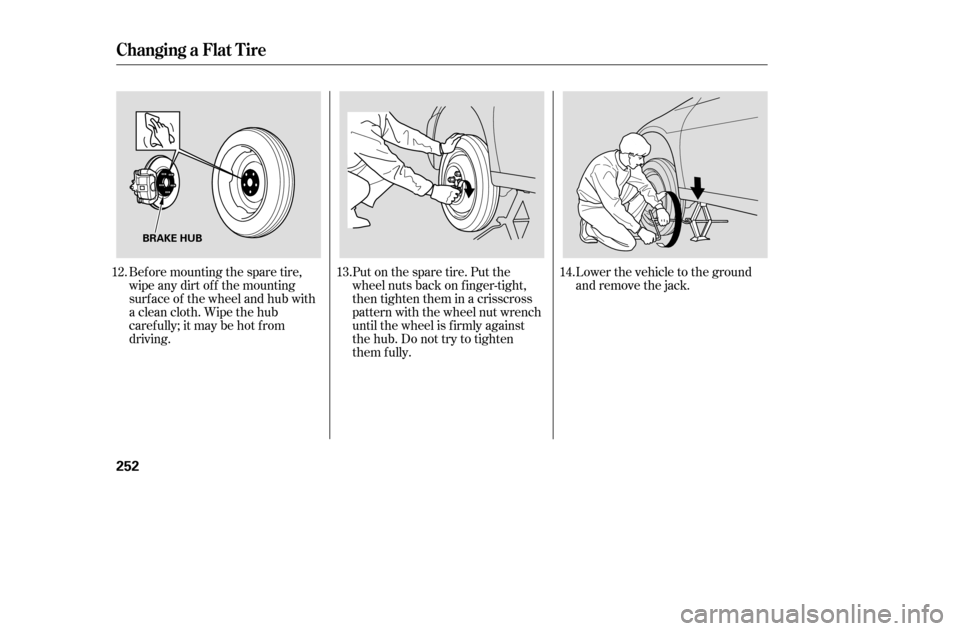
Lower the vehicle to the ground
and remove the jack.
Bef ore mounting the spare tire,
wipeanydirtoff themounting
surface of the wheel and hub with
a clean cloth. Wipe the hub
carefully;itmaybehotfrom
driving. Put on the spare tire. Put the
wheel nuts back on f inger-tight,
then tighten them in a crisscross
pattern with the wheel nut wrench
until the wheel is f irmly against
the hub. Do not try to tighten
them f ully.
13. 14.
12.
Changing a Flat T ire
252
BRAKE HUB
�����—�����—�����y�
�
��
��������y���
�(���%�������y���������y
Page 244 of 289
CONT INUED
Remove the center cap before
storing the f lat tire in the trunk
well.Place the flat tire face down in the
spare tire well.
Remove the spacer cone f rom the
wing bolt, turn it over, and put it
back on the bolt.
Securetheflattirebyscrewing
the wing bolt back into its hole.
Tighten the wheel nuts securely in
the same crisscross pattern. Have
the wheel nut torque checked at
the nearest automotive service
f acility.
Tighten the wheel nuts to:
15. 16. 17.
18.
19.
EX and EX-V6 models
Changing a Flat T ire
T aking Care of t he Unexpect ed
253
WING BOLT
SPACER CONEFor
sparetire
For
normaltire
80 lbf·ft (108 N·m , 11 kgf·m)
�����—�����—�����y�
�
��
��������y���
�(���%�������y���������y