Page 179 of 289

If the ABS indicator and the brake
system indicator come on together,
and the parking brake is f ully
released, the front-to-rear braking
distribution system may also be shut
down.
Test your brakes as instructed on
page . If the brakes f eel normal,
drive slowly and have your vehicle
repaired by your dealer as soon as
possible. Avoid sudden hard braking
which could cause the rear wheels to
lock up and possibly lead to a loss of
control.It only helps with the
steering control during braking.
such as trying to take a
corner too f ast or making a sudden
lane change. Always drive at a safe
speed f or the road and weather
conditions. on loose or
uneven surf aces, such as gravel or
snow, than a vehicle without anti-
lock. Slow down and allow a greater
distance between vehicles under
those conditions.
The TCS indicator will come on
alongwiththeABSindicator. Always steer moderately
when you are braking hard. Severe
or sharp steering wheel movement
can still cause your vehicle to veer
into oncoming traffic or off the road.
262
On all V6 models
Anti-lock Brakes (ABS)
Import ant Saf et y Reminders
A BS does not reduce the time or
distance it takes to stop the
vehicle.
A BS will not prevent a skid that
results f rom changing direction
abruptly,
A vehicle with A BS may require a
longer distance to stop
A BS cannot prevent a loss of
stability.
186
�����—�����—�����y�
�
�����������y���
�(���%�������y���
�����y
Page 180 of 289

Your vehicle is equipped with a
traction control system (TCS) to
assist you in maintaining traction
while driving slowly on loose or
slippery surf aces.
TCS monitors the speed of all f our
wheels. When it senses a f ront wheel
losing traction, it applies braking to
that wheel. The TCS Activation
indicator f lashes when this occurs.
Driving with TCS requires no special
skills or technique. The TCS does
not control your vehicle’s whole
braking system and cannot prevent
skidding if you enter a corner too
f ast. It is still your responsibility to
drive at reasonable speeds and to
leave a sufficient margin of safety.When starting out or driving on a
loose or slippery road surf ace, you
may notice that the vehicle does not
respond to the accelerator in the
samewayitdoesatothertimes.This
is a sign TCS is activating. You will
seetheTCSactivationindicator
flash.TheTCSindicator(seepage )
andtheTCSactivationindicator
comeonandstayonwhenthereisa
problem with the TCS.
You should still install winter tires on
your vehicle during the winter. Make
sure to use the same size originally
supplied with the vehicle. Exercise
the same caution in winter driving as
you would if your vehicle was not
equipped with TCS.
Driving with the compact spare tire
installed (see page ) may
activate the TCS. When driving with
the spare tire installed, turn off the
TCS.
58
248
On all V6 models
Traction Control System (TCS)
Driving
187
TCS INDICATOR
TCS ACTIVATION INDICATOR
�����—�����—�����y�
�
�������
���y���
�(���%�������y���
�����y
Page 181 of 289
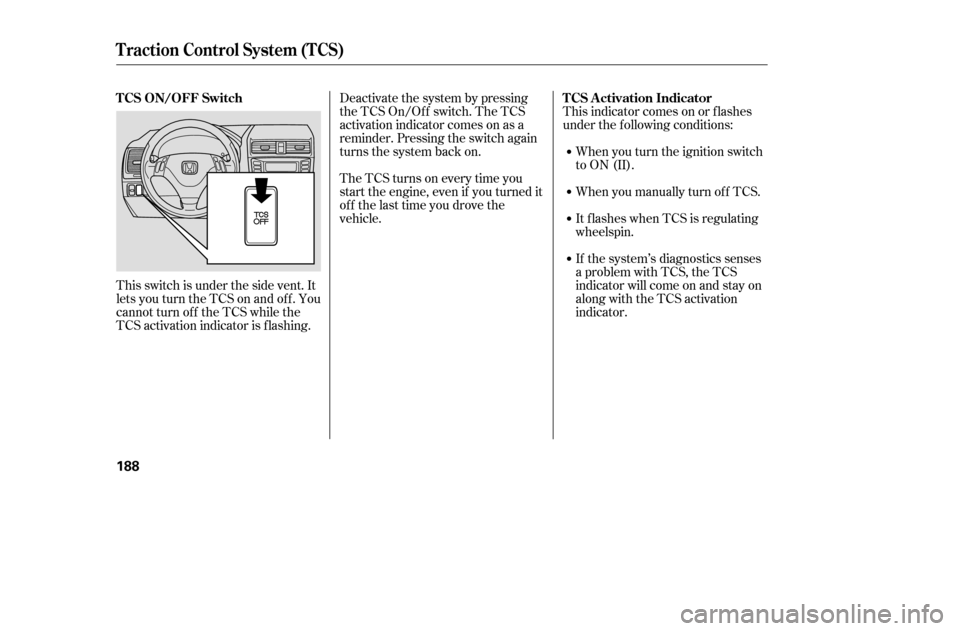
Deactivate the system by pressing
the TCS On/Off switch. The TCS
activation indicator comes on as a
reminder. Pressing the switch again
turns the system back on.
The TCS turns on every time you
start the engine, even if you turned it
off the last time you drove the
vehicle.
This switch is under the side vent. It
letsyouturntheTCSonandoff.You
cannot turn of f the TCS while the
TCS activation indicator is f lashing. This indicator comes on or f lashes
under the f ollowing conditions:
When you turn the ignition switch
to ON (II).
When you manually turn of f TCS.
It f lashes when TCS is regulating
wheelspin.
If the system’s diagnostics senses
a problem with TCS, the TCS
indicator will come on and stay on
along with the TCS activation
indicator.
Traction Control System (TCS)
TCS ON/OFF Switch TCS Activation Indicator
188
�����—�����—�����y�
�
�����������y���
�(���%�������y���
���
�y
Page 188 of 289
Always drive slowly and have
someone guide you when backing up.
Grip the of the steering
wheel; then turn the wheel to the lef t
to get the trailer to move to the lef t,
andturnthewheelrighttomovethe
trailer to the right.
Follow all normal precautions when
parking, including f irmly setting the
parking brake and putting the
transmission in Park (automatic) or
in 1st or Reverse (manual). Also,
place wheel chocks at each of the
trailer’s tires.
bottom
Towing a Trailer
Backing UpParking
Driving
195
�����—�����—�����y�
�
�����������y���
�(���%�������y���
�����y
Page 219 of 289

�µ�µ
The timing belt should be replaced
at the intervals shown in the
maintenance schedule.
Replace the belt at 60,000 miles (U.S.)
or 100,000 km (Canada) if you
regularly drive your vehicle in one or
more of these conditions:
Always use Honda Power Steering
Fluid. You may use another power
steering f luid as an emergency
replacement, but have the power
steering system f lushed and ref illed
with Honda PSF as soon as possible.
A low power steering f luid level can
indicate a leak in the system. Check
the f luid level f requently, and have
the system inspected as soon as
possible. In very high temperatures
(over 110°F, 43°C).
In very low temperatures
(under 20°F, 29°C).
If you f requently tow a trailer.
Pour the f luid slowly and caref ully so
you do not spill. Clean up any spill
immediately; it could damage
components in the engine
compartment.
6-cylinder models only
Timing Belt
Power Steering Fluid, Timing Belt
Maint enance
227
UPPER LEVEL
LOWER LEVEL
6-cylinder models
T urning the steering wheel to f ull lef t
or right lock and holding it there can
damage the power steering pump.
�����—�����—�����y�
�
��
��������y���
�(���%�������y���������y
Page 222 of 289
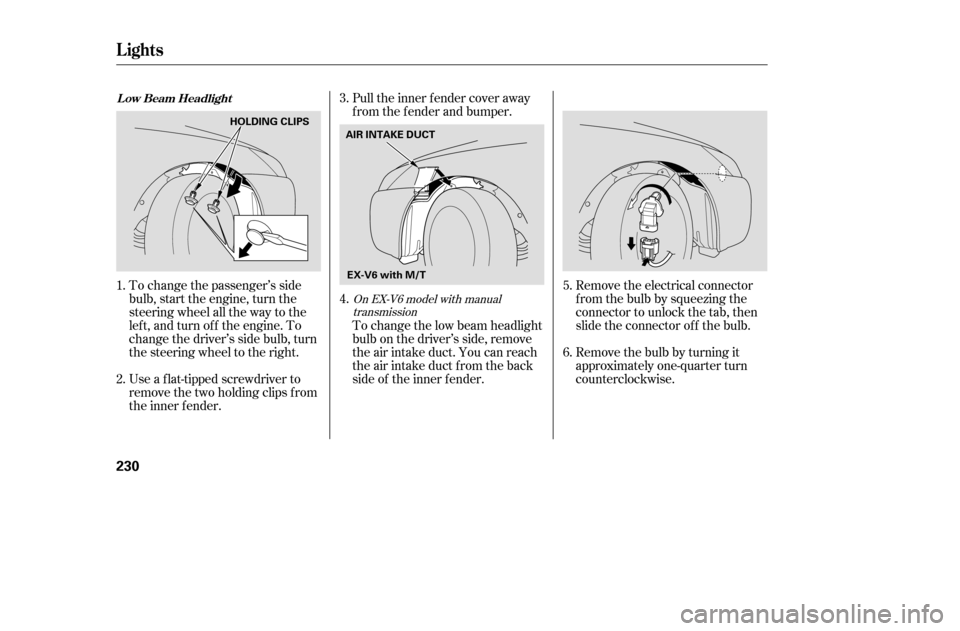
Remove the electrical connector
fromthebulbbysqueezingthe
connector to unlock the tab, then
slide the connector of f the bulb.
Remove the bulb by turning it
approximately one-quarter turn
counterclockwise.
To change the passenger’s side
bulb, start the engine, turn the
steering wheel all the way to the
lef t, and turn of f the engine. To
change the driver’s side bulb, turn
the steering wheel to the right.
Use a f lat-tipped screwdriver to
remove the two holding clips f rom
the inner f ender. Pull the inner f ender cover away
f rom the f ender and bumper.
To change the low beam headlight
bulb on the driver’s side, remove
the air intake duct. You can reach
the air intake duct f rom the back
side of the inner f ender.
6.
5.
4.
1. 2. 3.
On EX-V6 model with manual
transmission
Lights
L ow Beam Headlight
230
AIR INTAKE DUCT
EX-V6 with M/T
HOLDING CLIPS
�����—�����—�����y�
�
��
��������y���
�(���%�������y���������y
Page 223 of 289
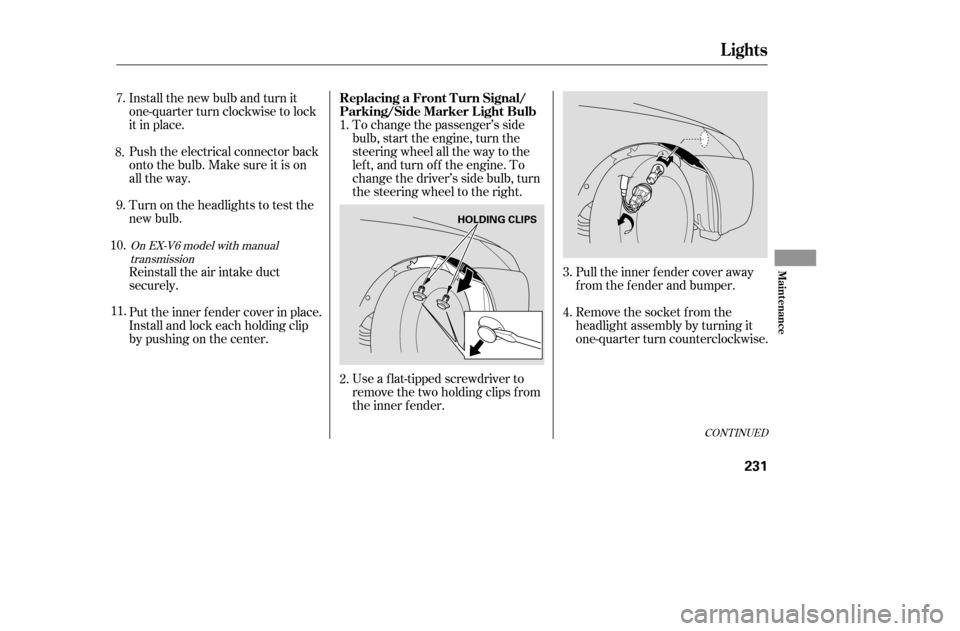
Pull the inner f ender cover away
f rom the f ender and bumper.
Remove the socket from the
headlight assembly by turning it
one-quarter turn counterclockwise.
To change the passenger’s side
bulb, start the engine, turn the
steering wheel all the way to the
lef t, and turn of f the engine. To
change the driver’s side bulb, turn
the steering wheel to the right.
Install the new bulb and turn it
one-quarter turn clockwise to lock
it in place.
Push the electrical connector back
onto the bulb. Make sure it is on
all the way.
Turn on the headlights to test the
new bulb.
Reinstall the air intake duct
securely.
Put the inner f ender cover in place.
Install and lock each holding clip
bypushingonthecenter.
Use a f lat-tipped screwdriver to
remove the two holding clips f rom
the inner f ender.
1.
3.
2. 4.
9.
7.
8.
10. 11.
CONT INUED
On EX-V6 model with manual transmission
Lights
Replacing a Front T urn Signal/
Parking/Side Marker Light Bulb
Maint enance
231
HOLDING CLIPS
�����—�����—�����y�
�
��
����
���y���
�(���%�������y���������y
Page 232 of 289
Every time you check inf lation, you
should also examine the tires f or
damage, f oreign objects, and wear.
Youshouldlookfor:Bumps or bulges in the tread or
side of the tire. Replace the tire if
youfindeitherof theseconditions.
Cuts, splits, or cracks in the side
of the tire. Replace the tire if you
can see f abric or cord.
Excessive tread wear. In addition to proper inf lation,
correct wheel alignment helps to
decrease tire wear. If you f ind a tire
is worn unevenly, have your dealer
check the wheel alignment.
Have your dealer check the tires if
you f eel a consistent vibration while
driving. A tire should always be
rebalanced if it is removed f rom the
wheel. When you have new tires
installed, make sure they are
balanced. This increases riding
comf ort and tire lif e. For best results,
have the installer perform a dynamic
balance.
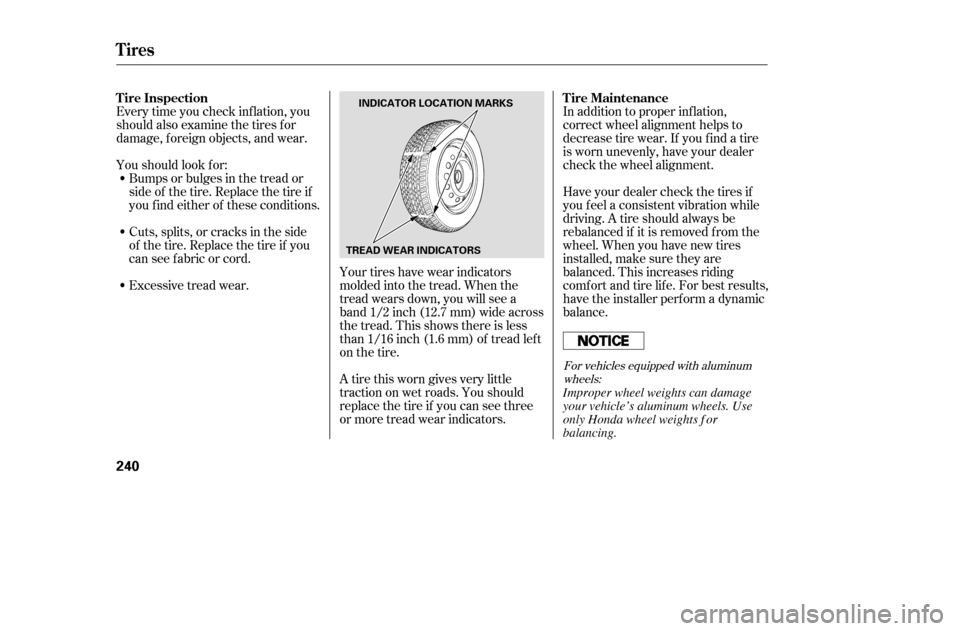
Your tires have wear indicators
molded into the tread. When the
tread wears down, you will see a
band 1/2 inch (12.7 mm) wide across
the tread. This shows there is less
than 1/16 inch (1.6 mm) of tread lef t
on the tire.
A tire this worn gives very little
traction on wet roads. You should
replace the tire if you can see three
or more tread wear indicators.
For vehicles equipped with aluminum
wheels:
Tire Inspection Tire Maintenance
Tires
240
INDICATOR LOCATION MARKS
TREAD WEAR INDICATORS
Improper wheel weights can damage
your vehicle’s aluminum wheels. Use
only Honda wheel weights f or
balancing.
�����—�����—�����y�
�
��
��������y���
�(���%�������y���������y