Page 216 of 289

The f luid level should be up to the
edge of the bolt hole. If it is not, add
Honda Manual Transmission Fluid
(MTF) until it starts to run out of the
hole. Reinstall the f iller bolt, and
tighten it securely.
If Honda MTF is not available, you
may use an SAE 10W-30 or 10W-40
viscosity motor oil with the API
Certif ication seal that says ‘‘FOR
GASOLINE ENGINES’’ as a
temporary replacement. However,
motor oil does not contain the proper
additives, and continued use can
cause stiffer shifting. Replace as
soon as it is convenient.
The transmission should be drained
and ref illed with new f luid according
to the time and distance recommen-
dations in the maintenance schedule.
If you are not sure how to check and
add f luid, contact your dealer.Check the f luid level with the
transmission at normal operating
temperature and the vehicle sitting
on level ground.
Remove the check bolt and look for
transmission f luid coming out of the
bolt hole. If a small amount of f luid
drips out of the bolt hole, reinstall
the check bolt.
If no f luid comes out, remove the
f iller bolt. Slowly add Honda Manual
Transmission Fluid (MTF) until it
starts to run out of the check bolt
hole. Let the f luid run out until it
stops, then reinstall the check bolt
and the f iller bolt.
On EX-V6 model
T ransmission Fluid
Manual Transmission
224
CHECK BOLT
WASHER
DRAIN BOLT FILLER BOLT
WASHER
�����—�����—�����y�
�
��
��������y���
�(���%�������y���������y
Page 217 of 289

Always use Honda Heavy Duty
Brake Fluid DOT 3. If it is not
available, you should use only DOT 3
or DOT 4 f luid, f rom a sealed
container, as a temporary
replacement.
Using any non-Honda brake f luid can
cause corrosion and decrease the lif e
of the system. Have the brake
system f lushed and ref illed with
Honda Heavy Duty Brake Fluid
DOT 3 as soon as possible.
Brake f luid marked DOT 5 is not
compatible with your vehicle’s
braking system and can cause
extensive damage.
Check the f luid level in the
reservoirs monthly. There are up to
two reservoirs, depending on the
model. They are:
If Honda MTF is not available, you
may use an SAE 10W-30 or 10W-40
viscosity motor oil with the API
Certif ication seal that says ‘‘FOR
GASOLINE ENGINES’’ as a
temporary replacement. However,
motor oil does not contain the proper
additives, and continued use can
cause stiffer shifting. Replace as
soon as it is convenient.
The transmission should be drained
and ref illed with new f luid according
to the time and distance recommen-
dations in the maintenance schedule.
If you are not sure how to check and
add f luid, contact your dealer.
Pour the f luid into the f iller hole
slowly and caref ully so you do not
spill. Clean up any spill immediately;
it could damage components in the
engine compartment.
Replace the brake f luid according to
the time recommendation in the
maintenance schedule.Brake f luid reservoir (all models)
Clutch f luid reservoir
(manual transmission only)
Transmission Fluid, Brake and Clutch Fluid
Brake and Clutch Fluid
Maint enance
225
�����—�����—�����y�
�
��
����
���y���
�(���%�������y���������y
Page 220 of 289
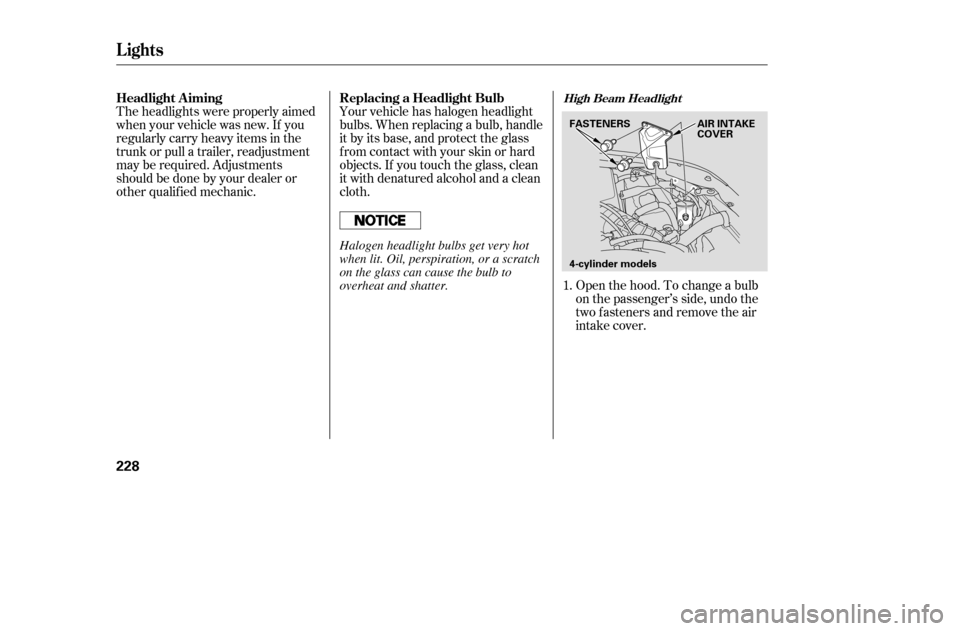
Open the hood. To change a bulb
on the passenger’s side, undo the
two fasteners and remove the air
intake cover.
Theheadlightswereproperlyaimed
when your vehicle was new. If you
regularly carry heavy items in the
trunk or pull a trailer, readjustment
may be required. Adjustments
should be done by your dealer or
other qualif ied mechanic.
Your vehicle has halogen headlight
bulbs. When replacing a bulb, handle
it by its base, and protect the glass
f rom contact with your skin or hard
objects. If you touch the glass, clean
it with denatured alcohol and a clean
cloth.
1.
Headlight A iming Replacing a Headlight Bulb
High Beam Headlight
Lights
228
4-cylinder models
FASTENERS AIR INTAKE
COVER
Halogen headlight bulbs get very hot
when lit. Oil, perspiration, or a scratch
on the glass can cause the bulb to
overheat and shatter.
�����—�����—�����y�
�
��
������
�y���
�(���%�������y�������
�y
Page 237 of 289

�µ
If you need to connect the battery to
a charger, disconnect both cables to
prevent damaging your vehicle’s
electrical system. Always disconnect
the negative ( ) cable first, and
reconnect it last.
If you need to park your vehicle f or
an extended period (more than one
month), there are several things you
should do to prepare it f or storage.
Proper preparation helps prevent
deterioration and makes it easier to
get your vehicle back on the road. If
possible, store your vehicle indoors.
Fill the f uel tank.
Change the engine oil and f ilter.
Wash and dry the exterior
completely.
Clean the interior. Make sure the
carpeting, floor mats, etc., are
completely dry.
CONT INUED
Vehicle Storage
Checking the Battery, Vehicle Storage
Maint enance
245
The battery gives off explosive
hydrogen gas during normaloperation.
A spark or flame can cause the
battery to explode with enough
force to kill or seriously hurt you.
Wear protective clothing and a
face shield, or have a skilled
mechanic do the batterymaintenance.
�����—�����—�����y�
�
��
��������y���
�(���%�������y���������y
Page 251 of 289

This indicator should never come on
when the engine is running. If it
starts flashing or stays on, the oil
pressure has dropped very low or
lost pressure. Serious engine
damage is possible and you should
take immediate action.Saf ely pull of f the road, and shut
of f the engine. Turn on the hazard
warning indicators.
Let the vehicle sit f or a minute.
Open the hood, and check the oil
level (see page ). An engine
very low on oil can lose pressure
during cornering and other driving
maneuvers.
If necessary, add oil to bring the
level back to the full mark on the
dipstick (see page ).
Start the engine, and watch the oil
pressure indicator. If it does not go
out within 10 seconds, turn of f the
engine. There is a mechanical
problem that needs to be repaired
bef ore you can continue driving
(see on page
). If the charging system indicator
comes on brightly when the engine
is running, the battery is not being
charged.
Immediately turn of f all electrical
accessories. Try not to use other
electrically operated controls such as
the power windows. Keep the engine
running; starting the engine will
discharge the battery rapidly.
Go to a service station or garage
where you can get technical
assistance.
1. 2. 3. 4.
213
164
269
L ow Oil Pressure
Indicator
Emergency T owing Charging System
Indicator
L ow Oil Pressure Indicator, Charging System Indicator
260
Running the engine with low oil
pressure can cause serious mechanical
damage almost immediately. Turn of f
the engine as soon as you can saf ely get
the vehicle stopped.
�����—�����—�����y�
�
��
����
���y���
�(���%�������y���������y
Page 258 of 289
�µ�µ
�Î �Î �Î
�´
�Î
No. Amps. Circuits Protected No. Amps. Circuits Protected No. Amps. Circuits Protected
CONT INUED
: 6-cylinder models
1 2345
10 A
(30A) 10 A
15 A
10 A Left Headlight Low Beam
(Rear Defroster Coil)
Left Headlight High Beam
Small Light
Right Headlight High Beam 6789
10 10 A
7.5 A 15 A
20 A Right Headlight Low Beam
Back Up
FI ECU
Condenser f an
Not Used 111112131415161717181819202122 23
20 A
30 A
7.5 A
20 A
40 A
40 A
15 A
30 A
30 A
20 A
40 A
40 A
(40 A)
40 A
100 A
50 A
50 A Cooling Fan
Cooling Fan
MG. Clutch
Horn, Stop
Rear Defroster
Back Up, ACC
Hazard
ABS Motor
TCS Motor
ABS F/S
TCS
Option
Option
Heater Motor
Battery
Not Used
BIG1Main
Power Window Main
Fuse Locations
T aking Care of t he Unexpect ed
267
UNDER-HOOD FUSE/RELAY BOX
�����—�����—�����y�
�
�����������y���
�(���%�������y���������y
Page 259 of 289
�Î
�µ �µ�µ �µ�µ
�µ �µ �µ
�Î
No. Amps. Circuits Protected Amps. Circuits Protected
No.No. Amps. Circuits Protected
: On Canadian models
1234567 (15 A)
15 A
(10 A) 15 A
10 A
7.5 A 10 A DBW
Ignition Coil
Daytime Running Light
Laf Heater
Radio
Interior Light
Back-Up Lights 20 A
15 A
7.5 A
30 A Door Lock
Front Accessory Sockets
IG OPDS (Occupant
Position Detection System)
IG Wiper
Not Used
Not Used
89
10 11 1213 141516 17 18192021222324252627282930313233(20 A)
(20 A)
(20 A)
15 A
15 A
7.5 A
7.5 A 10 A
7.5 A
20 A
20 A
(20 A)
7.5 A
7.5 A Driver’s Power Seat Sliding
Heated Seats
Driver’s Power Seat
Reclining
Not Used
IG ACG
IG Fuel Pump
IG Washer
IG Meter
IG SRS
IGP (PGM-FI ECU)
Not Used
Not Used
Passenger’s Power Window
Driver’s Power Window
Moonroof
Not Used
IG HAC
Not Used
ACC
Not Used
Fuse Locations
268
INTERIOR FUSE BOX
�����—�����—�����y�
�
�����������y���
�(���%�������y�������
�y
Page 260 of 289

�µ
�µ
If your vehicle needs to be towed,
call a prof essional towing service or
organization. Never tow your vehicle
with just a rope or chain. It is very
dangerous.
If , due to damage, your vehicle must
be towed with the f ront wheels on
the ground, do the f ollowing:
Release the parking brake.
Shif t the transmission to Neutral. With the f ront wheels on the ground,
it is best to tow the vehicle no farther
than 50 miles (80 km), and keep the
speedbelow35mph(55km/h).
If your vehicle is equipped with a
f ront spoiler, remove it bef ore
towing so it is not damaged.
Turn of f the engine.
ShifttoD,thentoN.
Start the engine.
Release the parking brake.
The tow
truck uses two pivoting arms that go
under the tires (f ront or rear) and lif t
them of f the ground. The other two
tires remain on the ground. The operator
loads your vehicle on the back of a
truck.
Therearetwowaystotowyour
vehicle.
CONT INUED
Manual Transmission:
Automatic Transmission:
Emergency T owing
Wheel-lif t Equipment
Flat -bed Equipment
T his is
an acceptable way to tow your
vehicle. This is the best way to trans-
port your vehicle.
T aking Care of t he Unexpect ed
269
Improper towing preparation will
damage the transmission. Follow the
above procedure exactly. If you cannot
shif t the transmission or start the
engine (automatic transmission), your
vehicle must be transported with the
f ront wheels of f the ground. Trying to lif t or tow your vehicle by the
bumpers will cause serious damage.
The bumpers are not designed to
support the vehicle’s weight.
�����—�����—�����y�
�
�����������y���
�(���%�������y���������y