Page 51 of 286
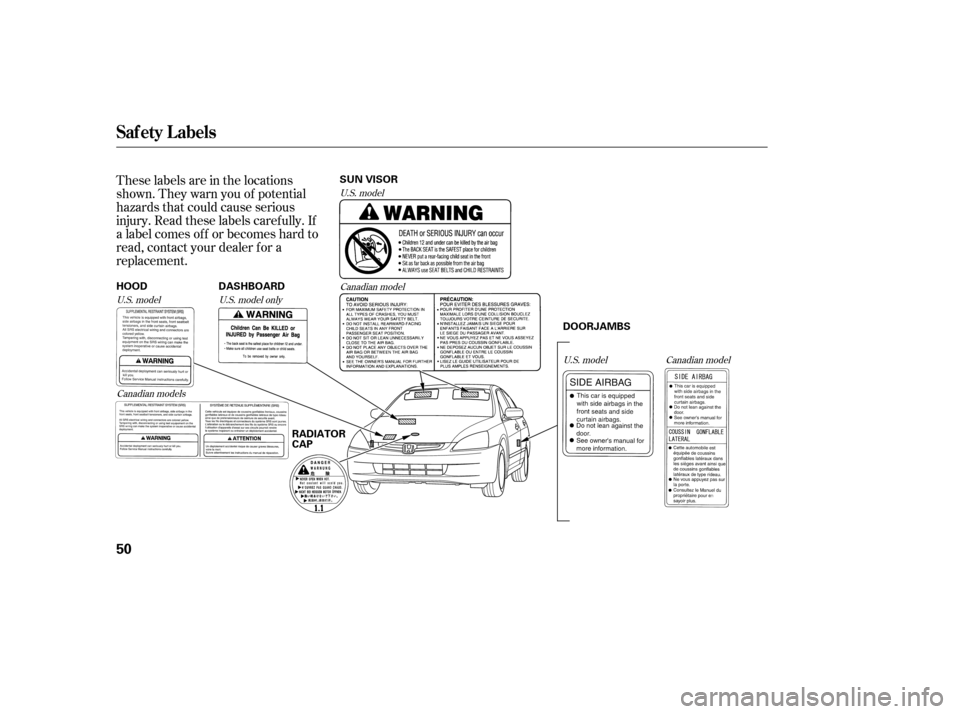
These labels are in the locations
shown. They warn you of potential
hazards that could cause serious
injury. Read these labels caref ully. If
a label comes of f or becomes hard to
read, contact your dealer f or a
replacement.
Canadian modelsU.S. model
U.S. model only
U.S. model
U.S. model Canadian model
Canadian model
Saf ety L abels
50
SUN VISOR
HOOD DOORJAMBS
RADIATOR
CAP
DASHBOARD
�����—�
���—���
�y���������������y���
�(���'�������y���������y
Page 157 of 286
Look at the coolant level in the
radiator reserve tank. Make sure it is
between the MAX and MIN lines. If
it is below the MIN line, seeon page f or
inf ormation on adding the proper
coolant. Refer to
on page f or inf ormation
about checking other items on your
vehicle.
206 193
Engine Coolant Check
A dding
Engine Coolant Owner’s Maintenance
Checks
Service Station Procedure
156
MAX RESERVE TANK
MIN
�����—�
���—���
�y���������������y���
�(���'�������y���
�����y
Page 194 of 286
�µ�µ �µ
�µ
�µ
�µ �µ
Youshouldcheckthefollowing
items at the specif ied intervals. If
you are unsure of how to perf orm
any check, turn to the appropriate
page listed.
Engine oil level Check every
time you fill the fuel tank. See
page .
Engine coolant level Check the
radiator reserve tank every time
you f ill the f uel tank. See page . Brakes Check the f luid level
monthly. See page .
Tires Check the tire pressure
monthly. Examine the tread f or
wear and foreign objects. See page
.
Automatic transmission Check
the f luid level monthly. See pages . Lights Check the operation of
the headlights, parking lights,
taillights, high-mount brake light,
and license plate lights monthly.
155
156
208 209 209
219
Maintenance Schedule
Owner’s Maintenance Checks
Maint enance
193
�����—�
���—���
�y���������������y���
�(���'�������y���
�����y
Page 201 of 286
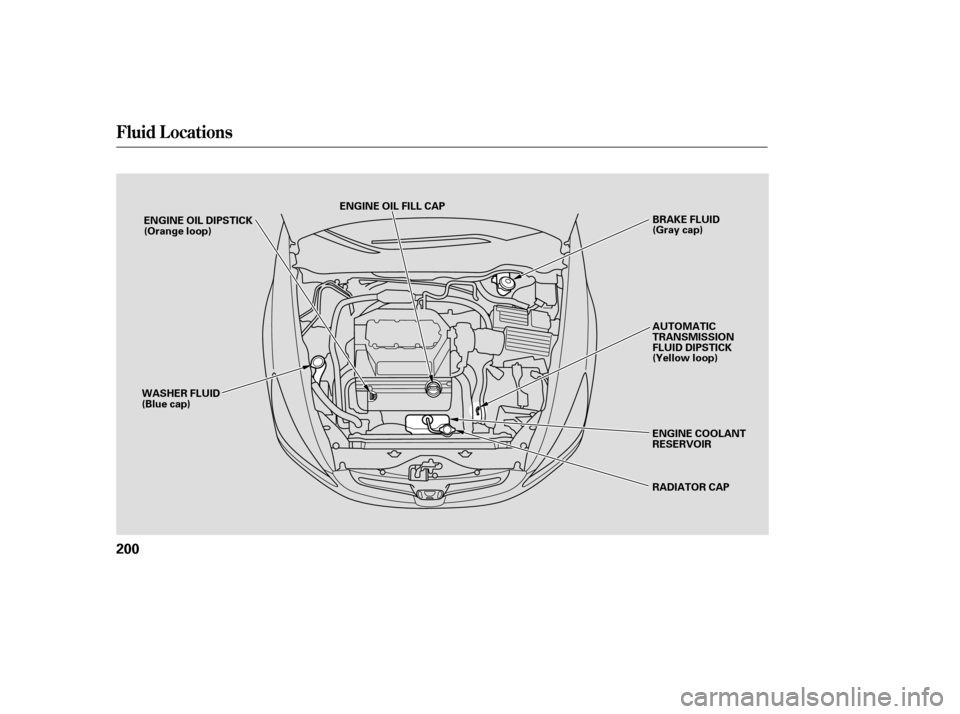
Fluid Locations
200
ENGINE OIL FILL CAPRADIATOR CAP
ENGINE OIL DIPSTICK
(Orange loop)
WASHER FLUID
(Blue cap) BRAKE FLUID
(Gray cap)
AUTOMATIC
TRANSMISSION
FLUID DIPSTICK
(Yellow loop)
ENGINE COOLANT
RESERVOIR
�����—���
�—�����y�
�������������y���
�(���'�������y���������y
Page 207 of 286

If the coolant level in the reserve
tank is at or below the MIN line, add
coolant to bring it up to the MAX line.
Inspect the cooling system f or leaks.
Always use Honda All Season
Antif reeze/Coolant Type 2. This
coolant is pre-mixed with 50 percent
antif reeze and 50 percent water.
Never add straight antifreeze or
plain water.If Honda antif reeze/coolant is not
available, you may use another
major-brand non-silicate coolant as a
temporaryreplacement.Makesureit
is a high-quality coolant
recommended f or aluminum engines.
Continued use of any non-Honda
coolant can result in corrosion,
causing the cooling system to
malf unction or f ail. Have the cooling
system f lushed and ref illed with
Honda antif reeze/coolant as soon as
possible.
If the reserve tank is completely
empty, you should also check the
coolant level in the radiator.
A dding Engine Coolant
Engine Coolant
206
RESERVE TANK
Removing the radiator cap
while the engine is hot can
cause the coolant to spray out,
seriously scalding you.
Always let the engine and
radiator cool down before
removing the radiator cap.
�����—�
���—���
�y�����������
���y���
�(���'�������y���������y
Page 208 of 286
Pour coolant into the reserve tank.
Fill it to half way between the MAX
and MIN marks. Put the cap back
on the reserve tank.
Do not add any rust inhibitors or
other additives to your vehicle’s
cooling system. They may not be
compatible with the coolant or
engine components.
The coolant level should be up to
the base of the f iller neck. Add
coolant if it is low.
Pourthecoolantslowlyand
caref ully so you do not spill. Clean
up any spill immediately; it could
damage components in the engine
compartment.
Put the radiator cap back on and
tighten it.
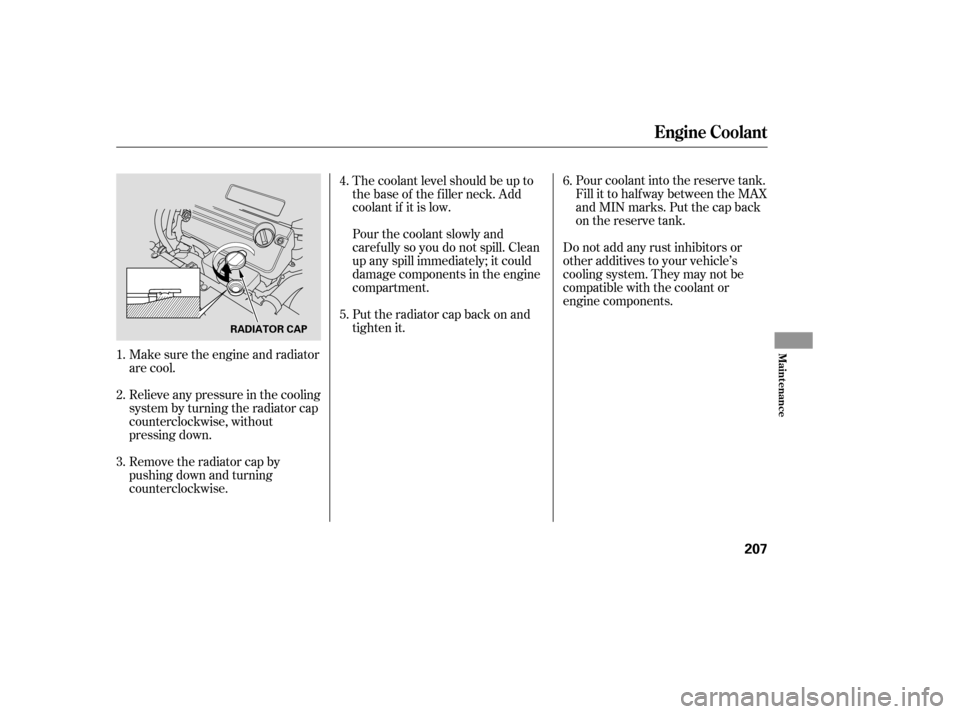
Make sure the engine and radiator
are cool.
Relieve any pressure in the cooling
system by turning the radiator cap
counterclockwise, without
pressing down.
Remove the radiator cap by
pushing down and turning
counterclockwise. 4.
1.
2.
3. 5.
6.
Engine Coolant
Maint enance
207
RADIATOR CAP
�����—�
���—���
�y���������������y���
�(���'�������y�����
���y
Page 245 of 286
Saf ely pull to the side of the road.
Put the transmission in Neutral or
Park, and set the parking brake.
Turn of f all accessories, and turn
on the hazard warning indicators.
If you see steam and/or spray
coming f rom under the hood, turn
of f the engine. Wait until you see
no more signs of steam or spray,
then open the hood.If you do not see steam or spray,
leave the engine running, and
watch the temperature gauge. If
the high heat is due to overloading,
the engine should start to cool
down almost immediately. If it
does, wait until the temperature
gauge comes down to the midpoint,
then continue driving.
If the temperature gauge stays at
the red mark, turn off the engine.
Look f or any obvious coolant leaks,
such as a split radiator hose.
Everything is still extremely hot,
so use caution. If you f ind a leak, it
must be repaired bef ore you
continue driving (see
on page ).
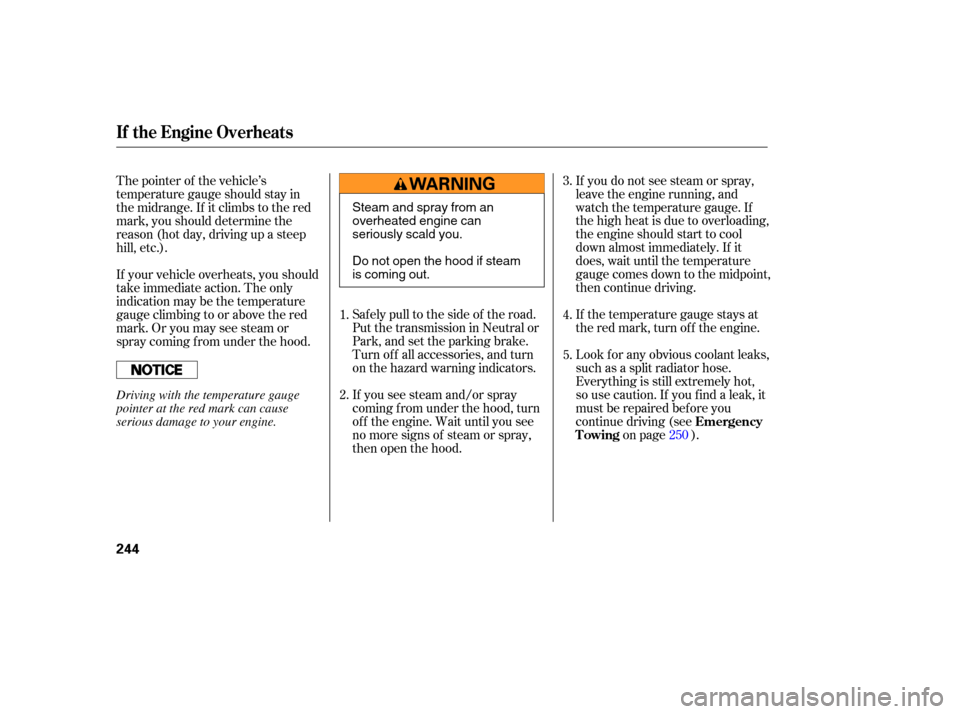
The pointer of the vehicle’s
temperature gauge should stay in
the midrange. If it climbs to the red
mark, you should determine the
reason (hot day, driving up a steep
hill, etc.).
If your vehicle overheats, you should
take immediate action. The only
indication may be the temperature
gauge climbing to or above the red
mark. Or you may see steam or
spray coming f rom under the hood.
1.
2.3.
4.
5.
250Emergency
Towing
If theEngineOverheats
244
Steam and spray from an
overheated engine can
seriously scald you.
Do not open the hood if steam
is coming out.
Driving with the temperature gauge
pointer at the red mark can cause
serious damage to your engine.
�����—�
���—���
�y�����������
�
�y���
�(���'�������y���������y
Page 246 of 286

Using gloves or a large heavy
cloth, turn the radiator cap
counterclockwise, without pushing
down, to the f irst stop. Af ter the
pressure releases, push down on
the cap, and turn it until it comes
off.
Start the engine and set the
temperature control dial to
maximum (climate control to
FULL AUTO at 90°F/32°C). Add
coolant to the radiator up to the
base of the f iller neck. If you do
not have the proper coolant
mixture available, you can add
plain water. Remember to have
the cooling system drained and
ref illed with the proper mixture as
soon as you can.Put the radiator cap back on
tightly. Run the engine, and watch
the temperature gauge. If it goes
back to the red mark, the engine
needs repair (see
on page ).
If the temperature stays normal,
check the coolant level in the
radiator reserve tank. If it has
gone down, add coolant to the
MAX mark. Put the cap back on
tightly.
If you do not f ind an obvious leak,
check the coolant level in the
radiator reserve tank. Add coolant
if the level is below the MIN mark.
If there was no coolant in the
reserve tank, you may need to add
coolant to the radiator. Let the
engine cool down until the pointer
reaches the middle of the tempera-
ture gauge, or lower, bef ore check-
ing the radiator.
7. 6.
8.
9.10.
11.
250
Emergency
Towing
If theEngineOverheats
T aking Care of t he Unexpect ed
245
Removing the radiator cap
while the engine is hot can
cause the coolant to spray out,
seriously scalding you.
Always let the engine and
radiator cool down before
removing the radiator cap.
�����—�
���—���
�y�������������
�y���
�(���'�������y���������y