Page 172 of 286
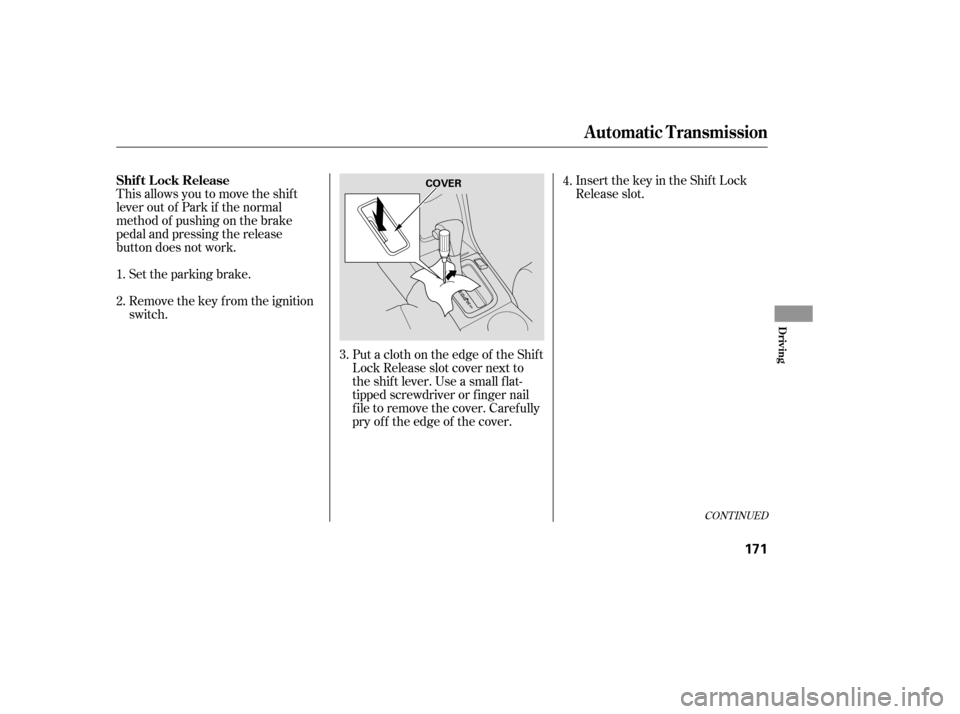
Put a cloth on the edge of the Shif t
Lock Release slot cover next to
theshiftlever.Useasmallflat-
tipped screwdriver or f inger nail
f ile to remove the cover. Caref ully
pryoff theedgeof thecover.Insert the key in the Shift Lock
Release slot.
This allows you to move the shif t
lever out of Park if the normal
method of pushing on the brake
pedal and pressing the release
button does not work.
Remove the key from the ignition
switch. Set the parking brake.
1.
2.
3.4.
CONT INUED
Automatic Transmission
Shif t L ock Release
Driving
171
COVER
�����—�
���—�����y�
�������������y���
�(���'�������y���
�����y
Page 173 of 286
Push down on the key while you
pressthereleasebuttononthe
shif t lever and move the shif t lever
out of Park to Neutral.
Remove the key from the Shift
Lock Release slot, then reinstall
thecover.Makesurethenotchon
the cover is on the lef t side.
Depress the brake pedal and
restart the engine.If you need to use the Shif t Lock
Release, it means your vehicle is
developing a problem. Have the
vehicle checked by your dealer.
5.
6.
Automatic Transmission
172
RELEASE
BUTTON
SHIFT LOCK RELEASE SLOT
�����—�
���—�����y�
�������������y���
�(���'�������y���
�����y
Page 174 of 286

�µ
�µ The engine restarts when you
release the brake pedal. Even while
you are pressing down on the brake
pedal, the engine restarts if the
conditions below are met.
You move the shif t lever f rom N to
R, or f rom D3 to 2nd.
Youstepontheacceleratorpedal.
Your vehicle has an auto idle stop
system. Af ter your vehicle comes to
a halt, the engine shuts of f
automatically if all the f ollowing
conditions are met.
The vehicle speed is over 8 mph
(12km/h)beforethevehicle
comes to a stop.
The engine coolant is nearly up to
normal operating temperature.
TheshiftleverisinD,D3orN.
You are pressing on the brake
pedal.
You are not pressing on the
accelerator pedal.
The IMA battery is charged
enough to operate the system.
Fan speed lower f an speeds, in
either AUTO or manual modes. During Auto Idle Stop, the IMA
charge and power brake vacuum
reserve is monitored by the system.
If the vacuum reserve drops below
an optimal level, the engine will
restart to replenish the vacuum
supply. If the IMA charge drops
below an optimal level, the engine
will restart to recharge the IMA
battery.
The auto idle stop system may not
work if the temperature of the IMA
battery is extremely high or
extremely low.
While the auto idle stop system is
working, the auto idle stop indicator
blinks (see page ).
Outside temperature is between
10 100 degrees F.
The f ront window def roster is of f . 174
Automatic Transmission
Auto Idle Stop
Driving
173
�����—�
���—���
�y��������
��
���y���
�(���'�������y���
�����y
Page 175 of 286
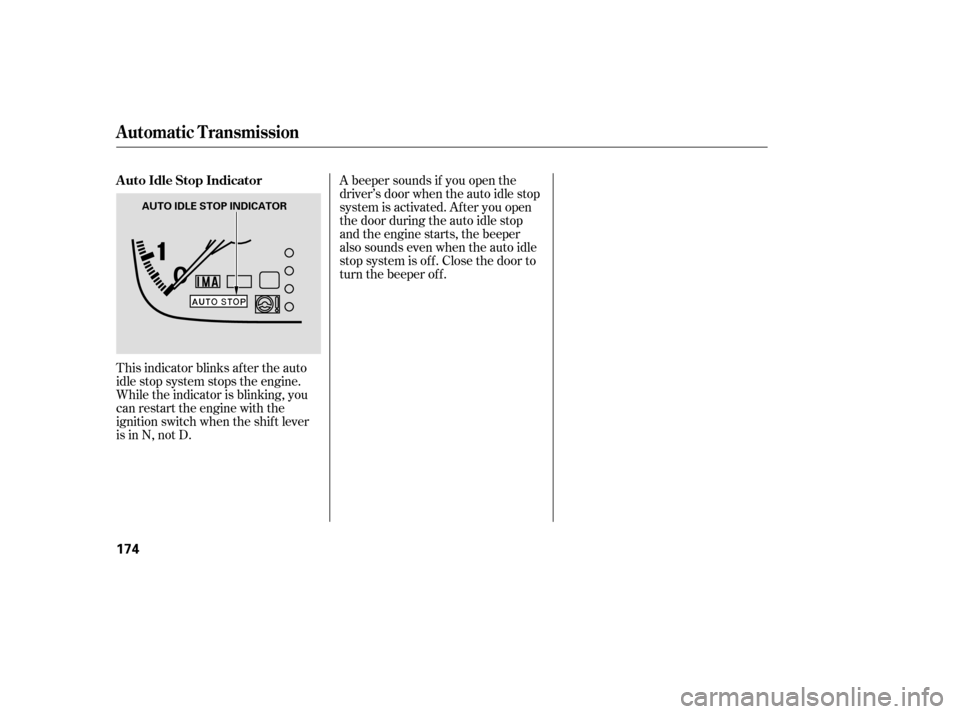
This indicator blinks af ter the auto
idle stop system stops the engine.
While the indicator is blinking, you
can restart the engine with the
ignition switch when the shif t lever
is in N, not D.A beeper sounds if you open the
driver’s door when the auto idle stop
system is activated. Af ter you open
the door during the auto idle stop
and the engine starts, the beeper
also sounds even when the auto idle
stop system is of f . Close the door to
turn the beeper of f .
Automatic Transmission
A uto Idle Stop Indicator
174
AUTO IDLE STOP INDICATOR
�����—�
���—���
�y��������
������y���
�(���'�������y���
�����y
Page 176 of 286

Always use the parking brake when
you park your vehicle. Make sure
the parking brake is set f irmly or
your vehicle may roll if it is parked
on an incline.
Set the parking brake bef ore you put
the transmission in Park. This keeps
the vehicle from moving and putting
pressure on the parking mechanism
in the transmission.Make sure the windows are closed.
Turn of f the lights.
Place any packages, valuables, etc.,
in the trunk or take them with you.
Lockthedoorswiththekeyorthe
remote transmitter.
Check the indicator on the
instrument panel to verif y that the
security system is set.
Never park over dry leaves, tall
grass, or other f lammable
materials. They may catch f ire
because of the extreme heat of the
three-way catalytic converter.If the vehicle is f acing uphill, turn
the f ront wheels away f rom the
curb.
If the vehicle is f acing downhill,
turn the front wheels toward the
curb.
Make sure the parking brake is
f ully released bef ore driving away.
Driving with the parking brake
partially set can overheat or
damage the rear brakes.
Parking T ips
Parking
Driving
175
�����—�
���—���
�y��������
������y���
�(���'�������y���
�����y
Page 187 of 286

When preparing to tow, and bef ore
driving away, be sure to check the
f ollowing:The vehicle has been properly
serviced, and the tires, brakes,
suspension, cooling system, and
lights are in good operating
condition. Your vehicle tires and spare are
properly inf lated (see page ),
and the trailer tires and spare are
trailer maker.
The lights and brakes on your
vehicle and the trailer are working
properly. All items in or on the trailer are
properly secured and cannot shif t
while you drive. Thehitch,safetychains,andany
other attachments are secure. All weights and loads are within
limits (see pages and ). The added weight, length, and
height of a trailer will af f ect your
vehicle’s handling and perf ormance,
so driving with a trailer requires
some special driving skills and
techniques.
Foryoursafetyandthesafetyof
others,taketimetopracticedriving
maneuvers bef ore heading f or the
open road, and f ollow the guidelines
below. Drive slower than normal in all
driving situations, and obey posted
speed limits f or vehicles with trailers.
If you have an automatic
transmission, use D position when
towing a trailer on level roads. D is
the proper shif t lever position to use
when towing a trailer in hilly terrain.
(See ‘‘ ’’ in the next
column f or additional gear
inf ormation.)
182 183 220
3
Pre-T ow Checklist
Driving Saf ely With a T railer
Towing a Trailer
T owing Speeds and Gears
Driving on Hills
186
�����—�
���—���
�y���������������y���
�(���'�������y���
�����y
Page 188 of 286

Maketurnsmoreslowlyandwider
than normal. The trailer tracks a
smaller arc than your vehicle, and it
canhitorrunoversomethingthe
vehicle misses. Allow more time and
distance f or braking. Do not brake or
turn suddenly as this could cause the
trailer to jackknif e or turn over.
When climbing hills, closely watch
your temperature gauge. If it nears
the red (hot) mark, turn the air
conditioning of f , reduce speed and, if
necessary, pull to the side of the
road to let the engine cool.
If the automatic transmission shif ts
f requently while going up a hill, shif t
to D .If you must stop when f acing uphill,
use the f oot brake or parking brake.
Do not try to hold the vehicle in
placebypressingontheaccelerator,
as this can cause the automatic
transmission to overheat.
When driving down hills, reduce
your speed, and shif t down to 2nd
gear. Do not ‘‘ride’’ the brakes, and
remember, it will take longer to slow
downandstopwhentowingatrailer.
Crosswinds and air turbulence
caused by passing trucks can disrupt
your steering and cause trailer
swaying. When being passed by a
large vehicle, keep a constant speed,
and steer straight ahead. Do not try
to make quick steering or braking
corrections.Always drive slowly and have
someone guide you when backing up.
Grip the of the steering
wheel; then turn the wheel to the lef t
to get the trailer to move to the lef t,
andturnthewheelrighttomovethe
trailer to the right.
Follow all normal precautions when
parking, including f irmly setting the
parking brake and putting the
transmission in Park. Also, place
wheel chocks at each of the trailer’s
tires.
3
bottom
Towing a Trailer
Making T urns and Braking
Driving on Hills Handling Crosswinds and Buf f et ingBacking Up
Parking
Driving
187
�����—�
���—���
�y�����������
���y���
�(���'�������y���
�����y
Page 190 of 286

This section also includes
Maintenance Schedules f or normal
driving and severe driving conditions,
a Maintenance Record, and instruc-
tions f or simple maintenance tasks
you may want to take care of
yourself .
If you have the skills and tools to per-
f orm more complex maintenance
tasks on your vehicle, you may want
to purchase the Service Manual. See
page f or inf ormation on how to
obtain a copy, or see your dealer. This section explains why it is
important to keep your vehicle well
maintained and how to f ollow basic
maintenance saf ety precautions.......................
Maintenance Saf ety .190
.................
Maintenance Schedule .191
............
Servicing Your Vehicle .192
Owner’s Maintenance
...................................
Checks .193
...................
Normal Conditions .194
.....................
Severe Conditions .195
....................
Maintenance Record .196
..............................
Fluid Locations .200
........................
Adding Engine Oil .201
.......
Recommended Engine Oil .201
..............................
Synthetic Oil .202
................
Engine Oil Additives .202
.........
Changing the Oil and Filter .203
....................
Windshield Washers .205
..............................
Engine Coolant .206
.......................
Transmission Fluid .208
....................................
Brake Fluid .209
....................................
Timing Belt .209
.............................................
Lights .210
.......................................
Seat Belts .216
........................
Driver’s Floor Mat .216
..................
Dust and Pollen Filter .216
.................................
Wiper Blades .217
...............................................
Tires .219
..................
Inf lation Guidelines .219 .
Recommended Tire Pressure .220
..........................
Tire Inspection .221
.....................
Tire Maintenance .221
.............................
Tire Rotation .222
...
Replacing Tires and Wheels .222
......................
Wheels and Tires .223
..........................
Winter Driving .223
.............................
Snow Tires .223
............................
Tire Chains .224
...................
Checking the Battery .225
.............................
Vehicle Storage .226
275
Maintenance
Maint enance
189
�����—�
���—���
�y���������������y���
�(���'�������y���
�����y