2005 GMC SIERRA DENALI wheel
[x] Cancel search: wheelPage 258 of 428
After you’ve loaded your vehicle and camper, drive to a
weigh station and weigh the front and rear wheels
separately. This will tell you the loads on your axles.
The loads on the front and rear axles shouldn’t be more
than either of the GAWRs. The total of the axle loads
should not be more than the GVWR.
Open your driver’s door and look at the Certication/Tire
label to nd out your GAWR and GVWR.
If you’ve gone over your weight ratings, move or take
out some things until all the weight falls below the
ratings. Of course, you should always tie down any
loose items when you load your vehicle or camper.
When you install and load your slide-in camper, check
the manufacturer’s instructions.
If you want more information on curb weights, cargo
weights, Cargo Weight Rating and the correct center of
gravity zone for your vehicle, your dealer can help
you. Just ask for a copy of″Consumer Information,
Truck-Camper Loading.″Pickup Conversion to Chassis Cab
General Motors is aware that some vehicle owners may
consider having the pickup box removed and a
commercial or recreational body installed. Before you do
so, rst contact GM Customer Assistance for information
on such conversions specic to this vehicle. Owners
should be aware that, as manufactured, there are
differences between a chassis cab and a pickup with
the box removed which may affect vehicle safety.
The components necessary to adapt a pickup to permit
its safe use with a specialized body should be
installed by a body builder in accordance with the
information available from GM Customer Assistance.
SeeCustomer Assistance Offices on page 7-4.
4-50
Page 259 of 428
Towing
Towing Your Vehicle
Consult your dealer or a professional towing service if
you need to have your disabled vehicle towed. See
Roadside Assistance Program on page 7-5.
If you want to tow your vehicle behind another vehicle
for recreational purposes (such as behind a motorhome),
see “Recreational Vehicle Towing” following.
Recreational Vehicle Towing
Recreational vehicle towing means towing your vehicle
behind another vehicle — such as behind a motorhome.
The two most common types of recreational vehicle
towing are known as “dinghy towing” (towing your vehicle
with all four wheels on the ground) and “dolly towing”
(towing your vehicle with two wheels on the ground and
two wheels up on a device known as a “dolly”).
Your vehicle was not designed to be towed with any of
its wheels on the ground. If your vehicle must be
towed, seeTowing Your Vehicle on page 4-51.Notice:Towing an all-wheel-drive vehicle with all
four wheels on the ground, or even with only two of
its wheels on the ground, will damage drivetrain
components. Do not tow an all-wheel-drive vehicle if
any of its wheels will be on the ground.
Trailer Recommendations
You must subtract your hitch loads from the CWR for
your vehicle. Weigh your vehicle with the trailer
attached, so that you won’t go over the GVWR or
GAWR. If you are using a weight-distributing hitch,
weigh the vehicle without the spring bars in place.
You’ll get the best performance if you spread out the
weight of your load the right way, and if you choose the
correct hitch and trailer brakes.
For more information, seeTowing a Trailer on
page 4-52.
4-51
Page 263 of 428

Vehicle* Axle Ratio Maximum Trailer Weight GCWR
K-1500*
6000 V8 3.73 8,100 lbs (3 674 kg) 14,000 lbs (6 350 kg)
*Fifth-wheel or gooseneck trailering is neither designed nor intended for this vehicle.
The Gross Combination Weight Rating (GCWR) is the
total allowable weight of the completely loaded
vehicle and trailer including any passengers, cargo,
equipment and conversions. The GCWR for your vehicle
should not be exceeded.
You can ask your dealer for our trailering information or
advice, or you can write us at the address listed in
your Warranty and Owner Assistance Information
Booklet.
In Canada, write to:
General Motors of Canada Limited
Customer Communication Centre, 163-005
1908 Colonel Sam Drive
Oshawa, Ontario L1H 8P7
Weight of Trailer Tongue
The tongue load (A) of any trailer is an important weight
to measure because it affects the total or gross weight
of your vehicle. The Gross Vehicle Weight (GVW)
includes the curb weight of the vehicle, any cargo you
may carry in it, and the people who will be riding in
the vehicle. If you have a lot of options, equipment,
passengers or cargo in your vehicle, it will reduce the
tongue weight your vehicle can carry, which will
also reduce the trailer weight your vehicle can tow. And
if you will tow a trailer, you must add the tongue load
to the GVW because your vehicle will be carrying
that weight, too. SeeLoading Your Vehicle on page 4-42
for more information about your vehicle’s maximum
load capacity.
4-55
Page 267 of 428
Towing a trailer requires a certain amount of experience.
Before setting out for the open road, you’ll want to get
to know your rig. Acquaint yourself with the feel of
handling and braking with the added weight of the trailer.
And always keep in mind that the vehicle you are
driving is now a good deal longer and not nearly as
responsive as your vehicle is by itself.
Before you start, check all trailer hitch parts and
attachments, safety chains, electrical connector, lamps,
tires and mirror adjustment. If the trailer has electric
brakes, start your vehicle and trailer moving and then
apply the trailer brake controller by hand to be sure
the brakes are working. This lets you check your
electrical connection at the same time.
During your trip, check occasionally to be sure that the
load is secure, and that the lamps and any trailer
brakes are still working.
While towing a trailer or when exposed to long periods
of sunshine, the oor of the truck bed may become
very warm. Avoid putting items in the truck bed
that might be affected by high ambient temperatures.Following Distance
Stay at least twice as far behind the vehicle ahead as
you would when driving your vehicle without a trailer.
This can help you avoid situations that require
heavy braking and sudden turns.
Passing
You’ll need more passing distance up ahead when
you’re towing a trailer. And, because you’re a good deal
longer, you’ll need to go much farther beyond the
passed vehicle before you can return to your lane.
Backing Up
Hold the bottom of the steering wheel with one hand.
Then, to move the trailer to the left, just move that hand
to the left. To move the trailer to the right, move your
hand to the right. Always back up slowly and, if possible,
have someone guide you.
Your vehicle is equipped with four-wheel steering and if
you use it while backing your trailer the same rules
apply. However, with four-wheel steering your rig will
respond more quickly and it may take additional practice
to get used to backing up with four-wheel steering.
4-59
Page 269 of 428
Parking on Hills
{CAUTION:
You really should not park your vehicle, with a
trailer attached, on a hill. If something goes
wrong, your rig could start to move. People
can be injured, and both your vehicle and the
trailer can be damaged.
But if you ever have to park your rig on a hill, here’s
how to do it:
1. Apply your regular brakes, but don’t shift into
PARK (P) yet.
2. Have someone place chocks under the trailer
wheels.
3. When the wheel chocks are in place, release the
regular brakes until the chocks absorb the load.
4. Reapply the regular brakes. Then apply your
parking brake and shift into PARK (P).
5. Release the regular brakes.
When You Are Ready to Leave After
Parking on a Hill
1. Apply your regular brakes and hold the pedal down
while you:
start your engine,
shift into a gear, and
release the parking brake.
2. Let up on the brake pedal.
3. Drive slowly until the trailer is clear of the chocks.
4. Stop and have someone pick up and store the
chocks.
Maintenance When Trailer Towing
Your vehicle will need service more often when you’re
pulling a trailer. See the Maintenance Schedule for more
on this. Things that are especially important in trailer
operation are automatic transmission uid (don’t overll),
engine oil, axle lubricant, belts, cooling system and brake
system. Each of these is covered in this manual, and the
Index will help you nd them quickly. If you’re trailering,
it’s a good idea to review these sections before you start
your trip.
Check periodically to see that all hitch nuts and bolts
are tight.
4-61
Page 273 of 428
Service............................................................5-3
Doing Your Own Service Work.........................5-4
Adding Equipment to the Outside of Your
Vehicle......................................................5-5
Fuel................................................................5-5
Gasoline Octane............................................5-5
Gasoline Specications....................................5-5
California Fuel...............................................5-6
Additives.......................................................5-6
Fuels in Foreign Countries...............................5-7
Filling Your Tank............................................5-7
Filling a Portable Fuel Container.......................5-9
Checking Things Under the Hood....................5-10
Hood Release..............................................5-10
Engine Compartment Overview.......................5-12
Engine Oil...................................................5-14
Engine Oil Life System..................................5-17
Engine Air Cleaner/Filter................................5-19
Automatic Transmission Fluid.........................5-21
Engine Coolant.............................................5-24
Coolant Surge Tank Pressure Cap..................5-26
Engine Overheating.......................................5-26
Overheated Engine Protection Operating Mode . . .5-28
Cooling System............................................5-29
Engine Fan Noise.........................................5-34
Power Steering Fluid.....................................5-34Windshield Washer Fluid................................5-36
Brakes........................................................5-37
Battery........................................................5-40
Jump Starting...............................................5-41
All-Wheel Drive..............................................5-46
Rear Axle.......................................................5-47
Front Axle......................................................5-48
Bulb Replacement..........................................5-49
Halogen Bulbs..............................................5-49
Headlamps..................................................5-49
Front Turn Signal, Sidemarker and Daytime
Running Lamps.........................................5-50
Center High-Mounted Stoplamp (CHMSL) and
Cargo Lamp.............................................5-51
Taillamps.....................................................5-53
Replacement Bulbs.......................................5-54
Windshield Wiper Blade Replacement..............5-55
Tires..............................................................5-56
Tire Sidewall Labelling...................................5-57
Tire Terminology and Denitions.....................5-60
Ination - Tire Pressure.................................5-62
Tire Inspection and Rotation...........................5-63
When It Is Time for New Tires.......................5-65
Buying New Tires.........................................5-66
Uniform Tire Quality Grading..........................5-67
Section 5 Service and Appearance Care
5-1
Page 274 of 428
Wheel Alignment and Tire Balance..................5-68
Wheel Replacement......................................5-69
Tire Chains..................................................5-70
If a Tire Goes Flat........................................5-71
Changing a Flat Tire.....................................5-72
Removing the Spare Tire and Tools................5-73
Removing the Flat Tire and Installing the
Spare Tire................................................5-76
Secondary Latch System...............................5-83
Storing a Flat or Spare Tire and Tools............5-87
Spare Tire...................................................5-91
Appearance Care............................................5-92
Fabric/Carpet...............................................5-92
Vinyl...........................................................5-94
Leather.......................................................5-94
Instrument Panel..........................................5-94
Interior Plastic Components............................5-95
Wood Panels...............................................5-95
Glass Surfaces.............................................5-95
Care of Safety Belts......................................5-95
Weatherstrips...............................................5-95
Washing Your Vehicle...................................5-96
Cleaning Exterior Lamps/Lenses.....................5-96Finish Care..................................................5-96
Windshield and Wiper Blades.........................5-97
Aluminum or Chrome-Plated Wheels................5-98
Tires...........................................................5-98
Sheet Metal Damage.....................................5-99
Finish Damage.............................................5-99
Underbody Maintenance................................5-99
Chemical Paint Spotting.................................5-99
Vehicle Care/Appearance Materials................5-100
Vehicle Identication.....................................5-101
Vehicle Identication Number (VIN)................5-101
Service Parts Identication Label...................5-101
Electrical System..........................................5-102
Add-On Electrical Equipment.........................5-102
Windshield Wiper Fuses...............................5-102
Power Windows and Other Power Options......5-102
Fuses and Circuit Breakers..........................5-102
Instrument Panel Fuse Block........................5-103
Center Instrument Panel Fuse Block..............5-106
Underhood Fuse Block................................5-107
Capacities and Specications........................5-112
Section 5 Service and Appearance Care
5-2
Page 282 of 428
Checking Things Under
the Hood
{CAUTION:
An electric fan under the hood can start up
and injure you even when the engine is not
running. Keep hands, clothing and tools away
from any underhood electric fan.
{CAUTION:
Things that burn can get on hot engine parts
and start a re. These include liquids like fuel,
oil, coolant, brake uid, windshield washer and
other uids, and plastic or rubber. You or
others could be burned. Be careful not to drop
or spill things that will burn onto a hot engine.
Hood Release
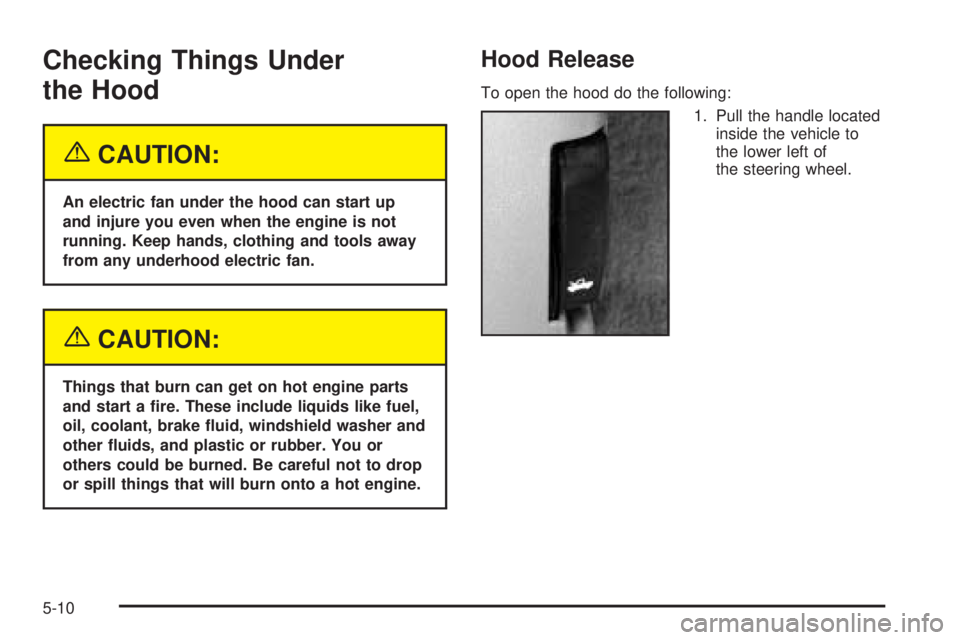
To open the hood do the following:
1. Pull the handle located
inside the vehicle to
the lower left of
the steering wheel.
5-10