When the front passenger seat is
occupied and the sensing system
has turned off the passenger's
frontal airbag, the9passenger airbag
off9or9pass airbag off9indicator will
light and stay lit to remind you that
the front passenger frontal airbag is off. When the front passenger seat is
not occupied (empty seat) or in the event that the front passenger
frontal airbag is enabled (may inflate), the indicator light will be unlit.
The9pass airbag off9indicator light is located next to the climate
controls on the bottom right corner of the center stack of the instrument
panel. To confirm the indicator light is functional, it will momentarily
illuminate when the ignition is turned to the ON position.
The front passenger sensing system is designed to turn off the front
passenger's frontal airbag when a rear facing infant seat, a forward-facing
child restraint, or a booster seat is detected. If the child restraint has
been installed and the indicator is not lit, then turn the vehicle off,
remove the child restraint from the vehicle and reinstall the restraint
following the child restraint manufacturer's directions.
The front passenger sensing system is designed to enable (may inflate)
the right front passenger's frontal airbag anytime the system senses that
a person of adult size is sitting properly in the front passenger seat.
When the passenger sensing system has allowed the airbag to be
enabled, the indicator will be unlit and stay unlit to remind you that the
airbag is enabled (may inflate).
If a person of adult-size is sitting in the front passenger's seat, but the
9passenger airbag off9or9pass airbag off9indicator is lit, it is possible
that the person isn't sitting properly in the seat. If this happens, turn the
vehicle off and ask the person to place the seatback in the full upright
position, sit upright in the seat, centered on the seat cushion, with the
person's legs comfortably extended. Restart the vehicle and have the
person remain in this position for about two minutes. This will allow the
system to detect that person and enable the passenger's airbag. If the
indicator lamp remains lit even after this, the occupant should be advised
to ride in the rear seat.
After all occupants have adjusted their seats and put on safety belts, it's
very important that they continue to sit upright with their back against
the seatback, with their feet comfortably extended on the floor while the
vehicle is still in motion. Sitting improperly can increase the chance of
injury in a crash event. For example, if an occupant slouches, lies down,
turns sideways, sits forward, leans forward or sideways, or puts one or
both feet up, the chance of injury during a crash is greatly increased.
Seating and Safety Restraints
113
Sitting improperly out of position or with the seat back reclined
too far can take off weight from the seat cushion and affect the
decision of the passenger sensing system, resulting in serious injury or
death in a crash. Always sit upright against your seatback, with your
feet on the floor.
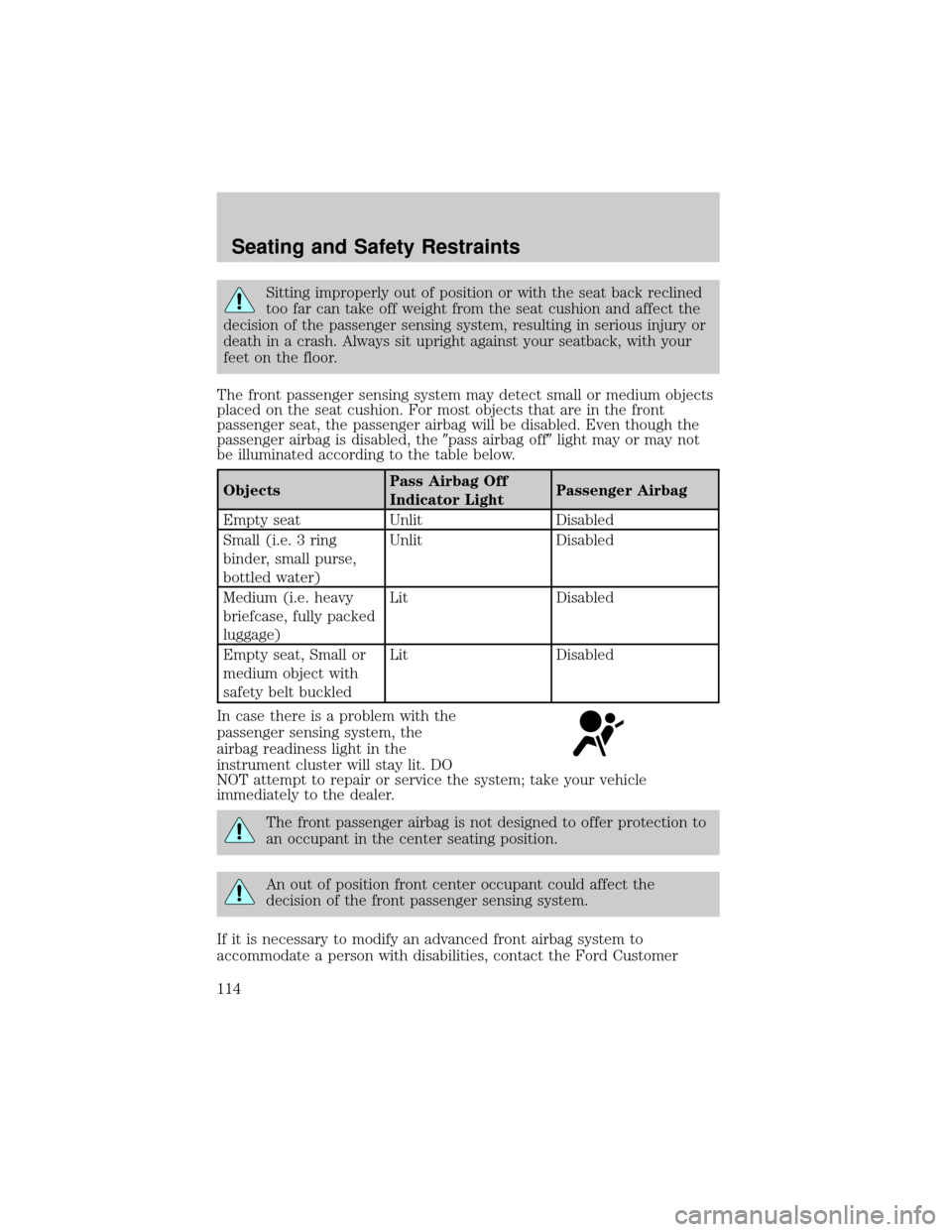
The front passenger sensing system may detect small or medium objects
placed on the seat cushion. For most objects that are in the front
passenger seat, the passenger airbag will be disabled. Even though the
passenger airbag is disabled, the9pass airbag off9light may or may not
be illuminated according to the table below.
ObjectsPass Airbag Off
Indicator LightPassenger Airbag
Empty seat Unlit Disabled
Small (i.e. 3 ring
binder, small purse,
bottled water)Unlit Disabled
Medium (i.e. heavy
briefcase, fully packed
luggage)Lit Disabled
Empty seat, Small or
medium object with
safety belt buckledLit Disabled
In case there is a problem with the
passenger sensing system, the
airbag readiness light in the
instrument cluster will stay lit. DO
NOT attempt to repair or service the system; take your vehicle
immediately to the dealer.
The front passenger airbag is not designed to offer protection to
an occupant in the center seating position.
An out of position front center occupant could affect the
decision of the front passenger sensing system.
If it is necessary to modify an advanced front airbag system to
accommodate a person with disabilities, contact the Ford Customer
Seating and Safety Restraints
114
Floor mats
Interior trim kits
Leather wrapped steering wheels
Scuff plates
Speed control
Lifestyle
Bike racks
Cargo organization and management
Engine block heaters and blankets
Peace of mind
Airbag anti-theft locks
First aid and safety kits
Full vehicle covers
Locking gas cap
Navigation systems
Remote start
Vehicle security systems
For maximum vehicle performance, keep the following information in
mind when adding accessories or equipment to your vehicle:
²When adding accessories, equipment, passengers and luggage to your
vehicle, do not exceed the total weight capacity of the vehicle or of
the front or rear axle (GVWR or GAWR as indicated on the Safety
Compliance Certification label). Consult your dealer for specific weight
information.
²The Federal Communications Commission (FCC) and Canadian Radio
Telecommunications Commission (CRTC) regulate the use of mobile
communications systems Ð such as two-way radios, telephones and
theft alarms - that are equipped with radio transmitters. Any such
equipment installed in your vehicle should comply with FCC or CRTC
regulations and should be installed only by a qualified service
technician.
²Mobile communications systems may harm the operation of your
vehicle, particularly if they are not properly designed for automotive
use.
Accessories
242