and one-half (1 1/2) times as well on the government course as a tire
graded 100. The relative performance of tires depends upon the actual
conditions of their use, however, and may depart significantly from the
norm due to variations in driving habits, service practices, and
differences in road characteristics and climate.
Traction AA A B C
The traction grades, from highest to lowest are AA, A, B, and C. The
grades represent the tire’s ability to stop on wet pavement as measured
under controlled conditions on specified government test surfaces of
asphalt and concrete. A tire marked C may have poor traction
performance.
The traction grade assigned to this tire is based on
straight-ahead braking traction tests, and does not include
acceleration, cornering, hydroplaning or peak traction characteristics.
Temperature A B C
The temperature grades are A (the highest), B and C, representing the
tire’s resistance to the generation of heat and its ability to dissipate heat
when tested under controlled conditions on a specified indoor laboratory
test wheel. Sustained high temperature can cause the material of the tire
to degenerate and reduce tire life, and excessive temperature can lead to
sudden tire failure. The grade C corresponds to a level of performance
which all passenger car tires must meet under the Federal Motor Vehicle
Safety Standard No. 109. Grades B and A represent higher levels of
performance on the laboratory test wheel than the minimum required by
law.
The temperature grade for this tire is established for a tire that
is properly inflated and not overloaded. Excessive speed,
underinflation, or excessive loading, either separately or in
combination, can cause heat buildup and possible tire failure.
TIRES
Tires are designed to give many thousands of miles of service, but they
must be maintained in order to get the maximum benefit from them.
Glossary of tire terminology
•Tire label:A label showing the OE (Original Equipment) tire sizes,
recommended inflation pressure and the maximum weight the vehicle
can carry.
REVIEW COPY
2005 F250/350/450/550(f23), Owners Guide (post-2002-fmt)(own2002),
Market:USA_English(fus)
Tires, Wheels and Loading
132
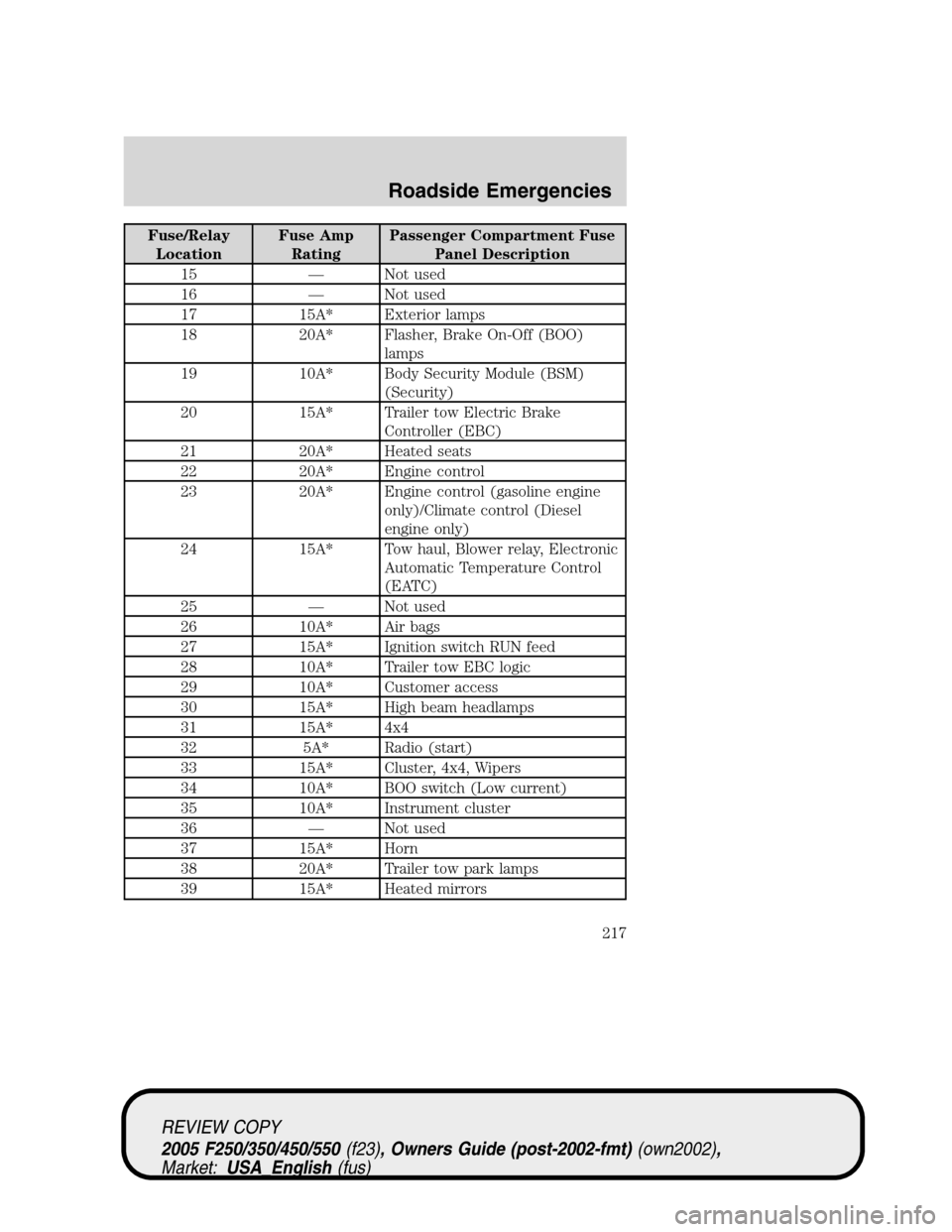
Fuse/Relay
LocationFuse Amp
RatingPassenger Compartment Fuse
Panel Description
15 — Not used
16 — Not used
17 15A* Exterior lamps
18 20A* Flasher, Brake On-Off (BOO)
lamps
19 10A* Body Security Module (BSM)
(Security)
20 15A* Trailer tow Electric Brake
Controller (EBC)
21 20A* Heated seats
22 20A* Engine control
23 20A* Engine control (gasoline engine
only)/Climate control (Diesel
engine only)
24 15A* Tow haul, Blower relay, Electronic
Automatic Temperature Control
(EATC)
25 — Not used
26 10A* Air bags
27 15A* Ignition switch RUN feed
28 10A* Trailer tow EBC logic
29 10A* Customer access
30 15A* High beam headlamps
31 15A* 4x4
32 5A* Radio (start)
33 15A* Cluster, 4x4, Wipers
34 10A* BOO switch (Low current)
35 10A* Instrument cluster
36 — Not used
37 15A* Horn
38 20A* Trailer tow park lamps
39 15A* Heated mirrors
REVIEW COPY
2005 F250/350/450/550(f23), Owners Guide (post-2002-fmt)(own2002),
Market:USA_English(fus)
Roadside Emergencies
217
waxing .....................................238
wheels ......................................239
wiper blades ............................241
Climate control (see Air
conditioning or Heating) ............37
Clutch
fluid ..........................................272
operation while driving ..........188
recommended shift speeds ....189
Compass, electronic
set zone adjustment .................71
Console ........................................67
overhead ....................................57
Controls
steering column ........................66
Coolant
checking and adding ..............255
refill capacities ................259, 281
specifications ..................283, 287
Cruise control (see
Speed control) ............................63
Customer Assistance ................211
Ford accessories for your
vehicle .....................................244
Ford Extended Service
Plan ..........................................235
Getting assistance outside
the U.S. and Canada ..............236
Getting roadside assistance ...211
Getting the service
you need .................................229
Ordering additional
owner’s literature ...................236
The Dispute Settlement
Board .......................................232
Utilizing the Mediation/
Arbitration Program ...............234D
Daytime running lamps
(see Lamps) ................................41
Dipstick
automatic transmission fluid .273
engine oil .................................249
Doors
lubricant specifications ..........283
Driveline universal joint
and slip yoke .............................277
Driving under special
conditions ..................188, 201, 204
sand .........................................203
snow and ice ...........................205
through water .................203, 207
E
Electronic message center ...67, 69
Emergencies, roadside
jump-starting ..........................221
Emergency Flashers .................212
Emission control system ..........269
Engine ........................................287
cleaning ...................................239
coolant .....................................255
diesel ...........................................8
fail-safe coolant ......................260
idle speed control ...................253
lubrication
specifications ..................283, 287
refill capacities ........................281
service points ..................247–248
starting after a collision .........213
Engine block heater .................180
Engine oil ..................................249
checking and adding ..............249
dipstick ....................................249
REVIEW COPY
2005 F250/350/450/550(f23), Owners Guide (post-2002-fmt)(own2002),
Market:USA_English(fus)
Index
300