Page 28 of 72
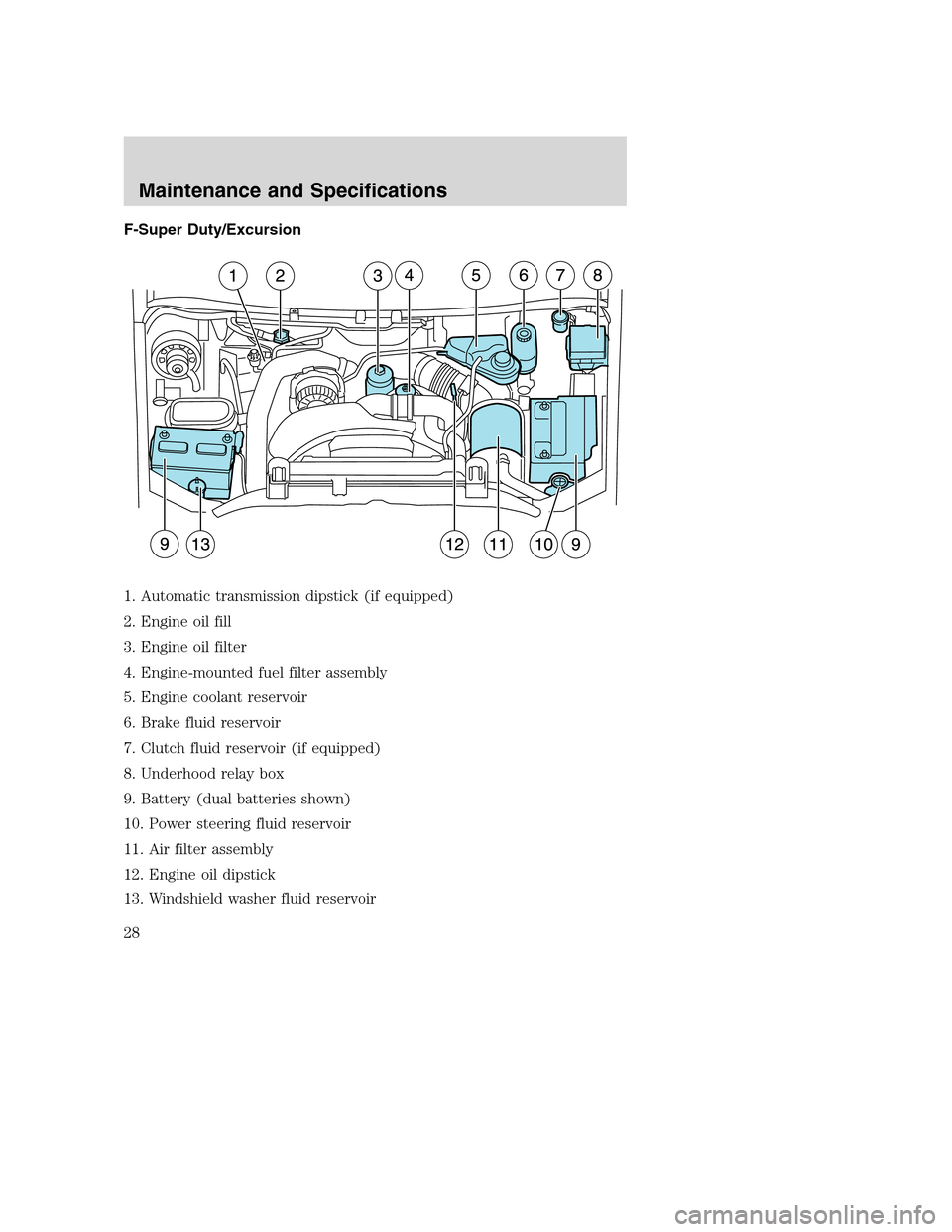
F-Super Duty/Excursion
1. Automatic transmission dipstick (if equipped)
2. Engine oil fill
3. Engine oil filter
4. Engine-mounted fuel filter assembly
5. Engine coolant reservoir
6. Brake fluid reservoir
7. Clutch fluid reservoir (if equipped)
8. Underhood relay box
9. Battery (dual batteries shown)
10. Power steering fluid reservoir
11. Air filter assembly
12. Engine oil dipstick
13. Windshield washer fluid reservoir
Maintenance and Specifications
28
Page 29 of 72
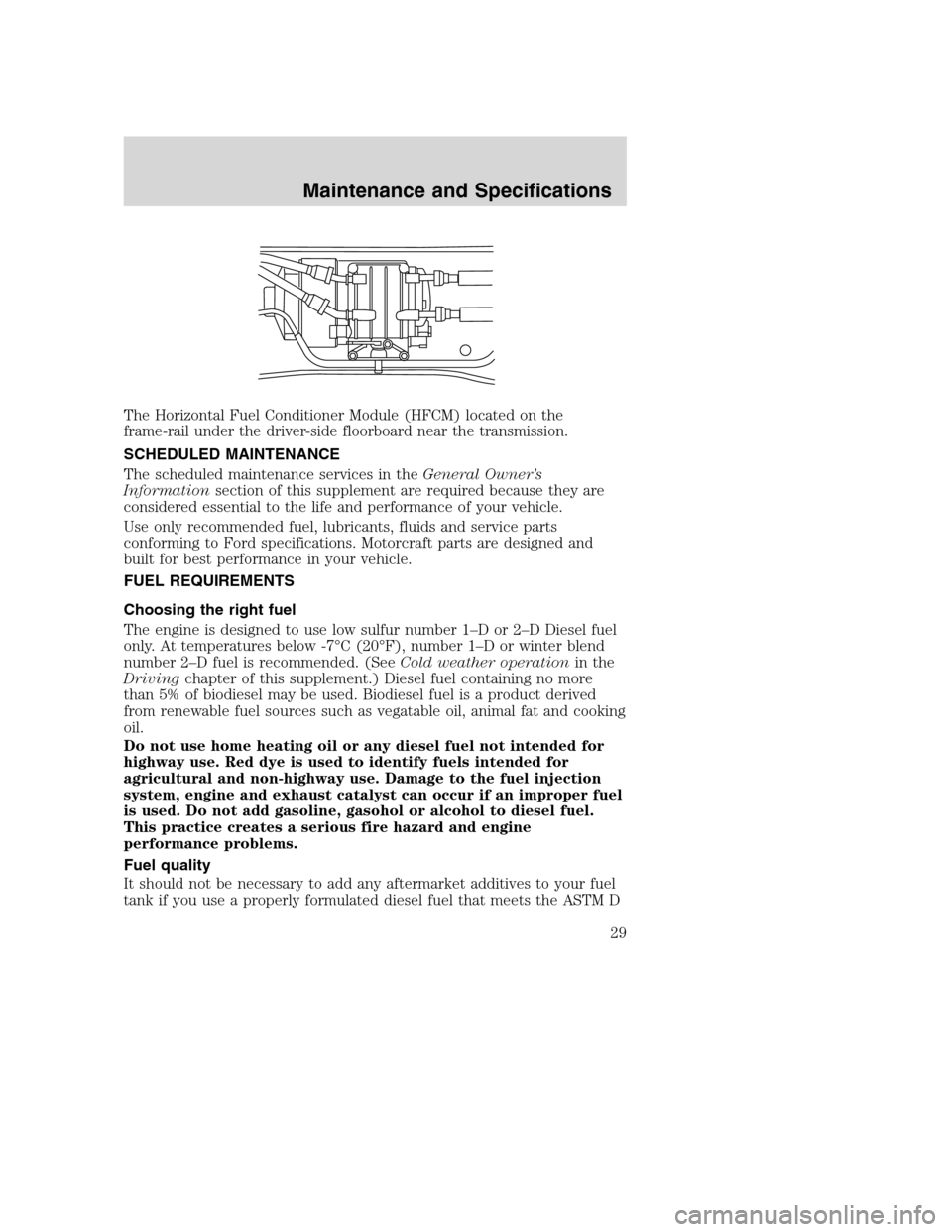
The Horizontal Fuel Conditioner Module (HFCM) located on the
frame-rail under the driver-side floorboard near the transmission.
SCHEDULED MAINTENANCE
The scheduled maintenance services in theGeneral Owner’s
Informationsection of this supplement are required because they are
considered essential to the life and performance of your vehicle.
Use only recommended fuel, lubricants, fluids and service parts
conforming to Ford specifications. Motorcraft parts are designed and
built for best performance in your vehicle.
FUEL REQUIREMENTS
Choosing the right fuel
The engine is designed to use low sulfur number 1–Dor2–D Diesel fuel
only. At temperatures below -7°C (20°F), number 1–D or winter blend
number 2–D fuel is recommended. (SeeCold weather operationin the
Drivingchapter of this supplement.) Diesel fuel containing no more
than 5% of biodiesel may be used. Biodiesel fuel is a product derived
from renewable fuel sources such as vegatable oil, animal fat and cooking
oil.
Do not use home heating oil or any diesel fuel not intended for
highway use. Red dye is used to identify fuels intended for
agricultural and non-highway use. Damage to the fuel injection
system, engine and exhaust catalyst can occur if an improper fuel
is used. Do not add gasoline, gasohol or alcohol to diesel fuel.
This practice creates a serious fire hazard and engine
performance problems.
Fuel quality
It should not be necessary to add any aftermarket additives to your fuel
tank if you use a properly formulated diesel fuel that meets the ASTM D
Maintenance and Specifications
29
Page 31 of 72
FUEL CONDITIONER MODULE (FCM - E-SERIES)/HORIZONTAL
FUEL CONDITIONING MODULE (HFCM - F-SUPER
DUTY/EXCURSION) - FUEL FILTER/WATER SEPARATOR
HFCM - F-Super Duty/Excursion
The vehicle is equipped with a Horizontal Fuel Conditioning Module
(HFCM) located on the frame-rail under the driver-side floorboard near
the transmission.
Water should be drained from the
module assembly whenever the
warning light comes on. The WATER
IN FUEL light will come on when
approximately 100 cc (0.2 pints) of water accumulates in the module.
Replace the fuel filters with Ford Part No. FD–4604. This part number
includes filters and seals for both the engine-mounted and
frame-mounted filters.
FCM - E-Series
The vehicle is equipped with a Fuel Conditioning Module (FCM) located
on the driver-side of the vehicle next to the transmission case.
Water should be drained from the
module assembly whenever the
warning light comes on. The WATER
IN FUEL light will come on when
approximately 100 cc (0.2 pints) of water accumulates in the module.
Replace the fuel filters with Ford Part No. FD–4604. This part number
includes filters and seals for both the engine-mounted filter and the FCM
filter.
DRAINING THE FCM/HFCM AND CHANGING THE FUEL FILTERS
Your vehicle is equipped with two fuel filters; one is mounted on top of
the engine.On F-Super Duty and Excursion vehicles,the second
filter, inside the HFCM, is mounted inside the frame rail under the
driver-side floorboard near the transmission.On E-Series vehicles,the
second filter, inside the FCM, is mounted on the driver-side of the
vehicle next to the transmission case.On all vehicles,both filters
should be replaced at the same time. The Motorcraft part number for the
replacement filters is FD-4604.
Maintenance and Specifications
31
Page 46 of 72
out, the battery connections may be loose or corroded, or the battery
may be discharged. If there is a clicking or stuttering sound coming from
the engine compartment when you turn the key to 5 (START), this may
also indicate a loose or corroded battery connection.
Check the battery connections at the battery posts, cable connection to
the engine grounding point and at the starter connection.
If a discharged battery is suspected, have it checked and corrected.
•For vehicles with manual transmissions,the clutch pedalmustbe
fully depressed in order for the starter to operate.
•For vehicles with automatic transmissions,the gearshift lever
must be in P (Park) or N (Neutral) in order for the starter to operate.
•Try operating the starter switch several times. Should the switch be
corroded, this operation may clean the contacts or make the switch
temporarily operable until you can reach the dealer.
•If all electrical connections are tight and you need assistance to start,
refer toJump startingin theRoadside Emergencieschapter of your
Owner Guide(F-Super Duty and Excursion) or refer to theJump
startingsection of this supplement (E-Series).
If engine cranks but won’t start
Prolonged starter cranking (in excess of 30 seconds) could cause
damage to the starter motor.
•Check the fuel gauge. You may be out of fuel. If the gauge shows that
there is fuel in the tank, the trouble may be in the electrical system or
the fuel system. If equipped with an auxiliary tank, be sure that the
tank control switch is set for the tank with fuel and not on an empty
tank.
•Leaving the ignition key turned to 4 (ON) for over two minutes
without starting may make starting difficult because the glow plugs
will cease activation. Reset the system by turning the ignition key to 3
(OFF) and then back to 4 (ON) again.
If the engine runs hot
The following could cause the engine to overheat:
•Lack of coolant.
•Dirty cooling system.
•Plugged radiator fins, charge air cooler, A/C condenser and/or oil
cooler.
Maintenance and Specifications
46
Page 48 of 72
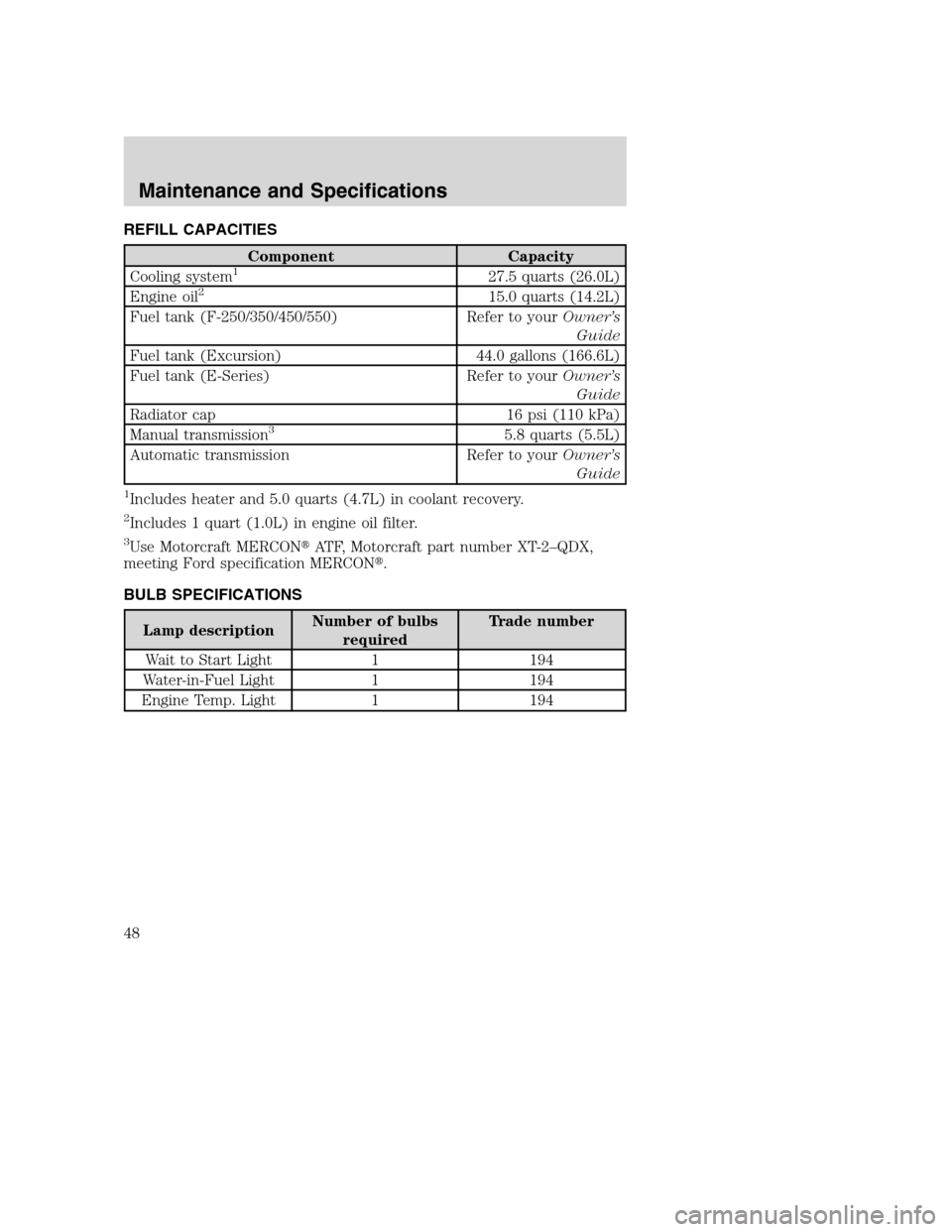
REFILL CAPACITIES
Component Capacity
Cooling system127.5 quarts (26.0L)
Engine oil215.0 quarts (14.2L)
Fuel tank (F-250/350/450/550) Refer to yourOwner’s
Guide
Fuel tank (Excursion) 44.0 gallons (166.6L)
Fuel tank (E-Series) Refer to yourOwner’s
Guide
Radiator cap 16 psi (110 kPa)
Manual transmission
35.8 quarts (5.5L)
Automatic transmission Refer to yourOwner’s
Guide
1Includes heater and 5.0 quarts (4.7L) in coolant recovery.
2Includes 1 quart (1.0L) in engine oil filter.
3Use Motorcraft MERCON�ATF, Motorcraft part number XT-2–QDX,
meeting Ford specification MERCON�.
BULB SPECIFICATIONS
Lamp descriptionNumber of bulbs
requiredTrade number
Wait to Start Light 1 194
Water-in-Fuel Light 1 194
Engine Temp. Light 1 194
Maintenance and Specifications
48
Page 49 of 72
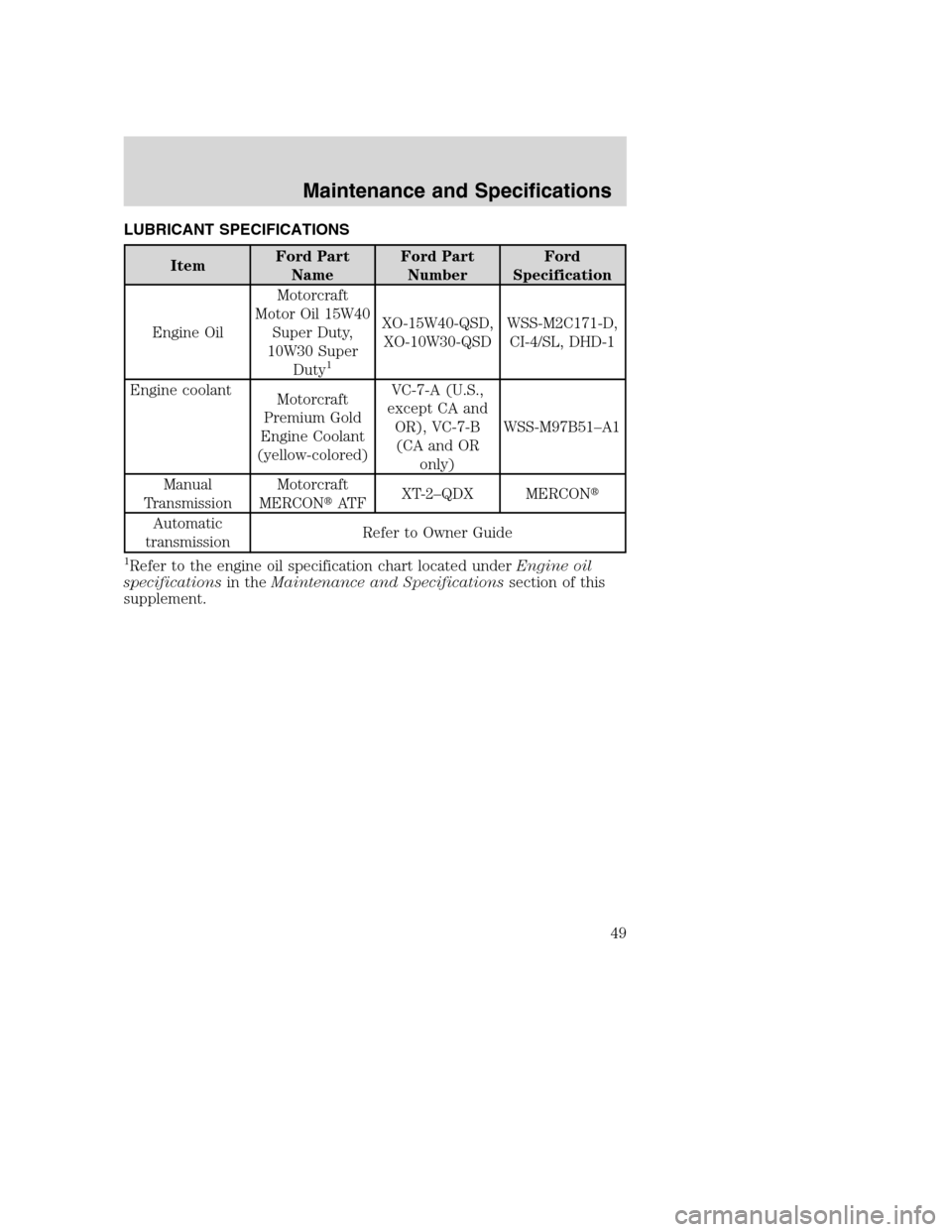
LUBRICANT SPECIFICATIONS
ItemFord Part
NameFord Part
NumberFord
Specification
Engine OilMotorcraft
Motor Oil 15W40
Super Duty,
10W30 Super
Duty
1
XO-15W40-QSD,
XO-10W30-QSDWSS-M2C171-D,
CI-4/SL, DHD-1
Engine coolant
Motorcraft
Premium Gold
Engine Coolant
(yellow-colored)VC-7-A (U.S.,
except CA and
OR), VC-7-B
(CA and OR
only)WSS-M97B51–A1
Manual
TransmissionMotorcraft
MERCON�AT FXT-2–QDX MERCON�
Automatic
transmissionRefer to Owner Guide
1Refer to the engine oil specification chart located underEngine oil
specificationsin theMaintenance and Specificationssection of this
supplement.
Maintenance and Specifications
49
Page 53 of 72
•Check power steering fluid level
•Check washer spray, wiper operation and clean all wiper blades
(replace as necessary)
•Check parking brake for proper operation
•Check and lubricate all hinges, latches and outside locks
•Check and lubricate door rubber weatherstrips
•Check and clean body and door drain holes
•Check safety warning lamps (brake, ABS, air bag, safety belt) for
operation
•Check cooling system fluid level and coolant strength
•Check battery connections and clean if necessary
•Check clutch fluid level, if equipped
Multi-point Inspection
In order to keep your vehicle running right, it is important that you have
the systems on your vehicle checked regularly. This can help identify any
potential issue before there are any problems. Ford Motor Company
suggests the following multi-point inspection to be performed at every
scheduled maintenance as the way to ensure your vehicle keeps running
right.
Multi-point inspection - Recommended at every visit
•Check and top up fluid levels: brake, coolant recovery reservoir,
manual and automatic transmission, power steering and window
washer.
•Inspect tires for wear and check air pressure, including spare.
•Check exhaust system for leaks, damage, loose parts and foreign
materials.
•Check battery performance.
•Check operation of horn, exterior lamps, turn signals and hazard
warning lights.
•Check radiator, coolers and heater and air conditioning hoses.
•Inspect windshield washer spray and wiper operation.
•Check windshield for cracks, chips and pitting.
•Inspect for oil and fluid leaks.
•Inspect air cleaner filter.
General Owner’s Information
53
Page 55 of 72
•Inspect exhaust system and heat shields
•Check wheels for end play and noise
•Inspect and lubricate 4x4 front axle u-joints
Date:
Odometer reading:
R.O.#Dealer’s Stamp:
22,500 miles (36,000 km)
•Change engine oil and replace oil filter
•Perform multi-point inspection (recommended)
•Inspect tires for wear. Rotation recommended for optimal tire life.
•Inspect air filter restriction gauge, replace filter as required
Date:
Odometer reading:
R.O.#Dealer’s Stamp:
30,000 miles (48,000 km)
•Change engine oil and replace oil filter
•Replace engine- and frame-mounted fuel filters
•Change automatic transmission fluid and external filter element
•Perform multi-point inspection (recommended)
•Inspect tires for wear and rotate
•Inspect air filter restriction gauge, replace filter as required
•Inspect and lubricate steering linkage, ball joints, suspension,
driveshaft and u-joints.
•Inspect engine cooling system and hoses
•Inspect brake pads, shoes, rotors, drums, brake lines and hoses and
parking brake system.
•Inspect exhaust system and heat shields
•Check wheels for end play and noise
General Owner’s Information
55