Page 95 of 200

STARTING
Positions of the ignition
1. OFF/LOCK, shuts off the engine
and all electrical accessories except
the audio system and power
windows, which retain power for 10
minutes or until the door is ajar.
This position also locks the steering
wheel and allows key removal.
2. ACC, allows electrical accessories
to operate while the engine is not
running.
3. ON, all electrical circuits are operational and warning lights are
illuminated. Key position when driving.
Preparing to start your vehicle
Engine starting is controlled by the powertrain control system. This
system meets all Canadian Interference-Causing Equipment standard
requirements regulating the impulse electrical field strength of radio
noise.
When starting a fuel-injected engine, don’t press the accelerator before
or during starting. Only use the accelerator when you have difficulty
starting the engine. For more information on starting the vehicle, refer to
Starting the engine in this chapter.
Extended idling at high engine speeds can produce very high
temperatures in the engine and exhaust system, creating the risk
of fire or other damage.
Do not park, idle, or drive your vehicle in dry grass or other dry
ground cover. The emission system heats up the engine
compartment and exhaust system, which can start a fire.
Do not start your vehicle in a closed garage or in other enclosed
areas. Exhaust fumes can be toxic. Always open the garage door
before you start the engine. See Guarding against exhaust fumes in
this chapter for more instructions.
2005 GT(gto)
Owners Guide (post-2002-fmt)
USA_English (fus)
Driving
Driving
95
Page 96 of 200
If you smell exhaust fumes inside your vehicle, have your dealer
inspect your vehicle immediately. Do not drive if you smell
exhaust fumes.
Important safety precautions
When the engine starts, the idle RPM runs faster to warm the engine. If
the engine idle speed does not slow down automatically, have the vehicle
checked.
Before starting the vehicle:
1. Make sure all occupants buckle their safety belts. For more
information on safety belts and their proper usage, refer to the Seating
and Safety Restraints chapter.
2. Make sure the headlamps and electrical accessories are off.
3. Make sure the parking brake is
set.
4. Push the clutch pedal to the floor.
2005 GT(gto)
Owners Guide (post-2002-fmt)
USA_English (fus)
Driving
96
Page 97 of 200
5. Turn the key to 3 (ON).
Make sure the corresponding lights illuminate or illuminate briefly. If a
light fails to illuminate, have the vehicle serviced.
Cold weather starting/operating tips
Due to the high-performance design of this vehicle, certain precautions
should be taken when starting and operating the vehicle at temperatures
below 0°F (-18 °C):
1. Ensure battery is fully charged.
2. Once engine is started, allow to operate at idle for 10-15 minutes to
allow engine fluids to reach operating temperature
3. Extra care should be taken engaging the clutch for the first few
minutes of driving. Quick engagement of the clutch or throttle should be
avoided.
4. Transmission shift efforts and clutch effort will be higher than normal
due to the viscosity of the fluids being higher at low temperatures.
2005 GT(gto)
Owners Guide (post-2002-fmt)
USA_English (fus)
Driving
97
Page 98 of 200

Starting the engine
1. Turn the key to 3 (ON).
2. Press the red START ENGINE
button on the instrument panel,
then release the button as soon as
the engine starts. Excessive
cranking could damage the starter.
Note:If the engine does not start within five seconds on the first try,
turn the key to 1 (OFF/LOCK), wait 10 seconds and try again. If the
engine still fails to start, press the accelerator to the floor and try again;
this will allow the engine to crank with the fuel shut off in case the
engine is flooded with fuel.
Guarding against exhaust fumes
Carbon monoxide is present in exhaust fumes. Take precautions to avoid
its dangerous effects.
If you smell exhaust fumes inside your vehicle, have your dealer
inspect your vehicle immediately. Do not drive if you smell
exhaust fumes.
Important ventilating information
If the engine is idling while the vehicle is stopped for a long period of
time, open the windows at least one inch (2.5 cm) or adjust the heating
or air conditioning to bring in fresh air.
2005 GT(gto)
Owners Guide (post-2002-fmt)
USA_English (fus)
Driving
98
Page 99 of 200

BRAKES
Occasional brake noise is normal. If a metal-to-metal, continuous grinding
or continuous squeal sound is present, the brake linings may be worn-out
and should be inspected by a qualified service technician. If the vehicle
has continuous vibration or shudder in the steering wheel while braking,
the vehicle should be inspected by a qualified service technician.
Refer toBrake system warning
light in the Instrument Cluster
chapter for information on the brake
system warning light.
Four-wheel anti-lock brake system (ABS)
Your vehicle is equipped with an Anti-lock Braking System (ABS). This
system helps you maintain steering control during emergency stops by
keeping the brakes from locking. Noise from the ABS pump motor and
brake pedal pulsation may be observed during ABS braking and the
brake pedal may suddenly travel a little farther as soon as ABS braking is
done and normal brake operation resumes. These are normal
characteristics of the ABS and should be no reason for concern.
ABS warning lamp
The ABS lamp in the instrument
cluster momentarily illuminates
when the ignition is turned on. If
the light does not illuminate during
start up, remains on or flashes, the
ABS may be disabled and may need to be serviced.
Even when the ABS is disabled,
normal braking is still effective. (If
your BRAKE warning lamp
illuminates with the parking brake
released, have your brake system serviced immediately.)
Using ABS
When hard braking is required, apply continuous force on the brake
pedal; do not pump the brake pedal since this will reduce the
effectiveness of the ABS and will increase your vehicle ’s stopping
distance. The ABS will be activated immediately, allowing you to retain
full steering control during hard braking and on slippery surfaces.
However, the ABS does not decrease stopping distance.
!
BRAKE
ABS
!
BRAKE
2005 GT(gto)
Owners Guide (post-2002-fmt)
USA_English (fus)
Driving
99
Page 100 of 200
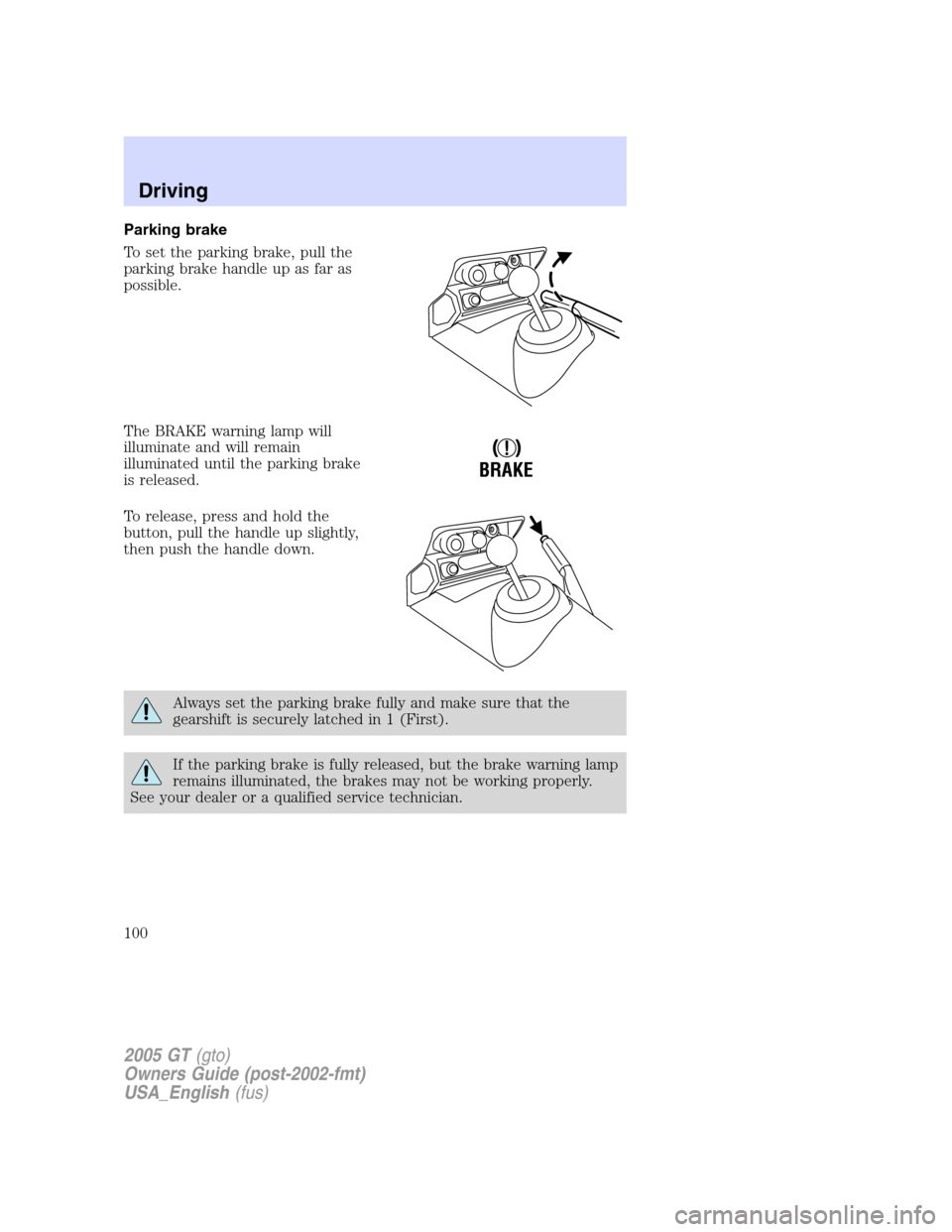
Parking brake
To set the parking brake, pull the
parking brake handle up as far as
possible.
The BRAKE warning lamp will
illuminate and will remain
illuminated until the parking brake
is released.
To release, press and hold the
button, pull the handle up slightly,
then push the handle down.
Always set the parking brake fully and make sure that the
gearshift is securely latched in 1 (First).
If the parking brake is fully released, but the brake warning lamp
remains illuminated, the brakes may not be working properly.
See your dealer or a qualified service technician.
!
BRAKE
2005 GT(gto)
Owners Guide (post-2002-fmt)
USA_English (fus)
Driving
100
Page 101 of 200

STEERING
To prevent damage to the power steering system:
•Never hold the steering wheel at its furthest turning points (until it
stops) for more than a few seconds when the engine is running.
• Do not operate the vehicle with a low power steering pump fluid level
(below the MIN mark on the reservoir). Refer to Checking and
adding power steering power fluid in theMaintenance and
Specifications chapter for information on checking and filling the
power steering fluid reservoir.
If the power steering system breaks down (or if the engine is turned
off), you can steer the vehicle manually, but it takes more effort.
If the steering wanders or pulls, check for:
• an improperly inflated tire
• uneven tire wear
• loose or worn suspension components
• loose or worn steering components
• improper steering alignment
A high crown in the road or high crosswinds may also make the steering
seem to wander/pull.
LIMITED-SLIP AXLE
This axle provides added traction on slippery surfaces, particularly when
one wheel is on a poor traction surface. Under normal conditions, the
limited slip axle functions like a standard rear axle.
Extended use of other than the manufacturer ’s specified size tires on a
limited slip rear axle could result in a permanent reduction in
effectiveness. This loss of effectiveness does not affect normal driving
and should not be noticeable to the driver.
PREPARING TO DRIVE YOUR VEHICLE
Your vehicle has special design features, such as a decreased ground
clearance; care should be taken when driving your vehicle near curbs,
speed bumps and parking lot bump-stops.
Use extra caution while becoming familiar with your vehicle. Know the
capabilities and limitations of both you as a driver and your vehicle.
2005 GT(gto)
Owners Guide (post-2002-fmt)
USA_English (fus)
Driving
101
Page 102 of 200
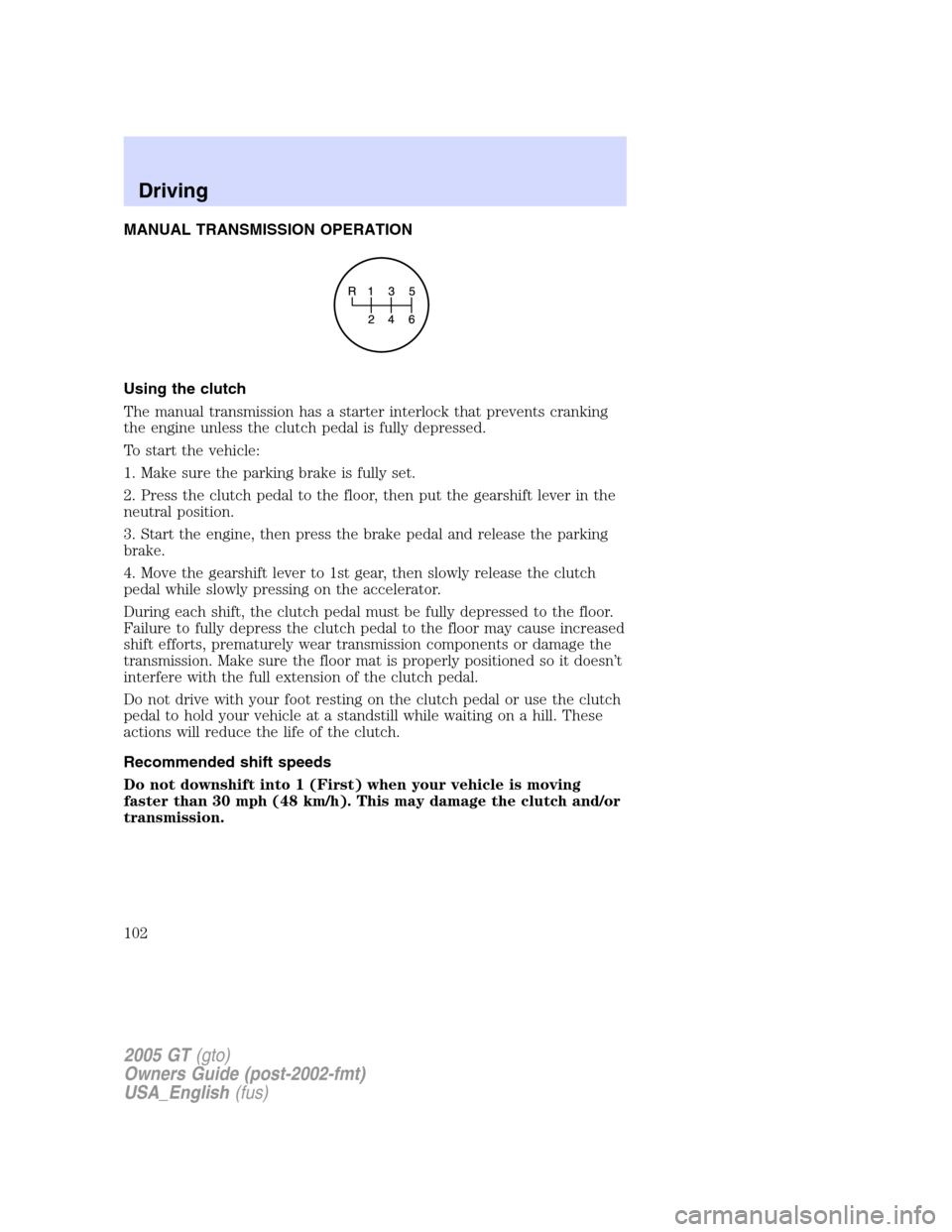
MANUAL TRANSMISSION OPERATION
Using the clutch
The manual transmission has a starter interlock that prevents cranking
the engine unless the clutch pedal is fully depressed.
To start the vehicle:
1. Make sure the parking brake is fully set.
2. Press the clutch pedal to the floor, then put the gearshift lever in the
neutral position.
3. Start the engine, then press the brake pedal and release the parking
brake.
4. Move the gearshift lever to 1st gear, then slowly release the clutch
pedal while slowly pressing on the accelerator.
During each shift, the clutch pedal must be fully depressed to the floor.
Failure to fully depress the clutch pedal to the floor may cause increased
shift efforts, prematurely wear transmission components or damage the
transmission. Make sure the floor mat is properly positioned so it doesn’t
interfere with the full extension of the clutch pedal.
Do not drive with your foot resting on the clutch pedal or use the clutch
pedal to hold your vehicle at a standstill while waiting on a hill. These
actions will reduce the life of the clutch.
Recommended shift speeds
Do not downshift into 1 (First) when your vehicle is moving
faster than 30 mph (48 km/h). This may damage the clutch and/or
transmission.
2005 GT(gto)
Owners Guide (post-2002-fmt)
USA_English (fus)
Driving
102