Page 251 of 368
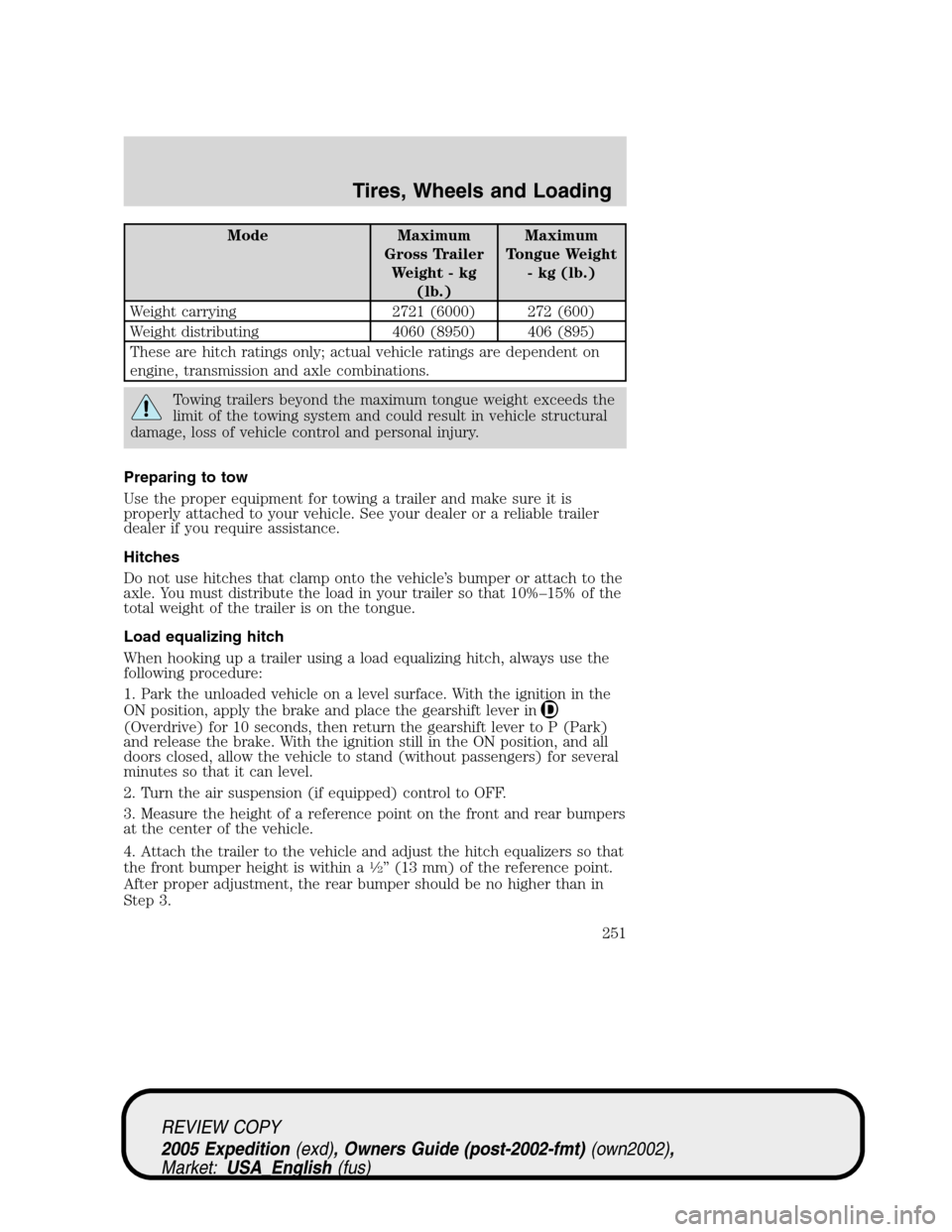
Mode Maximum
Gross Trailer
Weight - kg
(lb.)Maximum
Tongue Weight
- kg (lb.)
Weight carrying 2721 (6000) 272 (600)
Weight distributing 4060 (8950) 406 (895)
These are hitch ratings only; actual vehicle ratings are dependent on
engine, transmission and axle combinations.
Towing trailers beyond the maximum tongue weight exceeds the
limit of the towing system and could result in vehicle structural
damage, loss of vehicle control and personal injury.
Preparing to tow
Use the proper equipment for towing a trailer and make sure it is
properly attached to your vehicle. See your dealer or a reliable trailer
dealer if you require assistance.
Hitches
Do not use hitches that clamp onto the vehicle’s bumper or attach to the
axle. You must distribute the load in your trailer so that 10%–15% of the
total weight of the trailer is on the tongue.
Load equalizing hitch
When hooking up a trailer using a load equalizing hitch, always use the
following procedure:
1. Park the unloaded vehicle on a level surface. With the ignition in the
ON position, apply the brake and place the gearshift lever in
(Overdrive) for 10 seconds, then return the gearshift lever to P (Park)
and release the brake. With the ignition still in the ON position, and all
doors closed, allow the vehicle to stand (without passengers) for several
minutes so that it can level.
2. Turn the air suspension (if equipped) control to OFF.
3. Measure the height of a reference point on the front and rear bumpers
at the center of the vehicle.
4. Attach the trailer to the vehicle and adjust the hitch equalizers so that
the front bumper height is within a
12” (13 mm) of the reference point.
After proper adjustment, the rear bumper should be no higher than in
Step 3.
REVIEW COPY
2005 Expedition(exd), Owners Guide (post-2002-fmt)(own2002),
Market:USA_English(fus)
Tires, Wheels and Loading
251
Page 262 of 368
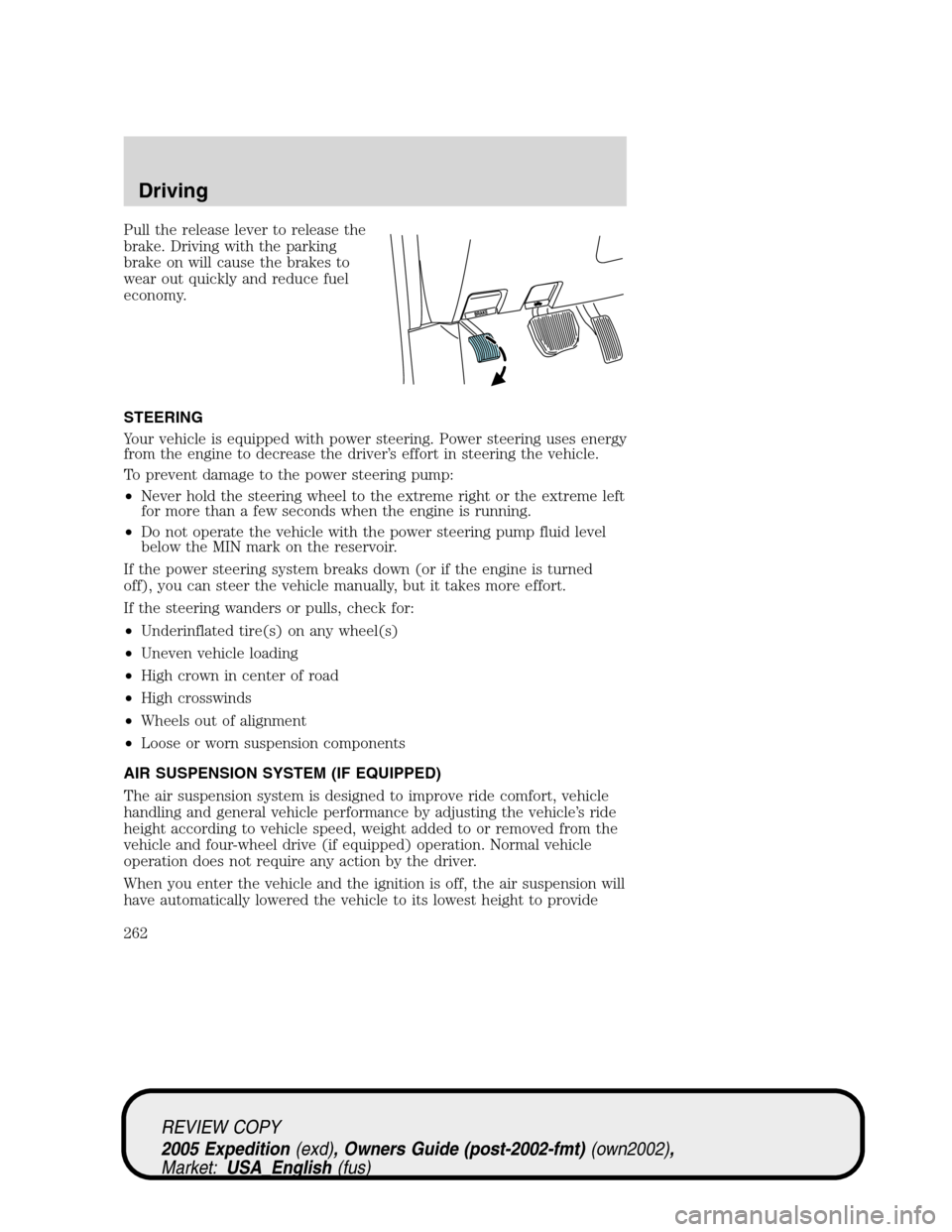
Pull the release lever to release the
brake. Driving with the parking
brake on will cause the brakes to
wear out quickly and reduce fuel
economy.
STEERING
Your vehicle is equipped with power steering. Power steering uses energy
from the engine to decrease the driver’s effort in steering the vehicle.
To prevent damage to the power steering pump:
•Never hold the steering wheel to the extreme right or the extreme left
for more than a few seconds when the engine is running.
•Do not operate the vehicle with the power steering pump fluid level
below the MIN mark on the reservoir.
If the power steering system breaks down (or if the engine is turned
off), you can steer the vehicle manually, but it takes more effort.
If the steering wanders or pulls, check for:
•Underinflated tire(s) on any wheel(s)
•Uneven vehicle loading
•High crown in center of road
•High crosswinds
•Wheels out of alignment
•Loose or worn suspension components
AIR SUSPENSION SYSTEM (IF EQUIPPED)
The air suspension system is designed to improve ride comfort, vehicle
handling and general vehicle performance by adjusting the vehicle’s ride
height according to vehicle speed, weight added to or removed from the
vehicle and four-wheel drive (if equipped) operation. Normal vehicle
operation does not require any action by the driver.
When you enter the vehicle and the ignition is off, the air suspension will
have automatically lowered the vehicle to its lowest height to provide
REVIEW COPY
2005 Expedition(exd), Owners Guide (post-2002-fmt)(own2002),
Market:USA_English(fus)
Driving
262
Page 263 of 368
easier entry. When a door or the liftgate is opened, the system
memorizes and maintains that height until either all doors are closed or
the vehicle’s speed exceeds 15 mph (24 km/h). The air suspension
system will then raise the vehicle’s height to its normal position when the
ignition is turned on, all doors are closed and the transmission is shifted
from P (Park).
When the vehicle is in motion, the air suspension will adjust the vehicle
ride height to normal operating position to maximize your ride comfort.
If your vehicle is equipped with four-wheel drive and you shift into 4WD
LOW, the air suspension will not move to it’s lowest position; instead, the
ride height is raised above the normal ride height position (at speeds
below 35 mph [56 km/h]) to improve ground clearance.
If a load is added to, or removed from the vehicle, the load leveling
feature of the air suspension system will adjust the suspension to keep
the vehicle at a constant level.
When exiting the vehicle, the air suspension will automatically lower the
vehicle to its lowest height to provide easier exit. You may hear a buzz or
click from the air suspension system when the ignition is turned off. The
air suspension system will stay active for 40 minutes after the ignition is
turned off to accommodate any load changes. (The air compressor may
run when the vehicle is off; this is normal.)
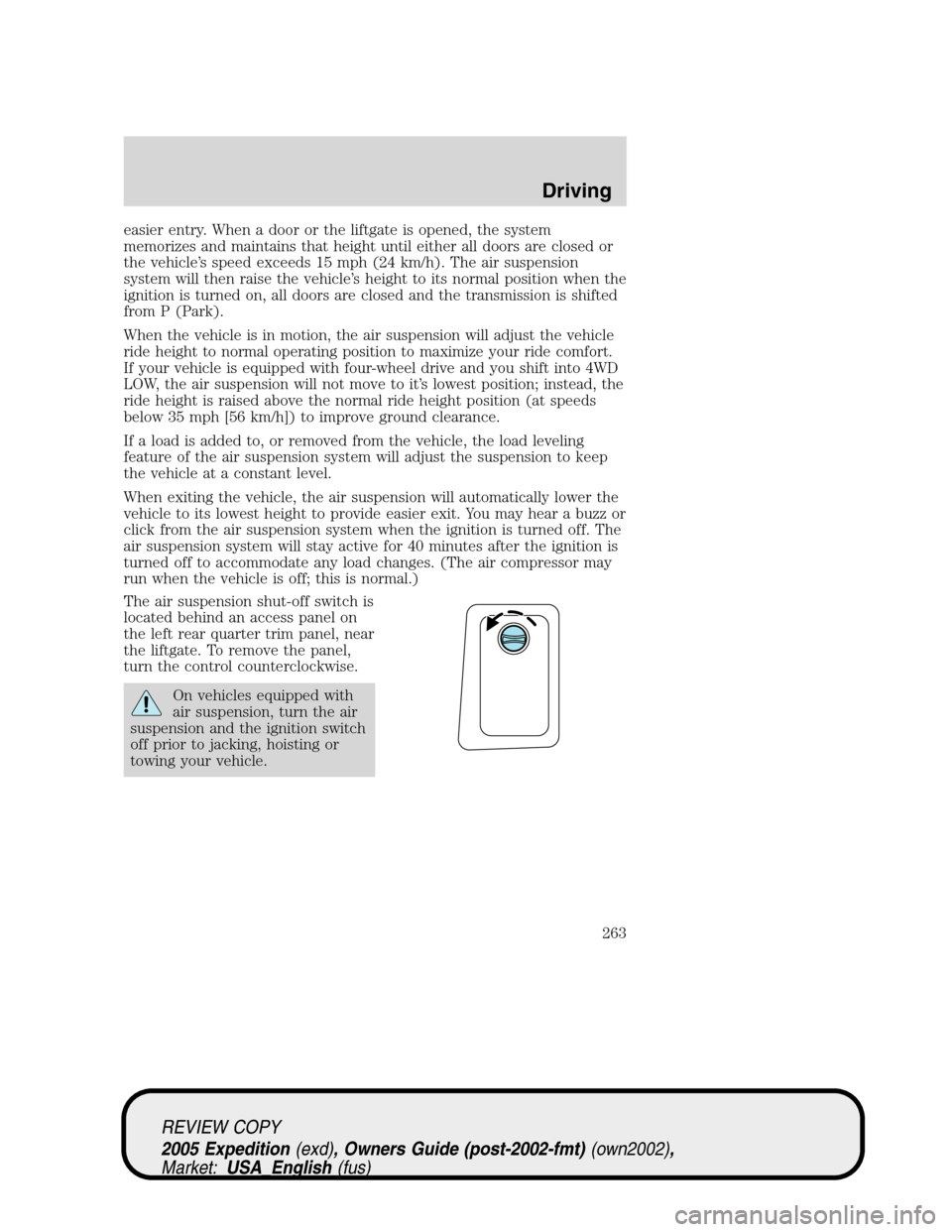
The air suspension shut-off switch is
located behind an access panel on
the left rear quarter trim panel, near
the liftgate. To remove the panel,
turn the control counterclockwise.
On vehicles equipped with
air suspension, turn the air
suspension and the ignition switch
off prior to jacking, hoisting or
towing your vehicle.
REVIEW COPY
2005 Expedition(exd), Owners Guide (post-2002-fmt)(own2002),
Market:USA_English(fus)
Driving
263
Page 295 of 368

Fuse/Relay
LocationFuse Amp
RatingPassenger Compartment Fuse
Panel Description
29 30A* Trailer tow electric brake
controller, Trailer tow 7–wire
connector (electric brake)
30 25A* Air suspension module (air spring
solenoids and height sensors),
PCM (4x4 transfer case clutch)
31 20A* Radio (B+), Subwoofer
32 15A* Catalyst Monitor Sensors (CMS),
Transmission solenoids, Canister
vent solenoid, HEGO sensors,
VMV solenoid, A/C compressor
clutch relay coil, CMCV, VCT
actuators
33 — Not used
34 15A* PCM, Fuel injectors, Mass Air
Flow (MAF) sensor
35 20A* Instrument cluster high beam
indicator, High beam headlamps
36 10A* Trailer tow right turn/stop lamps
37 20A* Cargo area power point
38 25A* Rear wiper motor, Washer pump
(rear window wash)
39 20A* Console power points (front and
rear of console), Instrument panel
power point (bench seat)
40 20A* DRL relays, DRL foglamps, DRL
headlamp relay coil, Headlamp
switch (headlamps), Multifunction
switch (flash-to-pass), BSM
(autolamp headlamps relay), High
beam relay coil, Fuse 25 (LH low
beam), Fuse 23 (RH low beam)
REVIEW COPY
2005 Expedition(exd), Owners Guide (post-2002-fmt)(own2002),
Market:USA_English(fus)
Roadside Emergencies
295
Page 356 of 368
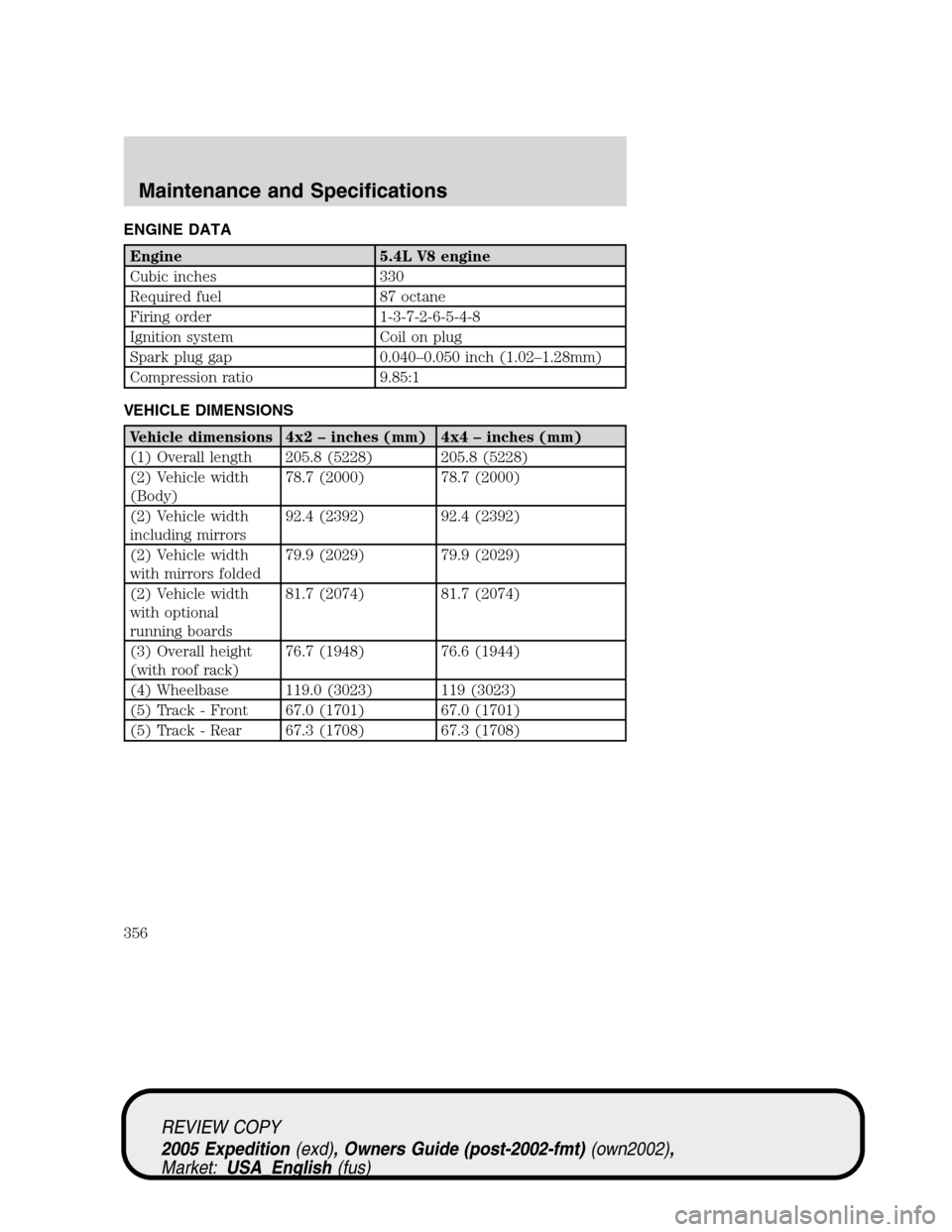
ENGINE DATA
Engine 5.4L V8 engine
Cubic inches 330
Required fuel 87 octane
Firing order 1-3-7-2-6-5-4-8
Ignition system Coil on plug
Spark plug gap 0.040–0.050 inch (1.02–1.28mm)
Compression ratio 9.85:1
VEHICLE DIMENSIONS
Vehicle dimensions 4x2 – inches (mm) 4x4 – inches (mm)
(1) Overall length 205.8 (5228) 205.8 (5228)
(2) Vehicle width
(Body)78.7 (2000) 78.7 (2000)
(2) Vehicle width
including mirrors92.4 (2392) 92.4 (2392)
(2) Vehicle width
with mirrors folded79.9 (2029) 79.9 (2029)
(2) Vehicle width
with optional
running boards81.7 (2074) 81.7 (2074)
(3) Overall height
(with roof rack)76.7 (1948) 76.6 (1944)
(4) Wheelbase 119.0 (3023) 119 (3023)
(5) Track - Front 67.0 (1701) 67.0 (1701)
(5) Track - Rear 67.3 (1708) 67.3 (1708)
REVIEW COPY
2005 Expedition(exd), Owners Guide (post-2002-fmt)(own2002),
Market:USA_English(fus)
Maintenance and Specifications
356