2005 FORD CROWN VICTORIA lock
[x] Cancel search: lockPage 190 of 264
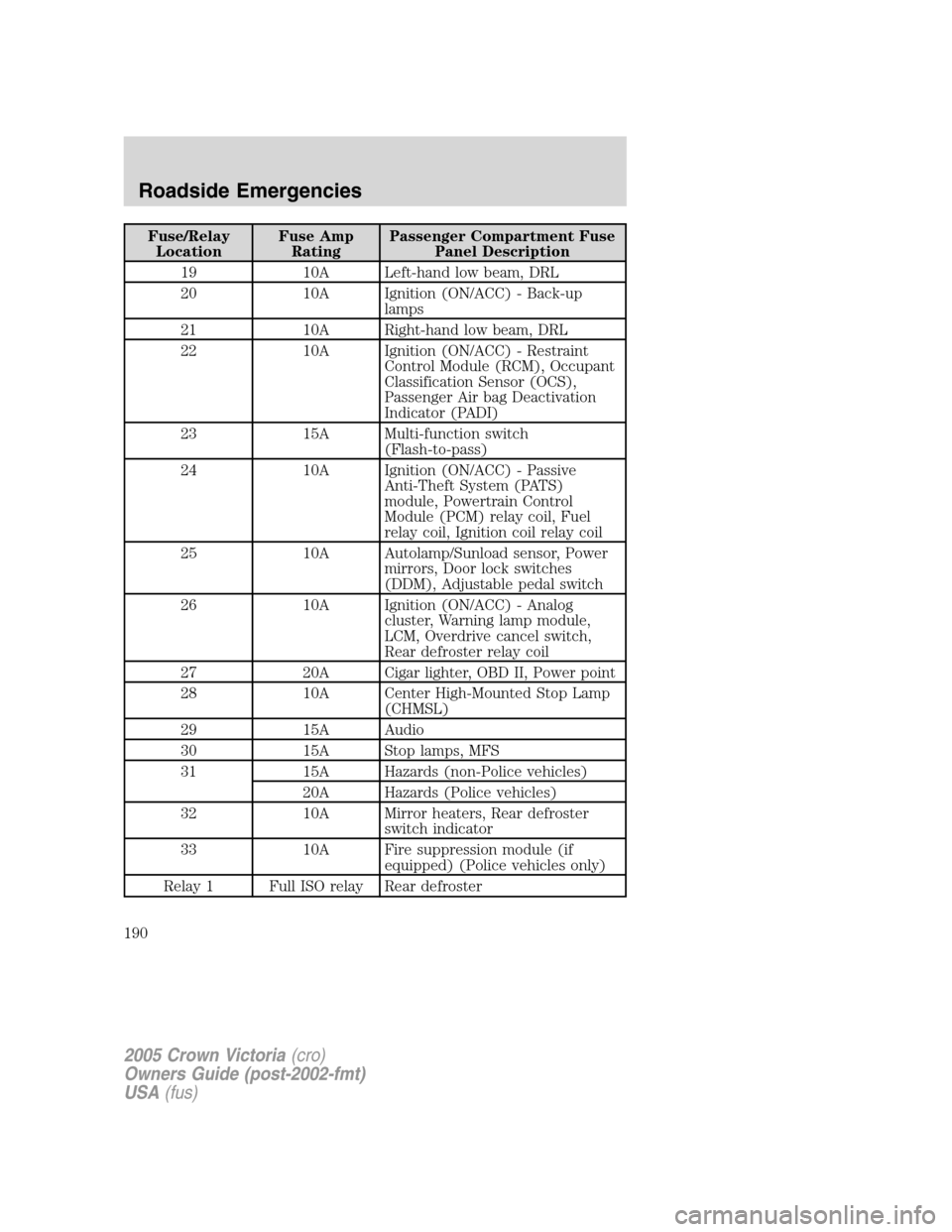
Fuse/Relay
LocationFuse Amp
RatingPassenger Compartment Fuse
Panel Description
19 10A Left-hand low beam, DRL
20 10A Ignition (ON/ACC) - Back-up
lamps
21 10A Right-hand low beam, DRL
22 10A Ignition (ON/ACC) - Restraint
Control Module (RCM), Occupant
Classification Sensor (OCS),
Passenger Air bag Deactivation
Indicator (PADI)
23 15A Multi-function switch
(Flash-to-pass)
24 10A Ignition (ON/ACC) - Passive
Anti-Theft System (PATS)
module, Powertrain Control
Module (PCM) relay coil, Fuel
relay coil, Ignition coil relay coil
25 10A Autolamp/Sunload sensor, Power
mirrors, Door lock switches
(DDM), Adjustable pedal switch
26 10A Ignition (ON/ACC) - Analog
cluster, Warning lamp module,
LCM, Overdrive cancel switch,
Rear defroster relay coil
27 20A Cigar lighter, OBD II, Power point
28 10A Center High-Mounted Stop Lamp
(CHMSL)
29 15A Audio
30 15A Stop lamps, MFS
31 15A Hazards (non-Police vehicles)
20A Hazards (Police vehicles)
32 10A Mirror heaters, Rear defroster
switch indicator
33 10A Fire suppression module (if
equipped) (Police vehicles only)
Relay 1 Full ISO relay Rear defroster
2005 Crown Victoria(cro)
Owners Guide (post-2002-fmt)
USA(fus)
Roadside Emergencies
190
Page 192 of 264
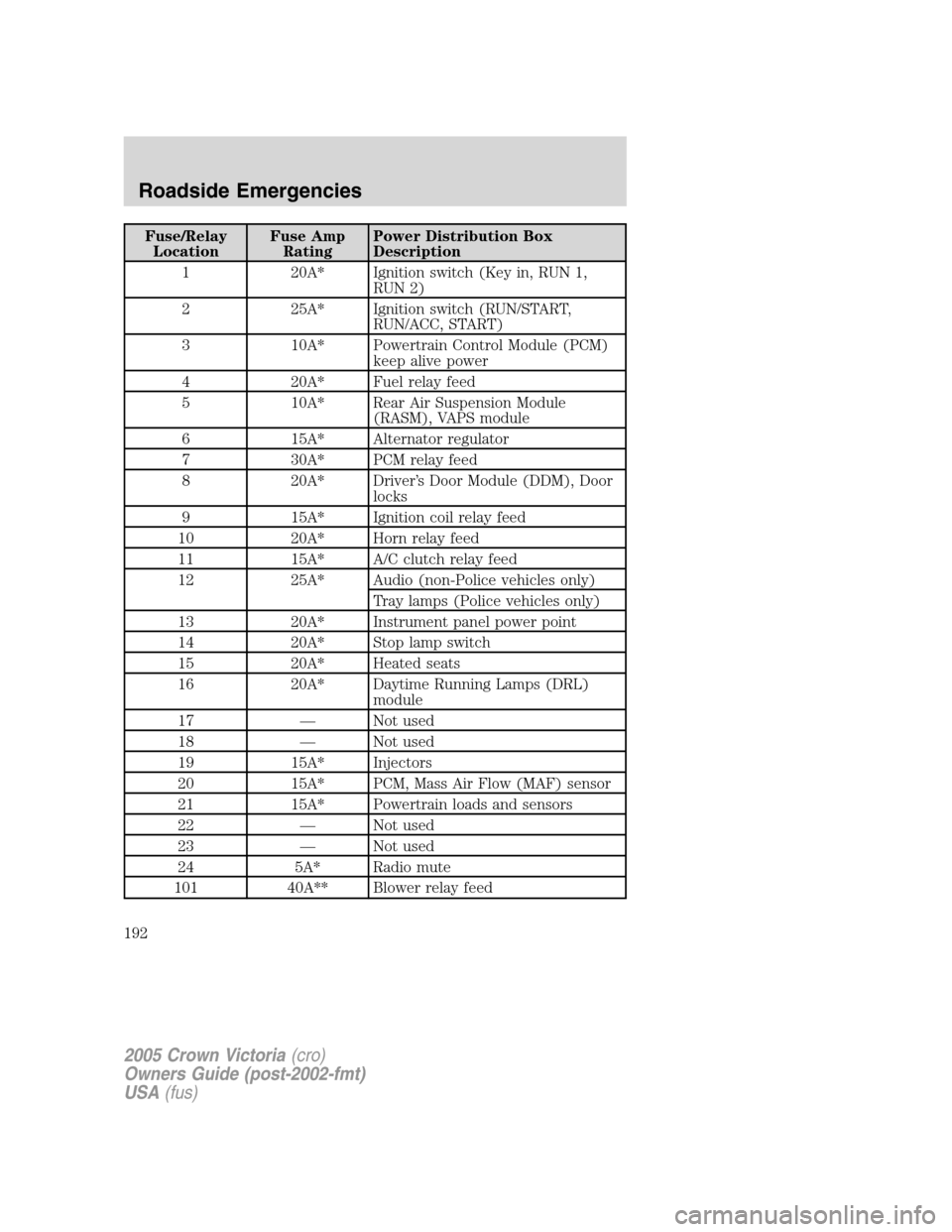
Fuse/Relay
LocationFuse Amp
RatingPower Distribution Box
Description
1 20A* Ignition switch (Key in, RUN 1,
RUN 2)
2 25A* Ignition switch (RUN/START,
RUN/ACC, START)
3 10A* Powertrain Control Module (PCM)
keep alive power
4 20A* Fuel relay feed
5 10A* Rear Air Suspension Module
(RASM), VAPS module
6 15A* Alternator regulator
7 30A* PCM relay feed
8 20A* Driver’s Door Module (DDM), Door
locks
9 15A* Ignition coil relay feed
10 20A* Horn relay feed
11 15A* A/C clutch relay feed
12 25A* Audio (non-Police vehicles only)
Tray lamps (Police vehicles only)
13 20A* Instrument panel power point
14 20A* Stop lamp switch
15 20A* Heated seats
16 20A* Daytime Running Lamps (DRL)
module
17 — Not used
18 — Not used
19 15A* Injectors
20 15A* PCM, Mass Air Flow (MAF) sensor
21 15A* Powertrain loads and sensors
22 — Not used
23 — Not used
24 5A* Radio mute
101 40A** Blower relay feed
2005 Crown Victoria(cro)
Owners Guide (post-2002-fmt)
USA(fus)
Roadside Emergencies
192
Page 193 of 264
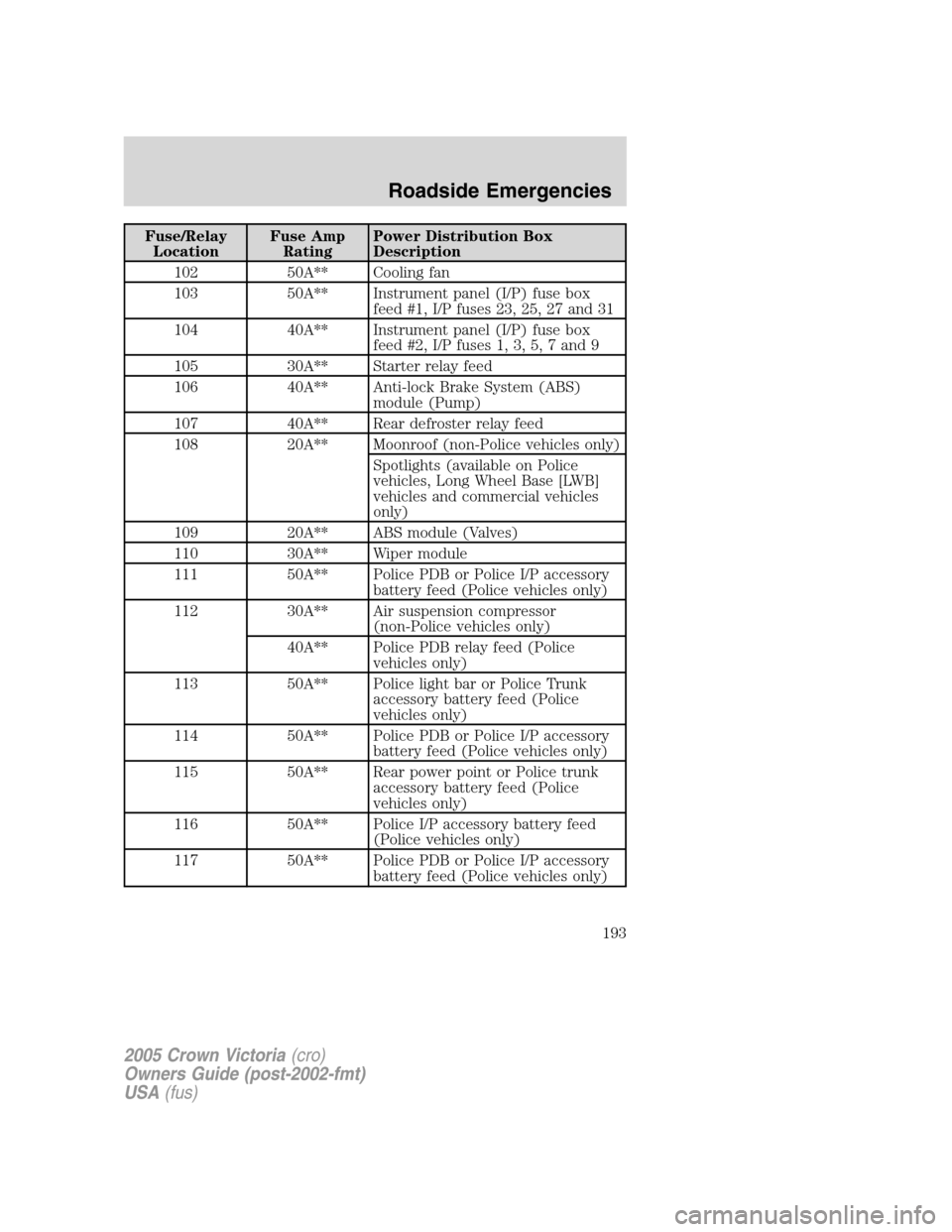
Fuse/Relay
LocationFuse Amp
RatingPower Distribution Box
Description
102 50A** Cooling fan
103 50A** Instrument panel (I/P) fuse box
feed #1, I/P fuses 23, 25, 27 and 31
104 40A** Instrument panel (I/P) fuse box
feed #2, I/P fuses 1, 3, 5, 7 and 9
105 30A** Starter relay feed
106 40A** Anti-lock Brake System (ABS)
module (Pump)
107 40A** Rear defroster relay feed
108 20A** Moonroof (non-Police vehicles only)
Spotlights (available on Police
vehicles, Long Wheel Base [LWB]
vehicles and commercial vehicles
only)
109 20A** ABS module (Valves)
110 30A** Wiper module
111 50A** Police PDB or Police I/P accessory
battery feed (Police vehicles only)
112 30A** Air suspension compressor
(non-Police vehicles only)
40A** Police PDB relay feed (Police
vehicles only)
113 50A** Police light bar or Police Trunk
accessory battery feed (Police
vehicles only)
114 50A** Police PDB or Police I/P accessory
battery feed (Police vehicles only)
115 50A** Rear power point or Police trunk
accessory battery feed (Police
vehicles only)
116 50A** Police I/P accessory battery feed
(Police vehicles only)
117 50A** Police PDB or Police I/P accessory
battery feed (Police vehicles only)
2005 Crown Victoria(cro)
Owners Guide (post-2002-fmt)
USA(fus)
Roadside Emergencies
193
Page 211 of 264
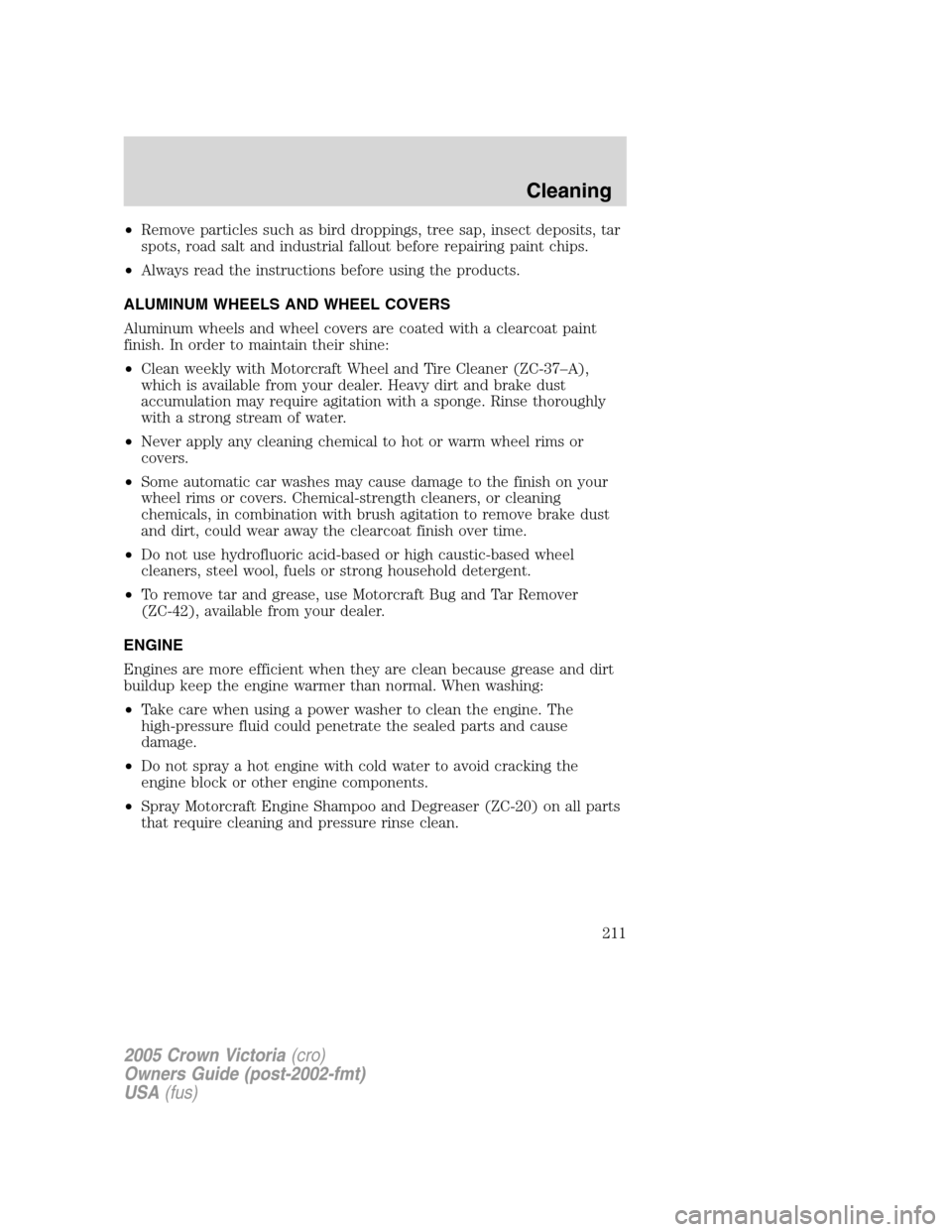
•Remove particles such as bird droppings, tree sap, insect deposits, tar
spots, road salt and industrial fallout before repairing paint chips.
•Always read the instructions before using the products.
ALUMINUM WHEELS AND WHEEL COVERS
Aluminum wheels and wheel covers are coated with a clearcoat paint
finish. In order to maintain their shine:
•Clean weekly with Motorcraft Wheel and Tire Cleaner (ZC-37–A),
which is available from your dealer. Heavy dirt and brake dust
accumulation may require agitation with a sponge. Rinse thoroughly
with a strong stream of water.
•Never apply any cleaning chemical to hot or warm wheel rims or
covers.
•Some automatic car washes may cause damage to the finish on your
wheel rims or covers. Chemical-strength cleaners, or cleaning
chemicals, in combination with brush agitation to remove brake dust
and dirt, could wear away the clearcoat finish over time.
•Do not use hydrofluoric acid-based or high caustic-based wheel
cleaners, steel wool, fuels or strong household detergent.
•To remove tar and grease, use Motorcraft Bug and Tar Remover
(ZC-42), available from your dealer.
ENGINE
Engines are more efficient when they are clean because grease and dirt
buildup keep the engine warmer than normal. When washing:
•Take care when using a power washer to clean the engine. The
high-pressure fluid could penetrate the sealed parts and cause
damage.
•Do not spray a hot engine with cold water to avoid cracking the
engine block or other engine components.
•Spray Motorcraft Engine Shampoo and Degreaser (ZC-20) on all parts
that require cleaning and pressure rinse clean.
2005 Crown Victoria(cro)
Owners Guide (post-2002-fmt)
USA(fus)
Cleaning
211
Page 216 of 264
SERVICE RECOMMENDATIONS
To help you service your vehicle:
•We highlight do-it-yourself items in the engine compartment for easy
location.
•We providescheduled maintenance informationwhich makes
tracking routine service easy.
If your vehicle requires professional service, your dealership can provide
the necessary parts and service. Check yourWarranty Guide/Owner
Information Guideto find out which parts and services are covered.
Use only recommended fuels, lubricants, fluids and service parts
conforming to specifications. Motorcraft parts are designed and built to
provide the best performance in your vehicle.
Notice to owners of Severe Duty vehicles
Before you have maintenance done on your vehicle, be sure to read the
“Severe Duty Owner’s Guide Supplement.” This book contains important
operation and maintenance information.
PRECAUTIONS WHEN SERVICING YOUR VEHICLE
•Do not work on a hot engine.
•Make sure that nothing gets caught in moving parts.
•Do not work on a vehicle with the engine running in an enclosed
space, unless you are sure you have enough ventilation.
•Keep all open flames and other burning (cigarettes) material away
from the battery and all fuel related parts.
Working with the engine off
1. Set the parking brake and shift to P (Park).
2. Turn off the engine and remove the key.
3. Block the wheels.
Working with the engine on
1. Set the parking brake and shift to P (Park).
2. Block the wheels.
Note:Do not start your engine with the air cleaner removed and do not
remove it while the engine is running.
2005 Crown Victoria(cro)
Owners Guide (post-2002-fmt)
USA(fus)
Maintenance and Specifications
216
Page 220 of 264
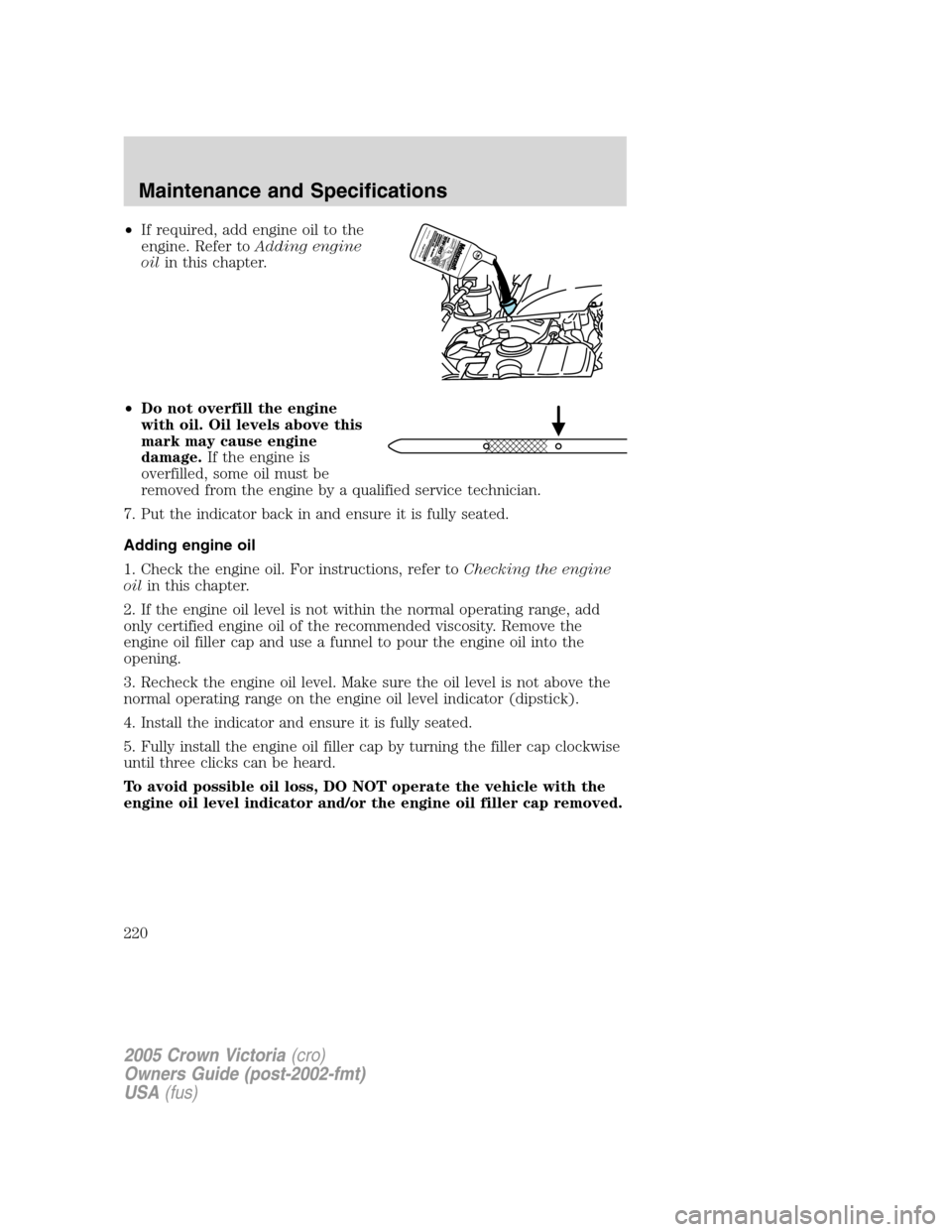
•If required, add engine oil to the
engine. Refer toAdding engine
oilin this chapter.
•Do not overfill the engine
with oil. Oil levels above this
mark may cause engine
damage.If the engine is
overfilled, some oil must be
removed from the engine by a qualified service technician.
7. Put the indicator back in and ensure it is fully seated.
Adding engine oil
1. Check the engine oil. For instructions, refer toChecking the engine
oilin this chapter.
2. If the engine oil level is not within the normal operating range, add
only certified engine oil of the recommended viscosity. Remove the
engine oil filler cap and use a funnel to pour the engine oil into the
opening.
3. Recheck the engine oil level. Make sure the oil level is not above the
normal operating range on the engine oil level indicator (dipstick).
4. Install the indicator and ensure it is fully seated.
5. Fully install the engine oil filler cap by turning the filler cap clockwise
until three clicks can be heard.
To avoid possible oil loss, DO NOT operate the vehicle with the
engine oil level indicator and/or the engine oil filler cap removed.
2005 Crown Victoria(cro)
Owners Guide (post-2002-fmt)
USA(fus)
Maintenance and Specifications
220
Page 223 of 264
When lifting a plastic-cased battery, excessive pressure on the
end walls could cause acid to flow through the vent caps,
resulting in personal injury and/or damage to the vehicle or battery.
Lift the battery with a battery carrier or with your hands on opposite
corners.
Keep batteries out of reach of children. Batteries contain sulfuric
acid. Avoid contact with skin, eyes or clothing. Shield your eyes
when working near the battery to protect against possible splashing of
acid solution. In case of acid contact with skin or eyes, flush
immediately with water for a minimum of 15 minutes and get prompt
medical attention. If acid is swallowed, call a physician immediately.
Battery posts, terminals and related accessories contain lead and
lead compounds.Wash hands after handling.
Because your vehicle’s engine is electronically controlled by a computer,
some control conditions are maintained by power from the battery. When
the battery is disconnected or a new battery is installed, the engine must
relearn its idle and fuel trim strategy for optimum driveability and
performance. To begin this process:
1. With the vehicle at a complete stop, set the parking brake.
2. Put the gearshift in P (Park), turn off all accessories and start the
engine.
3. Run the engine until it reaches normal operating temperature.
4. Allow the engine to idle for at least one minute.
5. Turn the A/C on and allow the engine to idle for at least one minute.
6. Release the parking brake. With your foot on the brake pedal and with
the A/C on, put the vehicle in D (Drive) and allow the engine to idle for
at least one minute.
7. Drive the vehicle to complete the relearning process.
•The vehicle may need to be driven 10 miles (16 km) or more to
relearn the idle and fuel trim strategy.
•If you do not allow the engine to relearn its idle trim, the idle
quality of your vehicle may be adversely affected until the idle
trim is eventually relearned.
If the battery has been disconnected or a new battery has been installed,
the clock and radio settings must be reset once the battery is
reconnected.
2005 Crown Victoria(cro)
Owners Guide (post-2002-fmt)
USA(fus)
Maintenance and Specifications
223
Page 227 of 264
coolant degas system with a pressurized cap, or if it is necessary to
remove the coolant pressure relief cap on the radiator of a vehicle with
an overflow system, follow these steps to add engine coolant.
To reduce the risk of personal injury, make sure the engine is
cool before unscrewing the coolant pressure relief cap. The
cooling system is under pressure; steam and hot liquid can come out
forcefully when the cap is loosened slightly.
1. Before you begin, turn the engine off and let it cool.
2. When the engine is cool, wrap a thick cloth around the coolant
pressure relief cap on the coolant reservoir (a translucent plastic bottle).
Slowly turn cap counterclockwise (left) until pressure begins to release.
3. Step back while the pressure releases.
4. When you are sure that all the pressure has been released, use the
cloth to turn it counterclockwise and remove the cap.
5. Fill the coolant reservoir slowly with the proper coolant mixture (see
above), to within the “COLD FILL RANGE” or the “FULL COLD” level on
the reservoir. If you removed the radiator cap in an overflow system, fill
the radiator until the coolant is visible and radiator is almost full.
6. Replace the cap. Turn until tightly installed. (Cap must be tightly
installed to prevent coolant loss.)
After any coolant has been added, check the coolant concentration (refer
toChecking engine coolant). If the concentration is not 50/50
(protection to –34° F/–36° C), drain some coolant and adjust the
concentration. It may take several drains and additions to obtain a 50/50
coolant concentration.
Whenever coolant has been added, the coolant level in the coolant
reservoir should be checked the next few times you drive the vehicle. If
necessary, add enough 50/50 concentration of engine coolant and
distilled water to bring the liquid level to the proper level.
If you have to add more than 1.0 quart (1.0 liter) of engine coolant per
month, have your dealer check the engine cooling system. Your cooling
system may have a leak. Operating an engine with a low level of coolant
can result in engine overheating and possible engine damage.
Recycled engine coolant
Ford Motor Company does NOT recommend the use of recycled engine
coolant in vehicles originally equipped with Motorcraft Premium Gold
Engine Coolant since a Ford-approved recycling process is not yet
available.
2005 Crown Victoria(cro)
Owners Guide (post-2002-fmt)
USA(fus)
Maintenance and Specifications
227