2005 FIAT DUCATO 244 steering wheel
[x] Cancel search: steering wheelPage 95 of 258
94GETTING TO KNOW YOUR VEHICLE
If the vehicle changes owner-
ship, the new owner must be in-
formed of the method of use of
airbags and the above warnings
and also be given this Owner
Handbook.
The triggering of pretensioners
and front and side airbags is de-
cided in a differentiated manner
by the electronic control unit, de-
pending on the type of crash. The
failure to deploy one or more of
them does not mean that the sys-
tem is not working properly.
If the ¬warning light does
not turn on when turning
the ignition key to MAR or if it stays
on when travelling, this could indi-
cate a failure in safety retaining sys-
tems; under this condition air bags
or pretensioners could not trigger
in the event of collision or, in a re-
stricted number of cases, they could
trigger accidentally. Stop the car
and contact Fiat Dealership to have
the system checked immediately.
WARNING
If the vehicle has been
stolen or an attempt to
steal it has been made, if it has
been subjected to vandals or floods,
have the airbag system checked by
Fiat Dealership.
WARNING
Do not apply stickers or
other objects to the steer-
ing wheel or to the airbag console
on the passenger’s side. Never trav-
el with objects on your lap, in front
of your chest or with a pipe, pencil,
etc. between your lips; injury may
result in the event of the airbag be-
ing triggered.
WARNING
Always keep your hands on
the steering wheel rim
when driving, so that if the airbag
is triggered, it can inflate without
meeting any obstacles which could
cause serious harm to you. Do not
drive with the body bent forwards,
keep the seat back rest in the erect
position and lean your back well
against it.
WARNING
When the passenger’s front
airbag is active (passenger
front airbag deactivation switch at
ON), the
Fwarning light will
come on for approx. 4 seconds and
flash for other four seconds when
the ignition key is turned to MAR to
remind the driver that the passen-
ger’s front and side airbags (where
provided) will be fired in the event
of a crash. The warning light should
go off immediately afterwards.
WARNING
Page 108 of 258

107GETTING THE BEST OUT OF YOUR VEHICLE
If you still cannot start the engine,
get in touch with a Fiat Dealership.
IMPORTANT When the outside
temperature is low, it is important to
note that the use of a more fluid oil
will facilitate starting the cold engine.
Therefore, in winter, follow the advice
in chapter “Technical specifications”,
paragraph “Fluids and lubricants”.
IMPORTANTNever leave the igni-
tion key at MARwhen the engine is off.
Minibus and School Bus versions:
press the ignition enable button lo-
cated to the left of the steering col-
umn as shown in the specific supple-
ment to this handbook.HOW TO WARM UP
THE ENGINE AFTER IT
HAS JUST STARTED
(petrol and diesel versions)
– Begin to move forward slowly let-
ting the engine turn at medium revs.
Do not accelerate abruptly.
– Do not push the engine to its lim-
it for the first few kilometres. You are
recommended to wait until the
coolant temperature indicator starts
to move.
EMERGENCY START-UP
If the Fiat CODE system fails to
recognise that code transmitted by the
ignition key (warning light Yon the
instrument panel lit) the emergency
start-up can be performed by using the
CODE card code.
See the “In an emergency” section.Catalysed vehicles must
not be bump started
(pushed, towed or coast-
ed downhill) as this could cause
fuel to flow into the catalytic ex-
haust system and damage it be-
yond repair.
Remember that until the
engine has started the
brake booster and power steering
systems will not work and a greater
effort will therefore be required to
depress the brake pedal or turn the
steering wheel.
WARNING
Page 122 of 258

121GETTING THE BEST OUT OF YOUR VEHICLE
– Do not drive too many hours at a
time but stop at intervals to stretch
your legs and recoup your energy;
– make sure the air in the passenger’s
compartment is being changed
continuously;
– never coast downhill (i.e. with the
engine off): if you do, you lose the aid
of engine braking, power brakes and
power steering so that braking re-
quires greater effort on the pedal and
steering requires greater effort on the
steering wheel.DRIVING AT NIGHT
These are the main rules to follow
when you are driving at night:
– drive especially carefully: it is hard-
er to drive at night;
– slow down especially if the road is
not lit;
– at the first signs of sleepiness, stop:
continuing would be a risk for yourself
and everybody else. Only start driving
again when you have had enough rest;
– keep a greater safety distance from
the vehicles in front of you than dur-
ing daylight hours: it is hard to judge
how fast other vehicles are going when
all you can see are their lights;
– make sure the headlights beams are
properly positioned: if they are too
low, they reduce visibility and strain
your eyes. If they are too high they can
dazzle other drivers. Adjust headlight
beam according to transported load;
– only use main beam headlights
when you are driving outside town
and when you are sure they do not an-
noy other drivers. dip your headlights
Water, ice or salt sprinkled
on the road can deposit on
the brake discs and reduce effi-
ciency of the first braking.
WARNING
Do not drive with objects
on the floor in front of the
driver’s seat: they could caught un-
der the pedals making braking or
accelerating impossible.
WARNING
Pay attention to the mats:
even a small problem to the
braking system may require in-
creased brake pedal stroke with re-
spect to normal.
WARNING
Page 138 of 258
137IN AN EMERGENCY
BUMP STARTING IF A TYRE IS
PUNCTURED
General instructions
Observe the instruc-
tions on this and the fol-
lowing pages to use the
jack and spare wheel correctly.Catalysed vehicles must
not be bump started
(pushed, towed or
coasted downhill) as this could
cause fuel to flow into the cat-
alytic exhaust system and dam-
age it beyond repair.
Never start the engine
when the vehicle is jacked
up.
WARNING
Remember that until the
engine has started the
brake booster and power steering
systems will not work and a greater
effort will therefore be required to
depress the brake pedal or turn the
steering wheel.
WARNING
If you are towing a trailer,
remove the trailer before
jacking up the vehicle.
WARNING
The jack should only be
used to changed a wheel on
the vehicle for which it was de-
signed. It should not be put to oth-
er uses or employed to raise other
models. Under no circumstances
should it be used when carrying out
repairs under the vehicle. An incor-
rectly positioned jack may cause
the vehicle to fall. Do not use the
jack to lift loads exceeding that in-
dicated on the label attached to the
to the jack itself.
WARNING
Page 160 of 258
159IN AN EMERGENCY
WITH A SHOP JACK
The vehicle can be raised on a shop
jack if it is empty. This is only possi-
ble from the side by placing the jack at
the points provided in the underbody
as indicated infig. 41.
WITH AN ARM HOIST
The vehicle must be raised by plac-
ing the ends of the arms at the points
indicated in fig. 41.TOWING THE
VEHICLE
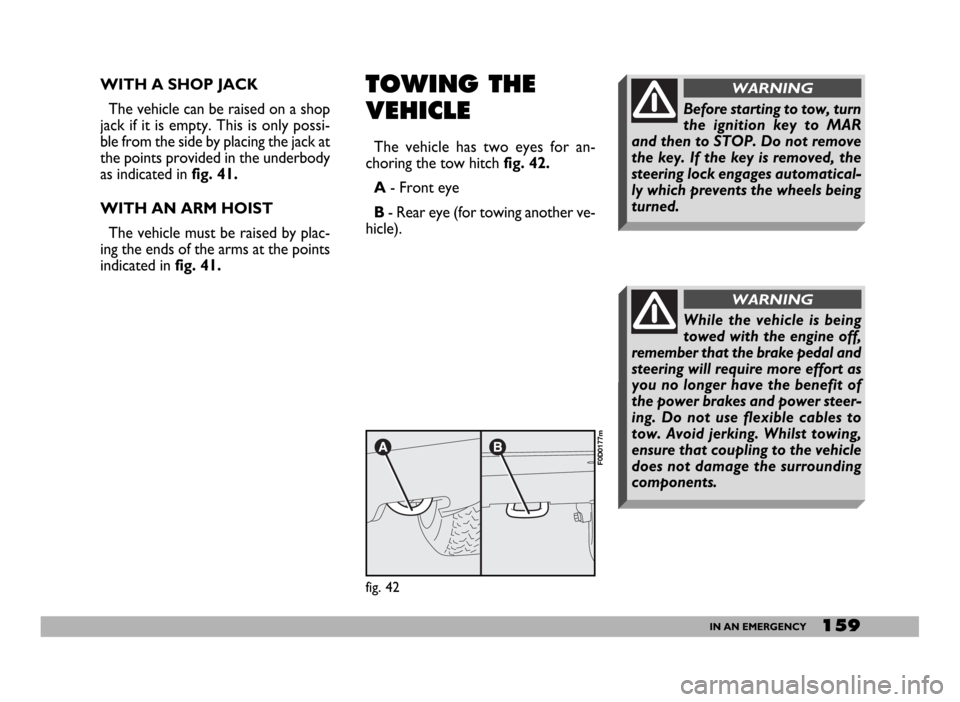
The vehicle has two eyes for an-
choring the tow hitch fig. 42.
A- Front eye
B- Rear eye (for towing another ve-
hicle).
fig. 42
F0D0177m
Before starting to tow, turn
the ignition key to MAR
and then to STOP. Do not remove
the key. If the key is removed, the
steering lock engages automatical-
ly which prevents the wheels being
turned.
WARNING
While the vehicle is being
towed with the engine off,
remember that the brake pedal and
steering will require more effort as
you no longer have the benefit of
the power brakes and power steer-
ing. Do not use flexible cables to
tow. Avoid jerking. Whilst towing,
ensure that coupling to the vehicle
does not damage the surrounding
components.
WARNING
Page 166 of 258

165VEHICLE MAINTENANCE
ANNUAL
INSPECTION
SCHEDULE
The following annual inspection
schedule is required for vehicles trav-
elling 15,000 Kmapprox. a year. The
schedule includes the following oper-
ations:
– check tyre condition and wear and
adjust pressure, if required (including
spare wheel);
– check operation of lights (head-
lights, direction indicators, hazard
lights, boot light, passenger compart-
ment light, instrument panel lights,
etc.);
– check windscreen wiper/washer
and adjust nozzles;
– check position and wear of wind-
screen/rear window wiper blades;
– check front pad conditions and
wear;
– check for bonnet and boot lock
cleanness, lever cleanness and lubri-
cation;– inspect conditions of: engine, gear-
box, transmission, piping (exhaust, fu-
el feed, brakes), rubber parts (boots,
sleeves, bushings, etc.), brake and fu-
el line hoses;
– check battery charge status;
– check conditions of various control
belts;
– check and top up fluid levels (en-
gine coolant, brakes, windscreen
washer, battery, etc.);
– check and top up engine oil;
– replace pollen filter.
ADDITIONAL
CHECKS
Every 1,000 km or before long
trips, check and top up as necessary:
– engine coolant level
– brake fluid level
– power steering fluid level
– battery electrolyte level
– windscreen washer fluid
– tyre pressure and conditions.
Every 3,000 km or before long
trips, check and top up as necessary:
engine oil
Every 10,000 kmor at cwarning
light coming on (diesel engines only):
bleed water from fuel filter.
You are recommended to use FL
Seleniaproducts designed and pro-
duced for Fiat vehicles (see the “Ca-
pacities” table in the “Technical Spec-
ifications” section).
Page 179 of 258
178VEHICLE MAINTENANCE
WHEELS AND
TYRES
Check the pressure of each tyre, in-
cluding the spare, every two weeks
and before long journeys.
The pressure must be checked when
the tyre is rested and cold.
It is normal for pressure to rise
when you are driving. If you have to
check or restore the pressure when
the tyres are warm, remember that
the pressure value must be 0.3 bar
above the specified value.
See “Wheels” in “Technical specifi-
cations” chapter for the correct tyre
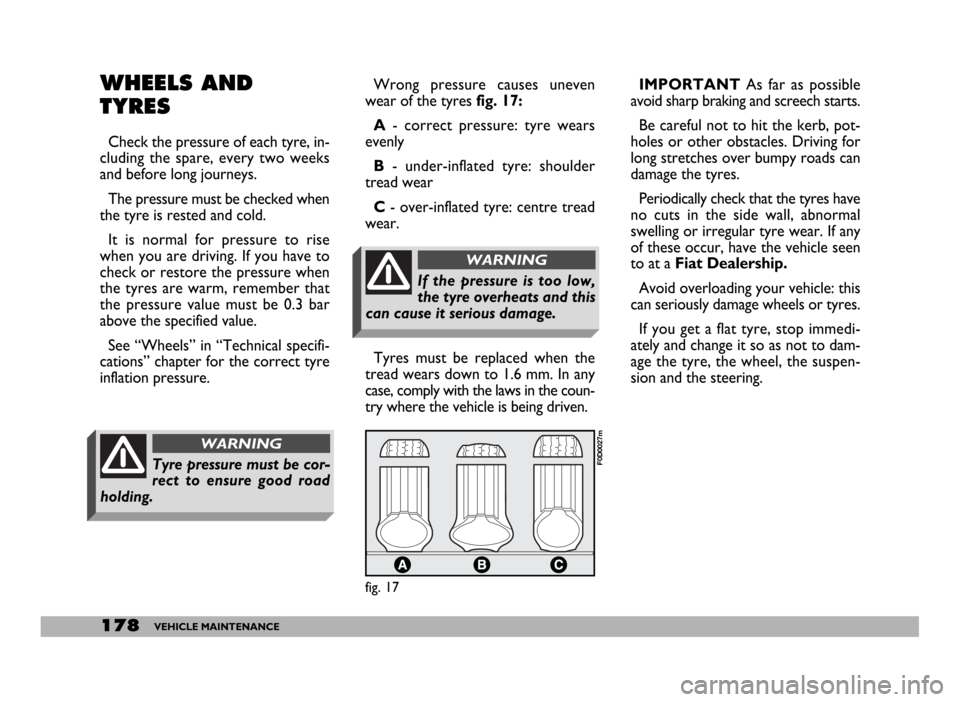
inflation pressure.Wrong pressure causes uneven
wear of the tyres fig. 17:
A- correct pressure: tyre wears
evenly
B- under-inflated tyre: shoulder
tread wear
C- over-inflated tyre: centre tread
wear.IMPORTANTAs far as possible
avoid sharp braking and screech starts.
Be careful not to hit the kerb, pot-
holes or other obstacles. Driving for
long stretches over bumpy roads can
damage the tyres.
Periodically check that the tyres have
no cuts in the side wall, abnormal
swelling or irregular tyre wear. If any
of these occur, have the vehicle seen
to at a Fiat Dealership.
Avoid overloading your vehicle: this
can seriously damage wheels or tyres.
If you get a flat tyre, stop immedi-
ately and change it so as not to dam-
age the tyre, the wheel, the suspen-
sion and the steering.
fig. 17
F0D0027m
If the pressure is too low,
the tyre overheats and this
can cause it serious damage.
WARNING
Tyre pressure must be cor-
rect to ensure good road
holding.
WARNING
Tyres must be replaced when the
tread wears down to 1.6 mm. In any
case, comply with the laws in the coun-
try where the vehicle is being driven.
Page 219 of 258

218TECHNICAL SPECIFICATIONS
WHEELS
RIMS AND TYRES
Printed steel rims with ventilated
disk.
Tubeless tyres with radial carcass.
The homologated tyres are listed in
the log book.
IMPORTANT In the event of dis-
crepancies between the information
provided in this Owner Handbook and
the Log Book, consider the specifica-
tions shown in the Log Book only.
To ensure safety of the vehicle in
movement, it must be fitted with tyres
of the same make and type on all
wheels.
IMPORTANT Do not use inner
tubes with tubeless tyres.SPARE WHEEL
Printed steel rim.
Tubeless tyre (same as those fitted).
SNOW CHAINS
Only use low profile chains, see
“Snow chains”.
WHEEL GEOMETRY
Front wheel toe-in measured from
rim to rim: – 2 ± 1 mm.
The values refer to the vehicle in run-
ning order.
STEERING
Energy-absorbing jointed steering
column and wheel.
Height adjustable steering wheel.
Permanently lubricated rack and pin-
ion.
Hydraulic power steering.
Minimum turning circle:
– short wheelbase ................ 11 m
– medium wheelbase ............ 12.1 m
– long wheelbase .................. 13,7 m
Number of steering wheel turns lock
to lock ......................................... 3.52
Do not hold the power as-
sisted steering wheel with
the engine running for longer than
15 seconds. It will make a noise and
you could damage the system.
WARNING