Page 15 of 258

14GETTING TO KNOW YOUR VEHICLE
Do not leave the key inserted in the
switch. Cover the keyhole with the
rubber cap to prevent dust and wa-
ter getting in.
Emergency keys should be left in the
car coupled with the switch.
HOW TO KNOW IF THE
ALARM HAS GONE OFF
After deactivating the system, led A-
fig. 9will indicate the theft attempt
specifying also the cause of the alarm:
fixed light:remote control bat-
tery down
1 blink:right-hand door
2 blinks:left-hand door
5 blinks:volumetric sensors
(indicate a movement
inside the passenger’s
compartment)
6 blinks:bonnet To cut off the alarm before this,
press the remote control button; if
this is unsuccessful, turn the emer-
gency key to OFF(see next paragraph
“How to turn the alarm off”)
HOW TO TURN
THE ALARM OFF
If the remote control batteries run
down, or the car alarm system is
faulty, the electronic alarm can be cut
out by using one of the two emer-
gency keys supplied set on the system
deactivation control unit (that is
housed in the fuse box on the right
side of the dashboard).
To do this, open the fuse box, take
off the switch rubber cap, insert the
key and turn it counterclockwise
(OFFposition); the system is now de-
activated.
To turn the system back on, turn the
key clockwise (ONposition).7 blinks:load
compartment
8 blinks:tampering with
ignition switch
9 blinks:alarm wires cut
10 blinks:at least three causes
of alarm.
The led goes off when turning the
key to MAR or after about 2 minutes
blinking.
Since the electronic car
alarm absorbs electricity,
if you will not be using
your car for more than a month,
switch the system off with the re-
mote control and turn the emer-
gency key to OFF.
Page 16 of 258
15GETTING TO KNOW YOUR VEHICLE
SEAT BELTS
USING THE SEAT BELTS
The belt should be worn keeping the
chest straight and rested against the
seat back.
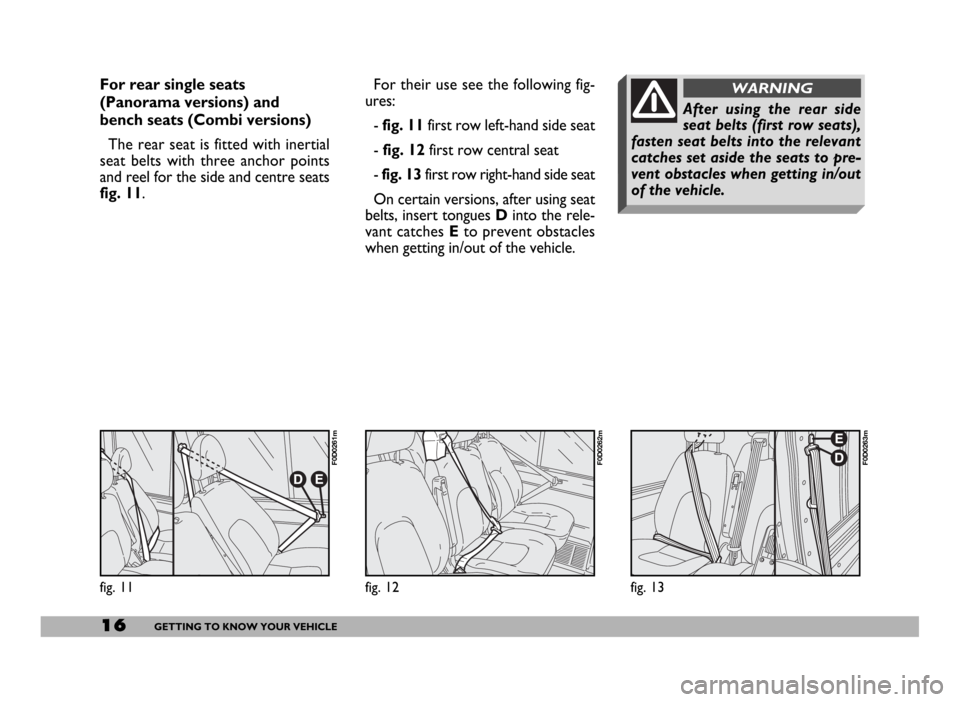
To fasten the seat belts, take hold the
fastener tongue A-fig. 10and insert
it into the buckle B, until hearing the
locking click.The seat belt reel mechanism en-
sures that the belt automatically ad-
justs to the wearer allowing him or
her to move in complete freedom.
When the vehicle is parked on a
steep slope the reel mechanism may
block; this is normal. The reel mech-
anism also prevents the webbing com-
ing out when it is jerked or if the ve-
hicle brakes sharply, is in a collision or
when cornering at high speed.
fig. 10
F0D0050m
Never press button C when
travelling.
WARNING
At removal, if it jams, let it rewind for
a short stretch, then pull it out again
without jerking.
To unfasten the seat belts, press but-
ton C. Guide the seat belt with your
hand while it is rewinding, to prevent
it from twisting.
Page 17 of 258
fig. 13
F0D0263m
After using the rear side
seat belts (first row seats),
fasten seat belts into the relevant
catches set aside the seats to pre-
vent obstacles when getting in/out
of the vehicle.
WARNING
16GETTING TO KNOW YOUR VEHICLE
fig. 12
F0D0262m
fig. 11
F0D0261m
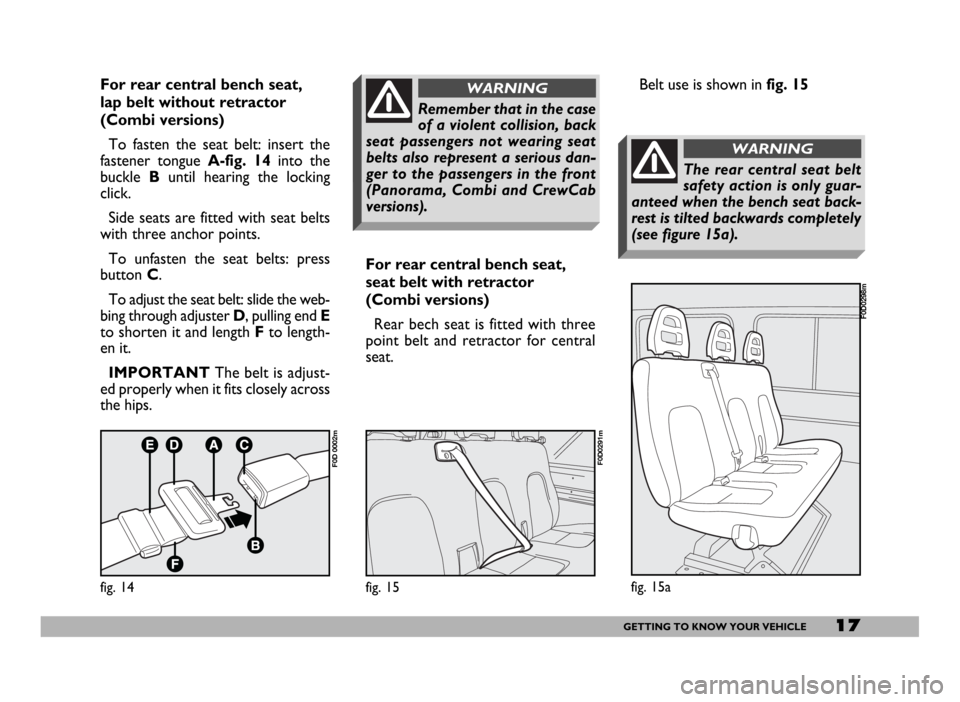
For rear single seats
(Panorama versions) and
bench seats (Combi versions)
The rear seat is fitted with inertial
seat belts with three anchor points
and reel for the side and centre seats
fig. 11.For their use see the following fig-
ures:
- fig. 11first row left-hand side seat
- fig. 12first row central seat
- fig. 13first row right-hand side seat
On certain versions, after using seat
belts, insert tongues Dinto the rele-
vant catches Eto prevent obstacles
when getting in/out of the vehicle.
Page 18 of 258
17GETTING TO KNOW YOUR VEHICLE
For rear central bench seat,
lap belt without retractor
(Combi versions)
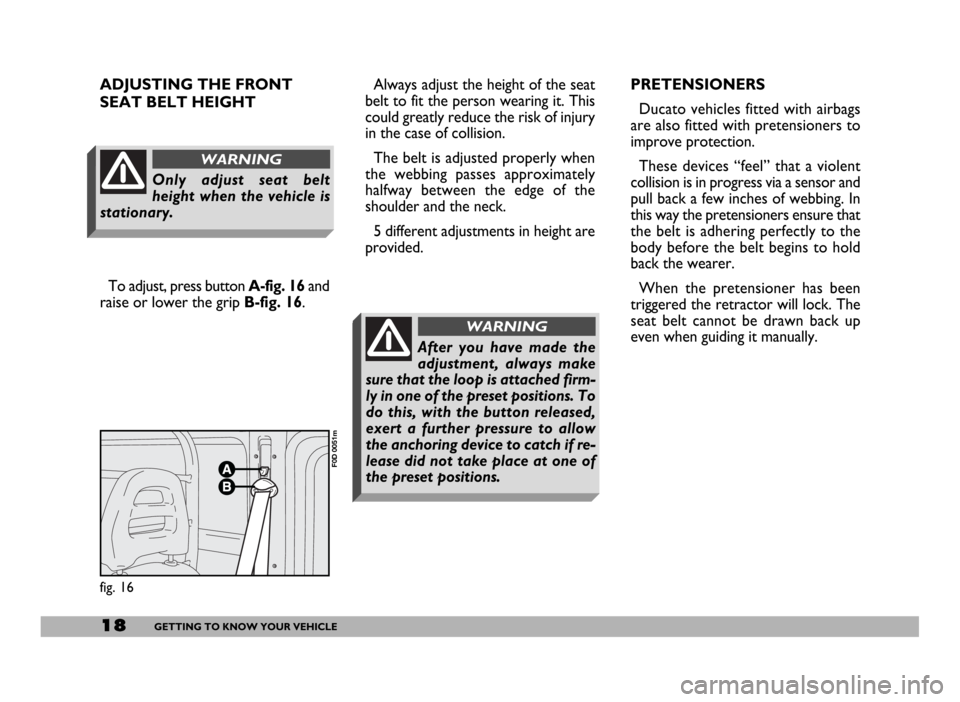
To fasten the seat belt: insert the
fastener tongue A-fig. 14into the
buckle Buntil hearing the locking
click.
Side seats are fitted with seat belts
with three anchor points.
To unfasten the seat belts: press
button C.
To adjust the seat belt: slide the web-
bing through adjuster D, pulling end E
to shorten it and length F to length-
en it.
IMPORTANT The belt is adjust-
ed properly when it fits closely across
the hips.
fig. 14
F0D 0002m
Remember that in the case
of a violent collision, back
seat passengers not wearing seat
belts also represent a serious dan-
ger to the passengers in the front
(Panorama, Combi and CrewCab
versions).
WARNING
For rear central bench seat,
seat belt with retractor
(Combi versions)
Rear bech seat is fitted with three
point belt and retractor for central
seat.
fig. 15
F0D0291m
Belt use is shown in fig. 15
fig. 15a
F0D0298m
The rear central seat belt
safety action is only guar-
anteed when the bench seat back-
rest is tilted backwards completely
(see figure 15a).
WARNING
Page 19 of 258
Always adjust the height of the seat
belt to fit the person wearing it. This
could greatly reduce the risk of injury
in the case of collision.
The belt is adjusted properly when
the webbing passes approximately
halfway between the edge of the
shoulder and the neck.
5 different adjustments in height are
provided.PRETENSIONERS
Ducato vehicles fitted with airbags
are also fitted with pretensioners to
improve protection.
These devices “feel” that a violent
collision is in progress via a sensor and
pull back a few inches of webbing. In
this way the pretensioners ensure that
the belt is adhering perfectly to the
body before the belt begins to hold
back the wearer.
When the pretensioner has been
triggered the retractor will lock. The
seat belt cannot be drawn back up
even when guiding it manually.
After you have made the
adjustment, always make
sure that the loop is attached firm-
ly in one of the preset positions. To
do this, with the button released,
exert a further pressure to allow
the anchoring device to catch if re-
lease did not take place at one of
the preset positions.
WARNING
18GETTING TO KNOW YOUR VEHICLE
To adjust, press button A-fig. 16and
raise or lower the grip B-fig. 16. ADJUSTING THE FRONT
SEAT BELT HEIGHT
fig. 16
F0D 0051m
Only adjust seat belt
height when the vehicle is
stationary.
WARNING
Page 20 of 258
19GETTING TO KNOW YOUR VEHICLE
IMPORTANTThe pretensioner
will give maximum protection when
the seat belt adheres snugly to the
wearer’s chest and hips.
A small amount of smoke may be
produced when the pretensioners are
fired. This smoke is harmless and does
not indicate the principle of a fire.
The pretensioner does not require
any maintenance or lubrication. Any
modification of its original state inval-
idates its efficiency. If, as the result of
exceptional natural occurrences
(floods, sea storms, etc.) the device is
soaked through with water and mud,
it must be replaced.Operations involving
banging, vibrations or
heating (exceeding 100°C
for a maximum of 6 hours) in the
area around the pretensioner
may trigger or damage the de-
vice. Vibrations from rough road
surfaces or accidental jolting
caused by mounting pavements,
etc. do not have any effect on the
pretensioner. If, however, you
need any assistance, go to a Fiat
Dealership.
fig. 17
F0D0264m
The pretensioner can only
be used once. After a colli-
sion that has triggered it, have it re-
placed at a Fiat Dealership. Pre-
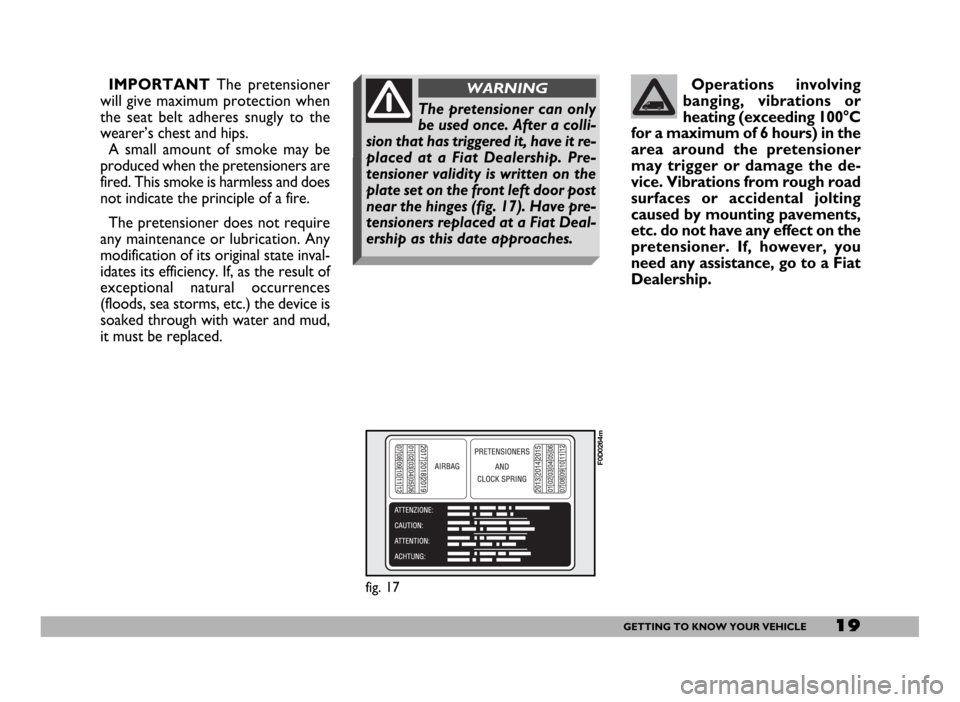
tensioner validity is written on the
plate set on the front left door post
near the hinges (fig. 17). Have pre-
tensioners replaced at a Fiat Deal-
ership as this date approaches.
WARNING
Page 21 of 258

20GETTING TO KNOW YOUR VEHICLE
fig. 18
F0D0003m
The webbing must not be
twisted. The upper section
must pass across the shoulder and
chest diagonally. The lower section
must fit closely across the passen-
ger’s hips and not the abdomen (fig.
18). Do not use clips, fasteners, etc.
to prevent the belt adhering to the
passenger’s body.
WARNING
Under no circumstances
should the components of
seat belts and pretensioners be
tampered with or removed. Any in-
terventions should be carried out by
qualified and authorised personnel.
Always contact a Fiat Dealership.
WARNINGGENERAL INSTRUCTIONS
FOR THE USE OF THE SEAT
BELTS
The driver is responsible for re-
specting and enforcing the local rules
and laws regarding the use of seat
belts.
Always fasten the seat belts before
starting.
For maximum safety, keep
the back of your seat up-
right, lean back into it and make
sure the seat belt fits closely across
your chest and hips. Always fasten
seat belts, in front and rear seats!
Travelling without seat belts in-
creases the risk of severe and fatal
injury in the event of a crash.
WARNING
Page 22 of 258
21GETTING TO KNOW YOUR VEHICLE
Seat belts must also be worn by ex-
pectant mothers: the risk of injury in
the case of accident is much greater for
them and their unborn child too if they
do not have a seat belt on. Of course
they must position the lower part of
the belt very low down so that it pass-
es under the abdomen (fig. 20).
fig. 19
F0D0004m
fig. 20
F0D0005m
If the belt has been sub-
jected to heavy stress, for
example after an accident, it should
be changed completely together
with the anchors, anchor fastening
screws and the pretensioners. In
fact, even if the belt has no visible
defects, it could have lost its re-
silience.
WARNING
Never travel with a child
sitting on the passenger’s
lap with a single belt to protect
them both (fig. 19). Do not fasten
other objects to the body.
WARNING