Page 132 of 258
131GETTING THE BEST OUT OF YOUR VEHICLE
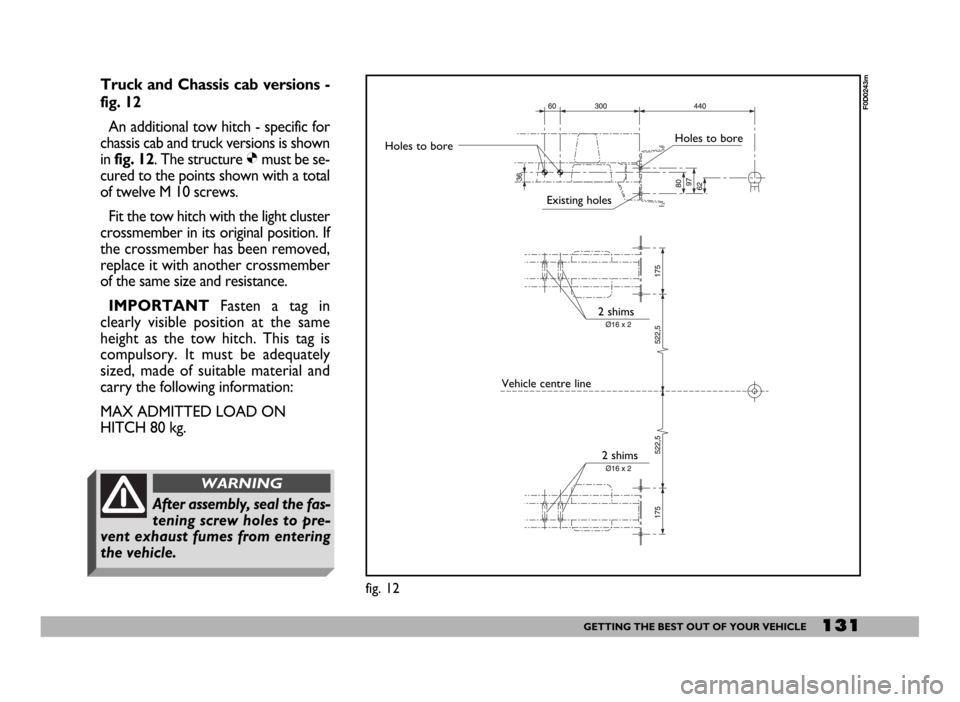
Truck and Chassis cab versions -
fig. 12
An additional tow hitch - specific for
chassis cab and truck versions is shown
in fig. 12. The structure Ømust be se-
cured to the points shown with a total
of twelve M 10 screws.
Fit the tow hitch with the light cluster
crossmember in its original position. If
the crossmember has been removed,
replace it with another crossmember
of the same size and resistance.
IMPORTANTFasten a tag in
clearly visible position at the same
height as the tow hitch. This tag is
compulsory. It must be adequately
sized, made of suitable material and
carry the following information:
MAX ADMITTED LOAD ON
HITCH 80 kg.
fig. 12
F0D0243m
Holes to boreHoles to bore
Existing holes
2 shims
Vehicle centre line
2 shims
After assembly, seal the fas-
tening screw holes to pre-
vent exhaust fumes from entering
the vehicle.
WARNING
Page 134 of 258

133GETTING THE BEST OUT OF YOUR VEHICLE
SNOW CHAINS
The use of snow chains is regulated
by the legislation in force in the coun-
try the vehicle is driven in.
The chains may only be applied to
the drive wheel tyres (front wheels).We recommend using Lineaccessori
Fiat snow chains.
Check the tautness of the chains af-
ter driving some twenty to thirty me-
tres.With chains
mounted keep
your speed down.
Do not exceed 50 kph. Avoid
holes in the road; do not mount
steps or kerbs. Do not drive long
stretches of snow-free road with
the chains mounted, as this can
damage the vehicle and the road
surface too.
Versions
11
15
MAXI
Tyres on which
chains can be fitted
195/70 R15C
205/70 R15C
215/70 R15 Camping
205/70 R15C
215/70 R15 Camping
215/75 R16C
205/75 R16C
215/75 R16 CampingTypes of snow chains
to be used
Snow chains with
reduced size with max.
protrusion beyond the
tyre profile of 15 mm
For rim size refer to “Wheels” in section “Technical Specifications”.
Refer to the following table
for information on the
wheels where snow chains can be
fitted. Follow the prescriptions.
WARNING
Page 166 of 258

165VEHICLE MAINTENANCE
ANNUAL
INSPECTION
SCHEDULE
The following annual inspection
schedule is required for vehicles trav-
elling 15,000 Kmapprox. a year. The
schedule includes the following oper-
ations:
– check tyre condition and wear and
adjust pressure, if required (including
spare wheel);
– check operation of lights (head-
lights, direction indicators, hazard
lights, boot light, passenger compart-
ment light, instrument panel lights,
etc.);
– check windscreen wiper/washer
and adjust nozzles;
– check position and wear of wind-
screen/rear window wiper blades;
– check front pad conditions and
wear;
– check for bonnet and boot lock
cleanness, lever cleanness and lubri-
cation;– inspect conditions of: engine, gear-
box, transmission, piping (exhaust, fu-
el feed, brakes), rubber parts (boots,
sleeves, bushings, etc.), brake and fu-
el line hoses;
– check battery charge status;
– check conditions of various control
belts;
– check and top up fluid levels (en-
gine coolant, brakes, windscreen
washer, battery, etc.);
– check and top up engine oil;
– replace pollen filter.
ADDITIONAL
CHECKS
Every 1,000 km or before long
trips, check and top up as necessary:
– engine coolant level
– brake fluid level
– power steering fluid level
– battery electrolyte level
– windscreen washer fluid
– tyre pressure and conditions.
Every 3,000 km or before long
trips, check and top up as necessary:
engine oil
Every 10,000 kmor at cwarning
light coming on (diesel engines only):
bleed water from fuel filter.
You are recommended to use FL
Seleniaproducts designed and pro-
duced for Fiat vehicles (see the “Ca-
pacities” table in the “Technical Spec-
ifications” section).
Page 170 of 258

169VEHICLE MAINTENANCE
Do not add oil with dif-
ferent specifications from
the oil already in the en-
gine.
ENGINE OIL
Fig. 5:2.0 versions
Fig. 6:2.0 JTD versions
Fig. 7:2.3 JTD versions
Fig. 8: 2.8 JTD - 2.8 JTD POWER
versions
Check engine oil with the vehicle on
level ground and while the engine is
still warm (approximately 10 minutes
after stopping the engine). The oil
level should be included between the
MINand MAXreference lines on
the dipstick.
The gap between MINand MAX
reference lines corresponds to ap-
proximately 2 litres oil.
The oil level must never exceed the
MAXline.If the oil level is near or even below
the MINline, pour in oil through the
filler hole until it reaches the MAX
line.
fig. 5
F0D0063m
fig. 6
F0D0064m
fig. 7
F0D0211m
fig. 8
F0D0183m
Be very careful under the
bonnet: you risk burning
yourself. Remember that when the
engine is hot, the fan can start up
and cause injuries.
WARNINGIMPORTANT After topping up or
changing the oil, let the engine turn
for a few seconds and wait a few min-
utes after stopping it before you check
the level.
Page 171 of 258
170VEHICLE MAINTENANCE
Engine oil consumption
Maximum engine oil consumption is
approx. 450 grams every 1000 Km.
During the beginning of the vehicle’s
life the engine is tuning in. Engine oil
consumption can only be considered
stabilised after the first 5,000 - 6,000
km.
IMPORTANTEngine oil consump-
tion depends on the conditions the ve-
hicle is being used in.ENGINE COOLANT
Check coolant level when the engine
is cold. The level should be included
between the MIN and MAXrefer-
ence lines on the reservoir.
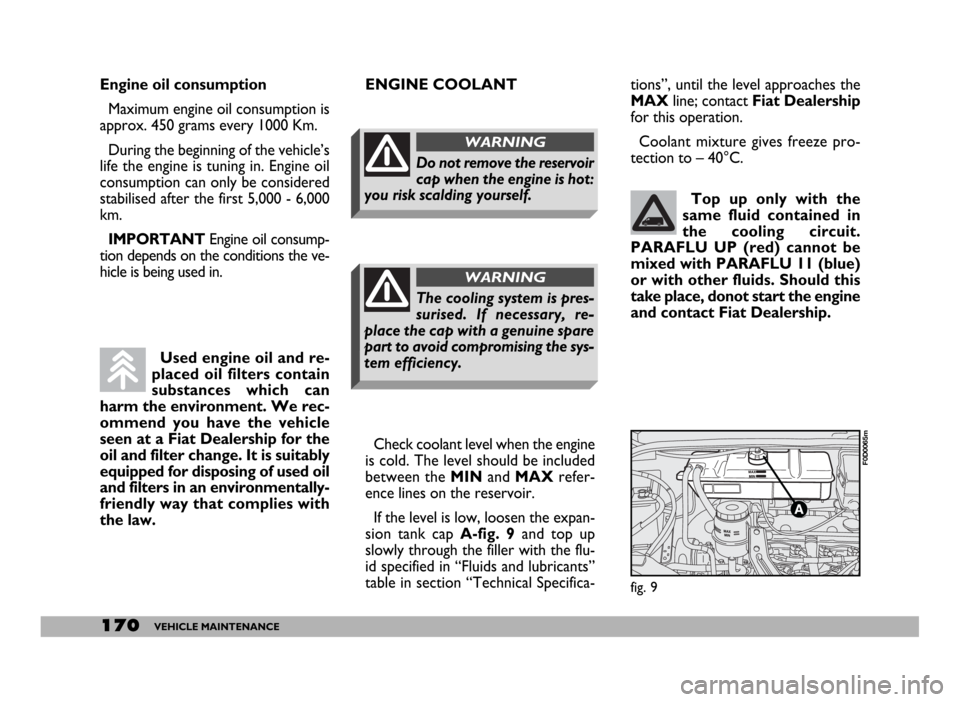
If the level is low, loosen the expan-
sion tank cap A-fig. 9and top up
slowly through the filler with the flu-
id specified in “Fluids and lubricants”
table in section “Technical Specifica-tions”, until the level approaches the
MAX line; contact Fiat Dealership
for this operation.
Coolant mixture gives freeze pro-
tection to – 40°C.
Used engine oil and re-
placed oil filters contain
substances which can
harm the environment. We rec-
ommend you have the vehicle
seen at a Fiat Dealership for the
oil and filter change. It is suitably
equipped for disposing of used oil
and filters in an environmentally-
friendly way that complies with
the law.
fig. 9
F0D0065m
The cooling system is pres-
surised. If necessary, re-
place the cap with a genuine spare
part to avoid compromising the sys-
tem efficiency.
WARNING
Do not remove the reservoir
cap when the engine is hot:
you risk scalding yourself.
WARNING
Top up only with the
same fluid contained in
the cooling circuit.
PARAFLU UP (red) cannot be
mixed with PARAFLU 11 (blue)
or with other fluids. Should this
take place, donot start the engine
and contact Fiat Dealership.
Page 172 of 258
171VEHICLE MAINTENANCE
WINDSCREEN WASHER
FLUID
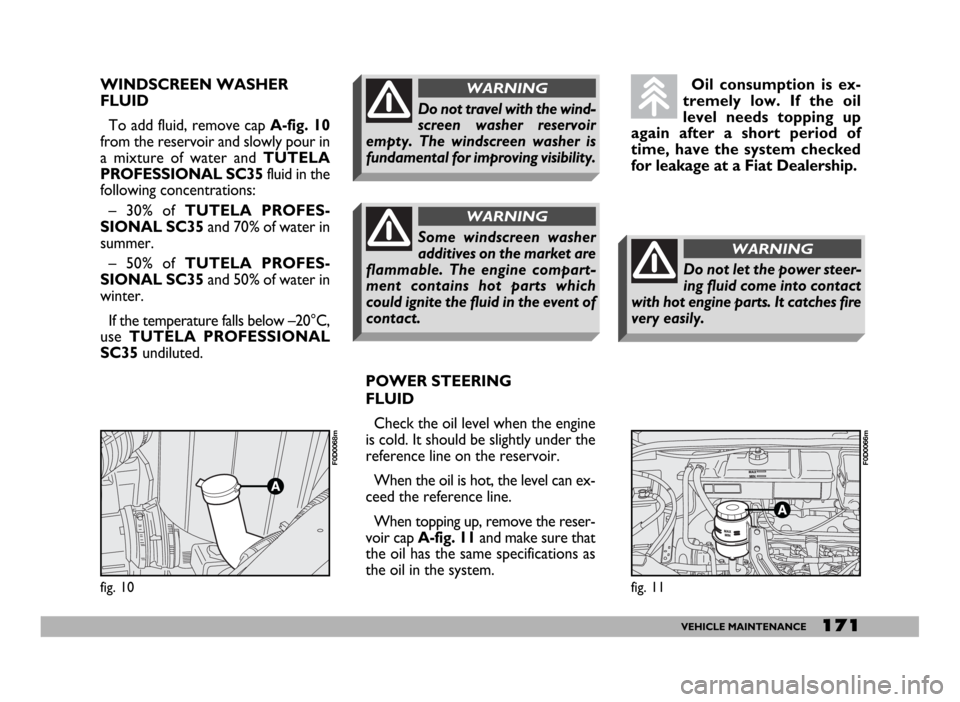
To add fluid, remove cap A-fig. 10
from the reservoir and slowly pour in
a mixture of water and TUTELA
PROFESSIONAL SC35fluid in the
following concentrations:
– 30% ofTUTELA PROFES-
SIONAL SC35and 70% of water in
summer.
– 50% ofTUTELA PROFES-
SIONAL SC35and 50% of water in
winter.
If the temperature falls below –20°C,
useTUTELA PROFESSIONAL
SC35undiluted.
POWER STEERING
FLUID
Check the oil level when the engine
is cold. It should be slightly under the
reference line on the reservoir.
When the oil is hot, the level can ex-
ceed the reference line.
When topping up, remove the reser-
voir cap A-fig. 11 and make sure that
the oil has the same specifications as
the oil in the system.Oil consumption is ex-
tremely low. If the oil
level needs topping up
again after a short period of
time, have the system checked
for leakage at a Fiat Dealership.
fig. 10
F0D0068m
fig. 11
F0D0066m
Do not let the power steer-
ing fluid come into contact
with hot engine parts. It catches fire
very easily.
WARNINGSome windscreen washer
additives on the market are
flammable. The engine compart-
ment contains hot parts which
could ignite the fluid in the event of
contact.
WARNING
Do not travel with the wind-
screen washer reservoir
empty. The windscreen washer is
fundamental for improving visibility.
WARNING
Page 215 of 258
214TECHNICAL SPECIFICATIONS
ENGINE
GENERAL FEATURES
Engine code
Cycle
Number and layout of cylinders
Diameter x stroke mm
Total capacity cm3
Compression ratio
kW
Maximum power output EEC HP
corresponding ratio rpm
Nm
Maximum torque EEC kgm
corresponding ratio rpm
Spark plugs
Fuel
2.0
RFL
Otto
4 in line
86x86
1998
9.5 : 1
81
110
5700
168
17.1
3700
RC9YCC
RFC52LS
Unleaded
petrol
95 RON2.0 JTD
RHV
Diesel
4 in line
85x88
1997
17.6 : 1
62
84
4000
192
19.6
1900
–
Diesel for
motor vehicles
(EN590
specifications)2.3 JTD
F1AE0481C
Diesel
4 in line
88x94
2286
19 : 1
81
110
3600
270
27.6
1800
–
Diesel for
motor vehicles
(EN590
specifications)2.8 JTD
8140.43 S
Diesel
4 in line
94.4x100
2800
18 : 1
93.5
127
3600
300
30.6
1800
–
Diesel for
motor vehicles
(EN590
specifications)2.8 JTD
POWER
8140.43 N
Diesel
4 in line
94.4x100
2800
18 : 1
107
146
3600
310
31.6
1500
–
Diesel for
motor vehicles
(EN590
specifications)
Page 220 of 258

219TECHNICAL SPECIFICATIONS
UNDERSTANDING TYRE
MARKINGS
The following are the necessary in-
dications to understand the meaning
of the markings on the tyre.
195= Nominal width
(S, distance between side
walls in mm).
70= Height/width ratio (H/S,
as a percentage).
R= Radial tyre.
15= Rim nominal diameter in
inches (Ø).
C= Letter identifying tyres
for light-duty
transportation.
103/101= Load rating (carrying ca-
pacity).
Q= Maximum speed rating.6= rim in inches (1)
J= rim drop centre outline
(side projection where the
tyre bead rests) (2)
15= rim nominal diameter in
inches (corresponds to di-
ameter of the tyre to be
mounted) (3 = Ø)
H2= “hump” shape and number
(relief on the circumfer-
ence holding the tubeless
tyre bead on the rim) Maximum speed rating
Q= up to 160 km/h.
R= up to 170 km/h.
S= up to 180 km/h.
T= up to 190 km/h.
U= up to 200 km/h.
H= up to 210 km/h.
V= up to 240 km/h.
Maximum speed rating
for snow tyres
Q M+S= up to 160 km/h
T M+S= up to 190 km/h
H M+S= up to 240 km/hUNDERSTANDING RIM
MARKINGS
The following are the necessary in-
dications to understand the meaning
of the markings on the rim.
Example: 195/70 R 15C 103/101 QExample: 6J x 15 H2
fig. 6
F0D0031m