2005 DODGE STRATUS COUPE trailer
[x] Cancel search: trailerPage 145 of 396

mCruise/speed control....................191
NTo activate...........................192
NTo deactivate.........................196
NTo resume the set speed.................197
mTraction control (if so equipped)...........198
mCatalytic converter.....................199
mVehicle preparation before driving..........201
NSeat belts and seats....................201
NDefrosters...........................201
NTires...............................201NLights..............................202
NFluid leaks..........................202
NDriver..............................202
mSafe driving techniques..................202
mDriving, alcohol and drugs...............203
mTips for driving in various conditions........203
mOperation during cold weather............204
mTrailer Towing.........................205
NWarranty Requirements.................205
STARTING AND DRIVING 145
5
Page 146 of 396

BREAK-IN RECOMMENDATIONS
Advanced automobile manufacturing techniques permit
you to operate your new vehicle without experiencing a
long break-in period of low-speed driving.
However, you can add to the future performance and
economy of your vehicle by observing the following
precautions during the first 300 miles (500 km).
It is recommended that you drive your vehicle at mod-
erate speeds during the break-in period.
1. Avoid racing the engine.
2. Avoid harsh driving such as fast starts, sudden accel-
eration, prolonged high-speed driving and abrupt appli-
cation of the brakes. These operations not only have a
detrimental effect on the engine but also cause increased
fuel and oil consumption, which could result in malfunc-
tion of engine components. Be particularly careful to
avoid wide-open throttle acceleration in low gear.
3. Do not overload the vehicle. Observe the seating
capacity. (See ªWeightsº page 375)
4. Do not use this vehicle for trailer towing during the
break-in period.
FUEL SELECTION
Your vehicle is designed to use unleaded gasoline only. It
is equipped with a fuel filler tube especially designed to
accept only the smaller diameter unleaded gasoline dis-
pensing nozzle.
WARNING!
Gasoline is highly flammable and explosive. You can
be burned or seriously injured when handling it.
When refueling this vehicle, always turn the engine
off and keep flames, sparks, and smoking materials
away. Always handle fuel in well-ventilated outdoor
areas.
146 STARTING AND DRIVING
Page 165 of 396
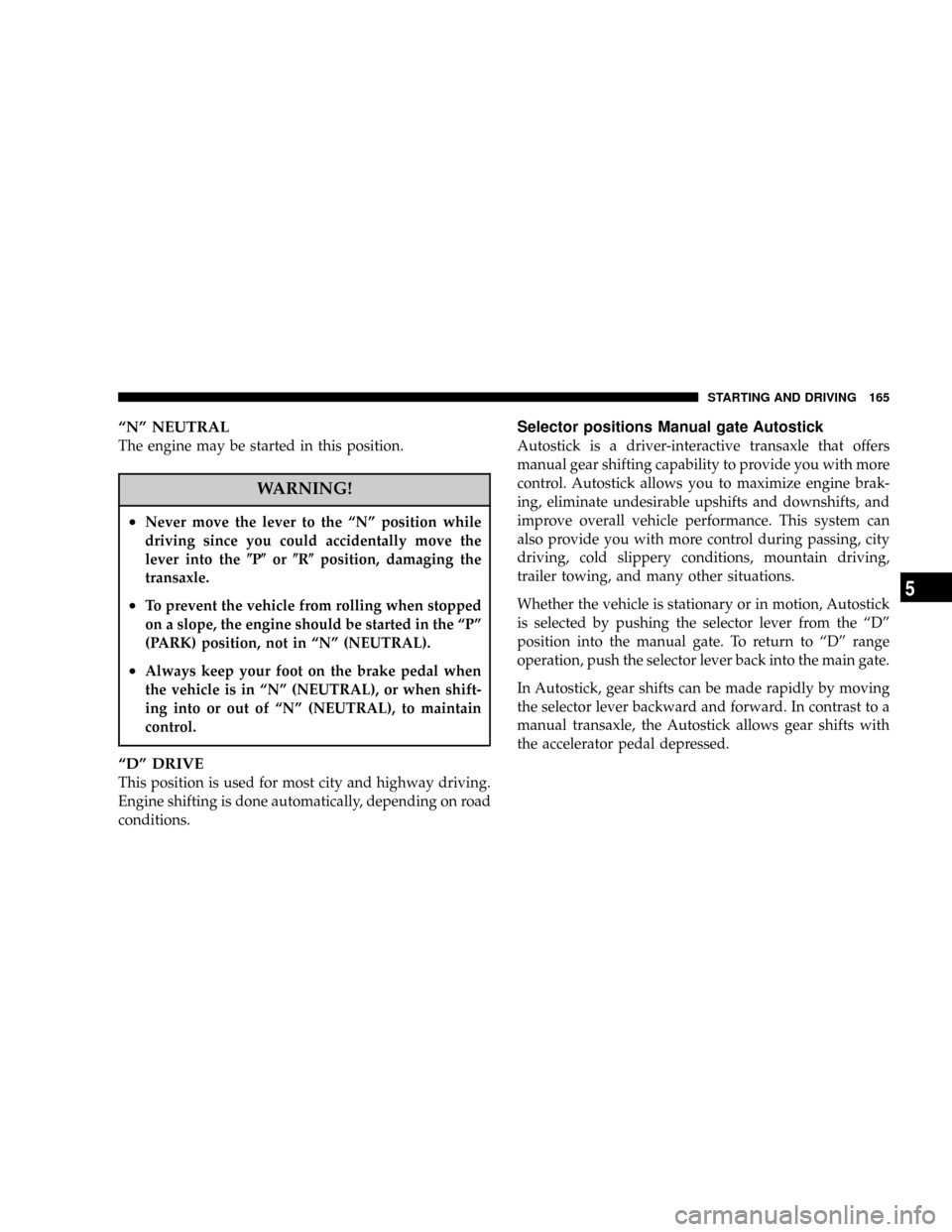
ªNº NEUTRAL
The engine may be started in this position.
WARNING!
²Never move the lever to the ªNº position while
driving since you could accidentally move the
lever into the(P(or(R(position, damaging the
transaxle.
²To prevent the vehicle from rolling when stopped
on a slope, the engine should be started in the ªPº
(PARK) position, not in ªNº (NEUTRAL).
²Always keep your foot on the brake pedal when
the vehicle is in ªNº (NEUTRAL), or when shift-
ing into or out of ªNº (NEUTRAL), to maintain
control.
ªDº DRIVE
This position is used for most city and highway driving.
Engine shifting is done automatically, depending on road
conditions.
Selector positions Manual gate Autostick
Autostick is a driver-interactive transaxle that offers
manual gear shifting capability to provide you with more
control. Autostick allows you to maximize engine brak-
ing, eliminate undesirable upshifts and downshifts, and
improve overall vehicle performance. This system can
also provide you with more control during passing, city
driving, cold slippery conditions, mountain driving,
trailer towing, and many other situations.
Whether the vehicle is stationary or in motion, Autostick
is selected by pushing the selector lever from the ªDº
position into the manual gate. To return to ªDº range
operation, push the selector lever back into the main gate.
In Autostick, gear shifts can be made rapidly by moving
the selector lever backward and forward. In contrast to a
manual transaxle, the Autostick allows gear shifts with
the accelerator pedal depressed.
STARTING AND DRIVING 165
5
Page 205 of 396
WARNING!
Never open the radiator cap when the radiator is hot.
You could be seriously burned.
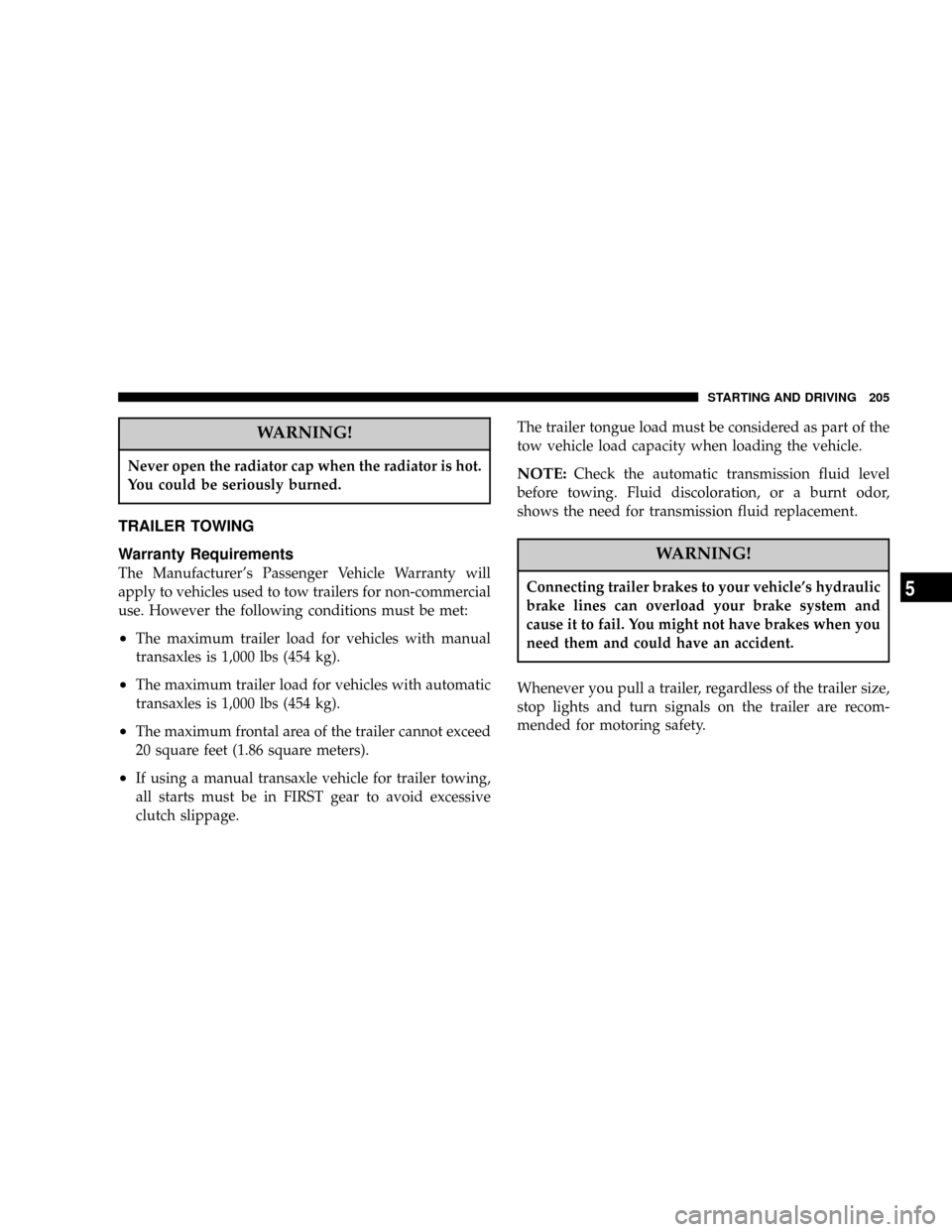
TRAILER TOWING
Warranty Requirements
The Manufacturer's Passenger Vehicle Warranty will
apply to vehicles used to tow trailers for non-commercial
use. However the following conditions must be met:
²The maximum trailer load for vehicles with manual
transaxles is 1,000 lbs (454 kg).
²The maximum trailer load for vehicles with automatic
transaxles is 1,000 lbs (454 kg).
²The maximum frontal area of the trailer cannot exceed
20 square feet (1.86 square meters).
²If using a manual transaxle vehicle for trailer towing,
all starts must be in FIRST gear to avoid excessive
clutch slippage.The trailer tongue load must be considered as part of the
tow vehicle load capacity when loading the vehicle.
NOTE:Check the automatic transmission fluid level
before towing. Fluid discoloration, or a burnt odor,
shows the need for transmission fluid replacement.
WARNING!
Connecting trailer brakes to your vehicle's hydraulic
brake lines can overload your brake system and
cause it to fail. You might not have brakes when you
need them and could have an accident.
Whenever you pull a trailer, regardless of the trailer size,
stop lights and turn signals on the trailer are recom-
mended for motoring safety.
STARTING AND DRIVING 205
5
Page 206 of 396

Weight limits
Never exceed the maximum trailer weight (A), maximum
tongue weight (B), Gross Vehicle Weight Rating (GVWR)
and Gross Axle Weight Rating (GAWR).
I26A1290
206 STARTING AND DRIVING
Page 344 of 396

2. Determine the combined weight of the driver and
passengers that will be riding in your vehicle.
3. Subtract the combined weight of the driver and pas-
sengers from XXX kilograms or XXX pounds.
4. The resulting figure equals the available amount of
cargo and luggage load capacity. For example, if the
9XXX9amount equals 1400 lbs. and there will be five 150
lb. passengers in your vehicle, the amount of available
cargo and luggage load capacity is 650 lbs. (1400-750 (5 x
150) = 650 lbs.)
5. Determine the combined weight of luggage and cargo
being loaded on the vehicle. That weight may not safely
exceed the available cargo and luggage load capacity
calculated in Step 4.
6. If your vehicle will be towing a trailer, load from your
trailer will be transferred to your vehicle. Consult this
manual to determine how this reduces the available
cargo and luggage load capacity of your vehicle.
NOTE: The above steps for determining correct load
limit were written in accordance with U.S.A. regulations.
Your vehicle cannot tow a trailer, so step 6 is irrelevant.
NOTE:
(1) The following table shows examples on how to
calculate total cargo/load capacity of your vehicle with
varying seating configurations and number and size of
occupants. This table is for illustration purposes only and
may not be accurate for the seating and load capacity of
your vehicle.
(2) For the following example the combined weight of
occupants and cargo should never exceed 865 lbs.
(392kg).
(3) Under a maximum loaded vehicle condition, gross
axle weight ratings (GAWR's) for the front and rear axles
must not be exceeded. For further information on
GAWR's, vehicle loading and trailer towing, see the
9Specifications9section of this manual.
344 MAINTENANCE
Page 396 of 396

Tire chains.......................... 348
Tread wear indicators.................. 346
Tools................................ 266
Towing.............................. 284
Trailering........................... 205
Trailer Towing......................... 205
Transaxle
Automatic transaxle................... 155
Autostick........................... 165
Manual transaxle..................... 168
Transmission
Automatic transmission................ 160
Transmitter, Garage Door Opener........... 134
Transporting Pets....................... 103
Trip odometer......................... 108
Trip odometer reset button................ 108
Trunklid .............................. 35
Turbocharger boost gauge................ 108
Turn signal indicators.................109,114
Lever.............................. 124
Uniform Tire Quality Grades.............. 387
Universal Transmitter.................... 134Vanity mirror.......................... 211
Vehicle Identification Number............... 5
Vehicle labeling........................ 372
Vehicle Weights........................ 375
Ventilators............................ 237
Warnings and Cautions.................... 5
Warranty Information.................... 382
Washer fluid level indicator............... 109
Washer
Windshield.......................130,333
Washing.............................. 255
Waxing.............................. 257
Wheel covers.......................... 268
Whip antenna......................... 221
Windshield washers..................130,333
Windshield wiper blades................. 333
Windshield wipers...................... 128
396 INDEX