Page 221 of 288
MAINTAINING YOUR VEHICLE 221
7
Engine Oil Level1. Oil dipstick
2. Oil filler neck Check the engine oil level at regular intervals with the
vehicle standing on a level surface.
Check engine oil level about 5 minutes after
stopping the engine, which should have reached its
regular operating temperature. The normal
operating temperature should have been reached
and maintained for some time.
Wipe the dipstick clean with a lint-free cloth before checking.
The engine oil level must be between the
lower (MIN) and upper (MAX) marks on
the dipstick.
Add engine oil only up to the MAX mark.
Excess oil must be drained or siphoned off.
Page 222 of 288
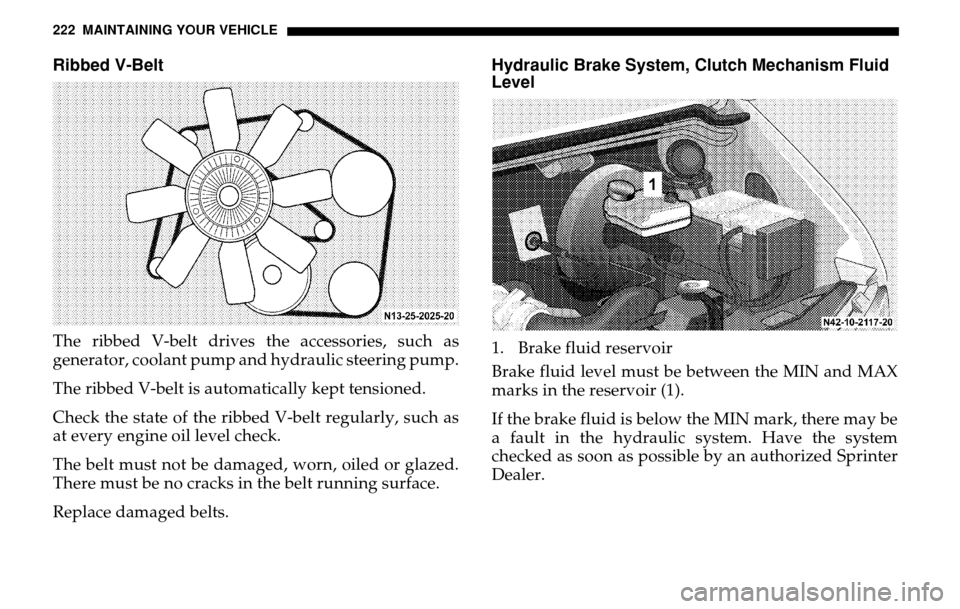
222 MAINTAINING YOUR VEHICLERibbed V-BeltThe ribbed V-belt drives the accessories, such as
generator, coolant pump and hydraulic steering pump.
The ribbed V-belt is automatically kept tensioned.
Check the state of the ribbed V-belt regularly, such as
at every engine oil level check.
The belt must not be damaged, worn, oiled or glazed.
There must be no cracks in the belt running surface.
Replace damaged belts.
Hydraulic Brake System, Clutch Mechanism Fluid
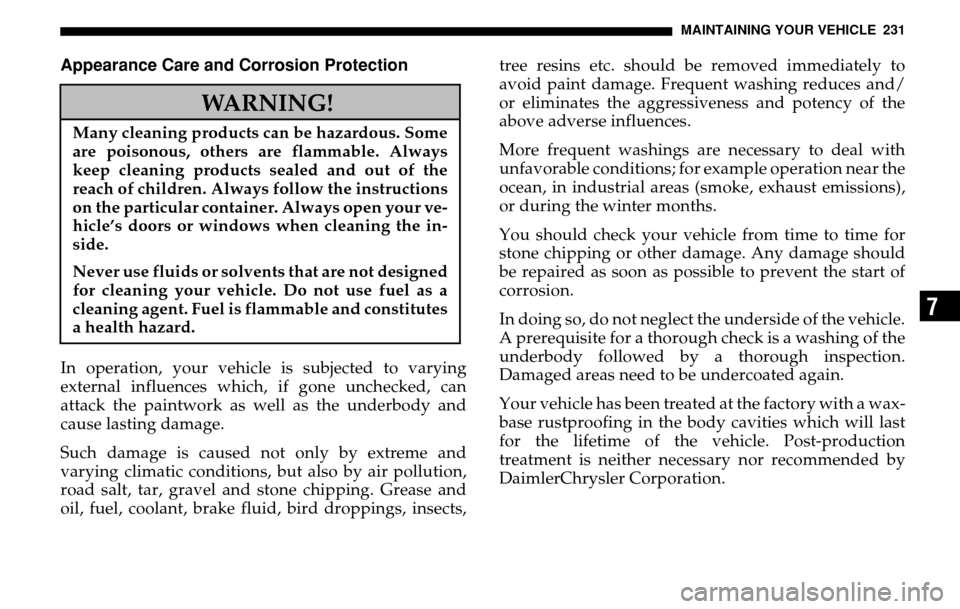
Level1. Brake fluid reservoir
Brake fluid level must be between the MIN and MAX
marks in the reservoir (1).
If the brake fluid is below the MIN mark, there may be
a fault in the hydraulic system. Have the system
checked as soon as possible by an authorized Sprinter
Dealer.
Page 223 of 288

MAINTAINING YOUR VEHICLE 223
7
Brake fluidRefer to the "Recommended Fluids" chart later in this
section for recommended brake fluids.
In the course of its service life, the boiling point of the
brake fluid will fall due to the continuous absorption of
moisture from the atmosphere.
If the brakes are placed under heavy loads (e.g., on
steep hills) bubbles of steam can then form in the brake
system.
This will adversely affect the brakes' effectiveness.Engine Cooling SystemThe use of aluminum components in Sprinter engines
requires that anticorrosive/antifreeze specifically
formulated to protect aluminum parts be used. The
factory approved Service Products are suitable for
Sprinter engines and can be mixed with the original
anticorrosion/antifreeze filled in at factory.
Cooling system design and anticorrosion/antifreeze
agent used stipulate the replacement interval for the
coolant solution in your vehicle. Please observe the
replacement interval specified in the Service Booklet
for your vehicle.
Failure to use MB 325.0 an ticorrosion/antifreeze and/or
equivalent to DaimlerChrys ler material standard MS-
9769 and/or adhere to the specified replacement interval
may result in a significantly shortened service life.For coolant composition and water quality, contact
your authorized Sprinter Dealer.Engine CoolantThe coolant is a mixture of water and a corrosion
inhibitor/antifreeze additive. Within the cooling
system, the corrosion inhibitor/antifreeze ensures
anti-corrosion protection
antifreeze protection
a higher boiling point.
The coolant added in the factory ensures adequate
antifreeze and anti-corrosion protection.
Refer to the "Recommended Fluids" chart for coolant
recommendations.
For reasons of anti-corrosion protection and to increase
the boiling point, the cool ant added to the cooling
system is designed for all year round operation – even
in countries with high prevailing temperatures.
Page 226 of 288

226 MAINTAINING YOUR VEHICLE
If the engine is already at its regular operating
temperature:
Add coolant until the coolant level is about 0.6 inch
(1.5 cm) above the base area which is visible
through the filler opening.
Replace and tighten the radiator cap.
If a large quantity of coolant has been lost, or if smaller
amounts are lost at regular intervals, have the engine
cooling system examined by an authorized Sprinter
Dealer.
For coolant composition and water quality, contact
your Sprinter Dealer.
WINTER OPERATIONHave your vehicle winterized by an authorized
Sprinter Dealer before the onset of winter.
Have the engine oil changed, if the engine oil filled is not approved for winter use.
Coolant: antifreeze/anti-corrosion concentration in the coolant checked.
Windshield washer system: add winter concentrate to the washer fluid.
Battery: the battery will lose capacity as temperatures drop. Only a well-charged battery will
ensure reliable engine starting even at low outside
temperatures.
Tires: fit M+S radial tires, taking note of the maximum permissible speed of the tires fitted.
Page 231 of 288
MAINTAINING YOUR VEHICLE 231
7
Appearance Care and Corrosion ProtectionIn operation, your vehicle is subjected to varying
external influences which, if gone unchecked, can
attack the paintwork as well as the underbody and
cause lasting damage.
Such damage is caused not only by extreme and
varying climatic conditions, but also by air pollution,
road salt, tar, gravel and stone chipping. Grease and
oil, fuel, coolant, brake flui d, bird droppings, insects, tree resins etc. should be removed immediately to
avoid paint damage. Frequent washing reduces and/
or eliminates the aggressiveness and potency of the
above adverse influences.
More frequent washings are necessary to deal with
unfavorable conditions; for example operation near the
ocean, in industrial areas (smoke, exhaust emissions),
or during the winter months.
You should check your vehicle from time to time for
stone chipping or other damage. Any damage should
be repaired as soon as possible to prevent the start of
corrosion.
In doing so, do not neglect the underside of the vehicle.
A prerequisite for a thorough check is a washing of the
underbody followed by a thorough inspection.
Damaged areas need to be undercoated again.
Your vehicle has been treated at the factory with a wax-
base rustproofing in the body cavities which will last
for the lifetime of the vehicle. Post-production
treatment is neither necessary nor recommended by
DaimlerChrysler Corporation.
WARNING!
Many cleaning products can be hazardous. Some
are poisonous, others are flammable. Always
keep cleaning products sealed and out of the
reach of children. Always follow the instructions
on the particular container. Always open your ve-
hicle’s doors or windows when cleaning the in-
side.
Never use fluids or solvents that are not designed
for cleaning your vehicle. Do not use fuel as a
cleaning agent. Fuel is flammable and constitutes
a health hazard.
Page 238 of 288

238 MAINTAINING YOUR VEHICLEPlastic and Rubber PartsDo not use oil or wax on these parts.
Do not use any caustic or alcohol-based or solvent-
based substances to clean plastic surfaces.
Avoid the use of stain removers, iodine tincture, nail
varnish and nail varnish remover, acetone, methylated
spirits, chlorine or ammonium-based cleaning agents,
cleaning agents containing abrasive substances.ELECTRICAL FUSESDamaged fuses are recognizable from their burnt-out
filament.
Prior to exchanging a fuse, turn the key in the ignition-
column lock to the 0 position and switch off the
consumer involved.
NOTE: Fuses must not be bridged. Replace fuses with
specified rated current. Only replace fuses when the
cause of the malfunction has been rectified.
NOTE: Fuses and relays (standard equipment) are on
the underside of the ignition column, refer to "Fuses
and Relays Standard Equipment". Fuses, relays and diodes (optional equipment) are
below the driver’s seat, refer to "Optional Fuse and
Relay Equipment".
CAUTION!
When replacing a blown fuse, it is important to
use only a fuse having the correct amperage
rating. The use of a fuse with a rating other than
indicated may result in a dangerous electrical
system overload. If a properly rated fuse
continues to blow, it indicates a problem in the
circuit that must be corrected.
Page 257 of 288
MAINTAINING YOUR VEHICLE 257
7
CAPACITIES
Engine with oil filter Engine oil Fuel tank Cooling system Windshield washer
system
Including
reserve fuel
All vehicles about 9.5 US qt
(9.0 l) about
26.4 US gal
(100 l) about
2.8 US gal
(10.5 l) about
2.7 US gal
(10.0 l) about
7.4 US qt
(7.0 l)
Page 258 of 288

258 MAINTAINING YOUR VEHICLERecommended Fluids and LubricantsThe manufacturer recommends for your vehicle model
the use of DaimlerChrysler approved fluids and
lubricants, e.g. engine oil, gear oil, automatic
transmission fluid, brake fluid, power steering fluid,
coolant and anti-corrosion/anti-freeze fluid only.
WARNING!
Failure to use fluids and lubricants which meet
the standards and specifications described in this
booklet or failure to adhere to the specified re-
placement intervals may result in damage to safe-
ty-related systems of your vehicle, such as the
brake system, which could cause an accident and/
or serious injury to you and others.
Use only fluids and lubricants meeting the
standards and specifications and adhere to
specified replacement intervals.
CAUTION!
Failure to use fluids and lubricants which meet
the standards and specifications described in this
booklet or failure to adhere to the specified
replacement intervals may result in a significantly
shortened service life and/or damage to
components of your vehicle, the repair of which
will not be covered by Warranty.
Use only fluids and lubricants meeting the
standards and specifications and adhere to
specified replacement intervals.