Page 46 of 288

46 THINGS TO KNOW BEFORE STARTING YOUR VEHICLERemoving Seat Belts
1. Press the release button in the belt buckle.
2. Guide the seat belt back to its rest position.
Seat Belt Warning System
When the key is turned to position 2 in the ignition
lock, a warning buzzer sounds for about 6 seconds if
the driver’s safety belt is not pressed into the belt
buckle. The buzzer stops as soon as the safety belt is
fastened. Press the safety belt into the belt buckle.
Belt Height AdjustmentBelt height adjustment button 4
Do not adjust the belt height while the vehicle is
moving.
To lower:
Press the button and move the belt sash guide down.
To raise:
Move the belt sash guide up.
The shoulder strap must pass between the neck and the
shoulder.
WARNING!
A frayed or torn belt could rip apart in a collision
and leave you with no protection. Inspect the belt
system periodically, checking for cuts, frays, or
loose parts. Damaged parts must be replaced im-
mediately. Do not disassemble or modify the sys-
tem. Seat belt assemblies must be replaced after a
collision if they have been damaged (bent retrac-
tor, torn webbing, etc.).
Page 47 of 288
THINGS TO KNOW BEFORE STARTING YOUR VEHICLE 47
2
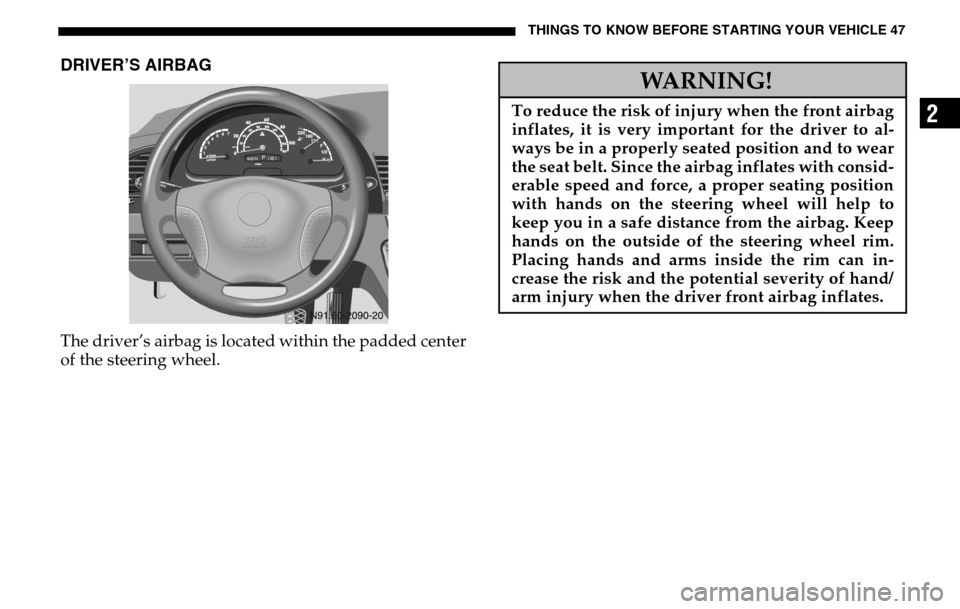
DRIVER’S AIRBAGThe driver’s airbag is located within the padded center
of the steering wheel.
WARNING!
To reduce the risk of injury when the front airbag
inflates, it is very important for the driver to al-
ways be in a properly seated position and to wear
the seat belt. Since the airbag inflates with consid-
erable speed and force, a proper seating position
with hands on the steering wheel will help to
keep you in a safe distance from the airbag. Keep
hands on the outside of the steering wheel rim.
Placing hands and arms inside the rim can in-
crease the risk and the potential severity of hand/
arm injury when the driver front airbag inflates.
Page 48 of 288
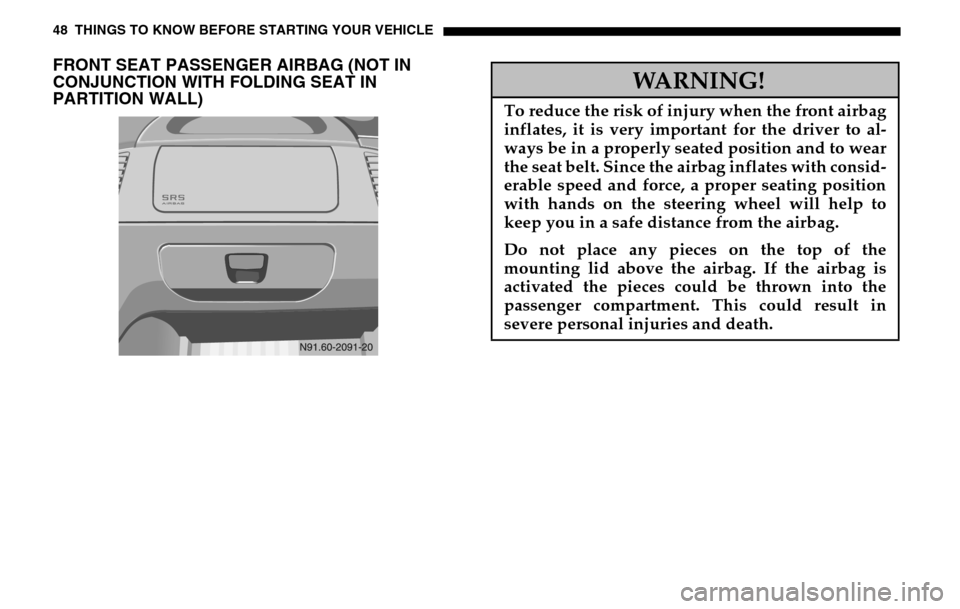
48 THINGS TO KNOW BEFORE STARTING YOUR VEHICLEFRONT SEAT PASSENGER AIRBAG (NOT IN
CONJUNCTION WITH FOLDING SEAT IN
PARTITION WALL)
WARNING!
To reduce the risk of injury when the front airbag
inflates, it is very important for the driver to al-
ways be in a properly seated position and to wear
the seat belt. Since the airbag inflates with consid-
erable speed and force, a proper seating position
with hands on the steering wheel will help to
keep you in a safe distance from the airbag.
Do not place any pieces on the top of the
mounting lid above the airbag. If the airbag is
activated the pieces could be thrown into the
passenger compartment. This could result in
severe personal injuries and death.
Page 49 of 288

THINGS TO KNOW BEFORE STARTING YOUR VEHICLE 49
2
AIRBAG AND BELT TENSIONERSThe vehicle is equipped with an airbag for the driver
and the front seat passenger as well as belt tensioners
for the driver and the front passenger. The system is
known as a Supplemental Restraint System (SRS). It
has been designed to work together with the seat belt
and to supplement.SRS Malfunction Indicator LampWhen the key is in position 2 in the ignition lock, the
malfunction indicator lamp 1 will light up in the
instrument cluster for about 4 seconds as a function
check.
Belt TensionersThe belt tensioners are located on the three-point seat
belts of the driver’s and front passenger seats.
The belt tensioners will not operate unless the key has
been turned to position 1 or 2 in the ignition lock.
The airbag and / or belt tensioners are designed to only
trigger in certain frontal impacts as not all accidents
call for airbag and / or belt tensioner deployment.
WARNING!
Do not put anything on or around the front airbag
covers or attempt to manually open them. You
may damage the airbags and you could be injured
because the airbags are not there to protect you.
These protective covers for the airbag cushions are
designed to open only when the airbags are inflat-
ing.
WARNING!
If the malfunction indicator lamp 1 does not
light up when the key is in position 2 in the igni-
tion lock, if it flickers or lights up while the vehi-
cle is moving, there might be a problem in the
airbag system. There is then a danger that the air-
bag will not deploy in the event of an accident or
will deploy when it should not do so. Have the ve-
hicle inspected and repaired by an authorized
Sprinter Dealer without delay.
Page 50 of 288

50 THINGS TO KNOW BEFORE STARTING YOUR VEHICLESafety Precautions for the Airbag
WARNING!
Airbags can seriously injure or kill you, especially
if you are close to the airbag when it deploys.
Always wear your seat belt. Airbags do not
replace seat belts but instead supplement the
protection offered by seat belts. Wearing a seat
belt also makes it less likely that you will be out
of position and will not be injured or killed as the
airbag deploys.
Never place an infant seat which faces to the rear
on the front passenger seat. Children 12 years old
and under, and any child who cannot wear a seat
belt properly, must never ride in the front of this
vehicle.
The airbag does offer an additional degree of
protection, especially to belted occupants, but the
following precautions should still be taken to
prevent injuries when the airbag is inflating.
Do not position the seat closer than necessary to
the airbag inflation point.
WARNING!
Do not lean forward when the vehicle is in mo-
tion.
Do not lean on the doors from inside the vehicle.
Do not put your feet on the dashboard.
Only hold the steering wheel by the outer rim so
that the airbag can inflate unhindered.
No objects should be positioned on the airbag or
between the airbag and the vehicle’s occupants.
If children are traveling, they should always use
an appropriate child restraint system.
Do not touch any hot parts after the airbag has
inflated. Airbags which have triggered in an
accident must be replaced.
The center of the padded steering wheel must not
be covered by any materials or have any labels or
stickers attached to it, or else the airbag may not
function reliably.
Page 53 of 288

THINGS TO KNOW BEFORE STARTING YOUR VEHICLE 53
2
Engine Oil ConsumptionWhen the engine has passed the break-in period, oil
consumption may reach 0.5 % of the fuel consumption
recorded in actual operating circumstances. In isolated
cases and in arduous operating conditions, oil
consumption may increase to 1 % of the fuel
consumption recorded in actual operating
circumstances.
Engine oil consumption depends on the driving style
adopted and the operating conditions. It can only be
judged after the engine has passed the break-in period.
SAFETY TIPS Check the vehicle’s lights and the general condition
of the vehicle before each trip.
Keep tires at the recommended inflation pressure.
All occupants should fasten their seat belts before each trip.
Driving in an environmentally responsible manner will reduce noise, fuel consumption and exhaust
emissions.
Allow the engine to warm up under low load use.
Avoid unnecessarily hard acceleration, driving with the throttle fully open, and carrying loads not
specifically needed on the journey.
Stop the engine during lengthy waiting periods, for example at traffic lights.
Remove ancillary parts, such as wind deflectors and roof racks, as soon as they are no longer needed.
Page 54 of 288
54 THINGS TO KNOW BEFORE STARTING YOUR VEHICLEINHALATION OF EXHAUST GAS TIE DOWN RINGS (OPTIONAL)
1. Tie Down Rings
The rings (1) are used to attach the load with the help
of tension belts. Place the te nsion belt around the load,
secure it on the rings (1) and tie it down.
WARNING!
When driving or parking the vehicle, make sure
that its exhause system do es not come into contact
with flamable material (such as dry leaves) as
these materials my otherwise catch fire.
Inhalation of exhaust gas is hazardous to your
health. All exhaust gas contains carbon monoxide
and inhaling it can cause unconsciousness and
lead to death.
Do not run the engine in confined areas (such as a
garage) which are not properly ventilated. If you
think that exhaust gas fumes are entering the
vehicle while driving, have the cause determined
and corrected immediately. If you must drive
under these conditions, drive only with at least
one window fully open.
Page 55 of 288
THINGS TO KNOW BEFORE STARTING YOUR VEHICLE 55
2
NOTE: Use neither elastic fastening straps nor nets
when lashing down the load. These are only intended
as anti-slip protection for lighter loads.
The means used to tie down the load must not be run
over sharp edges or corners. Sharp edges or corners
should be given protective padding. Observe the
operating instructions for the material used to tie down
the material. Spread the load evenly between the
anchorages. If using a tensioning device, do not
overstress the lashing rings.
WARNING!
If you tension the tensioning belts between the
sidewalls, the maximum permissible load for the
lashing rings could be exceeded if the brakes are
applied suddenly or in the event of an accident.
The load would no longer be secured, which could
result in serious injuries caused by the load slip-
ping.
For this reason, do not tension a tensioning belt
between the side walls.
Observe the loading guidelines.