Page 262 of 360

Special tools are required to properly measure tension
and to restore belt tension to factory specifications. Also,
check belt routing to make sure there is no interference
between the belts and other engine components.
Spark Plugs
Spark plugs must fire properly to assure engine perfor-
mance and emission control. New plugs should be in-
stalled at the specified mileage. The entire set should be
replaced if there is any malfunction due to a faulty spark
plug. Refer to the Engine data Label located under the
hood for the proper type of spark plug for use in your
vehicle.
Ignition Wiring System
The ignition cables should be kept clean and properly
connected. Terminals should be fully seated. Cracked,
damaged, or faulty cables should be replaced.
Catalytic Converter
The catalytic converter requires the use of unleaded fuel
only. Leaded gasoline will destroy the effectiveness of the
catalyst as an emission control device.
Under normal operating conditions, the catalytic con-
verter will not require maintenance. However, it is im-
portant to keep the engine properly tuned to assure
proper catalyst operation and prevent possible catalyst
damage.
262 MAINTAINING YOUR VEHICLE
Page 264 of 360

To minimize the possibility of catalyst damage:
•Do not shut off the engine or interrupt the ignition
when the transaxle is in gear and the vehicle is in
motion.
•Do not try to start the engine by pushing or towing the
vehicle.
•Do not idle the engine with any spark plug wires
disconnected for prolonged period.
Engine Timing Belt
Replace the engine timing belt at the intervals described
in the appropriate maintenance schedule.
Crankcase Emission Control System
Proper operation of this system depends on freedom
from sticking or plugging due to deposits. As vehicle
mileage builds up, the PCV valve and passages may
accumulate deposits. If a valve is not working properly,
replace it with a new valve. DO NOT ATTEMPT TO
CLEAN THE OLD PCV VALVE!Check ventilation hose for indication of damage or
plugging deposits. Replace if necessary.
Fuel Filter
A plugged fuel filter can cause hard starting or limit the
speed at which a vehicle can be driven. Should an
excessive amount of dirt accumulate in the fuel tank,
frequent filter replacement may be necessary. The fuel
filters are located inside the fuel tank. See your dealer for
service.
Air Cleaner Element (Filter)
Under normal driving conditions, replace the filter at the
intervals shown on Schedule“A”. If, however, you drive
the vehicle frequently under dusty or severe conditions,
the filter element should be inspected periodically and
replaced if necessary at the intervals shown on Schedule
“B”.
264 MAINTAINING YOUR VEHICLE
Page 277 of 360

•Do not change the thermostat for summer or winter
operation. If replacement is ever necessary, install
ONLY the correct type thermostat. Other designs may
result in unsatisfactory coolant performance, poor gas
mileage, and increased emissions.
Hoses And Vacuum/Vapor Harnesses
Inspect surfaces of hoses and nylon tubing for evidence
of heat and mechanical damage. Hard or soft spots,
brittle rubber, cracking, tears, cuts, abrasions, and exces-
sive swelling indicate deterioration of the rubber.
Pay particular attention to the hoses nearest to high heat
sources such as the exhaust manifold. Inspect hose rout-
ing to be sure hoses do not touch any heat source or
moving component that may cause heat damage or
mechanical wear.
Insure nylon tubing in these areas has not melted or
collapsed.Inspect all hose connections such as clamps and cou-
plings to make sure the are secure and no leaks are
present.
Components should be replaced immediately if there is
any evidence of degradation that could cause failure.Fuel System Connections
Electronic Fuel Injection high pressure fuel systems are
designed with tubes and special connects, connections
and clamps which have unique material characteristics to
provide adequate sealing and resist attack by deterio-
rated gasoline.
You are urged to use only the manufactures-specified
tubes, connections and clamps, or their equivalent in
material and specification, in any fuel system servicing.
MAINTAINING YOUR VEHICLE 277
7
Page 294 of 360
FUSE Amp/Color Items Fused
1 30 Amp/Pink Ignition Start
2 40 Amp/
GreenAnti-Lock Brake (ABS)
Pump
3 40 Amp/
GreenIgnition Run
4 30 Amp/Blue Heated Seats
5 40 Amp/
GreenRadiator Fan (Low Speed
Turbo only)
6 50 Amp/Red High Speed Radiator Fan
(Turbo Only)
7 30 Amp/Blue Anti-Lock Brake (ABS)
Solenoid
8 40 Amp/
GreenElectric Back Light (EBL)
9 40 Amp/
GreenPower Top10 40 Amp/
GreenIP Fuse Block
11 10 Amp/Red Air Conditioning (A/C)
12 15 Amp/Lt.
BlueStop Lights
13 20 Amp/
YellowFuel Pump/Auto Shut
Down (ASD)
14 15 Amp/Lt.
BlueHorn
15 20 Amp/
YellowElectronic Automatic
Transaxle (ETAX)
16
17 15 Amp/Lt.
BlueHi Beam
18 30 Amp/Blue Ignition Off Draw (IOD)
19 15 Amp/Lt.
BlueHazard Flasher
294 MAINTAINING YOUR VEHICLE
Page 297 of 360
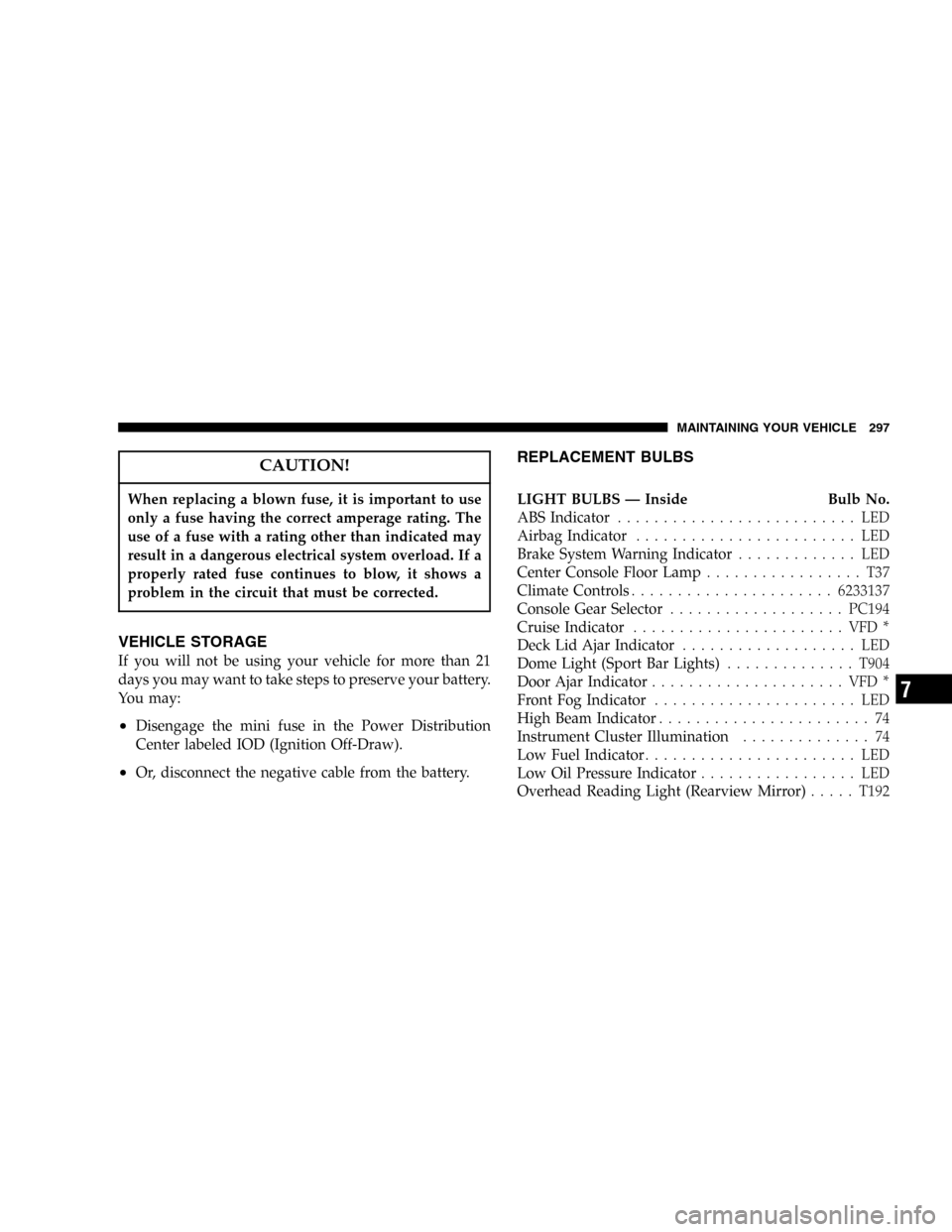
CAUTION!
When replacing a blown fuse, it is important to use
only a fuse having the correct amperage rating. The
use of a fuse with a rating other than indicated may
result in a dangerous electrical system overload. If a
properly rated fuse continues to blow, it shows a
problem in the circuit that must be corrected.
VEHICLE STORAGE
If you will not be using your vehicle for more than 21
days you may want to take steps to preserve your battery.
You may:
•Disengage the mini fuse in the Power Distribution
Center labeled IOD (Ignition Off-Draw).
•Or, disconnect the negative cable from the battery.
REPLACEMENT BULBS
LIGHT BULBS—Inside Bulb No.
ABS Indicator.......................... LED
Airbag Indicator........................ LED
Brake System Warning Indicator............. LED
Center Console Floor Lamp................. T37
Climate Controls......................6233137
Console Gear Selector...................PC194
Cruise Indicator....................... VFD*
Deck Lid Ajar Indicator................... LED
Dome Light (Sport Bar Lights)..............T904
Door Ajar Indicator..................... VFD*
Front Fog Indicator...................... LED
High Beam Indicator....................... 74
Instrument Cluster Illumination.............. 74
Low Fuel Indicator....................... LED
Low Oil Pressure Indicator................. LED
Overhead Reading Light (Rearview Mirror).....T192
MAINTAINING YOUR VEHICLE 297
7
Page 302 of 360
FLUIDS AND CAPACITIES
U.S. Metric
Fuel (Approximate)15 Gallons 56.7 Liters
Engine Oil-With Filter
2.4 Liter Engines (Use API Certified SAE 5W-30 Engine Oil.
Refer to your engine oil filler cap for correct SAE grade meet-
ing DaimlerChrysler Material Standard MS-6395.)5.0 qts 4.7 Liters
Cooling System *
2.4 Liter Engines (Mopar�Antifreeze/Coolant 5 Year/100,000
Miles Formula)6.5 qts 6.2 Liters
* Includes heater and coolant recovery bottle filled to MAX level.
302 MAINTAINING YOUR VEHICLE
Page 303 of 360
RECOMMENDED FLUIDS, LUBRICANTS AND GENUINE PARTS
Engine
Component Fluids, Lubricants and Genuine Parts
Engine Coolant Mopar�Antifreeze/Coolant 5 Year/100,000 Mile Formula HOAT (Hybrid Or-
ganic Additive Technology)
Engine Oil Use API Certified SAE 5W-30 Engine Oil. Refer to your engine oil filler cap
for correct SAE grade meeting DaimlerChrysler Material Standard MS-6395.
Engine Oil Filter Non Turbo—Mopar 4105409 or equiv. Turbo—Mopar 4781452AA or equiv.
Spark Plugs Refer to the Vehicle Emission Control Information label in the engine com-
partment.
Fuel Selection 91 Octane for High Output 2.4L Turbo and 87 Octane for 2.4L Standard
Turbo and 2.4L Standard Non Turbo Engines.
MAINTAINING YOUR VEHICLE 303
7
Page 307 of 360

•Taxi, police, or delivery service (commercial ser-
vice).†�
•Off-road or desert operation.
•If equipped for and operating with E-85 (ethanol)
fuel.
NOTE:IfANYof these apply to you then change your
engine oil every 3,000 miles (5 000 km) or 3 months,
whichever comes first, and follow schedule“B—All
Engines”of the�Maintenance Schedules�section of this
manual.
NOTE:IFANYof these apply to you then flush and
replace the engine coolant every 102,000 miles (164,000
km) or 60 months, whichever comes first, and follow
schedule“B—All Engines”of the�Maintenance Sched-
ules�section of this manual.
NOTE:Most vehicles are operated under the conditions
listed for Schedule�B�—ALL ENGINES.Second is Schedule“A”—NON TURBO. It is for vehicles
that are not operated under any of the conditions listed
under Schedule�B�—ALL ENGINES.
Third is Schedule“A”—TURBO. It is for vehicles that are
not operated under any of the conditions listed under
Schedule�B�—ALL ENGINES.
Use the schedule that best describes your driving condi-
tions. Where time and mileage are listed, follow the
interval that occurs first.
CAUTION!
Failure to perform the required maintenance items
may result in damage to the vehicle.
MAINTENANCE SCHEDULES 307
8
M
A
I
N
T
E
N
A
N
C
E
S
C
H
E
D
U
L
E
S


