Page 109 of 420
WARNING!
Adjust the seat only while the vehicle is parked.
Adjusting a seat while the vehicle is moving is
dangerous. The seat belt might not be properly
adjusted and you could be injured.
Second Row Bench Seating—If Equipped
The second row seats may be used with either or both
seatbacks folded forward for additional storage space.
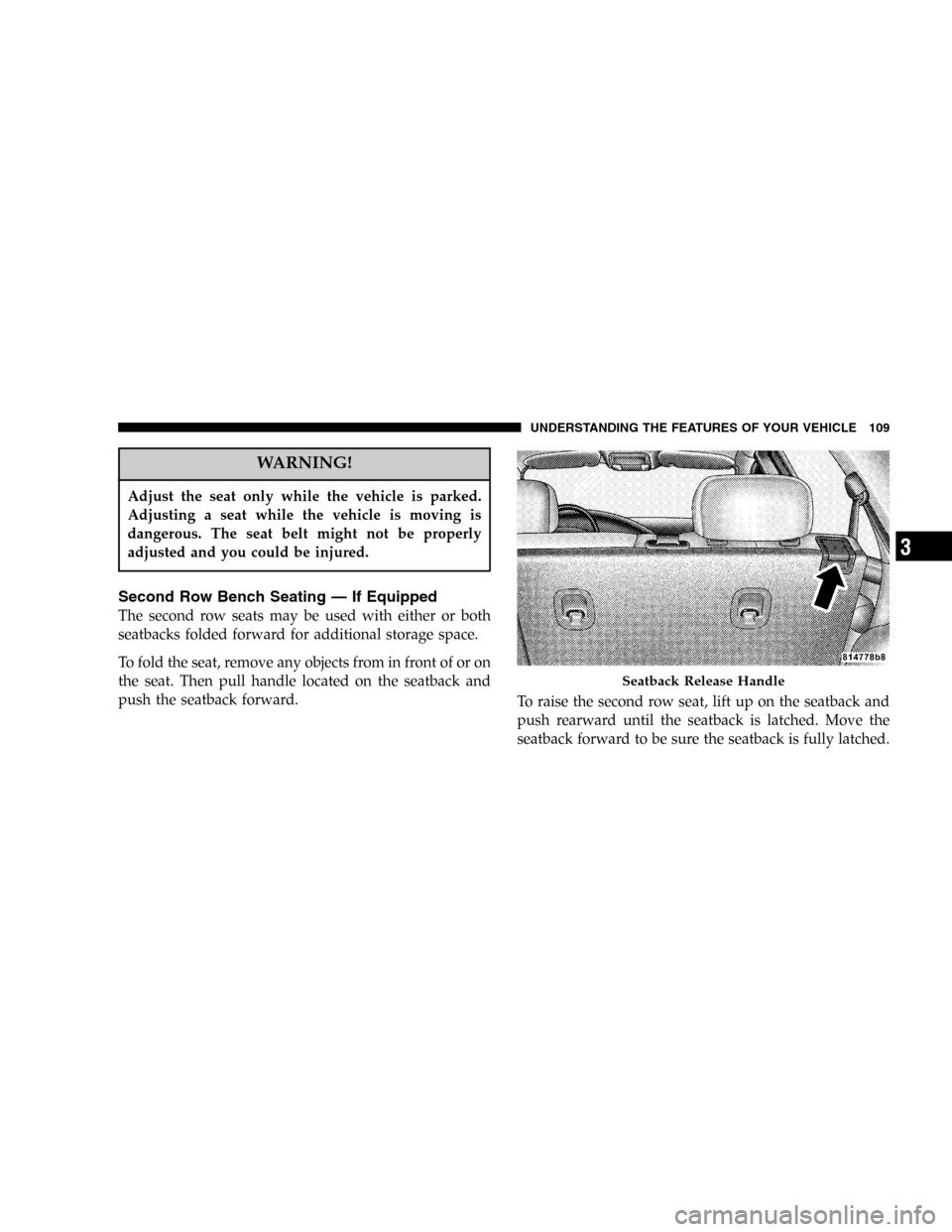
To fold the seat, remove any objects from in front of or on
the seat. Then pull handle located on the seatback and
push the seatback forward.
To raise the second row seat, lift up on the seatback and
push rearward until the seatback is latched. Move the
seatback forward to be sure the seatback is fully latched.
Seatback Release Handle
UNDERSTANDING THE FEATURES OF YOUR VEHICLE 109
3
Page 113 of 420
Third Row Seating—If Equipped
The third row seats may be used with either or both
seatbacks folded forward for additional storage space.
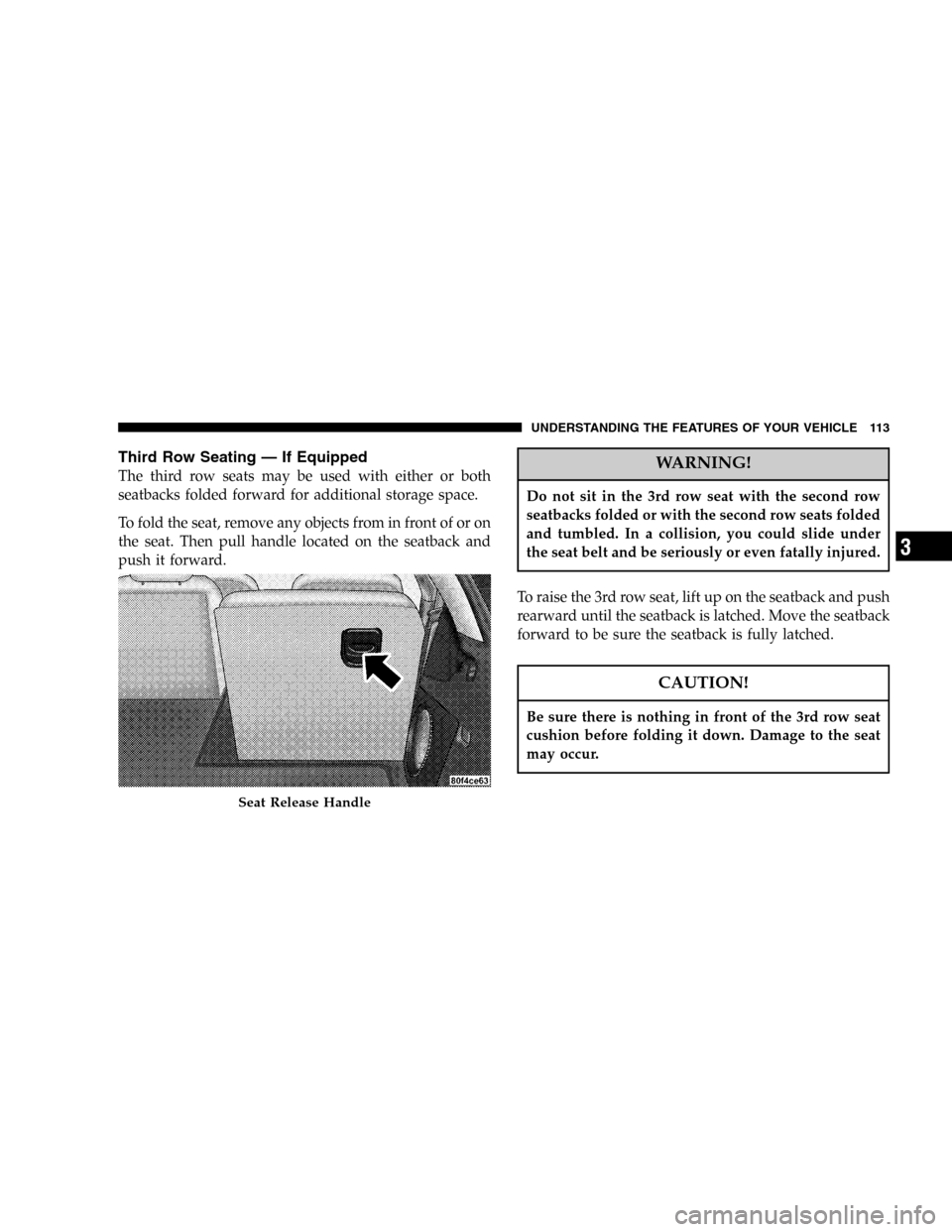
To fold the seat, remove any objects from in front of or on
the seat. Then pull handle located on the seatback and
push it forward.WARNING!
Do not sit in the 3rd row seat with the second row
seatbacks folded or with the second row seats folded
and tumbled. In a collision, you could slide under
the seat belt and be seriously or even fatally injured.
To raise the 3rd row seat, lift up on the seatback and push
rearward until the seatback is latched. Move the seatback
forward to be sure the seatback is fully latched.
CAUTION!
Be sure there is nothing in front of the 3rd row seat
cushion before folding it down. Damage to the seat
may occur.
Seat Release Handle
UNDERSTANDING THE FEATURES OF YOUR VEHICLE 113
3
Page 114 of 420
WARNING!
•Not all head restraints in this vehicle are the same.
Head restraints from one seating position should not
be removed and installed in any other seating posi-
tion. In a collision, serious injury or death may result
if the proper head restraint is not installed on each
seat.
•The cargo area in the rear of the vehicle should not
be used as a play area by children. They could be
seriously injured in a collision. Children should be
seated and using the proper restraint system.
•It is extremely dangerous to ride in a cargo area,
inside or outside of a vehicle. In a collision, people
riding in these areas are more likely to be seriously
injured or killed.
•Do not allow people to ride in any area of your
vehicle that is not equipped with seats and seat belts.
•Be sure everyone in your vehicle is in a seat and
using a seat belt properly.
Load Floor—If Equipped
For additional cargo space, the second and third row
seatbacks may be folded forward and the load floor
extended to cover the center console.
To extend the load floor, follow these steps:
1. Move the second row seats to the full rear position.
2. Fold the second and third row seatbacks down.
3. Pull on the load floor strap and lift the panel from the
driver’s second row seatback over the center console and
onto the passenger second row seat.
114 UNDERSTANDING THE FEATURES OF YOUR VEHICLE
Page 147 of 420
To close the sunroof, press and hold the“CLOSE”button
forward. Again, any release of the button will stop the
movement and the sunroof will remain in a partial open
condition until the button is pushed forward again.
The sunshade can be opened manually. It will also open
as the sunroof opens. The sunshade cannot be closed if
the sunroof is open.WARNING!
•Never leave children in a vehicle, with the keys in
the ignition switch. Occupants, particularly unat-
tended children, can become entrapped by the
power sunroof while operating the power sunroof
buttons. Such entrapment may result in serious
injury or death.
•In an accident, there is a greater risk of being
thrown from a vehicle with an open sunroof. You
could also be seriously injured or killed. Always
fasten your seat belt properly and make sure all
passengers are properly secured too.
•Do not allow small children to operate the sun-
roof. Never allow fingers or other body parts, or
any object to project through the sunroof opening.
Injury may result.
UNDERSTANDING THE FEATURES OF YOUR VEHICLE 147
3
Page 154 of 420
WARNING!
•Cargo tie-down hooks are not safe anchors for a
child seat tether strap. In a sudden stop or colli-
sion a hook could pull loose and allow the child
seat to come loose. A child could be badly injured.
Use only the anchors provided for child seat
tethers.
•The weight and position of cargo and passengers
can change the vehicle center of gravity and
vehicle handling. To avoid loss of control result-
ing in personal injury, follow these guidelines for
loading your vehicle:
•Always place cargo evenly on the cargo floor. Put
heavier objects as low and as far forward as possible.
•Place as much cargo as possible in front of the rear
axle. Too much weight or improperly placed weight
over or behind the rear axle can cause the rear of the
vehicle to sway.
•Do not pile luggage or cargo higher than the top of the
seatback. This could impair visibility or become a
dangerous projectile in a sudden stop or collision.
WARNING!
To help protect against personal injury, passengers
should not be seated in the rear cargo area. The rear
cargo space is intended for load carrying purposes
only, not for passengers, who should sit in seats and
use seat belts.
154 UNDERSTANDING THE FEATURES OF YOUR VEHICLE
Page 171 of 420

The Malfunction Indicator Light flashes to alert you to
serious conditions that could lead to immediate loss of
power or severe catalytic converter damage. The vehicle
should be serviced as soon as possible if this occurs.
16. High Beam Light
This light shows that the headlights are on high
beam. Pull the Multi-Function lever towards the
steering wheel to switch the headlights from high or low
beam.
17. Navigation Screen—If Equipped
The navigation system provides maps, turn identifica-
tion, selection menus and instructions for selecting a
variety of destinations and routes. Refer to your“Navi-
gation User’s Manual”for detailed operating instruc-
tions.
18. Front Fog Light Indicator—If Equipped
This light shows the front fog lights are ON.19. Oil Pressure Warning Light
This light shows low engine oil pressure. The light
should turn on momentarily when the engine is
started. If the light turns on while driving, stop the
vehicle and shut off the engine as soon as possible. A
continuous chime will sound when this light turns on.
Do not operate the vehicle until the cause is corrected.
This light does not show how much oil is in the engine.
The engine oil level must be checked under the hood.
20. Seat Belt Reminder Light
When the ignition switch is first turned ON, this
light will turn on for 5 to 8 seconds as a bulb check.
During the bulb check, if the driver’s seat belt is
unbuckled, a chime will sound. After the bulb check or
when driving, if the driver seat belt remains unbuckled,
the Seat Belt Warning Light will flash or remain on
continuously. Refer to�Enhanced Driver Seat Belt Re-
minder System (BeltAlert™)�in the Occupant Restraints
section for more information.
UNDERSTANDING YOUR INSTRUMENT PANEL 171
4
Page 311 of 420
5. Connect the other cable, first to the negative terminal
of the booster battery andthen to the engine of the
vehicle with the discharged battery.Make sure you have
a good contact on the engine.
6. Start the engine in the vehicle which has the booster
battery, let the engine idle a few minutes, then start the
engine in the vehicle with the discharged battery.
7. When removing the jumper cables, reverse the above
sequence exactly. Be careful of the moving belts and fan.
DRIVING ON SLIPPERY SURFACES
Acceleration
Rapid acceleration on snow covered, wet, or other slip-
pery surfaces may cause the front wheels to pull errati-
cally to the right or left. This phenomenon occurs when
there is a difference in the surface traction under the front
(driving) wheels.
WARNING!
Rapid acceleration on slippery surfaces is danger-
ous. Unequal traction can cause sudden pulling of
the front wheels. You could lose control of the
vehicle and possibly have an accident. Accelerate
slowly and carefully whenever there is likely to be
poor traction (ice, snow, wet mud, loose sand, etc.).
Traction
When driving on wet or slushy roads, it is possible for a
wedge of water to build up between the tire and road
surface. This is known as hydroplaning and may cause
partial or complete loss of vehicle control and stopping
ability. To reduce this possibility, the following precau-
tions should be observed:
1. Slow down during rainstorms or when roads are
slushy.
WHAT TO DO IN EMERGENCIES 311
6
Page 317 of 420
MAINTAINING YOUR VEHICLE
CONTENTS
�3.5L Engines..........................320
�3.8L Engines..........................321
�Onboard Diagnostic System—OBDII........322
▫Loose Fuel Filler Cap Message............323
�Emissions Inspection And Maintenance
Programs............................323
�Replacement Parts......................325
�Dealer Service.........................325
�Maintenance Procedures..................326▫Engine Oil..........................326
▫Engine Oil Filter......................330
▫Drive Belts—Check Condition And Tension . . 330
▫Spark Plugs.........................331
▫Engine Air Cleaner Filter................331
▫Fuel Filter..........................332
▫Catalytic Converter....................332
▫Maintenance-Free Battery................333
7