Page 237 of 280
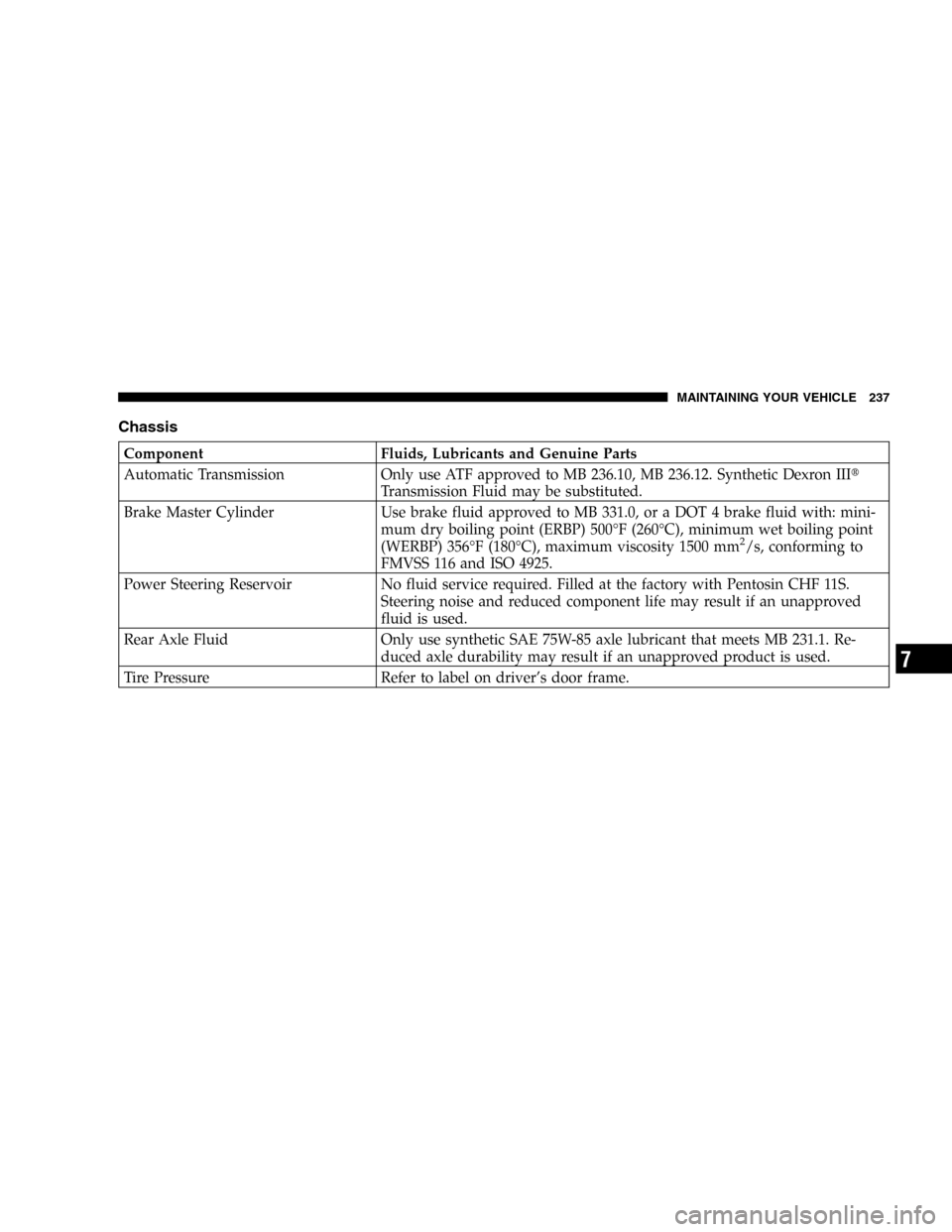
Chassis
Component Fluids, Lubricants and Genuine Parts
Automatic Transmission Only use ATF approved to MB 236.10, MB 236.12. Synthetic Dexron III�
Transmission Fluid may be substituted.
Brake Master Cylinder Use brake fluid approved to MB 331.0, or a DOT 4 brake fluid with: mini-
mum dry boiling point (ERBP) 500°F (260°C), minimum wet boiling point
(WERBP) 356°F (180°C), maximum viscosity 1500 mm
2/s, conforming to
FMVSS 116 and ISO 4925.
Power Steering Reservoir No fluid service required. Filled at the factory with Pentosin CHF 11S.
Steering noise and reduced component life may result if an unapproved
fluid is used.
Rear Axle Fluid Only use synthetic SAE 75W-85 axle lubricant that meets MB 231.1. Re-
duced axle durability may result if an unapproved product is used.
Tire Pressure Refer to label on driver’s door frame.
MAINTAINING YOUR VEHICLE 237
7
Page 239 of 280
MAINTENANCE SCHEDULES
CONTENTS
�Introduction..........................240
�Warranty............................240
�Emission Control System Maintenance......241
�Maintenance Schedules..................241
▫Scope Of Work For“A”Schedule Maintenance
Service.............................242
▫Scope Of Work For“B”Schedule Maintenance
Service.............................243
�FSS System...........................244
�Regular Check-Ups.....................246
▫Additional Periodic Maintenance..........247
�Special Maintenance Requirements.........248
▫Coolant............................248
▫Dust Filter For Heating/Ventilation
Replacement.........................248
�Engine Oil Change And Filter Replacement...2488
M
A
I
N
T
E
N
A
N
C
E
S
C
H
E
D
U
L
E
S
Page 240 of 280
INTRODUCTION
This is intended as a guide to the service requirements of
your vehicle.
It contains all necessary instructions concerning service
intervals and operations which have to be carried out.
Scope and frequency of maintenance work primarily
depend on the vehicle’s operating conditions. In the
interest of maintaining the vehicle’s operating safety, the
specified work should be performed regularly and in
good time.
Our vehicles are subject to ongoing development. Tech-
nical progress may also affect the scope of service work
performed.
“Daily vehicle checks”before starting a journey are the
responsibility of the driver.
WARRANTY
The DaimlerChrysler Corporation Dealer network is at
your disposal for maintenance work. Each of these work-
shops has the equipment and tools, the specially trained,
skilled and experienced personnel and receives regular
technical instruction from DaimlerChrysler Corporation
to ensure that your vehicle is inspected and maintained
thoroughly and in accordance with the latest procedures.
Please follow the instructions given in this Owner’s
Manual and ensure that they are observed, even if you
hand the vehicle over to a third party for use or care. By
not observing these instructions you may void your
warranty rights.
If the specified oil and maintenance services are not
carried out regularly or at the time intervals specified, a
decision as to the validity of a warranty claim can only be
made after DaimlerChrysler Corporation has investi-
gated your claim.
240 MAINTENANCE SCHEDULES
8
M
A
I
N
T
E
N
A
N
C
E
S
C
H
E
D
U
L
E
S
Page 241 of 280
The use of Special lubricant additives is not recom-
mended. The use of such additives may affect your
warranty rights. With regard to legal stipulations con-
cerning emissions control, please note that engines have
to be serviced and adjusted in accordance with special
instructions and using special measuring equipment.
Modifications to or interference with the emissions con-
trol systems are not permissible.
All DaimlerChrysler Corporation dealers are familiar
with the relevant and applicable regulations.
EMISSION CONTROL SYSTEM MAINTENANCE
The“Scheduled”maintenance services, listed inbold
typemust be done at the times or mileages specified to
assure the continued proper functioning of the emission
control system. These, and all other maintenance services
included in this manual, should be done to provide best
vehicle performance and reliability. More frequent main-
tenance may be needed for your Crossfire in severe
operating conditions such as dusty areas and very short
trip driving.Inspection and service also should be done any time a
malfunction is suspected.
NOTE:Maintenance, replacement, or repair of the
emission control devices and systems on your vehicle
may be performed by any automotive repair establish-
ment or individual using any automotive part which has
been certified pursuant to U.S. EPA or, in the State of
California, California Air Resources Board regulations.
MAINTENANCE SCHEDULES
There are two maintenance schedules that show the
requiredservice for your vehicle.
Schedule“A”typically rotates with Schedule“B.”Follow
Schedule“A”after the first service interval, Schedule“B”
after the second service interval, and so on. In some cases
where the service interval has been extended due to very
light duty driving, a Schedule“B”service may be indi-
cated following a previous Schedule“B”service. There
are additional service tasks required under Schedule“B.”
MAINTENANCE SCHEDULES 241
8
M
A
I
N
T
E
N
A
N
C
E
S
C
H
E
D
U
L
E
S
Page 242 of 280

Your Flexible Service System (FSS)—see Understanding
Your Instrument Panel section—should give you an
exact indication of when your vehicle should be sched-
uled for service and which schedule to follow.
Additional Periodic Maintenanceitems should also be
performed beyond the items listed in the following charts
to assure the optimum performance of your Crossfire.
SCOPE OF WORK FOR“A”SCHEDULE
MAINTENANCE SERVICE
Oil Change
•Change oil and replace filter
Maintenance
•Lubricate hood hinges, latch, and secondary latch
•Reset FSS Display
Function Check
•Horn, hazard warning flashers, turn signals, and indi-
cator lamps
•Headlamps and exterior lighting
•Windshield wipers and washer system
Inspection
•Check front and rear brake pads for lining thickness
•Check tires for damage and general condition
•Check tire inflation pressures and correct if necessary
Fluid Levels
Check fluid levels for the following systems and correct if
necessary. Should there be a loss of fluid that cannot be
explained by regular use, trace and eliminate the cause.
•Engine cooling system (check corrosion inhibitor/
antifreeze)
•Hydraulic brake system
•Power steering system
•Windshield washer system
242 MAINTENANCE SCHEDULES
8
M
A
I
N
T
E
N
A
N
C
E
S
C
H
E
D
U
L
E
S
Page 243 of 280

SCOPE OF WORK FOR“B”SCHEDULE
MAINTENANCE SERVICE
Oil Change
•Change oil and replace filter
Maintenance
•Rotate tires
•Replace dust filter
•Lubricate hood hinges, latch, and secondary latch
•Reset FSS Display
Function Check
•Horn, hazard warning flashers, turn signals, and indi-
cator lamps
•Headlamps and exterior lighting
•Windshield wipers and washer system
•Check seat belts for damage and proper function
•Test hydraulic brakes and check parking brake func-
tionInspection
•Check front and rear brake pads for lining thickness
•Check condition of front and rear brake discs
•Check tires for damage and general condition
•Check tire inflation pressures and correct if necessary
•Check major underbody components for leakage or
damage (if there are signs of leakage, determine cause
and repair)
•Check condition of front axle ball joints and rubber
boots
•Check condition of steering components and rubber
boots
•Check underhood components for leakage or damage
(if there are signs of leakage determine cause and
repair)
•Check condition of accessory drive belt
•Check headlamp aiming, adjust if necessary
•Check windshield wiper blades, replace if necessary
MAINTENANCE SCHEDULES 243
8
M
A
I
N
T
E
N
A
N
C
E
S
C
H
E
D
U
L
E
S
Page 244 of 280

Fluid Levels
Check fluid levels for the following systems and correct if
necessary. Should there be a loss of fluid that cannot be
explained by regular use, trace and eliminate the cause.
•Engine cooling system (check corrosion inhibitor/
antifreeze)
•Hydraulic brake system
•Power steering system
•Windshield washer system
FSS SYSTEM
The Flexible Service System (FSS) permits a flexible
service schedule that is directly related to the operating
conditions of the vehicle. See the Understanding Your
Instrument Panel section for details on how to use the
FSS.The oil change interval for your Crossfire is initially set at
7,000 miles (Canada: 11,000 km). Very light duty driving
cycles (most trips more than 10 miles [16 km] at moderate
speeds in moderate temperature conditions) can extend
the service interval beyond 7,000 miles (Canada: 11,000
km). IfANYof the following apply to your driving, the
oil change interval can be reduced significantly:
Day or night temperatures are below 32°F (0°C).
Stop and go driving.
Extensive engine idling.
Driving in dusty conditions.
Short trips of less than 10 miles (16 km).
More than 50% of your driving is at sustained high
speeds during hot weather, above 90°F (32°C).
244 MAINTENANCE SCHEDULES
8
M
A
I
N
T
E
N
A
N
C
E
S
C
H
E
D
U
L
E
S
Page 245 of 280

There are two symbols which will appear in the main
odometer display field prior to the next suggested ser-
vice.
This symbol represents Service A.
This second symbol represents Service B. Ser-
vice B rotates with Service A and includes
additional service tasks.
The next service is normally calculated and
displayed next to the Service A or Service B
symbol as distance remaining before the next
service is required.
Depending on operating conditions through-
out the year, a clock symbol may appear next to
the service symbol. When this occurs, the next
service is calculated and displayed in days
remaining before the next service is required.You should have the maintenance performed within the
stated time period or distance.
Following a completed A or B service your authorized
dealer sets the counter to 7,000 miles (Canada: 11,000
km).
NOTE:When disconnecting vehicle battery for one or
more days at a time, such days will not be counted. Any
such days not counted by FSS can be added by your
authorized dealer.
The interval between services is determined by the type
of vehicle operation. Driving at extreme speeds, and cold
starts combined with short distance driving in which the
engine does not reach normal operating temperature,
reduce the interval between services.
Regardless of the service interval determined by your
FSS, the scheduled services as posted in this manual must
be followed to properly care for your vehicle.
MAINTENANCE SCHEDULES 245
8
M
A
I
N
T
E
N
A
N
C
E
S
C
H
E
D
U
L
E
S