Page 153 of 280

if the temperature is very cold.ALWAYScheck the
pressure in your tires if the TPM lamp is illuminated.
Tire Chains
The RUD-matic�DISC is the only tire chain system
approved for use on the Chrysler Crossfire.
Chains should only be used on the rear wheels and only
with the recommended winter mud and snow (M+S)
tires and wheels. Follow the manufacturer’s mounting
instructions.
Tire chains should only be driven on snow-covered roads
at speeds not to exceed 30 mph (48 km/h). Remove
chains as soon as possible when driving on roads without
snow.
When driving with tire chains, press the ESP control
switch to OFF.
CAUTION!
Damage to the vehicle may result if unapproved tire
chains are used.
Original Equipment Tires
Your vehicle is equipped with either sport performance
tires or all-season performance tires. The sport perfor-
mance tires offer the maximum road handling capability
in dry and wet weather conditions. The all-season per-
formance tires, while offering slightly less road handling
capability, are able to provide traction capability in snow
and ice conditions. Both types of tires are rated for high
speed operation. It is important that you know what type
of tires your vehicle is equipped with so that you
understand their traction and handling characteristics for
various road conditions. Replacement tires should be of
the same size and speed rating to continue to provide the
same level of performance you are accustomed to.
STARTING AND OPERATING 153
5
Page 154 of 280

Snow Tires
Some areas of the country require the use of snow tires
during winter. See the recommended snow type winter
tire applications in this section.
WARNING!
Your vehicle may be equipped with sport perfor-
mance tires that are optimized for driving in dry and
wet weather conditions. However, these tires have
reduced traction capability in snow and ice. When
driving your Crossfire in these conditions with these
tires, you must take special care to maintain control
and avoid accidents. We recommend that you equip
your vehicle with“SNOW”or“ALL SEASON”tires
on all four wheels for driving in snowy and icy
conditions.
If you need snow tires, the recommended size for the
front and rear tires is the same size as the original
equipment front tires. This size tire on the rear allows the
use of tire chains on the rear wheels. Selection of this size
tire also requires the purchase of two additional wheels
with the same size specification as the original equip-
ment front wheels.
Snow tires may have a lower speed rating than factory
equipped tires and may not match the maximum vehicle
speed.
Snow tires should not be operated at sustained speeds
over 75 mph (120 km/h).
154 STARTING AND OPERATING
Page 156 of 280

WARNING!
•Do not use a tire, wheel size or rating other than
that specified for your vehicle. Some combina-
tions of unapproved tires and wheels may change
suspension dimensions and performance charac-
teristics, resulting in changes to steering, han-
dling, and braking of your vehicle. This can cause
unpredictable handling and stress to steering and
suspension components. You could lose control
and have an accident resulting in serious injury or
death. Use only the tire and wheel sizes with load
ratings approved for your vehicle.
•Never use a tire with a smaller load index or
capacity, other than what was originally equipped
on your vehicle. Using a tire with a smaller load
index could result in tire overloading and failure.
You could lose control and have an accident.
•Failure to equip your vehicle with tires having
adequate speed capability can result in sudden
tire failure and loss of vehicle control.
CAUTION!
Replacing original tires with tires of a different size
may result in false speedometer and odometer read-
ings. Check with your authorized dealer before
replacing tires with a different size.
Tire Rotation Recommendations
Tires on the front and rear axles of vehicles operate at
different loads and perform different steering, driving and
braking functions. For these reasons, they wear at unequal
rates, and tend to develop irregular wear patterns.
These effects can be reduced by timely rotation of tires.
The benefits of rotation are especially worthwhile with
aggressive tread designs such as those on all season type
tires. Rotation will increase tread life, help to maintain
mud, snow and wet traction levels, and contribute to a
smooth, quiet ride.
Rotate your tires at intervals shown on the maintenance
schedules. More frequent rotation is permissible if de-
sired. The reasons for any rapid or unusual wear should
be corrected before rotating.
156 STARTING AND OPERATING
Page 157 of 280
Alignment And Balance
The suspension components of your vehicle should be
inspected and aligned when needed to obtain full tire
tread mileage.
Poor suspension alignment may result in:
•Fast tire wear
•Uneven tire wear, such as feathering and one-sided
wear
•Vehicle pull to right or left
Tires may also cause vehicle to pull to the left or right.
Alignment will not correct this condition. See your
authorized dealer for proper diagnosis.
Improper alignment will not cause vehicle vibration.
Vehicle vibration may be a result of tire and wheel
out-of-balance. Proper balancing will reduce vibration
and avoid tire cupping and spotty wear.
STARTING AND OPERATING 157
5
Page 168 of 280
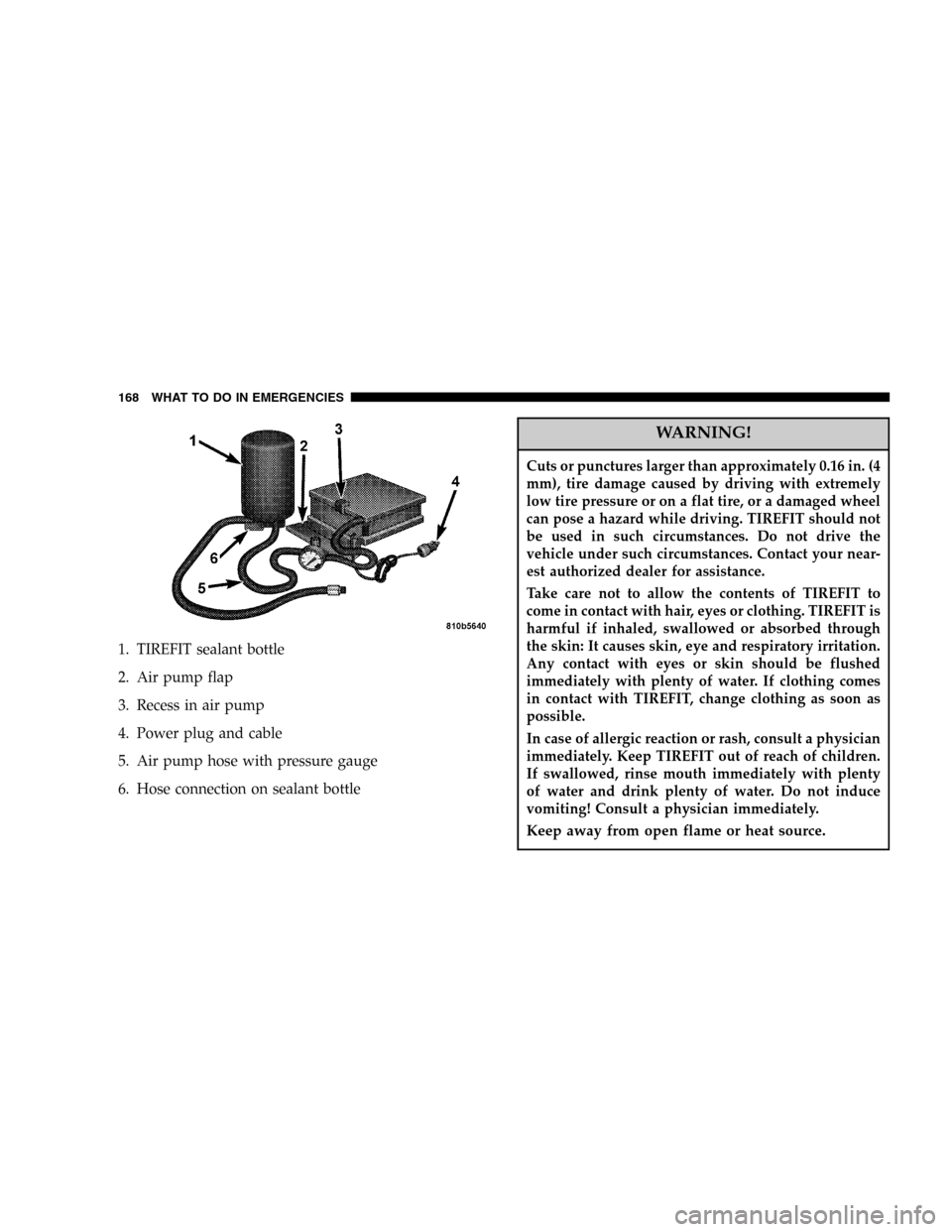
1. TIREFIT sealant bottle
2. Air pump flap
3. Recess in air pump
4. Power plug and cable
5. Air pump hose with pressure gauge
6. Hose connection on sealant bottle
WARNING!
Cuts or punctures larger than approximately 0.16 in. (4
mm), tire damage caused by driving with extremely
low tire pressure or on a flat tire, or a damaged wheel
can pose a hazard while driving. TIREFIT should not
be used in such circumstances. Do not drive the
vehicle under such circumstances. Contact your near-
est authorized dealer for assistance.
Take care not to allow the contents of TIREFIT to
come in contact with hair, eyes or clothing. TIREFIT is
harmful if inhaled, swallowed or absorbed through
the skin: It causes skin, eye and respiratory irritation.
Any contact with eyes or skin should be flushed
immediately with plenty of water. If clothing comes
in contact with TIREFIT, change clothing as soon as
possible.
In case of allergic reaction or rash, consult a physician
immediately. Keep TIREFIT out of reach of children.
If swallowed, rinse mouth immediately with plenty
of water and drink plenty of water. Do not induce
vomiting! Consult a physician immediately.
Keep away from open flame or heat source.
168 WHAT TO DO IN EMERGENCIES
Page 170 of 280

16. If a tire pressure of 26 psi (180 kPa) is obtained, press
the air pump switch to 0, turn the ignition switch to the
OFF/LOCK position, and disconnect the TIREFIT sys-
tem.
17. Drive the vehicle for about 10 minutes to ensure
optimum distribution of the tire sealant within the tire.
18. Check the pressure in the tire. If the pressure is above
19 psi (130 kPa), inflate the tire to the pressure indicated
on the tire pressure label on the driver side latch pillar.
19. Have the tire inspected at the earliest opportunity at
an authorized dealer or tire service center.
NOTE:Do not exceed 50 mph (80 km/h) until the tire
has been inspected.
NOTE:If a pressure of at least 19 psi (130 kPa) cannot
be maintained in the tire, the tire is too badly damaged.
Do not attempt to drive the vehicle further, and call for
assistance.
NOTE:Do not operate the electric air pump for more
than eight minutes to avoid overheating. The air pump
may be used again once it has cooled down.
NOTE:Replace the TIREFIT sealant bottle once every
four years to assure optimum operation of the system.
NOTE:If TIREFIT is liquid, clean water and a damp
cloth will remove the material from the vehicle or tire and
wheel components. Once TIREFIT sealing material has
dried, it can easily be peeled off and properly discarded.
Preparations for Jacking
WARNING!
Getting under a jacked-up vehicle is dangerous. The
vehicle could slip off the jack and fall on you. You
could be crushed. Never get any part of your body
under a vehicle that is on a jack. Never start or run
the engine while the vehicle is on a jack. If you need
to get under a raised vehicle, take it to a service
facility where it can be raised on a lift.
170 WHAT TO DO IN EMERGENCIES
Page 171 of 280
WARNING!
Do not attempt to repair a tire on the side of the
vehicle close to traffic. Pull far enough off the road to
avoid the danger of being hit when operating the
jack or repairing a tire.
Jacking the vehicle should only be necessary in the event
that a tire has been severely damaged, and must be
replaced. (See TIREFIT Tire Repair section for a descrip-
tion of cuts and punctures that may be repairable with
TIREFIT.)
•Turn on the hazard warning flashers and park the
vehicle on a firm, level surface; avoid ice or slippery
areas.
•Firmly set the parking brake and shift the transmission
selector lever into PARK.
•Turn off the engine.
•Block the wheel diagonally opposite the flat tire.
WHAT TO DO IN EMERGENCIES 171
6
Page 172 of 280
•Passengers must not remain in the vehicle when the
vehicle is jacked.
NOTE:The jack is designed exclusively for jacking up
the vehicle at the specified jack location points built
beneath either side of the vehicle.
Jack Location and Instructions
1. Remove the jack and jack handle from stowage be-
neath the cargo compartment carpet.2. The lifting points for the jack are located beneath the
outer edge of the body side, directly behind the front
wheel housings, and in front of the rear wheel housings.
172 WHAT TO DO IN EMERGENCIES