2005 CHEVROLET UPLANDER wheel alignment
[x] Cancel search: wheel alignmentPage 317 of 460

Service............................................................5-3
Doing Your Own Service Work.........................5-4
Adding Equipment to the Outside of
Your Vehicle..............................................5-5
Fuel................................................................5-5
Gasoline Octane............................................5-5
Gasoline Specications....................................5-5
California Fuel...............................................5-6
Additives.......................................................5-6
Fuels in Foreign Countries...............................5-7
Filling the Tank..............................................5-8
Filling a Portable Fuel Container.....................5-10
Checking Things Under the Hood....................5-10
Hood Release..............................................5-11
Engine Compartment Overview.......................5-12
Engine Oil...................................................5-13
Engine Oil Life System..................................5-16
Engine Air Cleaner/Filter................................5-18
Automatic Transaxle Fluid..............................5-19
Engine Coolant.............................................5-22
Radiator Pressure Cap..................................5-24
Engine Overheating.......................................5-25
Overheated Engine Protection
Operating Mode........................................5-27
Cooling System............................................5-27Power Steering Fluid.....................................5-34
Windshield Washer Fluid................................5-35
Brakes........................................................5-36
Battery........................................................5-39
Jump Starting...............................................5-39
All-Wheel Drive..............................................5-44
Bulb Replacement..........................................5-46
Halogen Bulbs..............................................5-46
Headlamps and Sidemarker Lamps.................5-46
Front Turn Signal, Parking and Daytime
Running Lamps (DRL)................................5-48
Taillamps, Turn Signal, Stoplamps and
Back-up Lamps.........................................5-48
Replacement Bulbs.......................................5-49
Windshield Wiper Blade Replacement..............5-50
Tires..............................................................5-51
Tire Sidewall Labelling...................................5-52
Tire Terminology and Denitions.....................5-55
Ination - Tire Pressure.................................5-57
Tire Inspection and Rotation...........................5-59
When It Is Time for New Tires.......................5-60
Buying New Tires.........................................5-60
Uniform Tire Quality Grading..........................5-61
Wheel Alignment and Tire Balance..................5-63
Section 5 Service and Appearance Care
5-1
Page 375 of 460

Tire Inspection and Rotation
Tires should be rotated every 5,000 to 8,000 miles
(8 000 to 13 000 km).
Any time you notice unusual wear, rotate your tires as
soon as possible and check wheel alignment. Also
check for damaged tires or wheels. SeeWhen It Is Time
for New Tires on page 5-60andWheel Replacement
on page 5-63for more information.
The purpose of regular rotation is to achieve more
uniform wear for all tires on the vehicle. The rst rotation
is the most important. SeeScheduled Maintenance
on page 6-4.
When rotating your tires, always use the correct rotation
pattern shown here.Do not include the compact spare tire in your tire
rotation.
After the tires have been rotated, adjust the front and
rear ination pressures as shown on the Tire and
Loading Information label.
Make certain that all wheel nuts are properly tightened.
See “Wheel Nut Torque” underCapacities and
Specications on page 5-101.
{CAUTION:
Rust or dirt on a wheel, or on the parts to
which it is fastened, can make wheel nuts
become loose after a time. The wheel could
come off and cause an accident. When you
change a wheel, remove any rust or dirt from
places where the wheel attaches to the vehicle.
In an emergency, you can use a cloth or a
paper towel to do this; but be sure to use a
scraper or wire brush later, if needed, to get all
the rust or dirt off. SeeChanging a Flat Tire on
page 5-68.
5-59
Page 379 of 460

Wheel Alignment and Tire Balance
The tires and wheels on your vehicle were aligned
and balanced carefully at the factory to give you the
longest tire life and best overall performance.
Adjustments to wheel alignment and tire balancing will
not be necessary on a regular basis. However, if
you notice unusual tire wear or your vehicle pulling to
one side or the other, the alignment may need to
be checked. If you notice your vehicle vibrating when
driving on a smooth road, your tires and wheels
may need to be rebalanced. See your dealer for proper
diagnosis.
Wheel Replacement
Replace any wheel that is bent, cracked or badly rusted
or corroded. If wheel nuts keep coming loose, the
wheel, wheel bolts and wheel nuts should be replaced.
If the wheel leaks air, replace it (except some
aluminum wheels, which can sometimes be repaired).
See your dealer if any of these conditions exist.
Your dealer will know the kind of wheel you need.
Each new wheel should have the same load-carrying
capacity, diameter, width, offset and be mounted
the same way as the one it replaces.If you need to replace any of your wheels, wheel bolts
or wheel nuts, replace them only with new GM
original equipment parts. This way, you will be sure to
have the right wheel, wheel bolts and wheel nuts
for your vehicle.
{CAUTION:
Using the wrong replacement wheels, wheel
bolts or wheel nuts on your vehicle can be
dangerous. It could affect the braking and
handling of your vehicle, make your tires lose
air and make you lose control. You could have
a collision in which you or others could be
injured. Always use the correct wheel, wheel
bolts and wheel nuts for replacement.
Notice:The wrong wheel can also cause problems
with bearing life, brake cooling, speedometer or
odometer calibration, headlamp aim, bumper height,
vehicle ground clearance and tire or tire chain
clearance to the body and chassis.
SeeChanging a Flat Tire on page 5-68for more
information.
5-63
Page 459 of 460
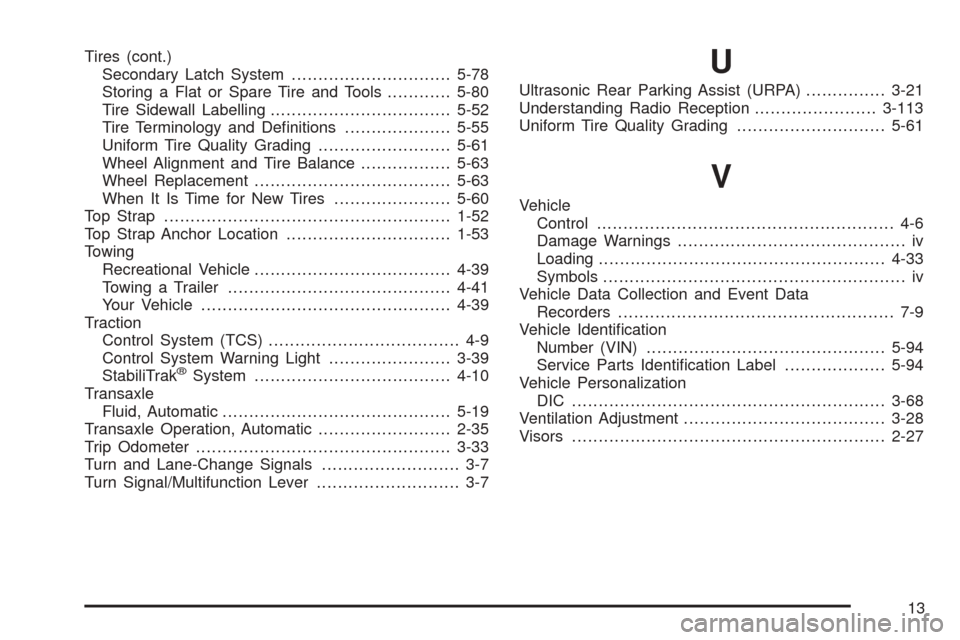
Tires (cont.)
Secondary Latch System..............................5-78
Storing a Flat or Spare Tire and Tools............5-80
Tire Sidewall Labelling..................................5-52
Tire Terminology and Denitions....................5-55
Uniform Tire Quality Grading.........................5-61
Wheel Alignment and Tire Balance.................5-63
Wheel Replacement.....................................5-63
When It Is Time for New Tires......................5-60
Top Strap......................................................1-52
Top Strap Anchor Location...............................1-53
Towing
Recreational Vehicle.....................................4-39
Towing a Trailer..........................................4-41
Your Vehicle...............................................4-39
Traction
Control System (TCS).................................... 4-9
Control System Warning Light.......................3-39
StabiliTrak
®System.....................................4-10
Transaxle
Fluid, Automatic...........................................5-19
Transaxle Operation, Automatic.........................2-35
Trip Odometer................................................3-33
Turn and Lane-Change Signals.......................... 3-7
Turn Signal/Multifunction Lever........................... 3-7
U
Ultrasonic Rear Parking Assist (URPA)...............3-21
Understanding Radio Reception.......................3-113
Uniform Tire Quality Grading............................5-61
V
Vehicle
Control........................................................ 4-6
Damage Warnings........................................... iv
Loading......................................................4-33
Symbols......................................................... iv
Vehicle Data Collection and Event Data
Recorders.................................................... 7-9
Vehicle Identication
Number (VIN).............................................5-94
Service Parts Identication Label...................5-94
Vehicle Personalization
DIC ...........................................................3-68
Ventilation Adjustment......................................3-28
Visors...........................................................2-27
13
Page 460 of 460

W
Warning Lights, Gages and Indicators................3-31
Warnings
DIC Warnings and Messages........................3-51
Hazard Warning Flashers............................... 3-6
Other Warning Devices.................................. 3-6
Safety and Symbols......................................... iii
Vehicle Damage.............................................. iv
Wheels
Alignment and Tire Balance..........................5-63
Replacement...............................................5-63
Where to Put the Restraint...............................1-51
Windows.......................................................2-24
Manual Rear Quarter...................................2-26
Power........................................................2-25
Power Rear Quarter.....................................2-26
Windshield
Backglass, and Wiper Blades, Cleaning..........5-90Windshield Washer........................................... 3-9
Fluid..........................................................5-35
Windshield Wiper
Blade Replacement......................................5-50
Fuses........................................................5-95
Windshield Wipers......................................... 3-9
Winter Driving................................................4-28
Wiper Activated Headlamps..............................3-15
X
XM™ Satellite Radio Antenna System..............3-114
Y
Your Vehicle and the Environment....................... 6-2
14