Page 94 of 460
If the LATCH system was being used during a more
severe crash, then you may need new LATCH
system parts.
If safety belts or built-in child restraint harness straps
are cut or damaged, replace them. Collision damage
also may mean you will need to have safety belt, built-in
child restraint, LATCH system or seat parts repaired
or replaced. New parts and repairs may be necessary
even if the safety belt, built-in child restraint or
LATCH system was not being used at the time of the
collision.
If an airbag inates, you will need to replace airbag
system parts. See the part on the airbag system earlier
in this section.If the frontal airbags inate, you will also need to
replace the driver’s and right front passenger’s safety
belt retractor assemblies. Be sure to do so. Then
the new retractor assemblies will be there to help protect
you in a collision.
After a crash you may need to replace the driver and
front passenger’s safety belt retractor assemblies, even
if the frontal airbags have not deployed. The driver
and front passenger’s safety belt retractor assemblies
contain the safety belt pretensioners. Have your
safety belt pretensioners checked if your vehicle has
been in a collision, or if your airbag readiness light stays
on after you start your vehicle or while you are driving.
SeeAirbag Readiness Light on page 3-34.
1-88
Page 103 of 460

Remote Vehicle Start
This feature allows you to start the engine from outside
the vehicle. It may also turn the rear window defogger
if the outside temperature is below 45°F (7°C).
Laws in some local communities may restrict the use of
remote starters. For example, some laws may require
a person using remote start to have the vehicle in view
when doing so. Check local regulations for any
requirements on remote starting of vehicles.
/(Remote Vehicle Start):If your vehicle has the
remote vehicle start feature, the remote keyless entry
transmitter will have a button with this symbol on it.
An increased range of operation is provided with the
remote keyless entry transmitter that has the remote
vehicle start button.
Do not use the remote start feature if your vehicle is low
on fuel. Your vehicle may run out of fuel.To start the engine using the remote start feature, do the
following:
1. Aim the remote keyless entry transmitter, equipped
with the remote vehicle start button, at the vehicle.
2. Press and release the transmitter’s lock button, then
immediately press and hold the remote vehicle start
button until the vehicle’s turn signal lamps ash,
or for at least two seconds, if the vehicle’s lights are
not visible. The vehicle’s doors will be locked.
3. When the vehicle’s engine starts, the parking lamps
will turn on and remain on while the engine is
running.
After a remote start, the engine will automatically shut
off after 10 minutes unless a time extension has
been done or the vehicle’s key is inserted into the
ignition switch and turned to RUN.
The maximum number of remote starts or remote start
attempts between ignition cycles with the key is two.
2-9
Page 117 of 460

If the door does not travel to the fully open position,
press the overhead console switch to the override
(deactivation) position and slide the door fully open and
closed. Check for foreign objects in the tracks. Repeat
the procedure starting with Step 1. If the door resists
travel to the fully open position, see your dealer
for service.
Liftgate
To unlock or lock the liftgate from the outside, use the
remote keyless entry transmitter. For more information,
seeRemote Keyless Entry System Operation on
page 2-5. You can also use the power door lock switch
to lock and unlock the liftgate.
Open the liftgate using the handle located above the
license plate. Once slightly opened, the liftgate will rise
by itself. Lamps in the rear of the vehicle will come
on, illuminating the rear cargo area.
Notice:If you open the liftgate without checking for
overhead obstructions such as a garage door,
you could break the liftgate glass. Always check to
make sure the area above the liftgate is clear
before opening it.
{CAUTION:
It can be dangerous to drive with the liftgate
open because carbon monoxide (CO) gas can
come into your vehicle. You cannot see or
smell CO. It can cause unconsciousness and
even death. If you must drive with the liftgate
open or if electrical wiring or other cable
connections must pass through the seal
between the body and the liftgate:
Make sure all other windows are shut.
Turn the fan on your heating or cooling
system to its highest speed and select the
control setting that will force outside air
into your vehicle. SeeClimate Control
System on page 3-25.
If you have air outlets on or under the
instrument panel, open them all the way.
SeeEngine Exhaust on page 2-41.
2-23
Page 118 of 460
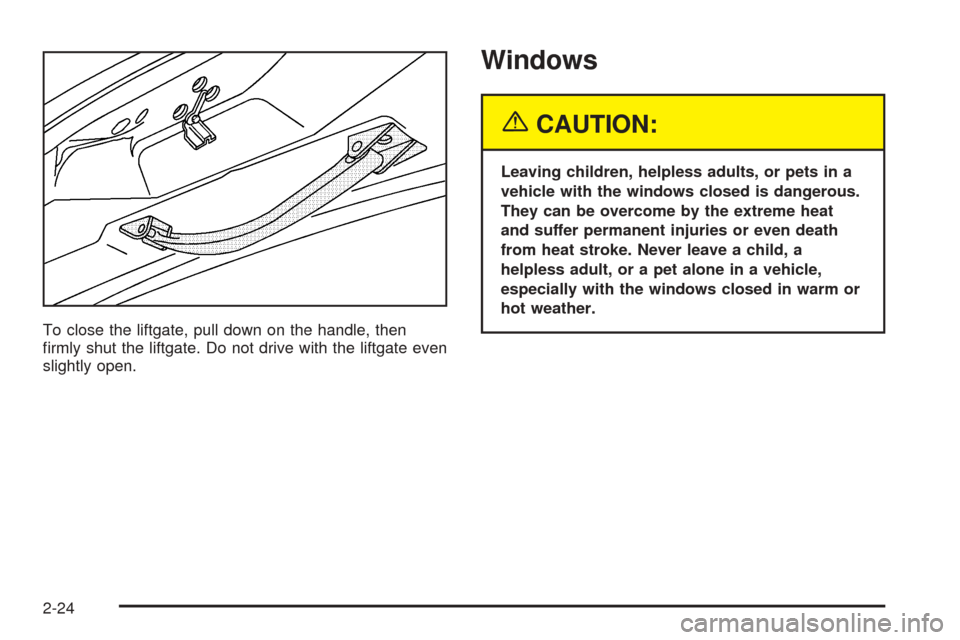
To close the liftgate, pull down on the handle, then
rmly shut the liftgate. Do not drive with the liftgate even
slightly open.
Windows
{CAUTION:
Leaving children, helpless adults, or pets in a
vehicle with the windows closed is dangerous.
They can be overcome by the extreme heat
and suffer permanent injuries or even death
from heat stroke. Never leave a child, a
helpless adult, or a pet alone in a vehicle,
especially with the windows closed in warm or
hot weather.
2-24
Page 121 of 460

Sun Visors
To block out glare, you can swing down the visors. You
can also remove them from the center mount and
swing them to the side.
Visor Vanity Mirror
Your vehicle may have a visor vanity mirror. Pull down
the sun visor to access the vanity mirror.
Lighted Vanity Mirror
Your vehicle may have a lighted vanity mirror. Pull down
the sun visor and ip up the cover to expose the
vanity mirror. The lamps will come on when you ip up
the cover.
Theft-Deterrent Systems
Vehicle theft is big business, especially in some cities.
Although your vehicle has a number of theft-deterrent
features, we know that nothing we put on it can make it
impossible to steal.
Content Theft-Deterrent
Your vehicle may have a theft-deterrent alarm system.
A light located on top of your instrument panel, near the
center of the vehicle next to the windshield, will ash
slowly to let you know that the system has been armed.
While armed, the doors will not unlock with the power
door lock switch.
Once armed, the alarm will go off if someone tries to
enter the vehicle without using the remote keyless entry
transmitter or a key, or turns the ignition to RUN. The
horn will sound and the turn signal lamps will ash for up
to two minutes.
2-27
Page 122 of 460

Arming with the Power Lock Switch
Your alarm system will arm when the key is removed
from the ignition and you use the driver’s power
door lock switch, with the driver’s door open or the
passenger’s door power door lock switch with the
passenger’s door open to lock the vehicle. If you would
like to turn on power door lock switch arming, see
DIC Vehicle Personalization (Uplevel Only) on
page 3-68.
When the security light ashes quickly the system is
arming. After all doors and the liftgate are closed
and locked, the security light will begin ashing at a
very slow rate to let you know the system is armed.
Arming with the Remote Keyless Entry
Transmitter
Your alarm system will arm if the key is not in the
ignition and you use your remote keyless entry
transmitter to lock the doors. The security light will ash
to let you know the system is arming. If you press
the transmitter’s lock button twice within 5 seconds, the
horn will sound. After all doors and the liftgate are
closed and locked, the security light will begin ashing
at a very slow rate to let you know the system is armed.
Arming with Your Key
Your alarm system will arm when you use your key to
lock the driver’s door. The security light will ash to
let you know the system is arming. After all doors and
the liftgate are closed and locked, the security light
will begin ashing at a very slow rate to let you know the
system is armed. If you would like your key not to
arm the system, seeDIC Vehicle Personalization
(Uplevel Only) on page 3-68.
Arming Conrmation
If remote unlock conrmation is on, the turn signal
lamps will ash briey to let you know when your alarm
system has disarmed. If you would not like the turn
signal lamps to ash, seeDIC Vehicle Personalization
(Uplevel Only) on page 3-68.
2-28
Page 123 of 460

Disarming with the Remote Keyless
Entry Transmitter
Your alarm system will disarm when you use your
remote keyless entry transmitter to unlock the doors.
The security light will stop ashing to let you know the
system is no longer armed.
Disarming with Your Key
Your alarm system will disarm when you use your key
to unlock the driver’s door. The security light will
stop ashing to let you know the system is no longer
armed. If you would like your key not to disarm the alarm
system, seeDIC Vehicle Personalization (Uplevel
Only) on page 3-68.
PASS-Key®III
Your PASS-Key®III system operates on a radio
frequency subject to Federal Communications
Commission (FCC) Rules and with Industry Canada.
This device complies with Part 15 of the FCC Rules.
Operation is subject to the following two conditions:
1. This device may not cause harmful interference.
2. This device must accept any interference received,
including interference that may cause undesired
operation.
This device complies with RSS-210 of Industry Canada.
Operation is subject to the following two conditions:
1. This device may not cause interference.
2. This device must accept any interference received,
including interference that may cause undesired
operation of the device.
Changes or modications to this system by other than
an authorized service facility could void authorization to
use this equipment.
PASS-Key
®III uses a radio frequency transponder in
the key that matches a decoder in your vehicle.
2-29
Page 126 of 460

Ignition Positions
The key can be turned to one of four positions while in
the ignition switch.
A (LOCK):This is the only position from which you can
remove the key. This position locks your ignition and
transaxle.
Notice:Using a tool to force the key from the
ignition switch could cause damage or break the
key. Use the correct key and turn the key only with
your hand. Make sure the key is all the way in. If
none of this works, then your vehicle needs service.B (ACCESSORY):This is the position in which you can
operate the electrical accessories, such as the radio.
C (RUN):This is the position to which the switch returns
after the engine is started and the ignition key is
released. This is the position for driving. Even while the
engine is not running, RUN can be used to operate
your electrical accessories and to display some
instrument panel warning lights.
D (START):This position starts the engine. When the
engine starts, release the ignition key. The switch
will return to RUN for driving.
Retained Accessory Power (RAP)
With RAP, your power windows and the audio system
will continue to work for up to 10 minutes after the
engine is turned off or until either door is opened. If a
door is opened, the power windows and audio system
will shut off.
2-32