2005 CHEVROLET UPLANDER cruise control
[x] Cancel search: cruise controlPage 195 of 460

The oil light could also come on in three other situations:
When the ignition is on but the engine is not
running, the light will come on as a test to show you
it is working. The light will go out when you turn
the ignition on. If it does not come on with the
ignition on, you may have a problem with the fuse
or bulb. Have it xed right away.
If you are idling at a stop sign, the light may blink
on and then off.
If you make a hard stop, the light may come on for
a moment. This is normal.
{CAUTION:
Do not keep driving if the oil pressure is low. If
you do, your engine can become so hot that it
catches re. You or others could be burned.
Check your oil as soon as possible and have
your vehicle serviced.
Notice:Lack of proper engine oil maintenance may
damage the engine. The repairs would not be
covered by your warranty. Always follow the
maintenance schedule in this manual for changing
engine oil.
Security Light
For information regarding
this light, see
Theft-Deterrent Systems
on page 2-27.
Cruise Control Light
This light comes on
whenever you set your
cruise control.
The light will go out when the cruise control is turned
off. SeeCruise Control on page 3-10for more
information.
3-43
Page 275 of 460
Traction Control System (TCS)
Your vehicle may have a traction control system that
limits wheel spin. This is especially useful in slippery
road conditions. The system operates if it senses that
one or both of the front wheels are spinning or beginning
to lose traction. When this happens, the system
brakes the spinning wheel(s) and/or reduces engine
power to limit wheel spin.
The TRACTION CONTROL ACTIVE message will come
on in the Driver Information Center (DIC) when the
traction control system is limiting wheel spin. You may
feel or hear the system working, but this is normal.
If your vehicle is in cruise control when the traction
control system begins to limit wheel spin, the cruise
control will automatically disengage. When road
conditions allow you to safely use it again, you may
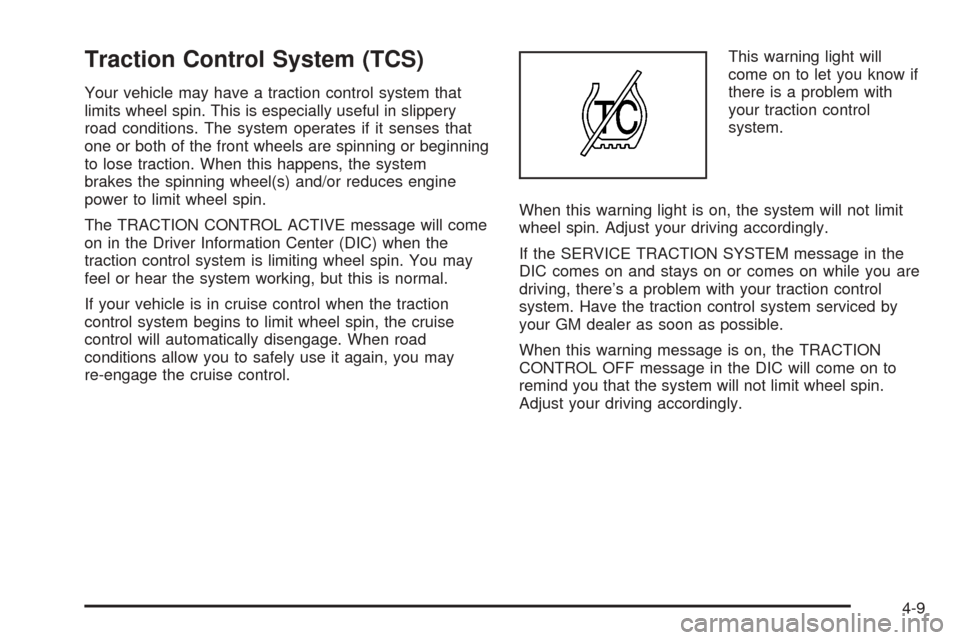
re-engage the cruise control.This warning light will
come on to let you know if
there is a problem with
your traction control
system.
When this warning light is on, the system will not limit
wheel spin. Adjust your driving accordingly.
If the SERVICE TRACTION SYSTEM message in the
DIC comes on and stays on or comes on while you are
driving, there’s a problem with your traction control
system. Have the traction control system serviced by
your GM dealer as soon as possible.
When this warning message is on, the TRACTION
CONTROL OFF message in the DIC will come on to
remind you that the system will not limit wheel spin.
Adjust your driving accordingly.
4-9
Page 278 of 460
If the brake traction-control system activates constantly
or if the brakes have heated up due to high-speed
braking, brake traction-control will be disabled and the
TRACTION CONTROL ACTIVE message will be
displayed. In the limited mode, the traction control
system will only use engine traction-control and is limited
in its ability to provide optimal performance since the
system will not utilize brake traction-control to control
slip on the drive wheels. The system will return to normal
operation after the brakes have cooled. This can take
up to two minutes or longer depending on brake usage.
The traction control system may activate on dry or
rough roads or under conditions such as heavy
acceleration while turning or abrupt upshifts/downshifts
of the transmission. When this happens you may
notice a reduction in acceleration, or may hear a noise
or vibration. This is normal.
If your vehicle is in cruise control when the system
activates, the STABILITY CONTROL ACTIVE message
will appear on the DIC and the cruise control will
automatically disengage. When road conditions allow
you to use cruise again, you may re-engage the cruise
control. SeeCruise Control on page 3-10.
StabiliTrak
®may also turn off automatically if it
determines that a problem exists with the system. If the
problem does not clear itself after restarting the
vehicle, you should see your dealer for service.
All-Wheel Drive (AWD) System
If your vehicle has all-wheel drive (AWD), the AWD
system operates automatically without any action
required by the driver. If the front drive wheels begin to
slip, the rear wheels will automatically begin to drive
the vehicle as required. There may be a slight
engagement noise during hard use but this is normal.
During heavy AWD applications, the engine torque may
be reduced to protect AWD system components. If
the vehicle is exposed to extended heavy AWD usage,
the AWD system will shut itself off to protect the
system from overheating. When the system cools down,
the AWD system will activate itself again automatically;
this cool-down can take up to 20 minutes depending
on outside temperature and vehicle use.
4-12
Page 413 of 460

Fuses Usage
1 Trunk, Door Locks
2 Electronic Level Control
3 Rear Wiper
4 Radio Amplier
5 Interior Lamps
6 OnStar
®
7 Keyless Entry Module
8Cluster, Heating, Ventilation, Air
Conditioning
9 Cruise Switch
10 Steering Wheel Illumination
11 Power Mirror
12 Stoplamp, Turn Lamps
13 Heated Seats
14 Blank
15 Electronic Level Control
16 Heated Mirror
17Center High-Mounted Stoplamp,
Back-up Lamps
18 Blank
19 Canister Ventilation
Fuses Usage
20 Park Lamps
21 Power Sliding Door
22 Blank
23 Blank
24 Left Power Sliding Door
25 Right Power Sliding Door
Relays Usage
26 Blank
27 Blank
28 Park Lamps
29 Retained Accessory Power
30 Rear Defog
PLR Fuse Puller
Circuit
BreakersUsage
31 Power Seats
32 Power Window
5-97
Page 415 of 460

Fuses Usage
1 Right High Beam
2 Fuel Pump
3 Diode
SPARE Spare
SPARE Spare
4 Left High Beam
SPARE Spare
SPARE Spare
SPARE Spare
5 Not Used
6 Air Conditioning Clutch
7 Horn
8 Left Low Beam
9Powertrain Control Module,
Electronic Throttle Control
10 Not Used
11 Transmission Solenoid
12 Right Low BeamFuses Usage
13 Anti-lock Brake System
14 Powertrain Control Module Ignition
15 Electronic Ignition
16 Fuel Injector
17Climate Control, RPA, Cruise
Control
18 Electronic Throttle Control
19 Engine Sensor, Evaporator
20 Airbag
21 Not Used
22 Emission, All-Wheel Drive
23 Auxiliary Power
24 Front Windshield Washer
25 AC/DC Inverter
26 Rear Blower
27 Front Blower
28 Front Windshield Wiper
5-99
Page 426 of 460

(h)Change automatic transaxle uid and lter if the
vehicle is mainly driven under one or more of these
conditions:
In heavy city traffic where the outside temperature
regularly reaches 90°F (32°C) or higher.
In hilly or mountainous terrain.
When doing frequent trailer towing.
Uses such as found in taxi, police, or delivery
service.
(i)Drain, ush, and rell cooling system. See Engine
Coolant on page 5-22 for what to use. Inspect hoses.
Clean radiator, condenser, pressure cap, and ller neck.
Pressure test the cooling system and pressure cap.
(j)Check system for interference or binding and
for damaged or missing parts. Replace parts as needed.
Replace any components that have high effort or
excessive wear. Do not lubricate accelerator or cruise
control cables.
(k)A uid loss in any vehicle system could indicate a
problem. Have the system inspected and repaired
and the uid level checked. Add uid if needed.
(m)Visually inspect belt for fraying, excessive cracks, or
obvious damage. Replace belt if necessary.Owner Checks and Services
These owner checks and services should be performed
at the intervals specied to help ensure the safety,
dependability and emission control performance of your
vehicle. Your GM Goodwrench
®dealer can assist
you with these checks and services.
Be sure any necessary repairs are completed at once.
Whenever any uids or lubricants are added to your
vehicle, make sure they are the proper ones, as shown
inRecommended Fluids and Lubricants on page 6-11.
At Each Fuel Fill
It is important to perform these underhood checks at
each fuel ll.
Engine Oil Level Check
Check the engine oil level and add the proper oil if
necessary. SeeEngine Oil on page 5-13for further
details.
Notice:It is important to check your oil regularly
and keep it at the proper level. Failure to keep your
engine oil at the proper level can cause damage
to your engine not covered by your warranty.
6-8
Page 449 of 460

Check
Engine Light...............................................3-40
Checking Things Under the Hood......................5-10
Chemical Paint Spotting...................................5-92
Child Restraints
Built-In Child Restraint..................................1-62
Child Restraint Systems...............................1-48
Infants and Young Children...........................1-45
Lower Anchorages and Top Tethers for
Children (LATCH System)..........................1-54
Older Children.............................................1-42
Securing a Child Restraint Designed for
the LATCH System...................................1-56
Securing a Child Restraint in a Rear
Seat Position...........................................1-56
Securing a Child Restraint in the Right
Front Seat Position...................................1-58
Top Strap...................................................1-52
Top Strap Anchor Location............................1-53
Where to Put the Restraint...........................1-51
Cleaning
Aluminum Wheels........................................5-91
Exterior Lamps/Lenses.................................5-90
Fabric/Carpet..............................................5-87
Finish Care.................................................5-90
Glass Surfaces............................................5-89
Inside of Your Vehicle..................................5-86Cleaning (cont.)
Instrument Panel, Vinyl, and Other Plastic
Surfaces.................................................5-88
Leather......................................................5-88
Tires..........................................................5-91
Underbody Maintenance...............................5-92
Washing Your Vehicle...................................5-89
Weatherstrips..............................................5-89
Windshield, Backglass, and Wiper Blades.......5-90
Climate Control System...................................3-25
Outlet Adjustment........................................3-28
Rear..........................................................3-28
Comfort Guides, Rear Safety Belt.....................1-39
Compact Spare Tire........................................5-84
Content Theft-Deterrent....................................2-27
Control of a Vehicle.......................................... 4-6
Convenience Center........................................2-56
Convenience Net....................................2-55, 2-56
Coolant
Engine Temperature Gage............................3-39
Heater, Engine............................................2-34
Cooling System..............................................5-27
Cruise Control................................................3-10
Cruise Control Light........................................3-43
Cupholder(s)..................................................2-51
3
Page 454 of 460

Light (cont.)
Cruise Control.............................................3-43
Highbeam On.............................................3-44
Low Fuel Warning.......................................3-44
Malfunction Indicator....................................3-40
Oil Pressure...............................................3-42
Passenger Airbag Status Indicator..................3-35
Passenger Safety Belt Reminder....................3-34
Safety Belt Reminder...................................3-33
Security.....................................................3-43
TCS Warning Light......................................3-39
Traction Control System (TCS) Warning..........3-39
Lighting
Delayed.....................................................3-18
Entry.........................................................3-18
Exit...........................................................3-19
Loading Your Vehicle.......................................4-33
Lockout Protection..........................................2-14
Locks
Automatic Door Locks..................................2-13
Delayed Locking..........................................2-13
Door..........................................................2-11
Lockout Protection.......................................2-14
Power Door................................................2-12
Programmable Automatic Door Unlock............2-14
Loss of Control...............................................4-17
Low Fuel Warning Light...................................3-44
Luggage Carrier..............................................2-54M
Maintenance Schedule
Additional Required Services........................... 6-6
At Each Fuel Fill........................................... 6-8
At Least Once a Month.................................. 6-9
At Least Once a Year.................................... 6-9
Introduction.................................................. 6-2
Maintenance Footnotes.................................. 6-7
Maintenance Record....................................6-14
Maintenance Requirements............................. 6-2
Normal Maintenance Replacement Parts.........6-13
Owner Checks and Services........................... 6-8
Recommended Fluids and Lubricants.............6-11
Scheduled Maintenance................................. 6-4
Using.......................................................... 6-2
Your Vehicle and the Environment................... 6-2
Malfunction Indicator Light................................3-40
Manual Rear Quarter Windows.........................2-26
Manual Seats................................................... 1-3
Message
DIC Warnings and Messages........................3-51
Mirrors
Manual Rearview Mirror................................2-43
Outside Convex Mirror.................................2-44
Outside Heated Mirrors................................2-44
Outside Power Mirrors..................................2-43
MyGMLink.com................................................ 7-3
8