Page 227 of 388
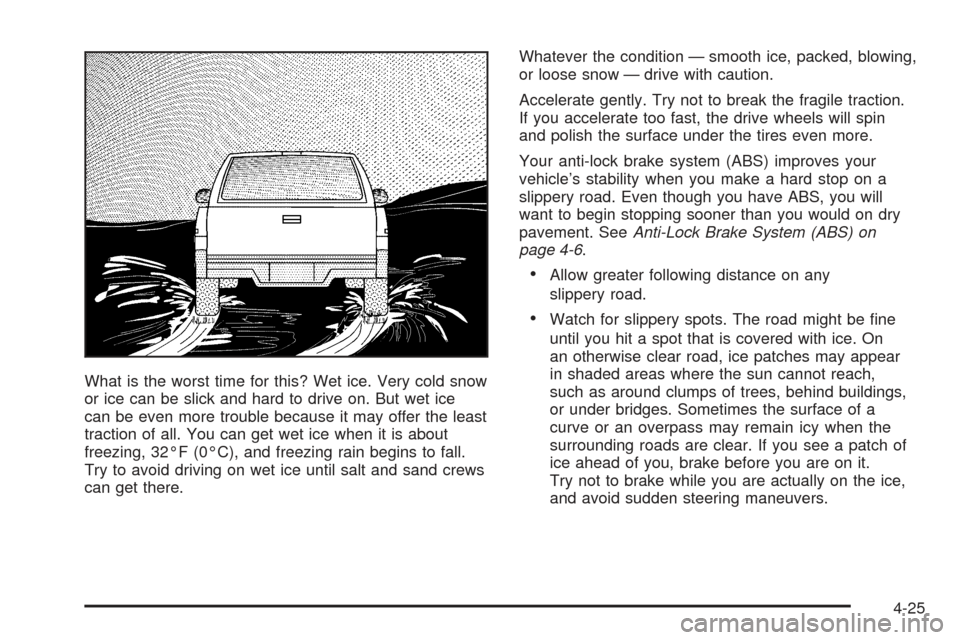
What is the worst time for this? Wet ice. Very cold snow
or ice can be slick and hard to drive on. But wet ice
can be even more trouble because it may offer the least
traction of all. You can get wet ice when it is about
freezing, 32°F (0°C), and freezing rain begins to fall.
Try to avoid driving on wet ice until salt and sand crews
can get there.Whatever the condition — smooth ice, packed, blowing,
or loose snow — drive with caution.
Accelerate gently. Try not to break the fragile traction.
If you accelerate too fast, the drive wheels will spin
and polish the surface under the tires even more.
Your anti-lock brake system (ABS) improves your
vehicle’s stability when you make a hard stop on a
slippery road. Even though you have ABS, you will
want to begin stopping sooner than you would on dry
pavement. SeeAnti-Lock Brake System (ABS) on
page 4-6.
Allow greater following distance on any
slippery road.
Watch for slippery spots. The road might be ne
until you hit a spot that is covered with ice. On
an otherwise clear road, ice patches may appear
in shaded areas where the sun cannot reach,
such as around clumps of trees, behind buildings,
or under bridges. Sometimes the surface of a
curve or an overpass may remain icy when the
surrounding roads are clear. If you see a patch of
ice ahead of you, brake before you are on it.
Try not to brake while you are actually on the ice,
and avoid sudden steering maneuvers.
4-25
Page 242 of 388
Installing the Ball Rod
To install the ball rod do the following:
1. Remove the cover of the housing located behind
the license plate area by pushing in the tabs and
pulling downward.2. Be sure the unit is unlocked before pretensioning.
Unlock using the key.
4-40
Page 248 of 388

Parking on Hills
{CAUTION:
You really should not park your vehicle, with
a trailer attached, on a hill. If something goes
wrong, your rig could start to move. People
can be injured, and both your vehicle and the
trailer can be damaged.
But if you ever have to park your rig on a hill, here’s
how to do it:
1. Apply your regular brakes, but don’t shift into
PARK (P) yet for an automatic transmission, or
into gear for a manual transmission. Turn your
wheels into the curb if facing downhill or into traffic
if facing uphill.
2. Have someone place chocks under the trailer
wheels.
3. When the wheel chocks are in place, release the
regular brakes until the chocks absorb the load.
4. Release the regular brakes.
When You Are Ready to Leave
After Parking on a Hill
1. Apply your regular brakes and hold the pedal down
while you:
Start your engine.
Shift into a gear.
Release the parking brake.
2. Let up on the brake pedal.
3. Drive slowly until the trailer is clear of the chocks.
4. Stop and have someone pick up and store the
chocks.
4-46
Page 290 of 388

4. Open the hoods and locate the positive (+) and
negative (−) terminal locations on the other vehicle.
Your vehicle has a remote positive (+) jump starting
terminal and a remote negative (−) jump starting
terminal. You should always use these remote
terminals instead of the terminals on the battery.
The remote positive (+)
terminal is located in the
engine compartment
on the passenger’s side
of the vehicle.
Press inward on the tabs located on the outboard
sides of the remote positive (+) terminal cover
and pull outward to access the terminal.The remote negative (−)
terminal is located near
the power steering
uid reservoir. It is marked
GND (−). SeeEngine
Compartment Overview
on page 5-12for more
information on location.
You will not see the battery of your vehicle under
the hood. It is located on the rear underside of
the vehicle. You will not need to access the battery
for jump starting. The remote positive (+) terminal
is for that purpose.
{CAUTION:
An electric fan can start up even when the
engine is not running and can injure you.
Keep hands, clothing and tools away from
any underhood electric fan.
5-40
Page 296 of 388
Front Turn Signal, Sidemarker and
Parking Lamps
Front Turn and Parking Lamps
To replace the front turn or parking lamp bulbs,
do the following:
1. Open the hood. SeeHood Release on page 5-11
for more information.
2. Locate the bar that runs across the front of the
vehicle and remove the two screws located near
the front of the hood that hold the bar in place.
3. Release the tabs that attach the bar to the
headlamps.
4. Pull outward on the bar to remove it from the
vehicle.
5-46
Page 297 of 388
5. Locate and release the tabs behind the grille that
hold the lamp assembly in place. Unsnap the tabs
and push forward to remove the lamp assembly.
6. Turn the bulb socket counterclockwise to access
the bulb.
7. Pull the old bulb out of the socket and push in a
new bulb.
8. Reverse the steps to reinstall the lamp assembly.
Sidemarker Lamps
To replace a sidemarker bulb, do the following:
1. Reach underneath the vehicle to locate the
sidemarker bulb.
2. Turn the bulb socket counterclockwise to remove it.
3. Pull the old bulb out of the socket and push in a
new bulb.
4. Reverse steps to reinstall the bulb socket.
5-47
Page 318 of 388
Tire Inator Kit
Your vehicle is equipped with a tire inator kit. It is
located behind the driver’s seat of your vehicle.
The repair kit contains the following:
A. Air Compressor
B. Tire Sealant
C. Sealant Filling Hose
D. Air Compressor
Accessory Plug
E. Air Compressor
Inator HoseF. Air Pressure Gage
G. Sealant Filling
Hose Plug
H. Valve Core Remover
I. Spare Valve Core
J. 55 mph (90 km/h)
Label
Accessing the Tire Inator Kit
To access the tire inator kit, do the following:
1. Loosen the two wing nuts holding the tire inator kit
cover in place.
2. Remove the cover.
3. Grasp the handle and pull the tire inator kit out.
4. Open the tire inator kit case by lifting up the
two tabs located on either side of the kit handle.
5-68
Page 338 of 388
Engine Compartment Fuse Block
The fuse block is located
under the hood in the
engine compartment on
the driver’s side of
the vehicle. SeeEngine
Compartment Overview
on page 5-12for more
information on location.To remove the fuse block cover and access the fuses,
do the following:
1. To remove the primary fuse block cover, press in
on the two locking tabs and then lift the cover off.
2. Lift up on the secondary cover to remove it.
3. Reverse the steps to reinstall the covers.
5-88


