If Your Vehicle is Stuck in Sand,
Mud, Ice or Snow
In order to free your vehicle when it is stuck, you will
need to spin the wheels, but you do not want to
spin your wheels too fast. The method known as rocking
can help you get out when you are stuck, but you
must use caution.
{CAUTION:
If you let your tires spin at high speed, they can
explode, and you or others could be injured.
And, the transmission or other parts of the
vehicle can overheat. That could cause an
engine compartment re or other damage.
When you are stuck, spin the wheels as little as
possible. Do not spin the wheels above 35 mph
(55 km/h) as shown on the speedometer.
Notice:Spinning your wheels can destroy parts of
your vehicle as well as the tires. If you spin the
wheels too fast while shifting your transmission
back and forth, you can destroy your transmission.
Rocking Your Vehicle to Get It Out
First, turn the steering wheel left and right. That will clear
the area around the front wheels. If you have a
four-wheel-drive vehicle, shift into 4HI. SeeFour-Wheel
Drive on page 2-33. If your vehicle has traction
control, you should turn the traction control system off.
SeeTraction Control System (TCS) on page 4-10.
Then shift back and forth between REVERSE (R) and a
forward gear, or with a manual transmission, between
FIRST (1) or SECOND (2) and REVERSE (R), spinning
the wheels as little as possible. Release the accelerator
pedal while you shift, and press lightly on the
accelerator pedal when the transmission is in gear. By
slowly spinning your wheels in the forward and
reverse directions, you will cause a rocking motion that
may free your vehicle. If that does not get you out
after a few tries, you may need to be towed out. If you
do need to be towed out, seeTowing Your Vehicle
on page 4-35.
4-30
Rear Axle Shift Motor
When to Check and Change Fluid
If you have an optional air-shift two-speed, controlled
traction, or locking differential type rear axle, a good time
to check the fluid level in the axle shift motor is when
the rear axle lubricant is checked. Use refrigerant
oil (shift motor only).
How to Check Fluid
Remove the plug on the front plate of the axle shift
motor, add enough fluid to raise the level to the bottom
of the filler plug hole, then replace the plug.
What to Use
Refer to your Maintenance Schedule to determine what
kind of lubricant to use. SeePart C: Recommended
Fluids and Lubricants on page 6-32.
Four-Wheel Drive
Transfer Case
When to Check Lubricant
It is not necessary to regularly check transfer case fluid
unless you suspect there is a leak or you hear an
unusual noise. A fluid loss could indicate a problem.
Have it inspected and repaired.
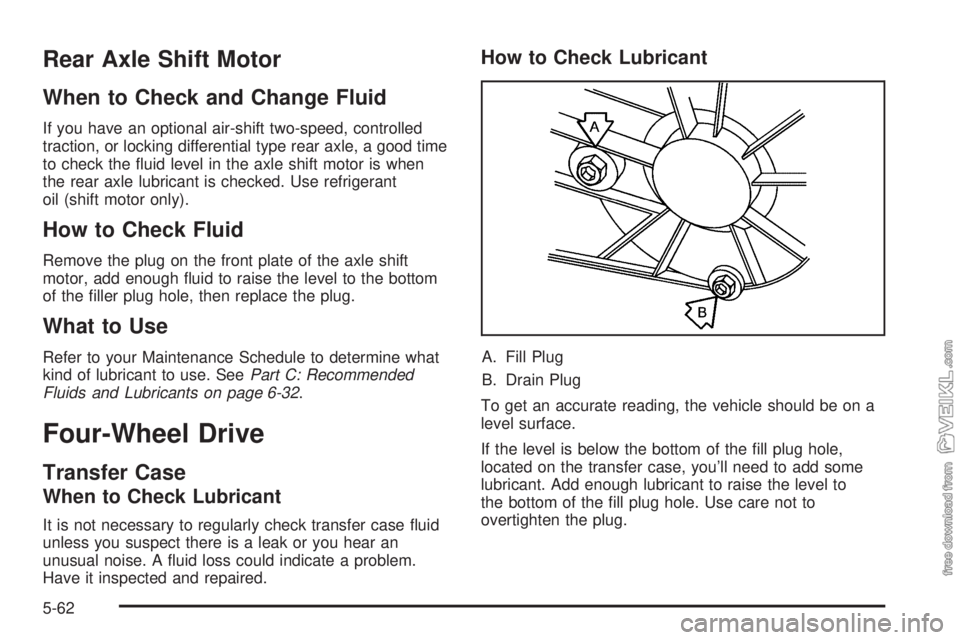
How to Check Lubricant
A. Fill Plug
B. Drain Plug
To get an accurate reading, the vehicle should be on a
level surface.
If the level is below the bottom of the fill plug hole,
located on the transfer case, you’ll need to add some
lubricant. Add enough lubricant to raise the level to
the bottom of the fill plug hole. Use care not to
overtighten the plug.
5-62
Towing
Power Take-Off (PTO)..................................4-38
Your Vehicle...............................................4-35
Traction
Control System (TCS)..................................4-10
Trailer
Connections................................................4-37
Trailer Brake Hand Control Valve........................ 4-8
Transmission
Fluid, Automatic...........................................5-34
Fluid, Manual..............................................5-35
Service Warning Light..................................3-31
Temperature Gage.......................................3-39
Transmission Operation, Automatic....................2-28
Transmission Operation, Manual........................2-29
Trip Odometer................................................3-26
Turn and Lane-Change Signals.......................... 3-8
Turn Signal/Multifunction Lever........................... 3-7
Two-Speed Rear Axle Electric Shift Control.........2-26U
Understanding Radio Reception........................3-57
V
Vehicle
Control........................................................ 4-5
Damage Warnings........................................... iv
Loading......................................................4-32
Symbols......................................................... iv
Vehicle Data Collection and Event Data
Recorders.................................................... 7-6
Vehicle Identification
Number (VIN).............................................5-87
Service Parts Identification Label...................5-88
Service Statement.......................................5-87
Ventilation Adjustment......................................3-23
Visors...........................................................2-10
Voltmeter Gage..............................................3-30
13