Page 264 of 320
Fuses and Circuit Breakers
The wiring circuits in your vehicle are protected from
short circuits by a combination of fuses, circuit breakers
and fusible thermal links in the wiring itself.
Look at the silver-colored band inside the fuse. If the
band is broken or melted, replace the fuse. Be sure you
replace a bad fuse with a new one of the identical
size and rating.
If you ever have a problem on the road and don’t have
a spare fuse, you can borrow one that has the same
amperage. Just pick a feature of your vehicle that
you can get along without — like the radio or cigarette
lighter — and use its fuse, if it is the correct amperage.
Replace it as soon as you can.
There are three fuse blocks in your vehicle:
two instrument panel fuse blocks and the engine
compartment fuse block.
There is a fuse puller located on the engine
compartment fuse block. It can be used to easily
remove fuses from the fuse block.
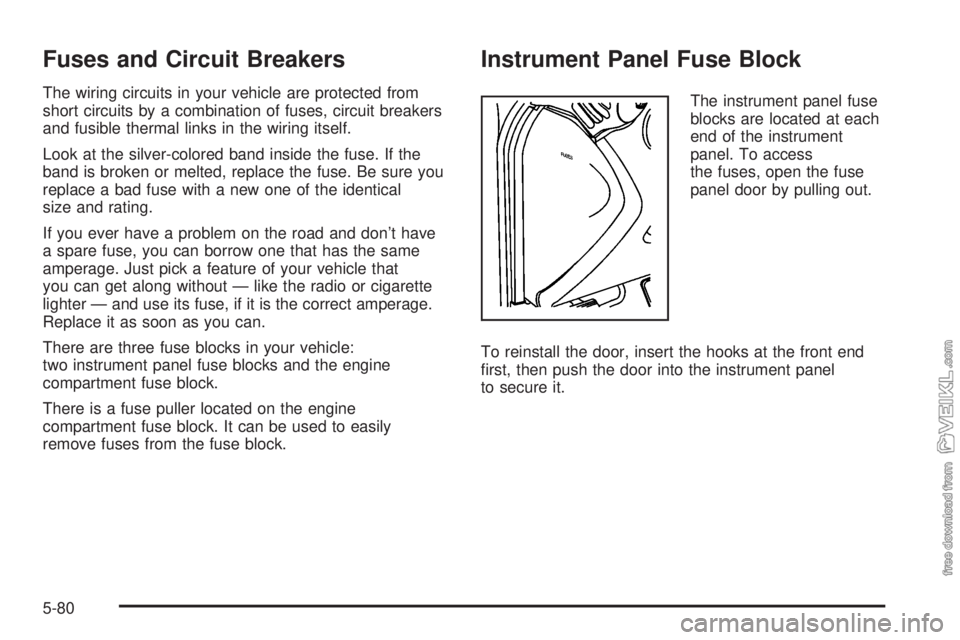
Instrument Panel Fuse Block
The instrument panel fuse
blocks are located at each
end of the instrument
panel. To access
the fuses, open the fuse
panel door by pulling out.
To reinstall the door, insert the hooks at the front end
first, then push the door into the instrument panel
to secure it.
5-80
Page 265 of 320
Driver’s Side
Your vehicle may not be equipped with all the fuses and
features listed.
Fuses Usage
A Wipers
BTrunk Release and Remote Keyless
Entry
C Turn Signals
D Power Mirrors
E Air Bag
F Body Function Control Module
G Powertrain Control Module (PCM)
Fuses Usage
H Door Locks
JBody Function Control Module/
Instrument Panel Cluster
STOP LPS Stoplamps
HAZARD LPS Hazard Lamps
IPC/
HVAC BATTInstrument Panel Cluster,
Climate Control
Relays Usage
MICRO RELAY
TRUNK RELRemote Trunk Release
MICRO
RELAY
DR UNLOCKDoor Locks
MICRO
RELAY
DR LOCKDoor Locks
MICRO
RELAY
DRIVERS
DR UNLOCKDoor Locks
Circuit
Breakers Usage
CIRCUIT BRKR
PWR SEATSPower Seats
5-81
Page 267 of 320
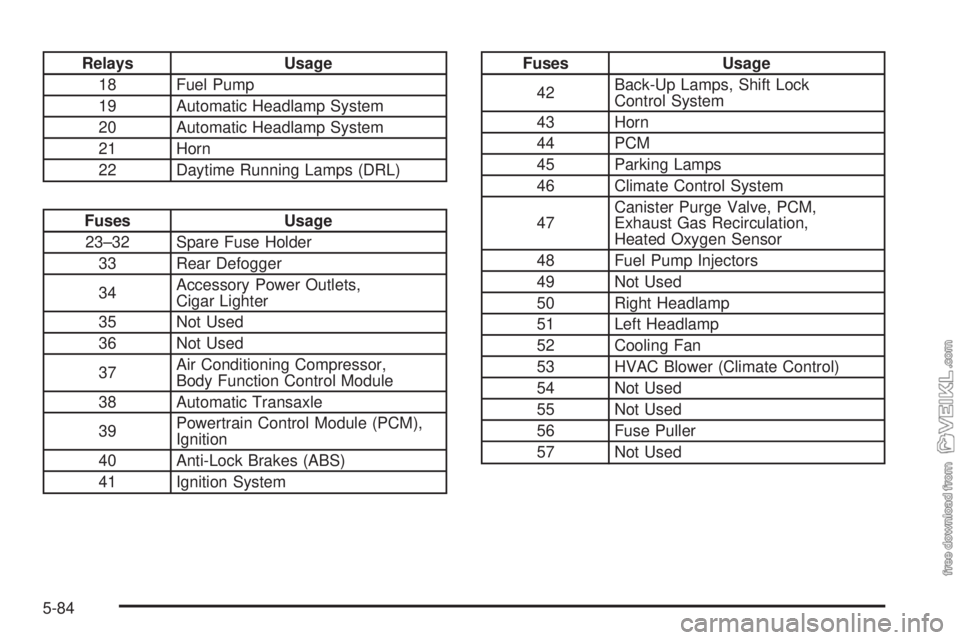
Engine Compartment Fuse Block
The engine compartment fuse block is located on the
driver’s side of the vehicle, near the engine air
cleaner/filter. SeeEngine Compartment Overview on
page 5-12for more information on location.
Fuses Usage
1 Ignition Switch
2Right Electrical Center-Fog Lamps
(If Equipped), Radio, Body Function
Control Module, Interior Lamps
Fuses Usage
3Left Electrical Center-Stoplamps,
Hazard Lamps, Body Function
Control Module, Cluster, Climate
Control System
4 Anti-Lock Brakes
5 Ignition Switch
6 Not Used
7Left Electrical Center-Power Seats,
Power Mirrors, Door Locks, Trunk
Release and Remote Lock Control
8 Cooling Fan #1
Relays Usage
9 Rear Defogger
10 Not Used
11 Not Used
12 Cooling Fan #1
13 HVAC Blower (Climate Control)
14 Not Used
15 Cooling Fan
16 Air Conditioning Compressor
17 Not Used
5-83
Page 268 of 320
Relays Usage
18 Fuel Pump
19 Automatic Headlamp System
20 Automatic Headlamp System
21 Horn
22 Daytime Running Lamps (DRL)
Fuses Usage
23–32 Spare Fuse Holder
33 Rear Defogger
34Accessory Power Outlets,
Cigar Lighter
35 Not Used
36 Not Used
37Air Conditioning Compressor,
Body Function Control Module
38 Automatic Transaxle
39Powertrain Control Module (PCM),
Ignition
40 Anti-Lock Brakes (ABS)
41 Ignition System
Fuses Usage
42Back-Up Lamps, Shift Lock
Control System
43 Horn
44 PCM
45 Parking Lamps
46 Climate Control System
47Canister Purge Valve, PCM,
Exhaust Gas Recirculation,
Heated Oxygen Sensor
48 Fuel Pump Injectors
49 Not Used
50 Right Headlamp
51 Left Headlamp
52 Cooling Fan
53 HVAC Blower (Climate Control)
54 Not Used
55 Not Used
56 Fuse Puller
57 Not Used
5-84
Page 287 of 320
At Least Twice a Year
Restraint System Check
Make sure the safety belt reminder light and all your
belts, buckles, latch plates, retractors and anchorages
are working properly. Look for any other loose or
damaged safety belt system parts. If you see anything
that might keep a safety belt system from doing its
job, have it repaired. Have any torn or frayed safety belts
replaced.
Also look for any opened or broken airbag coverings,
and have them repaired or replaced. (The airbag system
does not need regular maintenance.)
Wiper Blade Check
Inspect wiper blades for wear or cracking. Replace
blade inserts that appear worn or damaged or that
streak or miss areas of the windshield. Also see
Windshield and Wiper Blades on page 5-75.
Weatherstrip Lubrication
Silicone grease on weatherstrips will make them last
longer, seal better, and not stick or squeak. Apply
silicone grease with a clean cloth. During very cold,
damp weather more frequent application may be
required. SeePart D: Recommended Fluids and
Lubricants on page 6-22.
Automatic Transaxle Inspection
It is not necessary to check the transaxle fluid level.
A transaxle fluid leak is the only reason for fluid
loss. Check for leaks. If a leak occurs, take the vehicle
to your dealer and have it repaired as soon as
possible.
At Least Once a Year
Key Lock Cylinders Service
Lubricate the key lock cylinders with the lubricant
specified in Part D.
Body Lubrication Service
Lubricate all the body door hinges and latches, including
those for the hood and trunk lid. Part D tells you what
to use. More frequent lubrication may be required when
exposed to a corrosive environment.
6-17
Page 288 of 320
Starter Switch Check
{CAUTION:
When you are doing this inspection, the
vehicle could move suddenly. If the vehicle
moves, you or others could be injured.
1. Before you start, be sure you have enough room
around the vehicle.
2. Firmly apply both the parking brake and the regular
brake. SeeParking Brake on page 2-22.
Do not use the accelerator pedal, and be ready to
turn off the engine immediately if it starts.
3. Try to start the engine in each gear. The vehicle
should start only in PARK (P) or NEUTRAL (N).
If the vehicle starts in any other position, your
vehicle needs service.
Automatic Transaxle Shift Lock Control
System Check
{CAUTION:
When you are doing this inspection, the
vehicle could move suddenly. If the vehicle
moves, you or others could be injured.
1. Before you start, be sure you have enough room
around the vehicle. It should be parked on a level
surface.
2. Firmly apply the parking brake. SeeParking Brake
on page 2-22.
Be ready to apply the regular brake immediately if
the vehicle begins to move.
3. With the engine off, turn the ignition to ON, but do
not start the engine. Without applying the regular
brake, try to move the shift lever out of PARK (P)
with normal effort. If the shift lever moves out
of PARK (P), your vehicle needs service.
6-18
Page 289 of 320
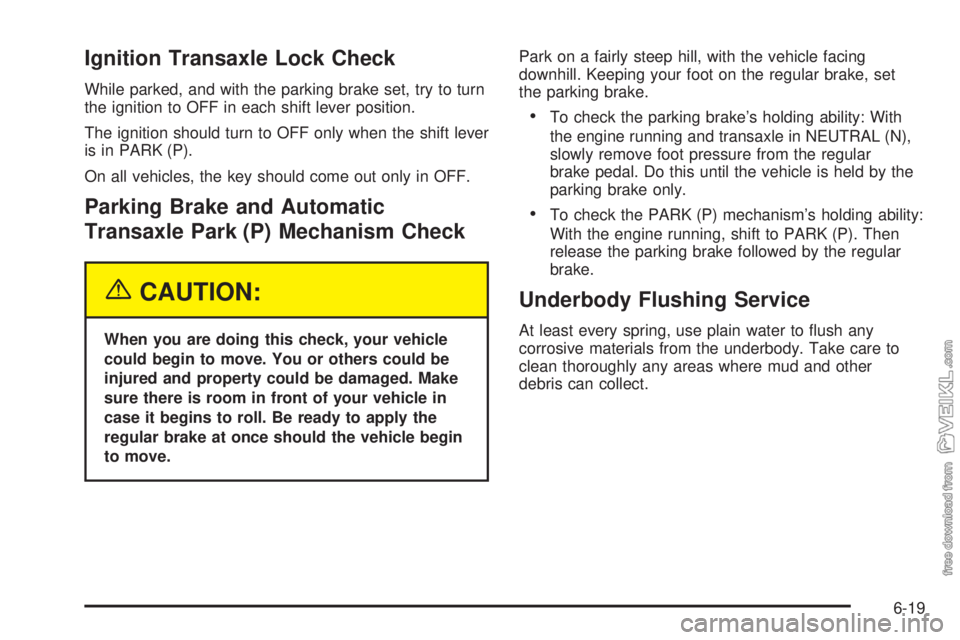
Ignition Transaxle Lock Check
While parked, and with the parking brake set, try to turn
the ignition to OFF in each shift lever position.
The ignition should turn to OFF only when the shift lever
is in PARK (P).
On all vehicles, the key should come out only in OFF.
Parking Brake and Automatic
Transaxle Park (P) Mechanism Check
{CAUTION:
When you are doing this check, your vehicle
could begin to move. You or others could be
injured and property could be damaged. Make
sure there is room in front of your vehicle in
case it begins to roll. Be ready to apply the
regular brake at once should the vehicle begin
to move.Park on a fairly steep hill, with the vehicle facing
downhill. Keeping your foot on the regular brake, set
the parking brake.
•To check the parking brake’s holding ability: With
the engine running and transaxle in NEUTRAL (N),
slowly remove foot pressure from the regular
brake pedal. Do this until the vehicle is held by the
parking brake only.
•To check the PARK (P) mechanism’s holding ability:
With the engine running, shift to PARK (P). Then
release the parking brake followed by the regular
brake.
Underbody Flushing Service
At least every spring, use plain water to flush any
corrosive materials from the underbody. Take care to
clean thoroughly any areas where mud and other
debris can collect.
6-19
Page 292 of 320
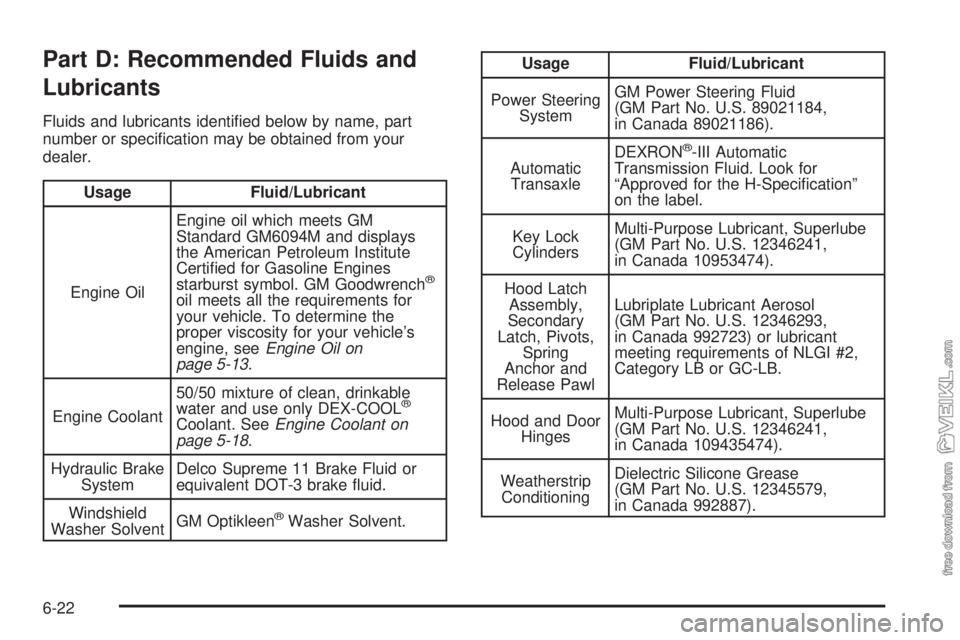
Part D: Recommended Fluids and
Lubricants
Fluids and lubricants identified below by name, part
number or specification may be obtained from your
dealer.
Usage Fluid/Lubricant
Engine OilEngine oil which meets GM
Standard GM6094M and displays
the American Petroleum Institute
Certified for Gasoline Engines
starburst symbol. GM Goodwrench
®
oil meets all the requirements for
your vehicle. To determine the
proper viscosity for your vehicle’s
engine, seeEngine Oil on
page 5-13.
Engine Coolant50/50 mixture of clean, drinkable
water and use only DEX-COOL
®
Coolant. SeeEngine Coolant on
page 5-18.
Hydraulic Brake
SystemDelco Supreme 11 Brake Fluid or
equivalent DOT-3 brake fluid.
Windshield
Washer SolventGM Optikleen
®Washer Solvent.
Usage Fluid/Lubricant
Power Steering
SystemGM Power Steering Fluid
(GM Part No. U.S. 89021184,
in Canada 89021186).
Automatic
TransaxleDEXRON
®-III Automatic
Transmission Fluid. Look for
“Approved for the H-Specification”
on the label.
Key Lock
CylindersMulti-Purpose Lubricant, Superlube
(GM Part No. U.S. 12346241,
in Canada 10953474).
Hood Latch
Assembly,
Secondary
Latch, Pivots,
Spring
Anchor and
Release PawlLubriplate Lubricant Aerosol
(GM Part No. U.S. 12346293,
in Canada 992723) or lubricant
meeting requirements of NLGI #2,
Category LB or GC-LB.
Hood and Door
HingesMulti-Purpose Lubricant, Superlube
(GM Part No. U.S. 12346241,
in Canada 109435474).
Weatherstrip
ConditioningDielectric Silicone Grease
(GM Part No. U.S. 12345579,
in Canada 992887).
6-22