2005 CHEVROLET CLASSIC lock
[x] Cancel search: lockPage 27 of 320
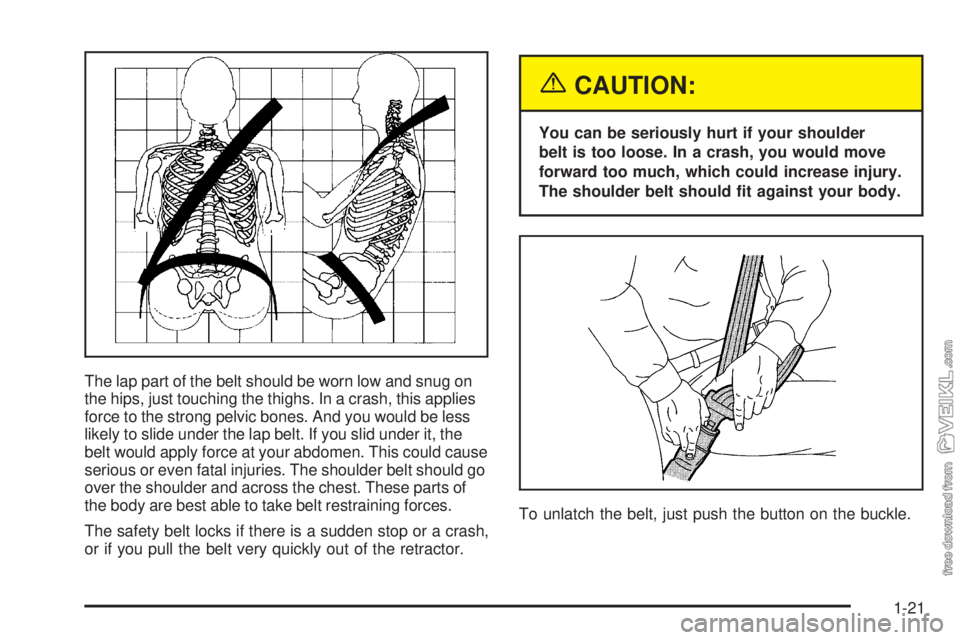
The lap part of the belt should be worn low and snug on
the hips, just touching the thighs. In a crash, this applies
force to the strong pelvic bones. And you would be less
likely to slide under the lap belt. If you slid under it, the
belt would apply force at your abdomen. This could cause
serious or even fatal injuries. The shoulder belt should go
over the shoulder and across the chest. These parts of
the body are best able to take belt restraining forces.
The safety belt locks if there is a sudden stop or a crash,
or if you pull the belt very quickly out of the retractor.
{CAUTION:
You can be seriously hurt if your shoulder
belt is too loose. In a crash, you would move
forward too much, which could increase injury.
The shoulder belt should t against your body.
To unlatch the belt, just push the button on the buckle.
1-21
Page 51 of 320
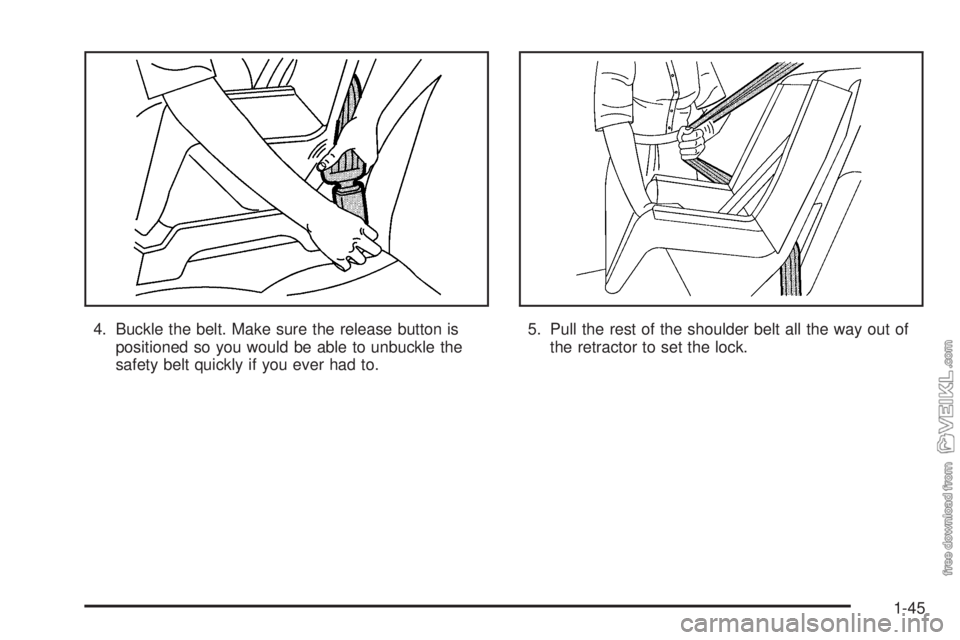
4. Buckle the belt. Make sure the release button is
positioned so you would be able to unbuckle the
safety belt quickly if you ever had to.5. Pull the rest of the shoulder belt all the way out of
the retractor to set the lock.
1-45
Page 61 of 320

Keys...............................................................2-2
Remote Keyless Entry System.........................2-3
Remote Keyless Entry System Operation...........2-4
Doors and Locks.............................................2-7
Door Locks....................................................2-7
Power Door Locks..........................................2-8
Door Ajar Reminder........................................2-8
Delayed Locking.............................................2-8
Programmable Automatic Door Locks................2-9
Rear Door Security Locks..............................2-10
Lockout Protection........................................2-11
Trunk..........................................................2-11
Windows........................................................2-13
Power Windows............................................2-14
Sun Visors...................................................2-14
Theft-Deterrent Systems..................................2-15
Passlock
®....................................................2-15
Starting and Operating Your Vehicle................2-15
New Vehicle Break-In....................................2-15
Ignition Positions..........................................2-16Retained Accessory Power (RAP)...................2-17
Starting the Engine.......................................2-17
Engine Coolant Heater..................................2-18
Automatic Transaxle Operation.......................2-19
Second-Gear Start........................................2-22
Parking Brake..............................................2-22
Shifting Into Park (P).....................................2-23
Shifting Out of Park (P).................................2-24
Parking Over Things That Burn.......................2-25
Engine Exhaust............................................2-25
Running the Engine While Parked...................2-26
Mirrors...........................................................2-27
Manual Rearview Mirror.................................2-27
Outside Power Mirrors...................................2-27
Outside Convex Mirror...................................2-28
Storage Areas................................................2-28
Glove Box...................................................2-28
Cupholder(s)................................................2-28
Center Console Storage Area.........................2-28
Section 2 Features and Controls
2-1
Page 63 of 320
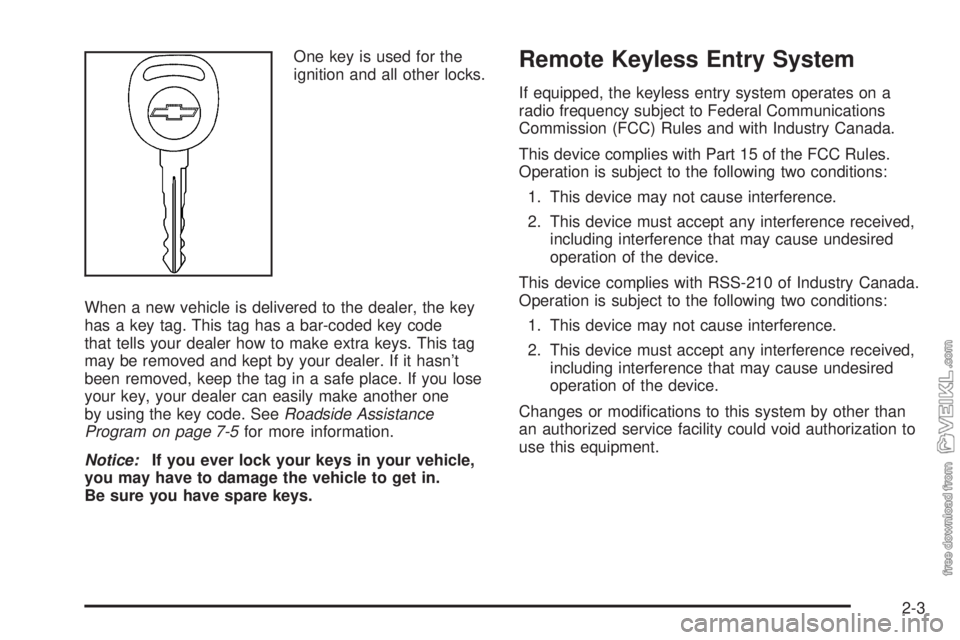
One key is used for the
ignition and all other locks.
When a new vehicle is delivered to the dealer, the key
has a key tag. This tag has a bar-coded key code
that tells your dealer how to make extra keys. This tag
may be removed and kept by your dealer. If it hasn’t
been removed, keep the tag in a safe place. If you lose
your key, your dealer can easily make another one
by using the key code. SeeRoadside Assistance
Program on page 7-5for more information.
Notice:If you ever lock your keys in your vehicle,
you may have to damage the vehicle to get in.
Be sure you have spare keys.Remote Keyless Entry System
If equipped, the keyless entry system operates on a
radio frequency subject to Federal Communications
Commission (FCC) Rules and with Industry Canada.
This device complies with Part 15 of the FCC Rules.
Operation is subject to the following two conditions:
1. This device may not cause interference.
2. This device must accept any interference received,
including interference that may cause undesired
operation of the device.
This device complies with RSS-210 of Industry Canada.
Operation is subject to the following two conditions:
1. This device may not cause interference.
2. This device must accept any interference received,
including interference that may cause undesired
operation of the device.
Changes or modifications to this system by other than
an authorized service facility could void authorization to
use this equipment.
2-3
Page 64 of 320
At times you may notice a decrease in range. This is
normal for any remote keyless entry system. If the
transmitter does not work or if you have to stand closer
to your vehicle for the transmitter to work, try this:
•Check the distance. You may be too far from your
vehicle. You may need to stand closer during
rainy or snowy weather.
•Check the location. Other vehicles or objects may
be blocking the signal. Take a few steps to the
left or right, hold the transmitter higher, and
try again.
•Check to determine if battery replacement is
necessary. See “Battery Replacement” under
Remote Keyless Entry System Operation on
page 2-4.
•If you are still having trouble, see your dealer or
a qualified technician for service.
Remote Keyless Entry System
Operation
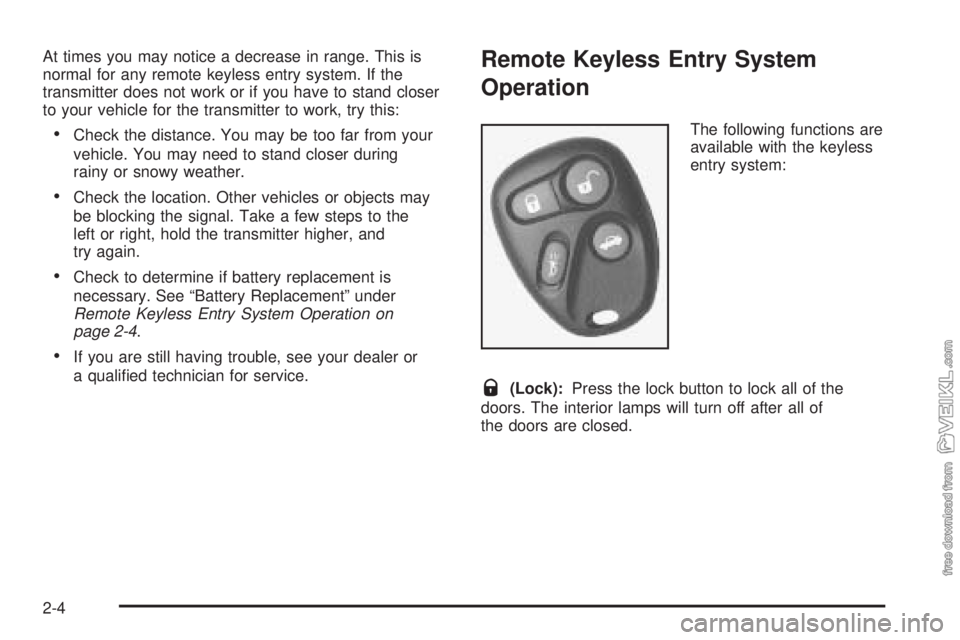
The following functions are
available with the keyless
entry system:
Q(Lock):Press the lock button to lock all of the
doors. The interior lamps will turn off after all of
the doors are closed.
2-4
Page 65 of 320
W(Unlock):Press the unlock button once to unlock
the driver’s door. Press the button again within five
seconds for all remaining doors to unlock. The interior
lamps will stay on for 10 seconds or until the ignition
is turned on.
V(Remote Trunk Release):Press the remote trunk
release button to unlock and release the trunk lid.
You can open the trunk with the transmitter when the
vehicle speed is less than 2 mph (3 km/h), when
the parking brake is engaged, or when the ignition is off.
The interior lamps will come on for 10 seconds or
until the ignition is turned to ON.
L(Remote Alarm):Press this button for the horn to
sound and the headlamps and the parking lamps to flash
for up to two minutes. The interior lamps will come on and
remain on while the horn is sounding and the lamps are
flashing. Press the remote alarm button again, or turn the
ignition to ON, to turn off the horn and lamps.
Programmable Horn Chirp
When you use the remote keyless entry transmitter
to lock the doors or use the delayed locking feature the
parking lamps will flash and the horn will chirp.The programmable horn chirp can be disabled by
pressing and holding either of the door lock switches in
the unlock position for 10 seconds with the ignition
ON and all of the doors closed. When you hear the horn
chirp, programming is complete.
To reactivate the horn chirp feature, repeat the above
procedure.
Matching Transmitter(s) to Your
Vehicle
Each remote keyless entry transmitter is coded to
prevent another transmitter from unlocking your vehicle.
If a transmitter is lost or stolen, a replacement can
be purchased through your dealer. Remember to bring
any remaining transmitters with you when you go to
your dealer. When the dealer matches the replacement
transmitter to your vehicle, any remaining transmitters
must also be matched. Once your dealer has coded the
new transmitter, the lost transmitter will not unlock
your vehicle. Each vehicle can have a maximum of
four transmitters matched to it.
2-5
Page 67 of 320
Doors and Locks
Door Locks
{CAUTION:
Unlocked doors can be dangerous.
Passengers — especially children — can
easily open the doors and fall out of a
moving vehicle. When a door is locked, the
handle will not open it. You increase the
chance of being thrown out of the vehicle
in a crash if the doors are not locked. So,
wear safety belts properly and lock the
doors whenever you drive.
Young children who get into unlocked
vehicles may be unable to get out. A child
can be overcome by extreme heat and can
suffer permanent injuries or even death
from heat stroke. Always lock your vehicle
whenever you leave it.
Outsiders can easily enter through an
unlocked door when you slow down or
stop your vehicle. Locking your doors can
help prevent this from happening.There are several ways to lock and unlock your vehicle.
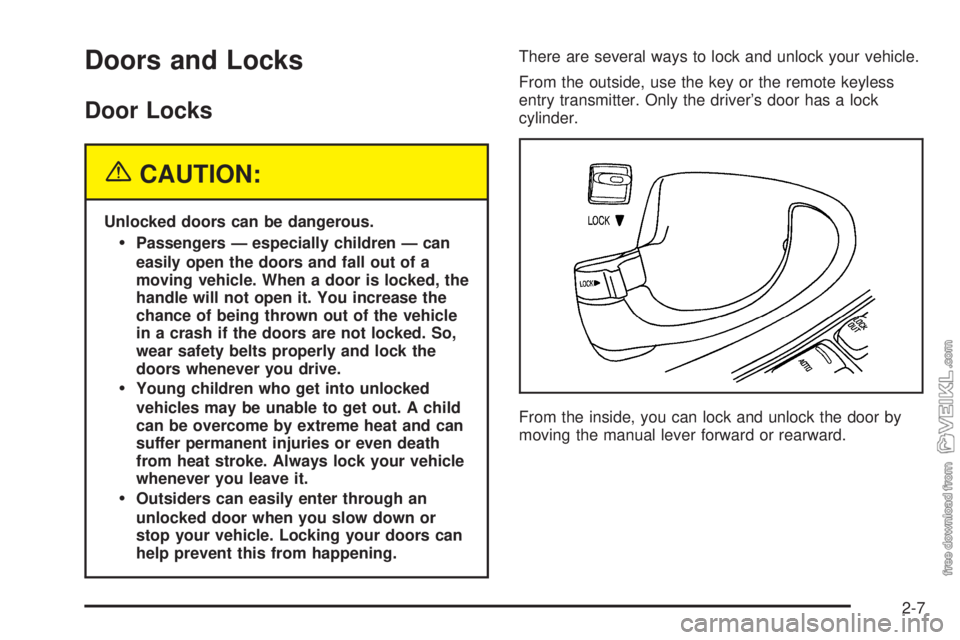
From the outside, use the key or the remote keyless
entry transmitter. Only the driver’s door has a lock
cylinder.
From the inside, you can lock and unlock the door by
moving the manual lever forward or rearward.
2-7
Page 68 of 320
Power Door Locks
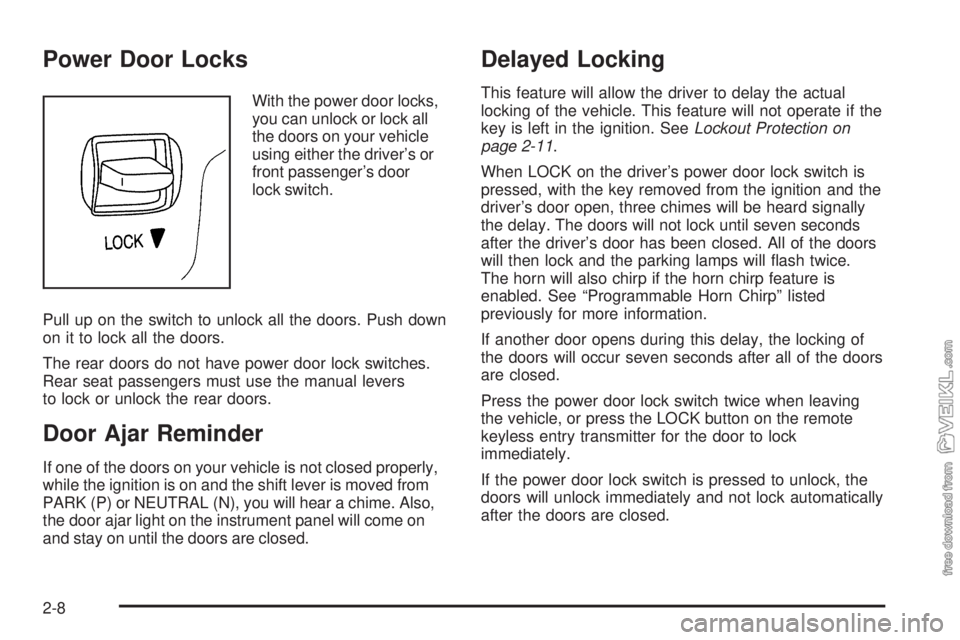
With the power door locks,
you can unlock or lock all
the doors on your vehicle
using either the driver’s or
front passenger’s door
lock switch.
Pull up on the switch to unlock all the doors. Push down
on it to lock all the doors.
The rear doors do not have power door lock switches.
Rear seat passengers must use the manual levers
to lock or unlock the rear doors.
Door Ajar Reminder
If one of the doors on your vehicle is not closed properly,
while the ignition is on and the shift lever is moved from
PARK (P) or NEUTRAL (N), you will hear a chime. Also,
the door ajar light on the instrument panel will come on
and stay on until the doors are closed.
Delayed Locking
This feature will allow the driver to delay the actual
locking of the vehicle. This feature will not operate if the
key is left in the ignition. SeeLockout Protection on
page 2-11.
When LOCK on the driver’s power door lock switch is
pressed, with the key removed from the ignition and the
driver’s door open, three chimes will be heard signally
the delay. The doors will not lock until seven seconds
after the driver’s door has been closed. All of the doors
will then lock and the parking lamps will flash twice.
The horn will also chirp if the horn chirp feature is
enabled. See “Programmable Horn Chirp” listed
previously for more information.
If another door opens during this delay, the locking of
the doors will occur seven seconds after all of the doors
are closed.
Press the power door lock switch twice when leaving
the vehicle, or press the LOCK button on the remote
keyless entry transmitter for the door to lock
immediately.
If the power door lock switch is pressed to unlock, the
doors will unlock immediately and not lock automatically
after the doors are closed.
2-8