2005 CHEVROLET BLAZER park assist
[x] Cancel search: park assistPage 112 of 436
Programming the HomeLink®
Transmitter
Do not use the HomeLink®Transmitter with any garage
door opener that does not have the “stop and reverse”
feature. This includes any garage door opener model
manufactured before April 1, 1982. If you have a newer
garage door opener with rolling codes, please be
sure to follow Steps 6 through 8 to complete the
programming of your HomeLink
®Transmitter.
Read the instructions completely before attempting to
program the HomeLink
®Transmitter. Because of
the steps involved, it may be helpful to have another
person available to assist you in programming the
transmitter.
Keep the original transmitter for use in other vehicles as
well as for future HomeLink
®programming. It is also
recommended that upon the sale of the vehicle,
the programmed HomeLink
®buttons should be erased
for security purposes. Refer to “Erasing HomeLink®
Buttons” or, for assistance, contact HomeLink®on the
Internet at: www.homelink.com or by calling
1-800-355-3515.
Be sure that people and objects are clear of the garage
door or gate operator you are programming. When
programming a garage door, it is advised to park outside
of the garage.It is recommended that a new battery be installed in
your hand-held transmitter for quicker and more
accurate transmission of the radio frequency.
Programming HomeLink®
Your vehicle’s engine should be turned off while
programming the transmitter. Follow these steps to
program up to three channels:
1. Press and hold down the two outside buttons,
releasing only when the indicator light begins to
ash, after 20 seconds. Do not hold down the
buttons for longer than 30 seconds and do not
repeat this step to program a second and/or third
transmitter to the remaining two HomeLink
®buttons.
2. Position the end of your hand-held transmitter about
1 to 3 inches (3 to 8 cm) away from the HomeLink
®
buttons while keeping the indicator light in view.
3. Simultaneously press and hold both the desired
button on HomeLink
®and the hand-held transmitter
button. Do not release the buttons until Step 4
has been completed.
Some entry gates and garage door openers may
require you to substitute Step 3 with the procedure
noted in “Gate Operator and Canadian
Programming” later in this section.
2-46
Page 263 of 436
Tow/Haul Mode
Your vehicle may be equipped with a tow/haul feature.
Tow/haul is designed to assist while your vehicle is
pulling a large or heavy load or trailer. Tow/haul is most
useful while pulling such a load in rolling terrain at
speeds less than 55 mph (88 km/h), in stop-and-go
traffic, or when you need improved low-speed control,
such as when parking. The purpose of the tow/haul
mode is to do the following:
Reduce the frequency and improve the predictability
or transmission shifts
provide the same solid shift feel while pulling a
heavy load as while the vehicle is unloaded, and
improve control of vehicle speed while requiring less
throttle pedal activity
Press the button on the end of the shift lever to turn
tow/haul mode on and off. While activated, the indicator
light on the instrument panel will be on. Tow/haul
mode will turn off automatically when the ignition is
turned off. SeeTow/Haul Mode Light on page 3-34.
Tow/haul mode is most effective when the vehicle and
load combined weight is at least 75 percent of the
vehicle’s Gross Vehicle Weight Rating (GVWR) and the
maximum trailer weight rating for the vehicle. See
“Weight of the Trailer” later in this section.Driving with tow/haul activated without a heavy load will
cause reduced fuel economy and unpleasant engine
and transmission driving characteristics, but will
not cause damage.
Weight of the Trailer
How heavy can a trailer safely be?
It depends on how you plan to use your rig. For
example, speed, altitude, road grades, outside
temperature and how much your vehicle is used to pull
a trailer are all important. And, it can also depend
on any special equipment that you have on your vehicle.
The following chart shows how much your trailer can
weigh, based upon your vehicle model and options.
Maximum trailer weight is calculated assuming the driver
and one passenger are in the tow vehicle and it has
all the required trailering equipment. The weight
of additional optional equipment, passengers and cargo
in the tow vehicle must be subtracted from the
maximum trailer weight. The weight of the trailer tongue
also affects the maximum trailer weight. See “ Weight
of the Trailer Tongue ” later in this section.
4-61
Page 344 of 436
Changing a Flat Tire
If a tire goes at, avoid further tire and wheel damage
by driving slowly to a level place. Turn on your
hazard warning ashers.
{CAUTION:
Changing a tire can be dangerous. The vehicle
can slip off the jack and roll over or fall on you
or other people. You and they could be badly
injured or even killed. Find a level place to
change your tire. To help prevent the vehicle
from moving:
1. Set the parking brake rmly.
2. Put an automatic transmission shift lever in
PARK (P), or shift a manual transmission to
FIRST (1) or REVERSE (R).
3. Turn off the engine and do not restart while
the vehicle is raised.
4. Do not allow passengers to remain in the
vehicle.
CAUTION: (Continued)
CAUTION: (Continued)
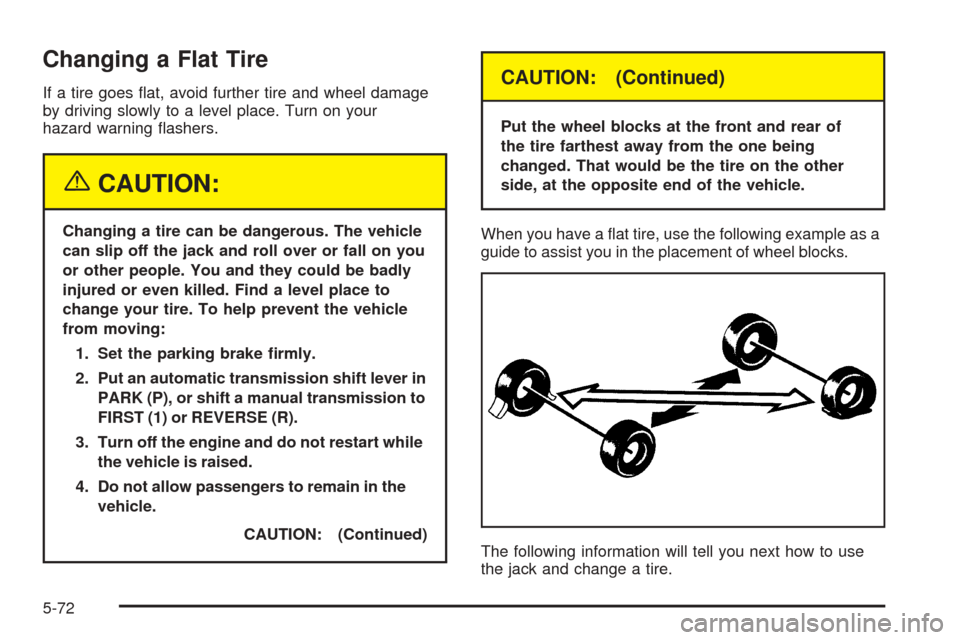
Put the wheel blocks at the front and rear of
the tire farthest away from the one being
changed. That would be the tire on the other
side, at the opposite end of the vehicle.
When you have a at tire, use the following example as a
guide to assist you in the placement of wheel blocks.
The following information will tell you next how to use
the jack and change a tire.
5-72
Page 421 of 436
Reporting Safety Defects to the
Canadian Government
If you live in Canada, and you believe that your vehicle
has a safety defect, you should immediately notify
Transport Canada, in addition to notifying General
Motors of Canada Limited. You may write to:
Transport Canada
330 Sparks Street
Tower C
Ottawa, Ontario K1A 0N5
Reporting Safety Defects to
General Motors
In addition to notifying NHTSA (or Transport Canada) in
a situation like this, we certainly hope you will notify
General Motors. Please call the Chevrolet Customer
Assistance Center at 1-800-222-1020, or write:
Chevrolet Motor Division
Chevrolet Customer Assistance Center
P.O. Box 33170
Detroit, MI 48232-5170In Canada, please call us at 1-800-263-3777 (English)
or 1-800-263-7854 (French). Or, write:
General Motors of Canada Limited
Customer Communication Centre, 163-005
1908 Colonel Sam Drive
Oshawa, Ontario L1H 8P7
Service Publications Ordering
Information
Service Manuals
Service Manuals have the diagnosis and repair
information on engines, transmission, axle suspension,
brakes, electrical, steering, body, etc.
Transmission, Transaxle, Transfer
Case Unit Repair Manual
This manual provides information on unit repair service
procedures, adjustments, and specications for GM
transmissions, transaxles, and transfer cases.
7-11
Page 432 of 436
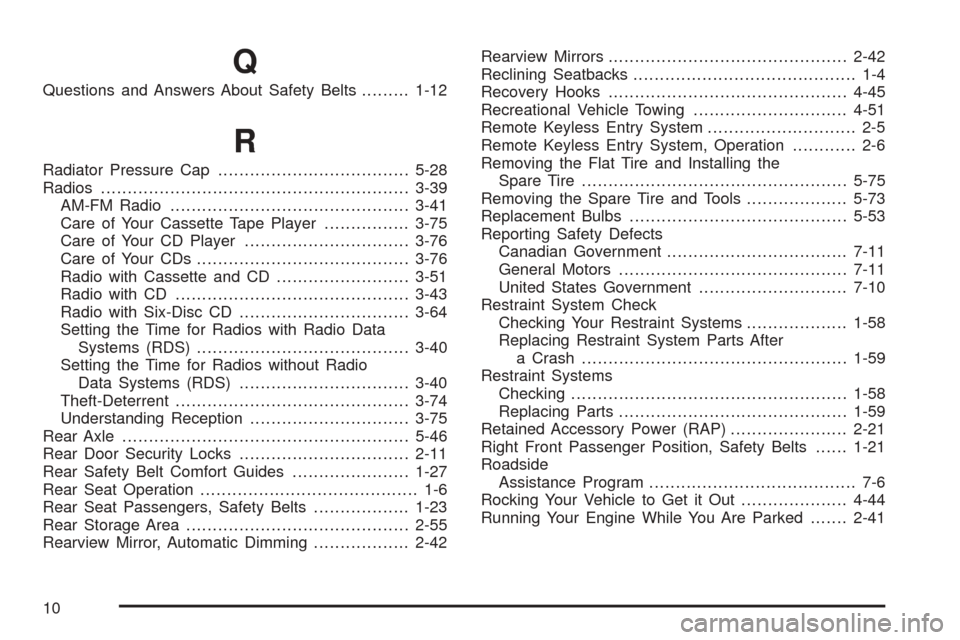
Q
Questions and Answers About Safety Belts.........1-12
R
Radiator Pressure Cap....................................5-28
Radios..........................................................3-39
AM-FM Radio.............................................3-41
Care of Your Cassette Tape Player................3-75
Care of Your CD Player...............................3-76
Care of Your CDs........................................3-76
Radio with Cassette and CD.........................3-51
Radio with CD............................................3-43
Radio with Six-Disc CD................................3-64
Setting the Time for Radios with Radio Data
Systems (RDS)........................................3-40
Setting the Time for Radios without Radio
Data Systems (RDS)................................3-40
Theft-Deterrent............................................3-74
Understanding Reception..............................3-75
Rear Axle......................................................5-46
Rear Door Security Locks................................2-11
Rear Safety Belt Comfort Guides......................1-27
Rear Seat Operation......................................... 1-6
Rear Seat Passengers, Safety Belts..................1-23
Rear Storage Area..........................................2-55
Rearview Mirror, Automatic Dimming..................2-42Rearview Mirrors.............................................2-42
Reclining Seatbacks.......................................... 1-4
Recovery Hooks.............................................4-45
Recreational Vehicle Towing.............................4-51
Remote Keyless Entry System............................ 2-5
Remote Keyless Entry System, Operation............ 2-6
Removing the Flat Tire and Installing the
Spare Tire..................................................5-75
Removing the Spare Tire and Tools...................5-73
Replacement Bulbs.........................................5-53
Reporting Safety Defects
Canadian Government..................................7-11
General Motors...........................................7-11
United States Government............................7-10
Restraint System Check
Checking Your Restraint Systems...................1-58
Replacing Restraint System Parts After
a Crash..................................................1-59
Restraint Systems
Checking....................................................1-58
Replacing Parts...........................................1-59
Retained Accessory Power (RAP)......................2-21
Right Front Passenger Position, Safety Belts......1-21
Roadside
Assistance Program....................................... 7-6
Rocking Your Vehicle to Get it Out....................4-44
Running Your Engine While You Are Parked.......2-41
10