Page 73 of 496

Keys...............................................................2-3
Remote Keyless Entry System.........................2-4
Remote Keyless Entry System Operation...........2-5
Doors and Locks.............................................2-8
Door Locks....................................................2-8
Power Door Locks..........................................2-9
Delayed Locking.............................................2-9
Programmable Automatic Door Locks..............2-10
Rear Door Security Locks..............................2-10
Lockout Protection........................................2-11
Midgate.......................................................2-11
Tailgate.......................................................2-20
Windows........................................................2-22
Power Windows............................................2-23
Sun Visors...................................................2-23
Theft-Deterrent Systems..................................2-24
Content Theft-Deterrent.................................2-24
Passlock
®....................................................2-26
Starting and Operating Your Vehicle................2-26
New Vehicle Break-In....................................2-26
Ignition Positions..........................................2-27
Retained Accessory Power (RAP)...................2-27
Starting the Engine.......................................2-28
Adjustable Throttle and Brake Pedal................2-29Engine Coolant Heater..................................2-30
Automatic Transmission Operation...................2-31
Tow/Haul Mode............................................2-33
Four-Wheel Drive..........................................2-34
Parking Brake..............................................2-38
Shifting Into Park (P).....................................2-39
Shifting Out of Park (P).................................2-41
Parking Over Things That Burn.......................2-41
Engine Exhaust............................................2-42
Running the Engine While Parked...................2-42
Mirrors...........................................................2-43
Automatic Dimming Rearview Mirror with
OnStar
®, Compass and Temperature
Display....................................................2-43
Automatic Dimming Rearview Mirror with
Compass and Temperature Display..............2-46
Outside Camper-Type Mirrors.........................2-48
Outside Power Mirrors...................................2-49
Outside Convex Mirror...................................2-50
Outside Heated Mirrors..................................2-50
Outside Automatic Dimming Mirror with Curb
View Assist..............................................2-51
OnStar
®System.............................................2-51
Section 2 Features and Controls
2-1
Page 85 of 496
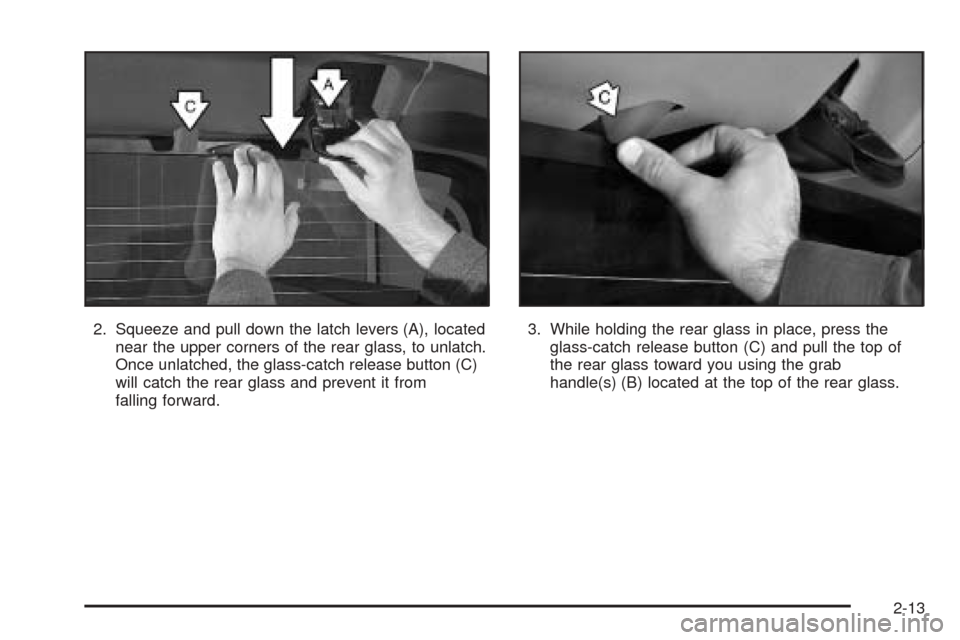
2. Squeeze and pull down the latch levers (A), located
near the upper corners of the rear glass, to unlatch.
Once unlatched, the glass-catch release button (C)
will catch the rear glass and prevent it from
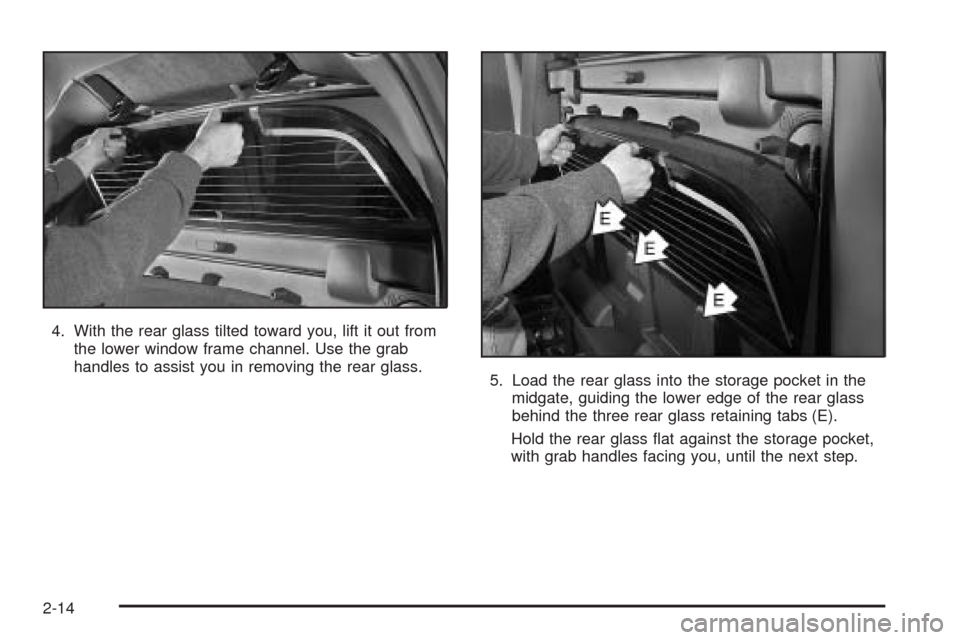
falling forward.3. While holding the rear glass in place, press the
glass-catch release button (C) and pull the top of
the rear glass toward you using the grab
handle(s) (B) located at the top of the rear glass.
2-13
Page 86 of 496
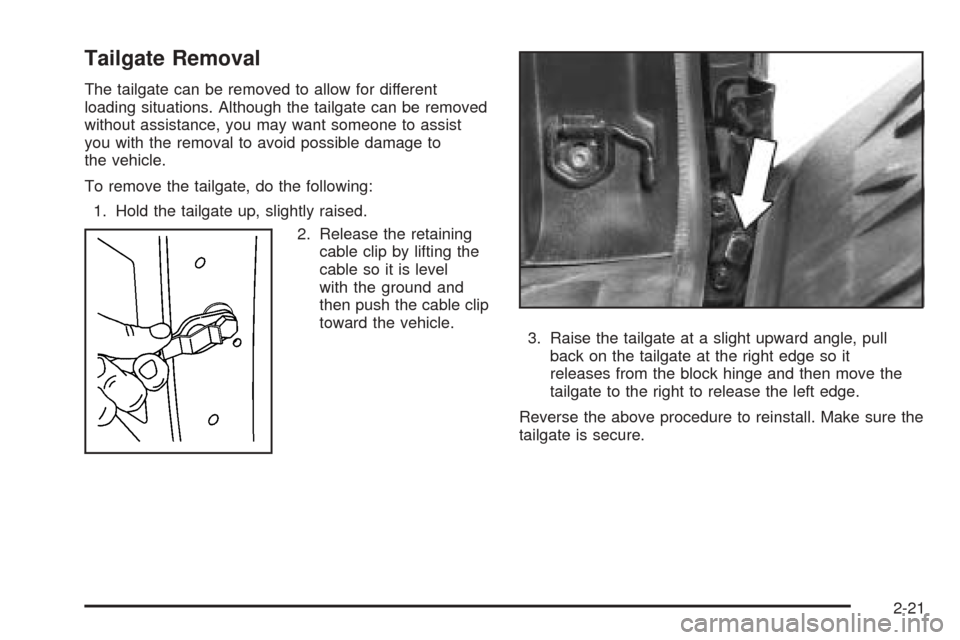
4. With the rear glass tilted toward you, lift it out from
the lower window frame channel. Use the grab
handles to assist you in removing the rear glass.
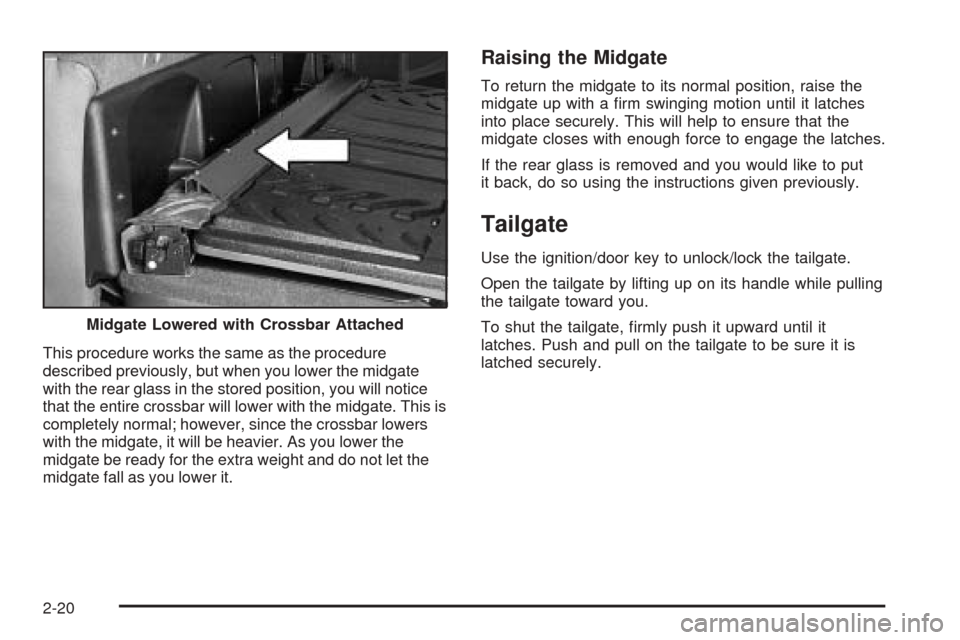
5. Load the rear glass into the storage pocket in the
midgate, guiding the lower edge of the rear glass
behind the three rear glass retaining tabs (E).
Hold the rear glass at against the storage pocket,
with grab handles facing you, until the next step.
2-14
Page 90 of 496
Lowering the Midgate with the Rear Glass
in Place
The midgate can be lowered to allow the cargo area of
your vehicle to extend into the cab. The rear glass
can be either installed in its normal position, or it can be
removed and stored in the rear glass storage pocket.
To lower the midgate, do the following:
1. Fold the rear seats. The front seats might have to
be moved forward slightly to allow the rear seats to
fold. SeeRear Seat Operation on page 1-7for
more information.
2. Standing outside of the vehicle, hold the midgate
securely so it does not fall forward. Turn the
midgate handle clockwise and pull the midgate
toward you.Rear Glass in Normal Position
2-18
Page 92 of 496
This procedure works the same as the procedure
described previously, but when you lower the midgate
with the rear glass in the stored position, you will notice
that the entire crossbar will lower with the midgate. This is
completely normal; however, since the crossbar lowers
with the midgate, it will be heavier. As you lower the
midgate be ready for the extra weight and do not let the
midgate fall as you lower it.
Raising the Midgate
To return the midgate to its normal position, raise the
midgate up with a rm swinging motion until it latches
into place securely. This will help to ensure that the
midgate closes with enough force to engage the latches.
If the rear glass is removed and you would like to put
it back, do so using the instructions given previously.
Tailgate
Use the ignition/door key to unlock/lock the tailgate.
Open the tailgate by lifting up on its handle while pulling
the tailgate toward you.
To shut the tailgate, rmly push it upward until it
latches. Push and pull on the tailgate to be sure it is
latched securely. Midgate Lowered with Crossbar Attached
2-20
Page 93 of 496
Tailgate Removal
The tailgate can be removed to allow for different
loading situations. Although the tailgate can be removed
without assistance, you may want someone to assist
you with the removal to avoid possible damage to
the vehicle.
To remove the tailgate, do the following:
1. Hold the tailgate up, slightly raised.
2. Release the retaining
cable clip by lifting the
cable so it is level
with the ground and
then push the cable clip
toward the vehicle.
3. Raise the tailgate at a slight upward angle, pull
back on the tailgate at the right edge so it
releases from the block hinge and then move the
tailgate to the right to release the left edge.
Reverse the above procedure to reinstall. Make sure the
tailgate is secure.
2-21
Page 98 of 496

Passlock®
Your vehicle is equipped with the Passlock®
theft-deterrent system.
Passlock®is a passive theft-deterrent system. Passlock®
enables fuel if the ignition lock cylinder is turned with
a valid key. If a correct key is not used or the ignition
lock cylinder is tampered with, the fuel system is
disabled and the vehicle will not start.
During normal operation, the security light will turn
off approximately ve seconds after the key is turned
to RUN.
If the engine stalls and the security light ashes, wait
about 10 minutes until the light stops ashing before
trying to restart the engine. Remember to release
the key from START as soon as the engine starts.
If the engine does not start after three tries, the vehicle
needs service.
If the engine is running and the security light comes on,
you will be able to restart the engine if you turn the
engine off. However, your Passlock
®system is
not working properly and must be serviced by your
dealer. Your vehicle is not protected by Passlock
®at this
time. You may also want to check the fuse. See
Fuses and Circuit Breakers on page 5-104. See your
dealer for service.
In an emergency, call the Roadside Assistance Center.
SeeRoadside Assistance Program on page 7-5.
Starting and Operating Your
Vehicle
New Vehicle Break-In
Notice:Your vehicle does not need an elaborate
break-in. But it will perform better in the long run if
you follow these guidelines:
Keep your speed at 55 mph (88 km/h) or less for
the rst 500 miles (805 km).
Do not drive at any one speed, fast or slow, for
the rst 500 miles (805 km). Do not make
full-throttle starts.
Avoid making hard stops for the rst 200 miles
(322 km) or so. During this time your new brake
linings are not yet broken in. Hard stops with new
linings can mean premature wear and earlier
replacement. Follow this breaking-in guideline
every time you get new brake linings.
Do not tow a trailer during break-in. SeeTowing a
Trailer on page 4-64for more information.
2-26
Page 103 of 496
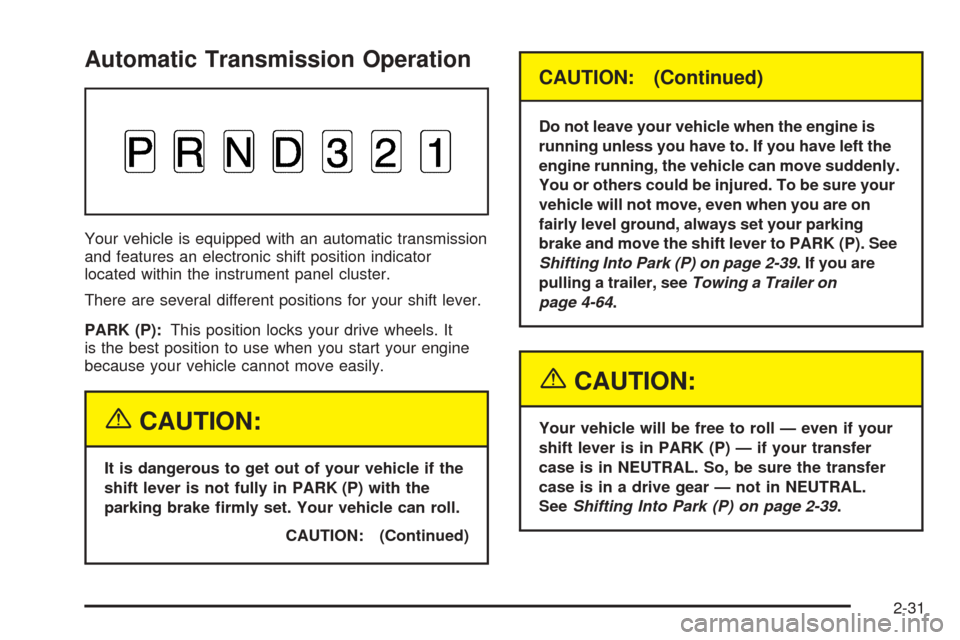
Automatic Transmission Operation
Your vehicle is equipped with an automatic transmission
and features an electronic shift position indicator
located within the instrument panel cluster.
There are several different positions for your shift lever.
PARK (P):This position locks your drive wheels. It
is the best position to use when you start your engine
because your vehicle cannot move easily.
{CAUTION:
It is dangerous to get out of your vehicle if the
shift lever is not fully in PARK (P) with the
parking brake rmly set. Your vehicle can roll.
CAUTION: (Continued)
CAUTION: (Continued)
Do not leave your vehicle when the engine is
running unless you have to. If you have left the
engine running, the vehicle can move suddenly.
You or others could be injured. To be sure your
vehicle will not move, even when you are on
fairly level ground, always set your parking
brake and move the shift lever to PARK (P). See
Shifting Into Park (P) on page 2-39. If you are
pulling a trailer, seeTowing a Trailer on
page 4-64.
{CAUTION:
Your vehicle will be free to roll — even if your
shift lever is in PARK (P) — if your transfer
case is in NEUTRAL. So, be sure the transfer
case is in a drive gear — not in NEUTRAL.
SeeShifting Into Park (P) on page 2-39.
2-31