2005 CADILLAC XLR tires
[x] Cancel search: tiresPage 298 of 438

Driving On Snow or Ice
Most of the time, those places where your tires meet
the road probably have good traction.
However, if there is snow or ice between your tires and
the road, you can have a very slippery situation. You
will have a lot less traction, or grip, and will need to be
very careful.
What is the worst time for this? Wet ice. Very cold snow
or ice can be slick and hard to drive on.But wet ice can be even more trouble because it may
offer the least traction of all. You can get wet ice when it
is about freezing (32°F; 0°C) and freezing rain begins
to fall. Try to avoid driving on wet ice until salt and sand
crews can get there.
Whatever the condition — smooth ice, packed, blowing,
or loose snow — drive with caution.
Traction control improves your ability to accelerate when
driving on a slippery road. Even though your vehicle has
a traction control system, you will want to slow down and
adjust your driving to the road conditions. Under certain
conditions, you may want to turn the traction control
system off, such as when driving through deep snow and
loose gravel, to help maintain vehicle motion at lower
speeds. SeeTraction Control System (TCS) on page 5-8.
The StabiliTrak
®System may also activate. See
StabiliTrak®System on page 5-10.
5-26
Page 301 of 438

Then, shut the engine off and close the window almost
all the way to preserve the heat. Start the engine
again and repeat this only when you feel really
uncomfortable from the cold. But do it as little as
possible. Preserve the fuel as long as you can. To help
keep warm, you can get out of the vehicle and do
some fairly vigorous exercises every half hour or so until
help comes.
If You Are Stuck: In Sand, Mud, Ice
or Snow
In order to free your vehicle when it is stuck, you will
need to spin the wheels, but you do not want to
spin your wheels too fast. The method known as rocking
can help you get out when you are stuck, but you
must use caution.
{CAUTION:
If you let your tires spin at high speed, they can
explode, and you or others could be injured.
And, the transmission or other parts of the
vehicle can overheat. That could cause an
engine compartment re or other damage.
When you are stuck, spin the wheels as little as
possible. Do not spin the wheels above 35 mph
(55 km/h) as shown on the speedometer.
Notice:Spinning your wheels can destroy parts of
your vehicle as well as the tires. If you spin the
wheels too fast while shifting your transmission
back and forth, you can destroy your transmission.
For more information about using tire chains on your
vehicle, seeTire Chains on page 6-63.
5-29
Page 303 of 438

Tire and Loading Information Label
A vehicle specic Tire and Loading Information label is
attached to the center pillar (B-pillar) of your vehicle. With
the driver’s door open, you will nd the label attached
below the door latch. This label shows the number of
occupant seating positions (A), and the maximum vehicle
capacity weight (B) in kilograms and pounds.The Tire and Loading Information label also shows the
size of the original equipment tires (C) and the
recommended cold tire ination pressures (D). For more
information on tires and ination seeTires on page 6-46
andInation - Tire Pressure on page 6-53.
There is also important loading information on the
vehicle Certication label. It tells you the Gross Vehicle
Weight Rating (GVWR) and the Gross Axle Weight
Rating (GAWR) for the front and rear axle. See
“Certication Label” later in this section.
Steps for Determining Correct Load Limit
1. Locate the statement “The combined weight of
occupants and cargo should never exceed XXX
kg or XXX pounds” on your vehicle’s placard.
2. Determine the combined weight of the driver and
passengers that will be riding in your vehicle.
3. Subtract the combined weight of the driver and
passengers from XXX kilograms or XXX pounds. Label Example
5-31
Page 309 of 438

Service............................................................6-3
Doing Your Own Service Work.........................6-4
Adding Equipment to the Outside of Your
Vehicle......................................................6-5
Fuel................................................................6-5
Gasoline Octane............................................6-5
Gasoline Specications....................................6-5
California Fuel...............................................6-5
Additives.......................................................6-6
Fuels in Foreign Countries...............................6-6
Filling Your Tank............................................6-7
Filling a Portable Fuel Container.....................6-10
Checking Things Under the Hood....................6-10
Hood Release..............................................6-11
Engine Compartment Overview.......................6-12
Engine Oil...................................................6-13
Engine Oil Life System..................................6-16
Engine Air Cleaner/Filter................................6-18
Automatic Transmission Fluid.........................6-20
Engine Coolant.............................................6-20
Coolant Surge Tank Pressure Cap..................6-23
Engine Overheating.......................................6-23
Overheated Engine Protection
Operating Mode........................................6-25
Cooling System............................................6-26
Power Steering Fluid.....................................6-31Windshield Washer Fluid................................6-32
Brakes........................................................6-33
Battery........................................................6-36
Jump Starting...............................................6-37
Rear Axle.......................................................6-41
Headlamp Aiming...........................................6-42
Headlamp Vertical Aiming..............................6-43
Bulb Replacement..........................................6-44
Windshield Wiper Blade Replacement..............6-45
Tires..............................................................6-46
Tire Sidewall Labelling...................................6-47
Tire Terminology and Denitions.....................6-49
Run-Flat Tires..............................................6-52
Ination - Tire Pressure.................................6-53
Tire Pressure Monitor System.........................6-55
Tire Inspection and Rotation...........................6-57
When It Is Time for New Tires.......................6-58
Buying New Tires.........................................6-58
Uniform Tire Quality Grading..........................6-59
Wheel Alignment and Tire Balance..................6-61
Wheel Replacement......................................6-61
Tire Chains..................................................6-63
Lifting Your Vehicle.......................................6-64
If a Tire Goes Flat........................................6-68
Section 6 Service and Appearance Care
6-1
Page 310 of 438

Appearance Care............................................6-70
Fabric/Carpet...............................................6-70
Vinyl...........................................................6-72
Leather.......................................................6-72
Instrument Panel..........................................6-72
Interior Plastic Components............................6-72
Wood Panels...............................................6-72
Speaker Covers............................................6-73
Glass Surfaces.............................................6-73
Care of Safety Belts......................................6-73
Weatherstrips...............................................6-73
Washing Your Vehicle...................................6-74
Cleaning Exterior Lamps/Lenses.....................6-74
Finish Care..................................................6-74
Windshield and Wiper Blades.........................6-75
Aluminum or Chrome-Plated Wheels................6-76
Tires...........................................................6-76Sheet Metal Damage.....................................6-77
Finish Damage.............................................6-77
Underbody Maintenance................................6-77
Chemical Paint Spotting.................................6-77
Vehicle Care/Appearance Materials..................6-78
Vehicle Identication......................................6-79
Vehicle Identication Number (VIN).................6-79
Service Parts Identication Label.....................6-79
Electrical System............................................6-80
Add-On Electrical Equipment..........................6-80
Windshield Wiper Fuses................................6-80
Power Windows and Other Power Options.......6-80
Fuses and Circuit Breakers............................6-80
Instrument Panel Fuse Block..........................6-81
Underhood Fuse Block..................................6-83
Capacities and Specications..........................6-85
Section 6 Service and Appearance Care
6-2
Page 350 of 438
What to Use
To add lubricant when the level is low, use SAE 75W–90
Synthetic Gear Lubricant (GM Part No. 12378261) or
equivalent meeting GM Specication 9986115. To
completely rell after draining, add 4 ounces (118 ml) of
Limited-Slip Differential Lubricant Additive (GM Part
No. 1052358) or equivalent. Then ll to the bottom of the
ller plug hole with the Synthetic Gear Lubricant.
Headlamp Aiming
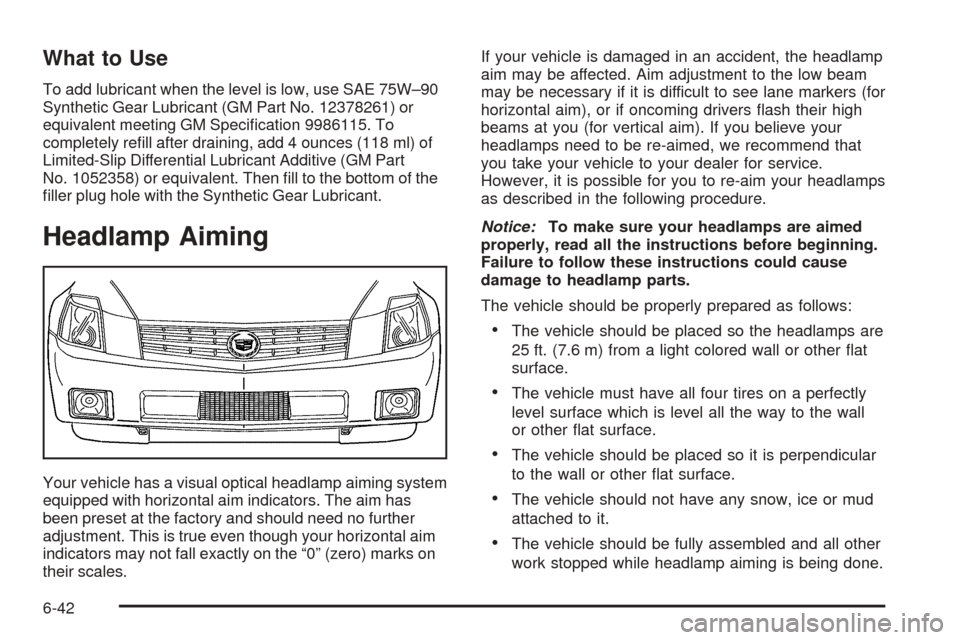
Your vehicle has a visual optical headlamp aiming system
equipped with horizontal aim indicators. The aim has
been preset at the factory and should need no further
adjustment. This is true even though your horizontal aim
indicators may not fall exactly on the “0” (zero) marks on
their scales.If your vehicle is damaged in an accident, the headlamp
aim may be affected. Aim adjustment to the low beam
may be necessary if it is difficult to see lane markers (for
horizontal aim), or if oncoming drivers ash their high
beams at you (for vertical aim). If you believe your
headlamps need to be re-aimed, we recommend that
you take your vehicle to your dealer for service.
However, it is possible for you to re-aim your headlamps
as described in the following procedure.
Notice:To make sure your headlamps are aimed
properly, read all the instructions before beginning.
Failure to follow these instructions could cause
damage to headlamp parts.
The vehicle should be properly prepared as follows:
The vehicle should be placed so the headlamps are
25 ft. (7.6 m) from a light colored wall or other at
surface.
The vehicle must have all four tires on a perfectly
level surface which is level all the way to the wall
or other at surface.
The vehicle should be placed so it is perpendicular
to the wall or other at surface.
The vehicle should not have any snow, ice or mud
attached to it.
The vehicle should be fully assembled and all other
work stopped while headlamp aiming is being done.
6-42
Page 351 of 438

The vehicle should be normally loaded with a full
tank of fuel and one person or 160 lbs (75 kg) on
the driver’s seat.
Tires should be properly inated.
Start the vehicle and rock it to level the suspension.
Headlamp aiming is done with the vehicle low beam
lamps. The high beam lamps will be correctly aimed if
the low beam lamps are aimed properly.
The headlamp aiming
devices are under the
hood near the headlamps.
If you believe your headlamps need vertical (up/down)
adjustment, follow the vertical aiming procedure.
Adjustment screws can be turned with an E8 Torx
®
socket or T15 Torx screwdriver.
Headlamp Vertical Aiming
Notice:Horizontal aiming must be performed
before making any adjustments to the vertical aim.
Adjusting the vertical aim rst will result in an
incorrect headlamp aim.
1. Find the aim dot on the lens of the low beam lamps.
2. Measure the distance from the ground to the aim
dot on each low beam lamp. Record this distance.
3. At the wall or other at surface, measure from the
ground upward the recorded distance from Step 2
and draw or tape a horizontal line the width of
the vehicle.
6-43
Page 354 of 438
Tires
Your new vehicle comes with high-quality tires made by
a leading tire manufacturer. If you ever have questions
about your tire warranty and where to obtain service,
see your GM Warranty booklet for details. For additional
information refer to the tire manufacturer’s booklet
included with your vehicle’s Owner’s Manual.{CAUTION:
Poorly maintained and improperly used tires
are dangerous.
Overloading your tires can cause
overheating as a result of too much
friction. You could have an air-out and a
serious accident. SeeLoading Your
Vehicle on page 5-30.
Underinated tires pose the same danger
as overloaded tires. The resulting accident
could cause serious injury. Check all tires
frequently to maintain the recommended
pressure. Tire pressure should be checked
when your tires are cold. SeeInflation - Tire
Pressure on page 6-53.
Overinated tires are more likely to be
cut, punctured or broken by a sudden
impact — such as when you hit a pothole.
Keep tires at the recommended pressure.
Worn, old tires can cause accidents. If your
tread is badly worn, or if your tires have
been damaged, replace them.
6-46