Page 297 of 446

Service............................................................5-3
Doing Your Own Service Work.........................5-4
Adding Equipment to the Outside
of Your Vehicle...........................................5-4
Fuel................................................................5-5
Gasoline Octane............................................5-5
Gasoline Specications....................................5-5
California Fuel...............................................5-6
Additives.......................................................5-6
Fuels in Foreign Countries...............................5-7
Filling the Tank..............................................5-8
Filling a Portable Fuel Container.....................5-10
Checking Things Under the Hood....................5-10
Hood Release..............................................5-11
Engine Compartment Overview.......................5-12
Engine Oil...................................................5-15
Engine Oil Life System..................................5-18
Engine Air Cleaner/Filter................................5-20
Automatic Transmission Fluid.........................5-21
Engine Coolant.............................................5-22
Coolant Surge Tank Pressure Cap..................5-24
Engine Overheating.......................................5-24
Overheated Engine Protection
Operating Mode........................................5-26
Cooling System............................................5-27Power Steering Fluid.....................................5-31
Windshield Washer Fluid................................5-32
Brakes........................................................5-34
Battery........................................................5-37
Jump Starting...............................................5-38
All-Wheel Drive..............................................5-42
Rear Axle.......................................................5-44
Front Axle......................................................5-45
Headlamp Aiming...........................................5-46
Bulb Replacement..........................................5-48
High Intensity Discharge (HID) Lighting............5-48
Halogen Bulbs..............................................5-49
Front Turn Signal Lamps...............................5-49
Sidemarker Lamps........................................5-50
Back-Up Lamps............................................5-50
Replacement Bulbs.......................................5-51
Windshield Replacement.................................5-51
Windshield Wiper Blade Replacement..............5-51
Tires..............................................................5-53
Tire Sidewall Labelling...................................5-54
Tire Terminology and Denitions.....................5-58
Ination - Tire Pressure.................................5-60
Tire Pressure Monitor System.........................5-62
Section 5 Service and Appearance Care
5-1
Page 301 of 446

Fuel
Use of the recommended fuel is an important part of the
proper maintenance of your vehicle.
Gasoline Octane
If your vehicle has the 3.6L V6 engine, use regular
unleaded gasoline with a posted octane of 87 or higher.
However, for best performance and for trailer towing,
you may wish to use middle grade or premium unleaded
gasoline. If the octane is less than 87, you may get a
heavy knocking noise when you drive. If this occurs, use
a gasoline rated at 87 octane or higher as soon as
possible. Otherwise, you might damage your engine.
If your vehicle has the 4.6L V8 engine, use premium
unleaded gasoline with a posted octane of 91 or higher
for best performance. You may also use middle
grade or regular unleaded gasoline rated at 87 octane
or higher, but your vehicle’s acceleration may be slightly
reduced. If the octane is less than 87, you may get a
heavy knocking noise when you drive. If this occurs, use
a gasoline rated at 87 octane or higher as soon as
possible. Otherwise, you might damage your engine.
Gasoline Specications
It is recommended that gasoline meet specications
which were developed by automobile manufacturers
around the world and contained in the World-Wide Fuel
Charter which is available from the Alliance of Automobile
Manufacturers at www.autoalliance.org/fuel_charter.htm.
Gasoline meeting these specications could provide
improved driveability and emission control system
performance compared to other gasoline.
5-5
Page 344 of 446

8. Turn the vertical aiming screw until the headlamp
beam is aimed to the horizontal tape line. If you
turn it clockwise, it will raise the beam and if
you turn it counterclockwise, it will lower the beam.
The top edge of the cut-off should be positioned
at the bottom edge of the horizontal tape line.
9. Repeat Steps 7 and 8 for the opposite headlamp.
Bulb Replacement
For the proper type of replacement bulbs, see
Replacement Bulbs on page 5-51.
For any bulb changing procedure not listed in this
section, contact your dealer.
High Intensity Discharge (HID)
Lighting
{CAUTION:
The low beam high intensity discharge lighting
system operates at a very high voltage. If you
try to service any of the system components,
you could be seriously injured. Have your
dealer or a qualied technician service them.
Your vehicle may have HID headlamps and fog lamps.
After your vehicle’s HID headlamp or fog lamp bulb has
been replaced, you may notice that the beam is a slightly
different shade than it was originally. This is normal.
5-48
Page 346 of 446
Sidemarker Lamps
To replace a sidemarker lamp bulb, do the following:
1. Locate the rear sidemarker lamp assembly
under the rear bumper.
2. Turn the socket
counterclockwise and
then pull it straight
out from the
sidemarker lamp
assembly.
3. Pull the old bulb straight out and reinstall
the new bulb.
4. Reverse Step 2 to reinstall the socket.
Back-Up Lamps
To replace a back-up lamp bulb, do the following:
1. Open the trunk. SeeTrunk on page 2-14for more
information.2. Pull out the push pins holding down the top portion
of the cloth cover.
3. Fold the cover down slightly and locate the lamp
assembly.
4. Turn the socket counterclockwise and pull it straight
out to remove it from the lamp assembly.
5. Pull the old bulb straight out and reinstall the
new bulb.
6. Reverse the steps to reinstall.
5-50
Page 347 of 446

Replacement Bulbs
Exterior Lamps Bulb Number
Back-up 3157K
Front Turn Signal 3757KA
Rear Sidemarker W3W
For replacement bulbs not listed here, contact your
dealer.
Windshield Replacement
Keep in mind that your windshield is part of the Head-Up
Display (HUD) system. If you ever have to get your
windshield replaced, be sure to get one that is designed
for HUD or your HUD image may look blurred or out
of focus.
Windshield Wiper Blade
Replacement
Windshield wiper blades should be inspected for wear
or cracking. SeeScheduled Maintenance on page 6-4.
It’s a good idea to clean or replace the wiper blade
assembly on a regular basis or when worn. For proper
windshield wiper blade length and type, seeNormal
Maintenance Replacement Parts on page 6-14.
To replace the wiper blade assembly, do the following:
1. Turn the ignition to OFF/ACC, with the engine off.
2. Turn on the windshield wipers and turn them off
again when the wipers are in the out-wipe
position. The driver’s side blade will be straight up
and down on the windshield.
3. Pull the windshield wiper assembly away from the
windshield.
5-51
Page 348 of 446
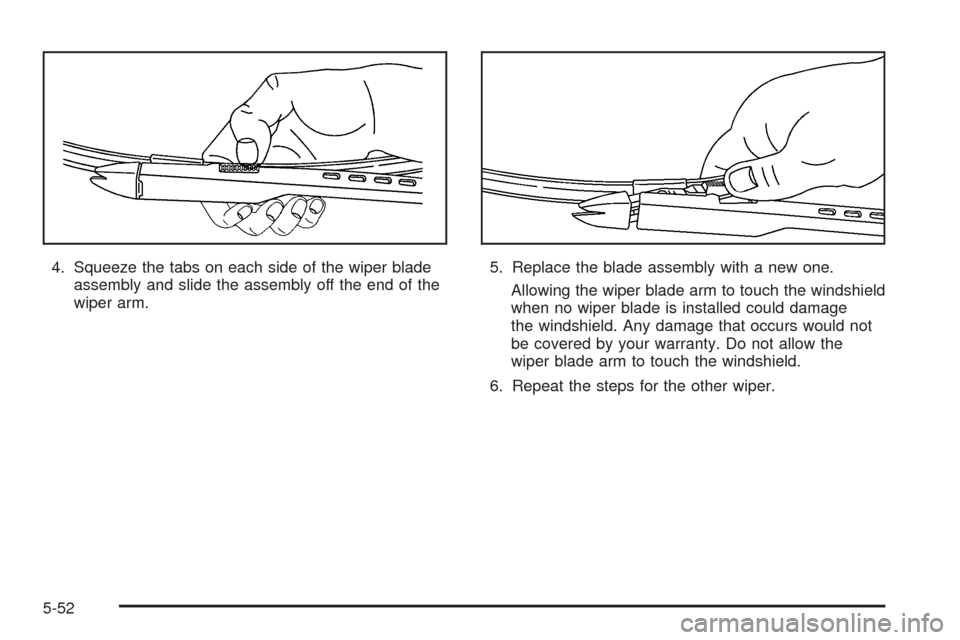
4. Squeeze the tabs on each side of the wiper blade
assembly and slide the assembly off the end of the
wiper arm.5. Replace the blade assembly with a new one.
Allowing the wiper blade arm to touch the windshield
when no wiper blade is installed could damage
the windshield. Any damage that occurs would not
be covered by your warranty. Do not allow the
wiper blade arm to touch the windshield.
6. Repeat the steps for the other wiper.
5-52
Page 349 of 446
Tires
Your new vehicle comes with high-quality tires made by
a leading tire manufacturer. If you ever have questions
about your tire warranty and where to obtain service,
see your GM Warranty booklet for details. For additional
information refer to the tire manufacturer’s booklet
included with your vehicle’s Owner’s Manual.{CAUTION:
Poorly maintained and improperly used
tires are dangerous.
Overloading your tires can cause
overheating as a result of too much
friction. You could have an air-out and a
serious accident. SeeLoading Your
Vehicle on page 4-30.
Underinated tires pose the same danger
as overloaded tires. The resulting accident
could cause serious injury. Check all tires
frequently to maintain the recommended
pressure. Tire pressure should be checked
when your tires are cold.
Overinated tires are more likely to be cut,
punctured, or broken by a sudden
impact — such as when you hit a pothole.
Keep tires at the recommended pressure.
Worn, old tires can cause accidents. If your
tread is badly worn, or if your tires have
been damaged, replace them.
SeeInflation - Tire Pressure on page 5-60for
ination pressure adjustment for high speed
driving.
5-53
Page 350 of 446

Winter Tires
If you expect to drive on snow or ice covered roads
often, you may want to get winter tires for your vehicle.
All season tires provide good overall performance on
most surfaces but they may not offer the traction
you would like or the same level of performance as
winter tires on snow or ice covered roads.
See your dealer for details regarding winter tire
availability and proper tire selection. Also, seeBuying
New Tires on page 5-68
If you choose to use winter tires:
Use tires of the same brand and tread type on all
four wheel positions.
Use only radial ply tires of the same size, load
range, and speed rating as the original equipment
tires.
Winter tires with the same speed rating as your original
equipment tires may not be available for H, V, W
and ZR speed rated tires. If you choose winter tires with
a lower speed rating, never exceed the tire’s maximum
speed capability.
Tire Sidewall Labelling
Useful information about a tire is molded into its
sidewall. The examples below show a typical passenger
vehicle tire and a compact spare tire sidewall.
(A) Tire Size:The tire size is a combination of letters
and numbers used to dene a particular tire’s width,
height, aspect ratio, construction type and service
description. See the “Tire Size” illustration later in this
section for more detail.Passenger (P-Metric) Tire Example
5-54