2005 BUICK LESABRE high beam
[x] Cancel search: high beamPage 213 of 392

What you do in the daytime can also affect your night
vision. For example, if you spend the day in bright
sunshine you are wise to wear sunglasses. Your eyes
will have less trouble adjusting to night. But if you
are driving, do not wear sunglasses at night. They may
cut down on glare from headlamps, but they also
make a lot of things invisible.
You can be temporarily blinded by approaching
headlamps. It can take a second or two, or even several
seconds, for your eyes to re-adjust to the dark. When
you are faced with severe glare, as from a driver
who does not lower the high beams, or a vehicle with
misaimed headlamps, slow down a little. Avoid
staring directly into the approaching headlamps.
Keep your windshield and all the glass on your vehicle
clean — inside and out. Glare at night is made much
worse by dirt on the glass. Even the inside of the glass
can build up a lm caused by dust. Dirty glass makes
lights dazzle and ash more than clean glass would,
making the pupils of your eyes contract repeatedly.
Remember that your headlamps light up far less of a
roadway when you are in a turn or curve. Keep
your eyes moving; that way, it is easier to pick out dimly
lighted objects. Just as your headlamps should be
checked regularly for proper aim, so should your eyes
be examined regularly. Some drivers suffer from
night blindness — the inability to see in dim light — and
are not even aware of it.Driving in Rain and on Wet Roads
Rain and wet roads can mean driving trouble. On a wet
road, you cannot stop, accelerate, or turn as well
because your tire-to-road traction is not as good as on
dry roads. And, if your tires do not have much tread
left, you will get even less traction. It is always wise to
go slower and be cautious if rain starts to fall while
you are driving. The surface may get wet suddenly when
your reexes are tuned for driving on dry pavement.
4-17
Page 285 of 392

Headlamp Aiming
Your vehicle has a visual optical headlamp aiming
system equipped with horizontal aim indicators. The aim
has been preset at the factory and should need no
further adjustment. This is true even though your
horizontal aim indicators may not fall exactly on the “0”
(zero) marks on their scales.
If your vehicle is damaged in an accident, the headlamp
aim may be affected. Aim adjustment to the low beam
may be necessary if it is difficult to see lane markers (for
horizontal aim), or if oncoming drivers ash their high
beams at you (for vertical aim). If you believe yourheadlamps need to be re-aimed, we recommend that
you take your vehicle to your dealer for service.
However, it is possible for you to re-aim your headlamps
as described in the following procedure.
Notice:To make sure your headlamps are aimed
properly, read all the instructions before beginning.
Failure to follow these instructions could cause
damage to headlamp parts.
The vehicle should be properly prepared as follows:
The vehicle should be placed so the headlamps
are 25 ft (7.6 m) from a light colored wall or
other at surface.
The vehicle must have all four tires on a perfectly
level surface which is level all the way to the wall
or other at surface.
The vehicle should be placed so it is perpendicular
to the wall or other at surface.
The vehicle should not have any snow, ice or mud
attached to it.
The vehicle should be fully assembled and all other
work stopped while headlamp aiming is being done.
The vehicle should be normally loaded with a
full tank of fuel and one person or 160 lbs (75 kg) on
the driver’s seat.
Tires should be properly inated.
5-45
Page 286 of 392

Headlamp aiming is done with the vehicle low-beam
lamps. The high-beam lamps will be correctly aimed if
the low-beam lamps are aimed properly.
The headlamp aiming devices are located under the
hood near the headlamps.
If you believe your headlamps need horizontal (left/right)
adjustment, follow the horizontal aiming procedure. If
you believe your headlamps need only vertical
(up/down) adjustment, follow only the vertical
aiming procedure.
Adjustment screws can be turned with an E8 Torx
®
socket or T15 Torx®screwdriver.
Headlamp Horizontal Aiming
To adjust the horizontal aim, do the following:
1. Open the hood. SeeHood Release on page 5-11
for more information.
2. Locate the horizontal aiming screw (A).
3. Turn the horizontal aiming screw (A) until the
indicator (B) is lined up with zero.
Once the horizontal aim is adjusted, then adjust the
vertical aim.
5-46
Page 293 of 392

Replacement Bulbs
Exterior Lamp Bulb Number
Front Turn Signals 3157
Headlamps
High-Beam 9005
Low-Beam 9006
Trunk-Mounted Back-Up Lamps 3057
Trunk-Mounted Taillamps 194
Tail/Stop/Turn Signal Lamps 3357
For replacement bulbs not listed here, contact
your dealer.
Windshield Wiper Blade
Replacement
Windshield wiper blades should be inspected at least
twice a year for wear or cracking. See “Wiper Blade
Check” underPart B: Owner Checks and Services on
page 6-18for more information.
Replacement blades come in different types and are
removed in different ways.
To replace the wiper blade assembly, do the following:
1. Lift the windshield wiper arm away from
the windshield.2. Push the tab on the wiper blade assembly and pull
the assembly down enough to release it from the
U-hooked end of the wiper arm. Slide the assembly
away from the arm.
3. Remove the blade.
4. To reinstall the wiper blade assembly, slide it over
the wiper arm to engage the U-hooked end on the
wiper blade assembly. Pull up on the assembly
to lock it into place.
For the proper windshield wiper blade replacement
length and type, seeNormal Maintenance Replacement
Parts on page 5-97.
5-53
Page 329 of 392

Engine Compartment Fuse Block
The engine compartment
fuse block is located near
the front on the
passenger’s side of the
vehicle. SeeEngine
Compartment Overview on
page 5-12for more
information on location.
Lift the cover to gain access. On some vehicles, there
may be an additional cover that you will need to lift
to gain access to the fuses.
Fuses Usage
1 Not Used
2 Accessory
3 Windshield Wipers
4 Not Used
5 Left Low-Beam Headlamp
6 Right Low-Beam Headlamp
7 Instrument Panel
8 Powertrain Control Module Battery
9 Right High-Beam Headlamp
10 Left High-Beam Headlamp
11 Ignition 1
12 Not Used
13 Transaxle
5-89
Page 330 of 392
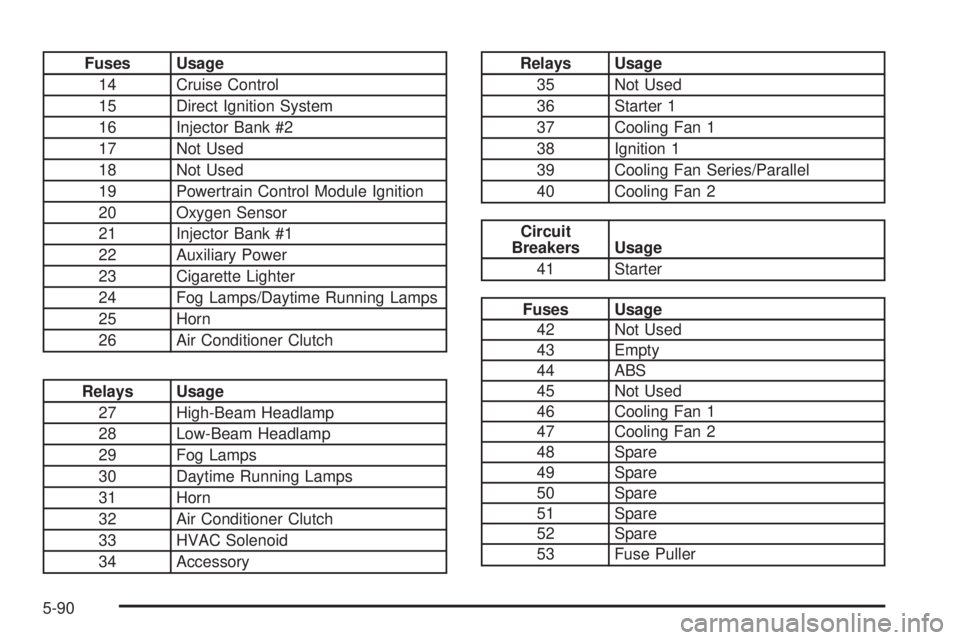
Fuses Usage
14 Cruise Control
15 Direct Ignition System
16 Injector Bank #2
17 Not Used
18 Not Used
19 Powertrain Control Module Ignition
20 Oxygen Sensor
21 Injector Bank #1
22 Auxiliary Power
23 Cigarette Lighter
24 Fog Lamps/Daytime Running Lamps
25 Horn
26 Air Conditioner Clutch
Relays Usage
27 High-Beam Headlamp
28 Low-Beam Headlamp
29 Fog Lamps
30 Daytime Running Lamps
31 Horn
32 Air Conditioner Clutch
33 HVAC Solenoid
34 Accessory
Relays Usage
35 Not Used
36 Starter 1
37 Cooling Fan 1
38 Ignition 1
39 Cooling Fan Series/Parallel
40 Cooling Fan 2
Circuit
Breakers Usage
41 Starter
Fuses Usage
42 Not Used
43 Empty
44 ABS
45 Not Used
46 Cooling Fan 1
47 Cooling Fan 2
48 Spare
49 Spare
50 Spare
51 Spare
52 Spare
53 Fuse Puller
5-90
Page 384 of 392

Gasoline
Octane........................................................ 5-5
Specications............................................... 5-6
Glove Box.....................................................2-43
GM Mobility Reimbursement Program.................. 7-5
H
Hazard Warning Flashers................................... 3-6
Head Restraints............................................... 1-7
Headlamp
Aiming.......................................................5-45
Horizontal Aiming.........................................5-46
Vertical Aiming............................................5-47
Headlamps....................................................5-49
Bulb Replacement.......................................5-48
Daytime Running Lamps...............................3-15
Flash-to-Pass............................................... 3-8
Front Turn Signal Lamps..............................5-50
Halogen Bulbs............................................5-48
High/Low Beam Changer................................ 3-8
On Reminder..............................................3-14
Wiper Activated...........................................3-14
Head-Up Display (HUD)...................................3-20
Heated Seats................................................... 1-4
Heater...........................................................3-24
Heater...........................................................3-27Highbeam On Light.........................................3-45
Highway Hypnosis...........................................4-23
Hill and Mountain Roads..................................4-24
HomeLink
®Transmitter....................................2-38
HomeLink®Transmitter, Programming................2-39
Hood
Checking Things Under................................5-10
Release.....................................................5-11
Horn............................................................... 3-6
How to Use This Manual...................................... ii
How to Wear Safety Belts Properly...................1-13
I
Ignition Positions.............................................2-22
Inadvertent Power Battery Saver.......................3-20
Infants and Young Children, Restraints...............1-31
Ination -- Tire Pressure..................................5-60
Inspection
Brake System.............................................6-23
Engine Cooling System................................6-23
Exhaust System..........................................6-22
Fuel System...............................................6-23
Part C - Periodic Maintenance.......................6-22
Steering, Suspension and Front Drive Axle
Boot and Seal.........................................6-22
Throttle System...........................................6-23
6
Page 385 of 392

Instrument Panel
Brightness..................................................3-17
Cluster.......................................................3-33
Overview..................................................... 3-4
J
Jump Starting.................................................5-40
K
Keyless Entry System....................................... 2-5
Keys............................................................... 2-3
L
Labelling, Tire Sidewall....................................5-55
Lamps
Battery Load Management............................3-20
Cornering...................................................3-15
Courtesy....................................................3-17
Exterior......................................................3-14
Exterior Lighting Battery Saver......................3-17
Front Reading.............................................3-19
Inadvertent Power Battery Saver....................3-20
Twilight Sentinel
®........................................3-16LATCH System
Child Restraints...........................................1-40
Securing a Child Restraint Designed for the
LATCH System........................................1-42
Light
Airbag Readiness........................................3-37
Anti-Lock Brake System Warning...................3-39
Battery Warning..........................................3-38
Brake System Warning.................................3-38
Cruise Control.............................................3-45
Highbeam On.............................................3-45
Malfunction Indicator....................................3-41
Oil Pressure...............................................3-44
Safety Belt Reminder...................................3-36
Security.....................................................3-45
Service Vehicle Soon...................................3-46
TCS Warning Light......................................3-40
Traction Control System (TCS) Warning..........3-40
Lighting
Delayed Entry.............................................3-18
Delayed Exit...............................................3-18
Entry.........................................................3-18
Perimeter...................................................3-18
Theater Dimming.........................................3-18
Lockout Protection..........................................2-14
7