2005 BUICK CENTURY ECU
[x] Cancel search: ECUPage 82 of 348

Theft-Deterrent Systems
Vehicle theft is big business, especially in some cities.
Although your vehicle has a number of theft-deterrent
features, we know that nothing we put on it can make it
impossible to steal. However, there are ways you
can help.
PASS-Key®II
The vehicle is equipped
with the PASS-Key®II
(Personalized Automotive
Security System)
theft-deterrent system.
PASS-Key
®II is a passive
theft-deterrent system.
It works when the ignition
key is inserted or
removed from the ignition.
PASS-Key
®II uses a resistor pellet in the ignition key
that matches a decoder in the vehicle.When the PASS-Key
®II system senses that the wrong
key has been inserted into the ignition, it shuts down
the vehicle’s starter and fuel systems. The starter will not
work and fuel will not go to the engine for about
three minutes. If someone tries to start the vehicle again
with the wrong key, or uses another incorrect key
during this time, the vehicle will not start. This
discourages someone from randomly trying keys with
different resistor pellets in an attempt to make a match.
The ignition key must be clean and dry before it is
inserted in the ignition or the engine may not start. If the
engine does not start and the SECURITY warning
light on the instrument panel is ashing, the key may be
dirty or wet. Turn the ignition off.
Clean and dry the key. Wait about three minutes and try
again. If the vehicle still does not start, the ignition
key may be faulty. Wait about three more minutes and
try a spare ignition key. At this time, you may also
want to check the fuse. SeeFuses and Circuit Breakers
on page 5-91for information on fuse location. If the
starter will not work with the spare key, the vehicle
needs service. See your dealer or a locksmith who can
service the PASS-Key
®II.
2-16
Page 83 of 348

If a key is accidentally used that has a damaged or
missing resistor pellet, the starter will not work.
The SECURITY warning light on the instrument panel
will then come on. But you do not have to wait three
minutes before trying another ignition key.
See your dealer or a locksmith who can service the
PASS-Key
®II to have a new key made.
If the SECURITY warning light comes on the instrument
panel while the vehicle is being driven, the engine
will still be able to be started after it is turned off.
The PASS-Key
®II system, however, is not working
properly and must be serviced by your dealer.
The vehicle is not protected by the PASS-Key
®II
system when this happens.
If a PASS-Key
®II ignition key is lost or damaged,
see your dealer or a locksmith who can service
PASS-Key
®II to have a new key made. Also, see
Roadside Assistance Program on page 7-6for
more information.
Starting and Operating
Your Vehicle
New Vehicle Break-In
Notice:Your vehicle does not need an elaborate
“break-in.” But it will perform better in the long run
if you follow these guidelines:
Do not drive at any one speed — fast or
slow — for the rst 500 miles (805 km).
Do not make full-throttle starts.
Avoid making hard stops for the rst 200 miles
(322 km) or so. During this time your new
brake linings are not yet broken in. Hard stops
with new linings can mean premature wear
and earlier replacement. Follow this
breaking-in guideline every time you
get new brake linings.
Do not tow a trailer during break-in. SeeTowing
a Trailer on page 4-38for more information.
2-17
Page 97 of 348
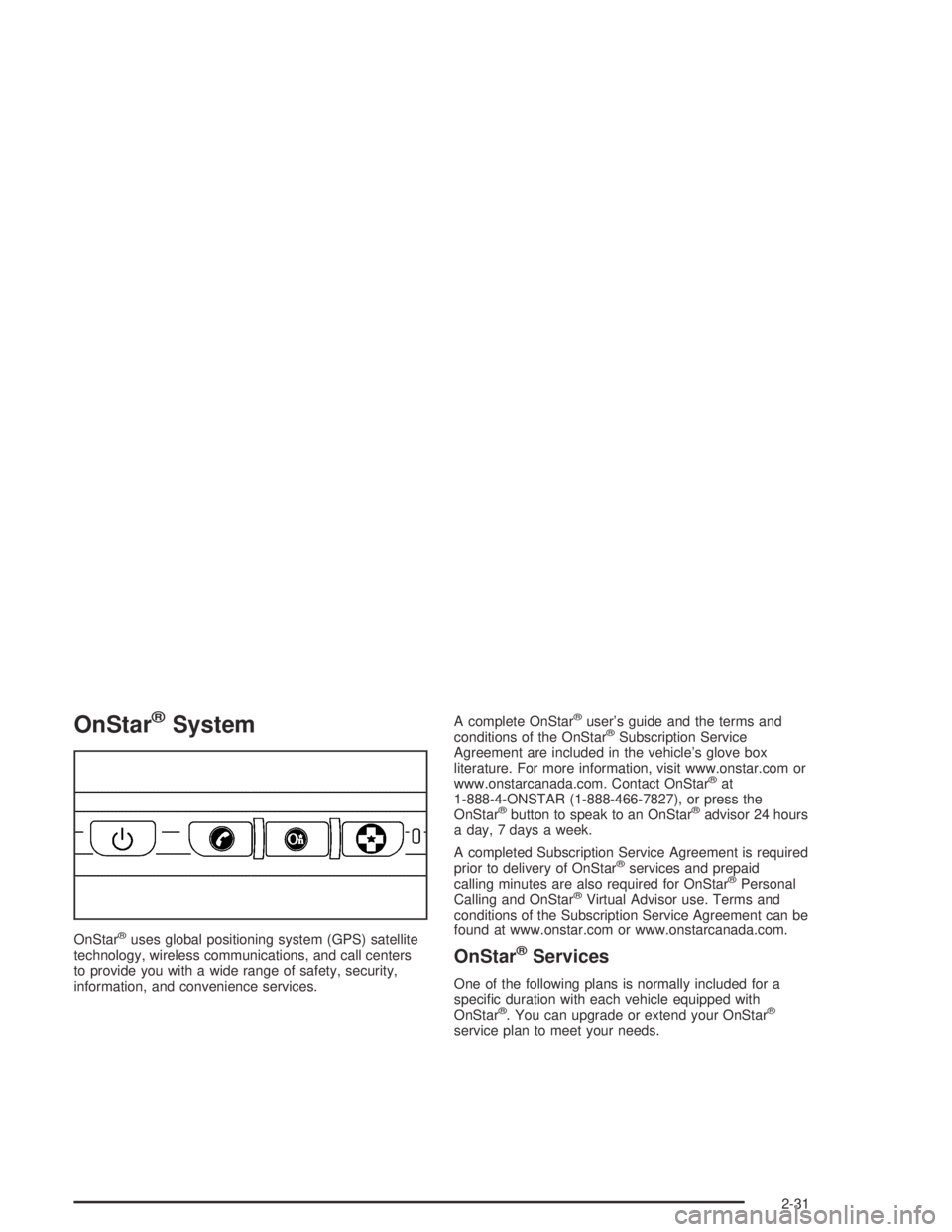
OnStar®System
OnStar®uses global positioning system (GPS) satellite
technology, wireless communications, and call centers
to provide you with a wide range of safety, security,
information, and convenience services.A complete OnStar
®user’s guide and the terms and
conditions of the OnStar®Subscription Service
Agreement are included in the vehicle’s glove box
literature. For more information, visit www.onstar.com or
www.onstarcanada.com. Contact OnStar
®at
1-888-4-ONSTAR (1-888-466-7827), or press the
OnStar
®button to speak to an OnStar®advisor 24 hours
a day, 7 days a week.
A completed Subscription Service Agreement is required
prior to delivery of OnStar
®services and prepaid
calling minutes are also required for OnStar®Personal
Calling and OnStar®Virtual Advisor use. Terms and
conditions of the Subscription Service Agreement can be
found at www.onstar.com or www.onstarcanada.com.
OnStar®Services
One of the following plans is normally included for a
specic duration with each vehicle equipped with
OnStar
®. You can upgrade or extend your OnStar®
service plan to meet your needs.
2-31
Page 102 of 348

Malfunction Indicator Lamp.............................3-36
Oil Pressure Light.........................................3-40
Change Engine Oil Light................................3-40
Security Light...............................................3-41
Cruise Control Light......................................3-41
Low Washer Fluid Warning Light.....................3-41
Door/Trunk Ajar Warning Light........................3-42
Service Vehicle Soon Light............................3-42
Fuel Gage...................................................3-42
Low Fuel Warning Light.................................3-43Audio System(s).............................................3-44
Setting the Time...........................................3-44
Radio with CD..............................................3-45
Radio with Cassette and CD..........................3-53
Theft-Deterrent Feature..................................3-63
Audio Steering Wheel Controls.......................3-63
Radio Reception...........................................3-64
Care of Your Cassette Tape Player.................3-65
Care of Your CDs.........................................3-66
Care of Your CD Player................................3-66
Fixed Mast Antenna......................................3-66
Chime Level Adjustment................................3-66
Section 3 Instrument Panel
3-2
Page 141 of 348

For additional information, see “When to Change
Engine Oil (GM Oil Life System)” and “How to Reset
the CHANGE OIL SOON Light ” underEngine Oil
on page 5-13.
Security Light
The SECURITY light will
come on when the key is
turned to START, and
will stay on until the
vehicle starts.
It will also ash if the ignition key is too dirty or wet for
the PASS-Key
®II system to read the resistor pellet.
SeePASS-Key®II on page 2-16.
If the resistor pellet is damaged or missing, the light
will come on.
Cruise Control Light
The CRUISE light comes
on whenever the cruise
control is set. See “Cruise
Control” underTurn
Signal/Multifunction Lever
on page 3-7.
Low Washer Fluid Warning Light
If the LOW WASH light
comes on when the
windshield washer paddle
is used, this indicates
that the uid is low
in the windshield
washer reservoir.
The light will also come on briey when the ignition is
turned on to show that it is working properly.
3-41
Page 192 of 348
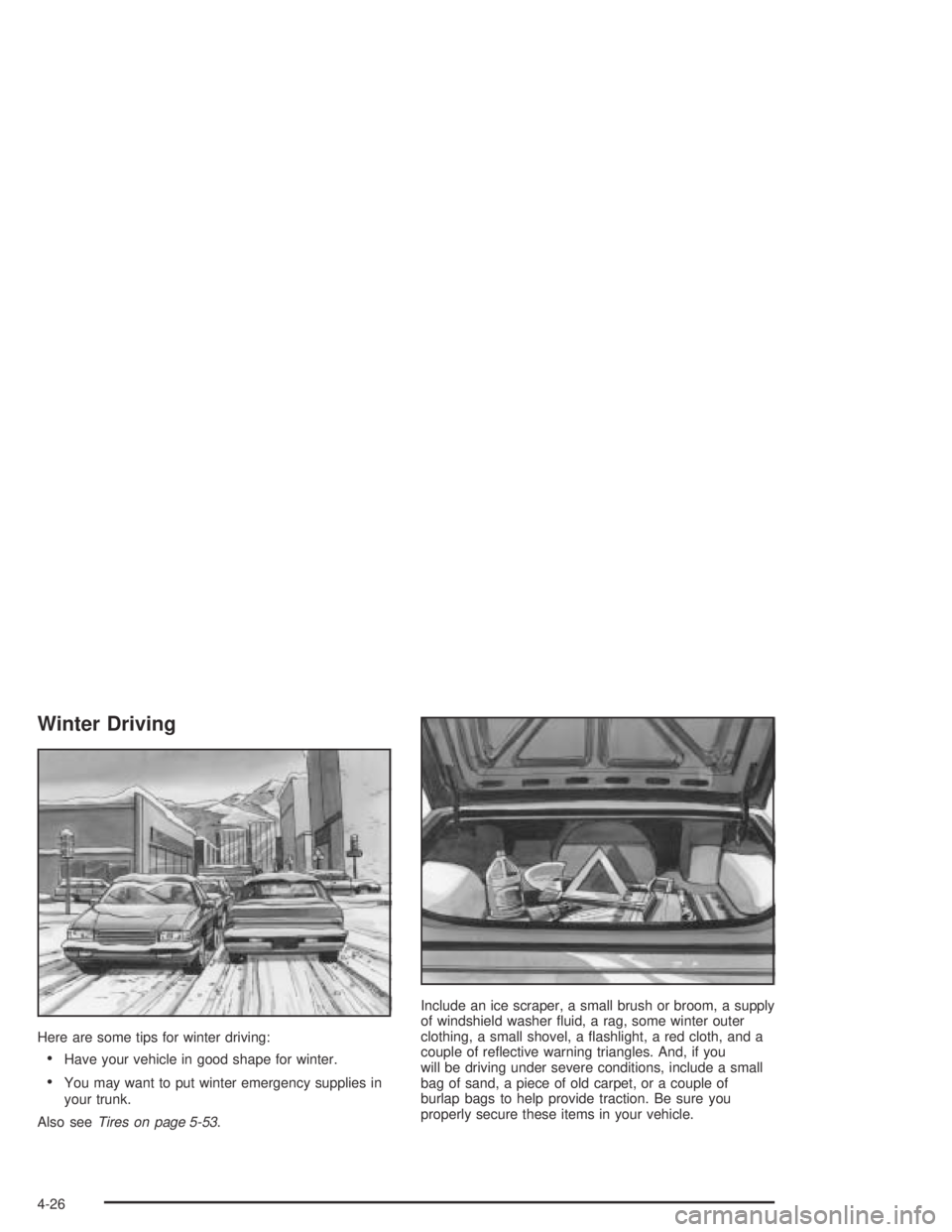
Winter Driving
Here are some tips for winter driving:
Have your vehicle in good shape for winter.
You may want to put winter emergency supplies in
your trunk.
Also seeTires on page 5-53.Include an ice scraper, a small brush or broom, a supply
of windshield washer uid, a rag, some winter outer
clothing, a small shovel, a ashlight, a red cloth, and a
couple of reective warning triangles. And, if you
will be driving under severe conditions, include a small
bag of sand, a piece of old carpet, or a couple of
burlap bags to help provide traction. Be sure you
properly secure these items in your vehicle.
4-26
Page 202 of 348
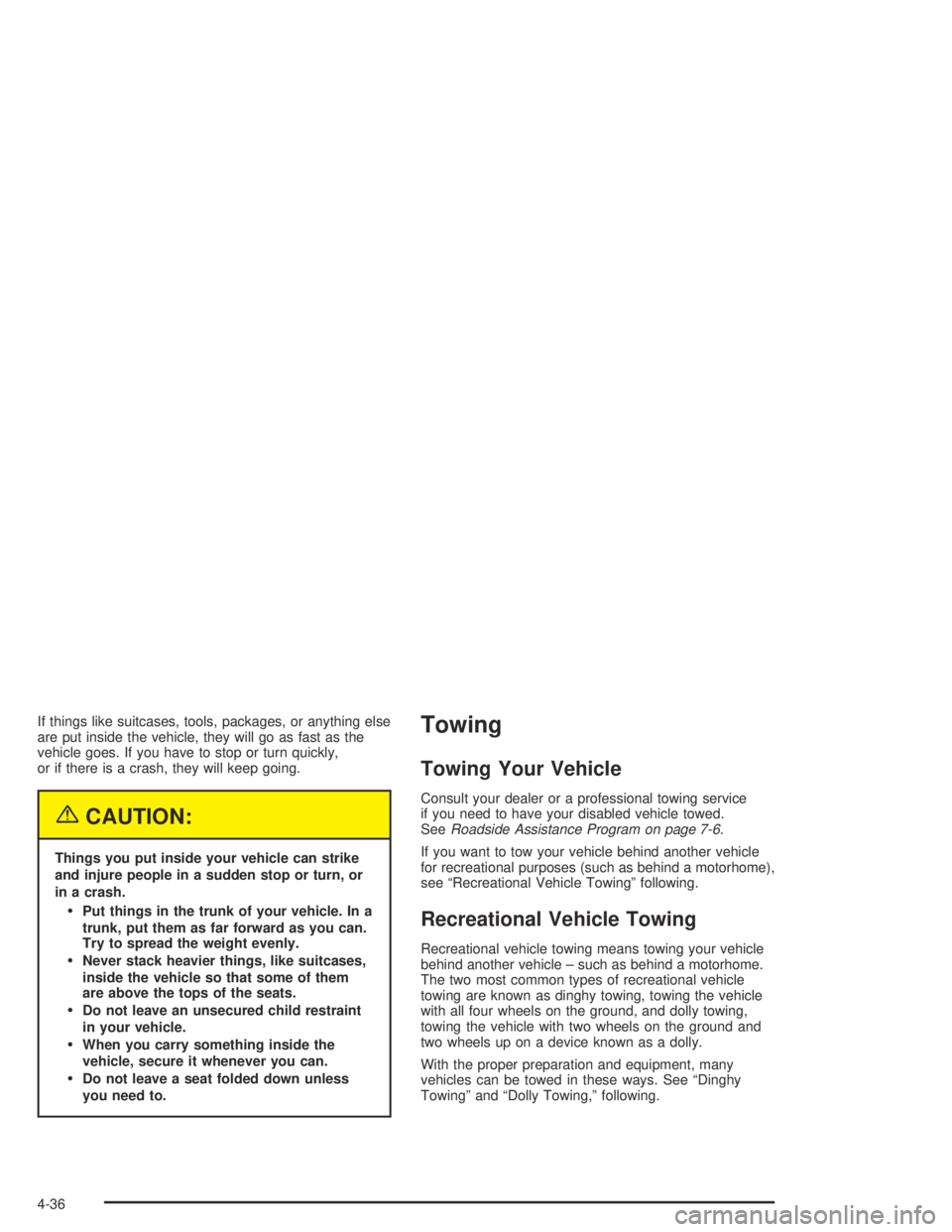
If things like suitcases, tools, packages, or anything else
are put inside the vehicle, they will go as fast as the
vehicle goes. If you have to stop or turn quickly,
or if there is a crash, they will keep going.
{CAUTION:
Things you put inside your vehicle can strike
and injure people in a sudden stop or turn, or
in a crash.
Put things in the trunk of your vehicle. In a
trunk, put them as far forward as you can.
Try to spread the weight evenly.
Never stack heavier things, like suitcases,
inside the vehicle so that some of them
are above the tops of the seats.
Do not leave an unsecured child restraint
in your vehicle.
When you carry something inside the
vehicle, secure it whenever you can.
Do not leave a seat folded down unless
you need to.
Towing
Towing Your Vehicle
Consult your dealer or a professional towing service
if you need to have your disabled vehicle towed.
SeeRoadside Assistance Program on page 7-6.
If you want to tow your vehicle behind another vehicle
for recreational purposes (such as behind a motorhome),
see “Recreational Vehicle Towing” following.
Recreational Vehicle Towing
Recreational vehicle towing means towing your vehicle
behind another vehicle – such as behind a motorhome.
The two most common types of recreational vehicle
towing are known as dinghy towing, towing the vehicle
with all four wheels on the ground, and dolly towing,
towing the vehicle with two wheels on the ground and
two wheels up on a device known as a dolly.
With the proper preparation and equipment, many
vehicles can be towed in these ways. See “Dinghy
Towing” and “Dolly Towing,” following.
4-36
Page 208 of 348
Driving with a Trailer
Towing a trailer requires a certain amount of experience.
Before setting out for the open road, get to know the
rig. Acquaint yourself with the feel of handling and
braking with the added weight of the trailer. And always
keep in mind that the vehicle is now a good deal
longer and not nearly as responsive as the vehicle is
by itself.
Before starting, check all trailer hitch parts and
attachments, safety chains, electrical connector, lamps,
tires, and mirror adjustment. If the trailer has electric
brakes, start the vehicle and trailer moving and then
apply the trailer brake controller by hand to be sure the
brakes are working. This lets you check the electrical
connection at the same time.
During your trip, check occasionally to be sure that the
load is secure, and that the lamps and any trailer
brakes are still working.
Following Distance
Stay at least twice as far behind the vehicle ahead as
when driving the vehicle without a trailer. This can
help avoid situations that require heavy braking
and sudden turns.
Passing
More passing distance is needed up ahead when
towing a trailer. And, because the vehicle is a good deal
longer with the trailer, you will need to go much farther
beyond the vehicle you have passed before you
can return to the proper lane.
Backing Up
Hold the bottom of the steering wheel with one hand.
Then, to move the trailer to the left, move that hand
to the left. To move the trailer to the right, move your
hand to the right. Always back up slowly and, if possible,
have someone guide you.
Making Turns
Notice:Making very sharp turns while trailering
could cause the trailer to come in contact with the
vehicle. Your vehicle could be damaged. Avoid
making very sharp turns while trailering.
When turning with a trailer, make wider turns than
normal. Do this so the trailer will not strike soft shoulders,
curbs, road signs, trees, or other objects. Avoid jerky or
sudden maneuvers. Signal well in advance.
4-42