2005 BMW 325XI SEDAN start
[x] Cancel search: startPage 3 of 178
Congratulations, and thank you for choosing a BMW.
Thorough familiarity with your vehicle will provide you with enhanced control and
security when you drive it. Therefore we have one request:
Please take the time to read this Owner's Manual and familiarize yourself with the
information that we have compiled for you before starting off in your new BMW. The
manual contains important data and instructions intended to assist you in obtaining
maximum satisfaction from your BMW's unique array of advanced technical fea-
tures. It also contains information on vehicle maintenance designed to enhance
operating safety while simultaneously helping you to maintain your BMW's value
throughout an extended service life. For additional information refer to the supple-
mental manuals.
This Owner's Manual should be considered a permanent part of this vehicle. It
should stay with the vehicle when sold to provide the next owner with important
operating, safety and maintenance information.
We wish you an enjoyable driving experience.
BMW AG
Page 5 of 178
5
Notes
Your individual vehicle
On purchasing your BMW, you have
decided in favor of a model with individ-
ualized equipment and features. This
Owner's Manual describes all models
and equipment that BMW offers within
the same group.
We hope you will understand that
equipment and features are included
that you might not have chosen for your
vehicle. You can easily identify any dif-
ferences with the aid of the asterisk
used to identify all optional equipment
and accessories.
If your BMW features equipment, such
as a car radio or telephone, which is not
described in this Owner's Manual, sup-
plementary Owner's Manuals are
enclosed. We ask you to read these
manuals as well.
Status at time of printing
BMW pursues a policy of continuous,
ongoing development designed to
ensure that our vehicles continue to
embody the highest quality and safety
standards combined with advanced,
state-of-the-art technology. For this
reason, the features described in this
Owner's Manual could differ from those
in your vehicle. Nor can errors and
omissions be entirely ruled out. You are
therefore asked to appreciate that no
claims can be recognized on the basis
of the data, illustrations or descriptions
in this Owner's Manual.
For your own safety
Fuels
Use unleaded gasoline only. Fuels
containing up to and including
10 % ethanol or other oxygenates with
up to 2.8 % oxygen by weight – that is,
15 % MTBE or 3 % methanol plus an
equivalent amount of co-solvent – will
not void the applicable warranties
respecting defects in materials or work-
manship. Field experience has indi-
cated significant differences in fuel
quality – volatility, composition, addi-
tives, etc. – among gasolines offered for
sale in the United States and Canada.
The use of poor-quality fuels may result
in driveability, starting and stalling
problems especially under certain envi-
ronmental conditions, such as high
ambient temperature and high altitude.
Should you encounter driveability prob-
lems which you suspect could be
related to the fuel you are using, we
recommend that you respond by
switching to a recognized high-quality
brand.
Failure to comply with these recom-
mendations may result in unscheduled
maintenance.
Obey all applicable safety rules when
you are handling gasoline.
<
Page 9 of 178

Contents
9
Passenger safety systems:
Airbags54
Transporting children safely57
Vehicle Memory, Key
Memory61
Driving:
Ignition lock63
Starting the engine63
Switching off the engine65
Parking brake65
Manual transmission66
Sequential manual gearbox
SMG*67
Automatic transmission with
Steptronic*71
Turn signal indicator/Headlamp
flasher74
Washer/wiper system/Rain
sensor*75
Cruise control*77
Everything under control:
Odometer79
Tachometer79
Energy control79
Fuel gauge80
Engine coolant temperature
gauge80
Service interval display81
Check Control81
Clock82
Computer*83
Technology for safety and
driving convenience:
Park Distance Control (PDC)*85
Dynamic Stability Control
(DSC)86
Dynamic Stability Control (DSC) –
325xi88
Hill Descent Control (HDC)*90
Flat Tire Monitor*91
Brake force display92
Lamps:
Parking lamps/Low beams93
Instrument lighting94
High beams/Standing lamps94
Fog lamps*95
Interior lamps95
Controlling the climate for
pleasant driving:
Air conditioning96
Automatic climate control*100
Interior conveniences:
Premium sound system*105
Glove compartment105
Storage compartments106
Cellular phone*107
Ashtray, front*108
Ashtray, rear*108
Socket109
Loading and transporting:
Ski bag*110
Cargo area111
Cargo loading113
Roof-mounted luggage
rack*116
Controls and features
Page 10 of 178

Contents
Operation, maintenance
Special operating instructions:
Break-in procedures120
General driving notes121
Antilock Brake System
(ABS)121
Brake system122
Wheels and tires:
Tire inflation pressure124
Tire condition124
Tire replacement125
Wheel and tire
combinations127
Winter tires127
In the engine compartment:
Hood129
Engine compartment
essentials130
Washer fluids132
Engine oil132
Coolant134
Brake fluid135
Maintenance:
The BMW Maintenance
System136
Laws and regulations:
California Proposition 65
warning138
OBD interface socket138
Owner service procedures
Replacement procedures:
Onboard tool kit142
Windshield wiper blades142
Lamps and bulbs143
Changing a wheel147
Run Flat tires*150
Battery151
Fuses151
Giving and receiving
assistance: Receiving assistance152
Jump-starting153
Towing the vehicle154
Technical data
Engine data160
Dimensions161
Weights162
Capacities163
Page 18 of 178

18
Indicator and warning lamps
Technology that monitors itself
Indicator and warning lamps that are
identified by
●
are tested for proper
functioning whenever the ignition key is
turned. They each light up once for dif-
ferent periods of time.
If a fault should occur in one of these
systems, the corresponding lamp does
not go out after the engine is started, or
it lights up while the vehicle is moving.
You will see how to react to this in the
following section.
Red: stop immediately
Battery charge current
●
The battery is no longer being
charged. Indicates a defective
alternator drive belt or a problem with
the alternator's charge circuit. Please
contact the nearest BMW center.
If the drive belt is defective, stop
and switch off the engine immedi-
ately to prevent overheating and seri-
ous engine damage. If the drive belt is
defective, increased steering effort is
also required.
<
Engine oil pressure
●
Stop the vehicle immediately
and switch off the engine.
Check the engine oil level and top off as
required. If the oil level is correct:
please contact the nearest BMW cen-
ter.
Do not continue driving, as the
engine could sustain serious dam-
age from inadequate lubrication.
<
Brake warning lamp
●
If the lamp comes on when the
parking brake is not engaged:
check the brake fluid level. Before driv-
ing further, be sure to comply with the
instructions on pages 122 and 135.
Brake warning lamp for Cana-
dian models.
Flat Tire Monitor
●
In addition, an acoustic signal is
sounded: there is a flat tire.
Reduce speed and carefully come to a
stop. Avoid sudden braking and steer-
ing maneuvers.
For additional information: refer to
page 91
Red and yellow: continue driving
cautiously
The brake warning lamp comes
on together with the yellow indi-
cator lamps for ABS
●
and
DSC:
The entire ABS, CBC, DSC and
ADB-X/DBC control system has
failed. Continue driving cau-
tiously and defensively. Avoid
full brake applications. Please have the
system checked by your BMW center
as soon as possible.
Additional information beginning on
page 86
CBC, ABS, DSC and
ADB-X/DBC indicator and warn-
ing lamps for Canadian models.
Red: an important reminder
Brake warning lamp
●
Comes on when the parking
brake is engaged – an additional
acoustic signal sounds when starting
off. For additional information: refer to
page 65
Page 36 of 178
36
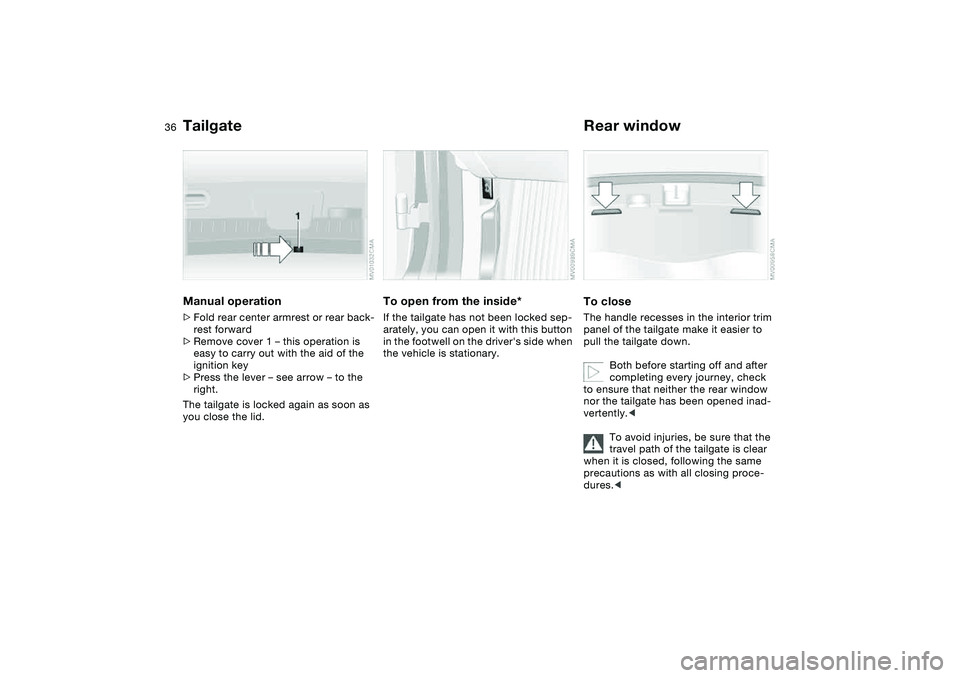
Manual operation>Fold rear center armrest or rear back-
rest forward
>Remove cover 1 – this operation is
easy to carry out with the aid of the
ignition key
>Press the lever – see arrow – to the
right.
The tailgate is locked again as soon as
you close the lid.
To open from the inside*If the tailgate has not been locked sep-
arately, you can open it with this button
in the footwell on the driver's side when
the vehicle is stationary.
Rear windowTo closeThe handle recesses in the interior trim
panel of the tailgate make it easier to
pull the tailgate down.
Both before starting off and after
completing every journey, check
to ensure that neither the rear window
nor the tailgate has been opened inad-
vertently.<
To avoid injuries, be sure that the
travel path of the tailgate is clear
when it is closed, following the same
precautions as with all closing proce-
dures.<
Tailgate
Page 39 of 178
39
armed: an attempted entry has been
detected in the period since the sys-
tem was armed.
Following triggering of an alarm, the
indicator lamp will flash continuously.Avoiding unintentional alarmsThe tilt alarm sensor and interior motion
sensor may be switched off at the same
time. You can do this to prevent a false
alarm from being triggered in garages
with elevator ramps, for instance, or
when the vehicle is transported by train:
Lock the vehicle twice to arm the sys-
tem. Press the button on the remote
control twice in succession or lock the
vehicle twice with the key.
The indicator lamp lights up briefly and
then flashes continuously. The tilt alarm
sensor and the interior motion sensor
are deactivated as long as the system is
armed.
You can have the tilt alarm sensor
and the interior motion sensor
permanently deactivated.<
Interior motion sensorIn order for the interior motion sensor to
function properly, the windows and the
glass sunroof must be completely
closed.
Nevertheless, you should deactivate
the interior motion sensor, refer to
Avoiding unintentional alarms, if
>persons or animals are left in the
vehicle
>the windows or the glass sunroof are
being left open.
The system deactivates the tilt-
alarm sensor and the interior
motion sensor if the convenience clos-
ing of windows and the glass sunroof is
interrupted in the first 10 seconds and
then restarted. The alarm must then be
disarmed and reactivated before it will
resume operation.<
Alarm system*
OverviewControlsMaintenanceRepairsDataIndex
Page 48 of 178
48
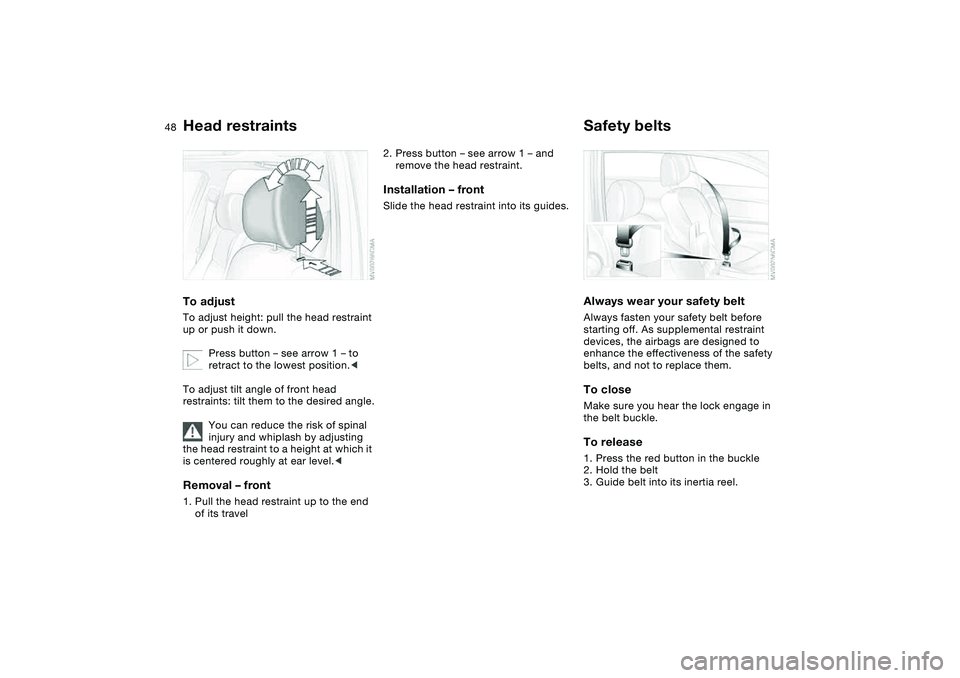
Head restraintsTo adjustTo adjust height: pull the head restraint
up or push it down.
Press button – see arrow 1 – to
retract to the lowest position.<
To adjust tilt angle of front head
restraints: tilt them to the desired angle.
You can reduce the risk of spinal
injury and whiplash by adjusting
the head restraint to a height at which it
is centered roughly at ear level.
2. Press button – see arrow 1 – and
remove the head restraint.Installation – frontSlide the head restraint into its guides.
Safety beltsAlways wear your safety beltAlways fasten your safety belt before
starting off. As supplemental restraint
devices, the airbags are designed to
enhance the effectiveness of the safety
belts, and not to replace them.To closeMake sure you hear the lock engage in
the belt buckle.To release1. Press the red button in the buckle
2. Hold the belt
3. Guide belt into its inertia reel.