2005 Alfa Romeo 156 wheel
[x] Cancel search: wheelPage 216 of 357

IN AN EMERGENCY
214
INFLATING PROCEDURE 1)Place the wheel in the position illus-
trated in the figure (A-fig. 13) for the op-
eration with the valve, then engage the
handbrake.
2)Screw the filling pipe (B-fig. 14) to
the bottle (C).
3)Unscrew the tyre valve plug, remove
the element inside the valve by using the
appropriate tool (D-fig. 15); be careful
not to place it on the sand or on a dirty sur-
face .
4)Introduce the filling pipe (B-fig. 16)
in the tyre valve, keep the bottle (C-fig.
16) with the pipe directed downwards, then
press it so that the whole sealer can get in-
to the tyre.5)Screw again the element inside the
valve with the tool (D-fig. 17).
6)Use the appropriate lever (E-fig. 18)
to insert and clamp the air compressor pipe
(F) to the tyre valve.
7)Start the engine, insert the plug (G-
fig. 19) in the lighter (or socket 12V) and
inflate the tyre according to the right pres-
sure value (see “Cold inflation pressures” in
the “Technical specification” chapter). You
are advised to check the tyre pressure val-
ue on the pressure gauge (H-fig. 18) with
the compressor off, in order to have a more
accurate reading.fig. 13
A0B0334m
fig. 14
A0B335m
IT IS NECESSARY TO KNOW
THAT:The sealer included in the quick repairing
kit, good for temperatures between –30°C
e +80°C, is not adequate for permanent
fixing.
The liquid inside the tyre can be easily re-
moved with water.
The sealer has no expire date.
Do not operate the com-
pressor for more than 20
minutes. Risk of overheating.
WARNING
Page 245 of 357

IN AN EMERGENCY
243
IF THE VEHICLE IS TO BE TOWEDThe tow ring supplied with the vehicle is
housed in the tool box under the boot mat.
To install the tow ring, proceed as follows:
– Take the tow ring from the tool box.
– Remove the cover (A) snap-fitted on the
front (fig. 77) or rear bumper (fig. 78).
If the supplied flat screwdriver is used to car-
ry out this operation, protect the tip with a
soft cloth to prevent damaging the car.– Firmly screw the ring in its housing.fig. 77
A0B0593m
fig. 78
A0B0594m
Carefully clean the thread-
ed housing before tighten-
ing the ring. Before beginning to
tow the car make sure that the
tow ring is firmly tightened in its
threaded housing.
WARNING
Before beginning to tow
the car, turn the ignition
key to MAR and then to STOP, do
not remove it. Removing the key
automatically engages the steering
lock resulting in the impossibility
to steer the wheels. When towing
remember that without the help of
the servo-brake and power steer-
ing, it is necessary to exert more
effort on the brake pedal and for
steering. Do not use flexible cables
for towing and avoid jerks. Dur-
ing towing operations make sure
that fastening the joint to the car
does not damage the components
in contact with it. When towing the
car it is compulsory to comply with
the specific traffic regulations con-
cerning both the towing device and
behaviour on the road.
WARNING
Page 246 of 357
IN AN EMERGENCY
244
TOWING THE 2.0 JTS
SELESPEED VERSIONWARNINGFor version with Selespeed
gearbox, make sure that it is in neutral (N)
(checking that the car moves when pushed)
and proceed as for towing a normal car with
mechanical gearbox following the instruc-
tions given on the previous page.
Should it be impossible to set to neutral,
do not tow the vehicle; contact Alfa Romeo
Authorised Services.
TOWING THE VERSION WITH
AUTOMATIC GEARBOX
(2.5 V6 24V Q-SYSTEM)WARNINGFor towing the vehicle com-
ply with current local regulations. Also fol-
low the instructions given on the previous
page.
If the car needs to be towed, observe the
following recommendations:
– if possible, put the car on a rescue ve-
hicle;
– if this is not possible, tow the car rais-
ing the driving wheels (front) from the
ground;
– if this, too, is not possible, the car may
only be towed for 50 Km at a speed of
50 km/h.
The gearshift lever should be at position N
for towing.The failure to follow the
above instructions may
cause serious damage to
the automatic gearbox.
Cars with automatic gear-
box may be towed only for
short distances and at a
low speed: if longer towing is nec-
essary, the driving wheels must be
raised to prevent the gearbox from
being pulled into rotation during
towing.
Do not start the engine
when towing the vehicle.
WARNING
Do not start the engine
when the vehicle is being
towed.
WARNING
Page 247 of 357

IN AN EMERGENCY
245
USING THE JACKSee paragraph “In the event of a punc-
ture” in this chapter.
You are informed that:
– the jack mass is 2,100 kg;
– the jack requires no adjustment;
– the jack cannot be repaired and in case
of breakage it must be replaced by anoth-
er original one;
– no tool other than its cranking lever may
be installed on the jack.
USING AN ARM LIFT OR
WORKSHOP LIFTThe vehicle must only be lifted laterally po-
sitioning the ends of the arms or the work-
shop lift in the areas illustrated, approx. 40
cm from the profile of the wheelhouse
(fig. 79).
IF THE VEHICLE IS TO BE LIFTED
fig. 79
A0B0588m
The purpose of the jack is
only for replacing wheels
on the car with which it is provid-
ed or on cars of the same model. It
must never be used for other pur-
poses such as for example raising
cars of other models. In no case
must it be used for repairs under
the car.
WARNING
The car may fall if the jack
is not positioned correctly.
Never use the jack for higher ca-
pacities than the one stated on its
label.
WARNING
The car is to be lifted po-
sitioning the jack or the
workshop lift arm plate only in the
points shown (fig. 79).
WARNING
Page 253 of 357

CAR MAINTENANCE
251
ADDITIONAL
OPERATIONSEvery 1000 kmor before long journeys
check and if necessary top up:
– engine coolant level
– brake fluid/hydraulic clutch control flu-
id level
– power steering fluid level
– windscreen washer and headlamp wash-
er fluid level
– tyre pressure and conditions.
Every 3000 kmcheck the level of the
engine oil and top up if necessary.
You are recommended to use products of
the FL Selenia, designed and developed
expressly for Alfa Romeo cars (see the table
“Specifications of fluids and lubricants” in
the “Technical specifications” chapter).
ANNUAL INSPECTION
PROGRAMMEAn annual inspection programme
has been established for cars thet
cover less than 20,000 km (e.g.
10,000 km). It consists of the fol-
lowing:
– Check tyre conditions/wear and adjust
pressure if required (including the compact
spare wheel)
– Check lighting system operation (head-
lights, direction indicators, hazard lights,
boot lights, passenger compartment lights,
glovebox light, warning lights of instrument
panel, etc.)
– Check windscreen and rear-screen
wiper/washer operation, adjust nozzles
– Check windscreen/rear-screen blade po-
sition/wear
– Check condition and wear of the front
brake pad
– Check for bonnet and boot lock clean-
ness, lever cleanness and lubrication– Visually check the following: engine,
gearbox, transmission, piping (exhaust - fu-
el - brakes) rubber components (casings -
sleeves - bushings, etc..), brake and fuel
hoses
– Check battery charge condition
– Visually check the condition of the belts
and various controls
– Check and top up if necessary, the flu-
id levels (coolant, brake fluid, windscreen
washer fluid, battery, etc.)
– Change engine oil
– Replace engine oil filter
– Change pollen filter.
Page 264 of 357
CAR MAINTENANCE
262
WARNINGContact Alfa Romeo Autho-
rized Services for maintenance and repair
operations. If the level of the oil in the reservoir falls
below the specified level, top up only with
one of the products listed in the table
“Fluids and lubricants” in the “Technical
specifications” chapter as follows:
– Start the engine and allow the oil in the
reservoir to settle.
– When the engine is running turn the
steering wheel lock to lock a few minutes.
– Top up to the MAXlevel notch and
then replace the cover.Oil consumption is very
low, if topping up again is
needed shortly afterwards,
have the system checked for pos-
sible leaks by Alfa Romeo Autho-
rized Services.fig. 19 fig. 18
A0B0158m
A0B0158m
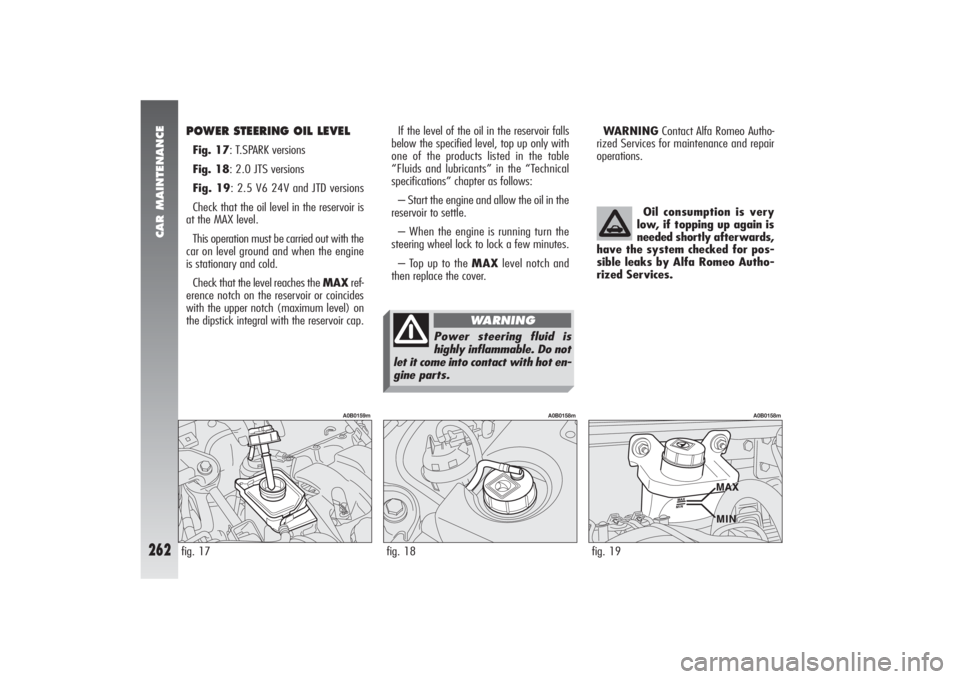
POWER STEERING OIL LEVEL Fig. 17: T.SPARK versions
Fig. 18: 2.0 JTS versions
Fig. 19: 2.5 V6 24V and JTD versions
Check that the oil level in the reservoir is
at the MAX level.
This operation must be carried out with the
car on level ground and when the engine
is stationary and cold.
Check that the level reaches the MAXref-
erence notch on the reservoir or coincides
with the upper notch (maximum level) on
the dipstick integral with the reservoir cap.fig. 17
A0B0159m
Power steering fluid is
highly inflammable. Do not
let it come into contact with hot en-
gine parts.
WARNING
Page 273 of 357
CAR MAINTENANCE
271
WHEELS AND TYRESTYRES PRESSURECheck the pressure of each tyre, includ-
ing the compact spare wheel, every two
weeks and before a long journey.
The pressure should be checked with the
tyre rested and cold.
It is normal for the pressure to increase
when the car is in use. If you have to check
or restore the pressure when the tyres are
hot, bear in mind that the pressure should
be +0.3 bar compare with the specified rat-
ing.
For the correct tyre inflation pressure, see
“Wheels” in the “Technical specifications”
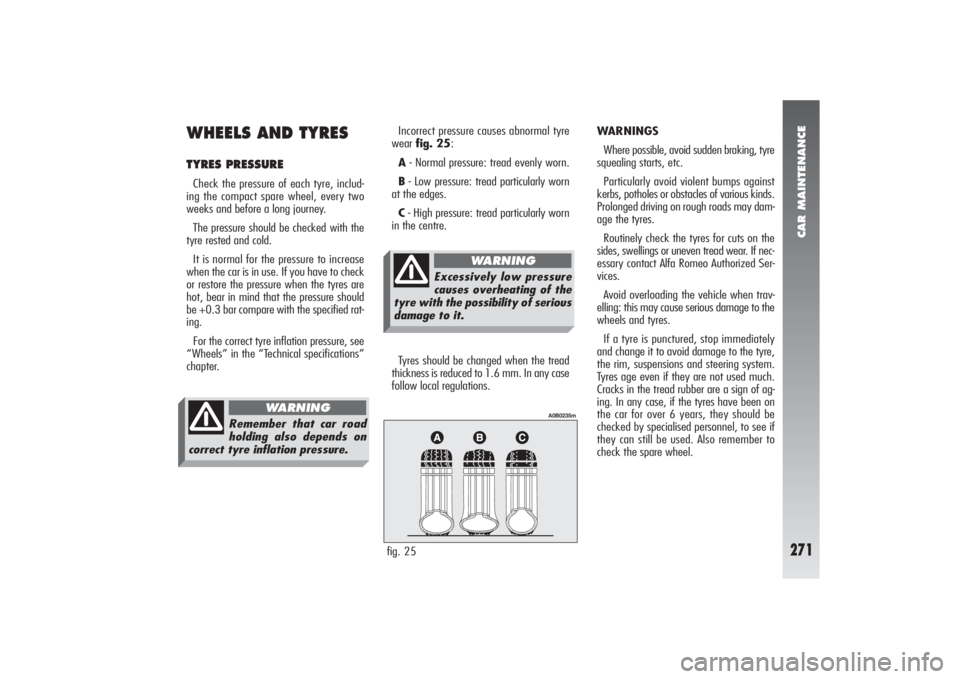
chapter.Incorrect pressure causes abnormal tyre
wear fig. 25:
A- Normal pressure: tread evenly worn.
B- Low pressure: tread particularly worn
at the edges.
C- High pressure: tread particularly worn
in the centre.
fig. 25
A0B0235m
WARNINGS
Where possible, avoid sudden braking, tyre
squealing starts, etc.
Particularly avoid violent bumps against
kerbs, potholes or obstacles of various kinds.
Prolonged driving on rough roads may dam-
age the tyres.
Routinely check the tyres for cuts on the
sides, swellings or uneven tread wear. If nec-
essary contact Alfa Romeo Authorized Ser-
vices.
Avoid overloading the vehicle when trav-
elling: this may cause serious damage to the
wheels and tyres.
If a tyre is punctured, stop immediately
and change it to avoid damage to the tyre,
the rim, suspensions and steering system.
Tyres age even if they are not used much.
Cracks in the tread rubber are a sign of ag-
ing. In any case, if the tyres have been on
the car for over 6 years, they should be
checked by specialised personnel, to see if
they can still be used. Also remember to
check the spare wheel.
Remember that car road
holding also depends on
correct tyre inflation pressure.
WARNING
Excessively low pressure
causes overheating of the
tyre with the possibility of serious
damage to it.
WARNING
Tyres should be changed when the tread
thickness is reduced to 1.6 mm. In any case
follow local regulations.
Page 274 of 357

CAR MAINTENANCE
272
fig. 26
A0B0589m
In the case of replacement, always fit new
tyres, avoiding those of dubious origin.
Alfa 156uses Tubeless tyres. Never
use an inner tube with these tyres.
If a tyre is changed, also change the in-
flation valve
To allow even wear between the front and
rear tyres, it is advisable to change them
over every 10-15 thousand kilometres,
keeping them on the same side of the car
so as to not reverse the direction of rotation
(fig. 26).
RUBBER HOSESAs far as the brake system and fuel sup-
ply rubber hoses are concerned, carefully fol-
low the Scheduled Maintenance Programme
of this chapter. Indeed ozone, high tem-
peratures and prolonged lack of fluid in the
system may cause hardening and cracking
of the hoses, with possible leaks. Careful
control is therefore necessary.
Do not cross switch the
tyres, moving them from
the right of the car to the left and
vice versa.
WARNING
Alloy rim painting involv-
ing temperatures exceed-
ing 150°C should be avoided since
wheel mechanical characteristics
could be impaired.
WARNING