2004 VOLVO V4 lock
[x] Cancel search: lockPage 34 of 89

4. To release the gear selector from the (P)ark position, the ignition key must be in position II and the brake pedal
must be depressed.
5. Select the desired gear. The gear engages after a slight delay which is especially noticeable when selecting R.
NOTE: Your car is equipped with a KEYLOCK system. When the engine is switched off, the gear selector must be
in the (P)ark position before the starting key can be removed from the ignition switch.
WARNING!
Volvo offers floor mats specially manufactured for your vehicle. They must be properly placed and secured in the
mat clips.
An extra mat on the driver's floor can cause the accelerator pedal to catch. Check that the movement of the
accelerator pedal is not impeded. No more than one protective floor covering may be used at one time.
CAUTION :
The engine should be idling; never accelerate until after you feel the gear engage! Too-rapid acceleration immediately
after selecting a gear will cause harsh engagement and premature transmission wear.
NOTE : Selecting P or N when idling at a standstill for prolonged periods of time will help prevent overheating of
transmission oil.
Ignition sleep mode
If the key is turned to "drive" position (see page 26
) for several minutes without the engine running, the car's starting
system will power down to "sleep" mode. To start the car, momentarily turn the key back to the "locked" position.
Then start the car as you would normally do.
WARNING!
Always place the gear selector in Park and apply the parking brake before leaving the vehicle. Never leave the car
unattended with the engine running.
Always open the garage doors fully before starting the engine inside a garage to ensure adequate ventilation. The
exhaust gases contain carbon monoxide, which is invisible and odorless but very poisonous.
CAUTION:
Never race the engine immediately after starting. Oil flow may not reach some lubricating points fast enough to
prevent engine damage.
Do not race the engine just prior to switching off!
pg. 66 Automatic transmission
ProCarManuals.com
Page 35 of 89

Gear selector positions
P Park
The transmission must be in Park position to start the engine, and to allow removal of the key from the ignition when
you leave the car. The car should be stationary when you select P! In the position P the transmission is mechanically
locked. Always apply the parking brake when parking!
Shift lock
In order to move the gear selector from P position to the other gear positions the key must be in driving position
(position II) and the brake pedal must be depressed. See page 99
for information on how to move the gear selector
manually in case of a dead battery.
R Reverse
The car must be at a standstill before you select Reverse gear.
N Neutral position
The N position is the neutral position. The engine can be started, but no gear is selected. Apply the parking brake when
the car is stationary with the gear selector in position N.
D Driving position
D is the normal driving position. The gear selector automatically shifts up and down between the transmission gears,
based on the level of acceleration and the speed. The car should be stationary when you select D from position R.
4 Low gear position
Shifting up and down between the 1st, 2nd, 3rd, and 4th occurs automatically.
Shifting up to Drive does not occur.
Position 4 can be used:
for mountain driving
for driving with trailer
to increase the engine braking
3 Low gear position
Shifting up and down between the 1st, 2nd, and 3rd occurs automatically.
The 4th and Drive gears will not be engaged.
Position 3 can be used:
for mountain driving
for driving with trailer
to increase the engine braking
L Low gear position
Choose position L if you want to drive with the 1st or 2nd gear engaged. Position L gives the best possible engine
ProCarManuals.com
Page 39 of 89

tire damage.
Wear indicator
The tires have a so-called "wear indicator" in the form of a number of narrow strips running across or parallel to the
tread. When approx. 1/16" (1.6 mm) is left on the tread, these strips become visible and indicate that the tire should be
replaced.
Tires with less than 1/16" (1.6 mm) tread have a very poor grip in rain or snow.
When replacing worn tires, it is recommended that the tire be identical in type (radial) and size as the one being
replaced. Using a tire of the same make (manufacturer) will prevent alteration of the driving characteristics of the
vehicle.
To improve tire economy:
Maintain correct tire pressure. See the tire pressure label on the inside of the fuel filler door.
Drive smoothly: avoid fast starts, hard braking and tire screeching.
Tire wear increases with speed.
Correct front wheel alignment is very important.
Unbalanced wheels impair tire economy and driving comfort.
If the wheels are rotated, they should be kept on the same side of the car so that they revolve in the same direction
as prior to rotation.
Hitting curbs or potholes can damage the tires and/or wheels permanently.
Flat spots
All tires become warm during use. After cooling, when the vehicle is parked, the tires have a tendency to distort
slightly, forming flat spots. These flat spots can cause vibrations similar to the vibrations caused by unbalanced wheels.
They do, however, disappear when the tire warms up. The degree to which flat spots form depends on the type of cord
used in the tire. Remember that, in cold weather, it takes longer for the tire to warm up and consequently longer for the
flat spot to disappear.
pg. 81 Wheels and tires
Snow chains
Snow chains can be used on your Volvo with the following restrictions:
Snow chains should be installed on front wheels only. Use only Volvo approved snow chains.
Snow chains may only be mounted on approved snow tires 185/65 R15. Consult your Volvo retailer.
If accessory, aftermarket or "custom" tires and wheels are installed and are of a size different than the original tires
and wheels, chains in some cases CANNOT be used. Sufficient clearances between chains and brakes, suspension and
body components must be maintained.
Some strap on type chains will interfere with brake components and therefore CANNOT be used.
Consult your Volvo retailer for additional snow chain information.
CAUTION:
Check local regulations regarding the use of snow chains before installing.
Always follow the chain manufacturer's installation instructions carefully. Install chains as tightly as possible and
retighten periodically.
Never exceed the chain manufacturer's specified maximum speed limit. (Under no circumstances should that limit
be higher than 30 mph (45 km/h)).
Avoid bumps, holes or sharp turns when driving with snow chains.
The handling of the vehicle can be adversely affected when driving with chains. Avoid fast or sharp turns as well as
locked wheel braking.
Snow tires, studded tires *
Tires for winter use:
ProCarManuals.com
Page 44 of 89

The screwdriver is combined with the socket wrench. The tools can be alternated by pulling the shaft out of the handle
and re-inserting the opposite end of the shaft into the handle.
Removing the jack
Remove the spare tire out. Loosen the jack slightly by turning the axle (1) and remove it from the retaining clip.
Replacing the jack
Put the jack in the clip and turn axle (1) until the jack is securely in place.
Replace the tools in the same place.
WARNING!
The jack (see the following pages) must be correctly placed in the jack attachment.
Be sure the jack is on a firm, level, non-slippery surface.
Never allow any part of your body to be extended under a car supported by a jack.
Use the jack intended for the car when replacing a wheel. For any other job, use stands to support the side of the
car being worked on.
Apply the parking brake and put the gear selector in position P.
Block the wheels standing on the ground, use rigid wooden blocks or large stones.
The jack should be kept well-greased.
Use gloves
pg. 87 Tire changing
Changing a tire
Engage the parking brake.
Put the gear selector in (P)ark.
ProCarManuals.com
Page 45 of 89

Get all the passengers to move to a safe place outside the car.
Close all doors.
Block the wheels remaining on the ground with wooden blocks, stones or something similar.
With the car still on the ground, use the lug wrench to loosen the wheel lugs 1/2 - 1 turn. Position the lug wrench so
that you apply force in a downward direction. Never lift up on the lug wrench to loosen or tighten lugs.
Turn the bolts counterclockwise to loosen. If necessary, press down on the lug wrench with your foot to loosen the
lugs.
CAUTION:
The car must not be driven with wheels of different dimensions or with a spare tire other than the one that came
with the car. The use of different size wheels can seriously damage your car's transmission.
pg. 88 Wheel changing
Attaching the jack
There are two jack attachment points located on each side of the car. These attachment points are marked by arrows on
the outside of the cover over the bottom sill (see illustration).
Check that the doors are closed and stay closed all the time the car is jacked up.
Position the jack under the two notches closest to the wheel to be changed.
Attach the crank to the jack (A).
Attach the lug wrench (B) to the crank.
Raise the jack by cranking it clockwise. Be sure the jack engages the attachment point correctly.
The base of the jack must be flat on a level, firm, non-slippery surface. Before raising the car, check that the
jack is still correctly positioned in the attachment point.
Raise the car until the wheel to be changed is lifted off the ground.
Unscrew the wheel bolts completely and carefully remove the wheel so as not to damage the thread on the studs.
WARNING!
The jack must be correctly placed in the jack attachment.
Installing the wheel
Clean the contact surfaces on the wheel and hub.
Lift the wheel and place it on the hub.
ProCarManuals.com
Page 47 of 89

Installing high/low beam headlight bulbs
Insert the new bulb in the headlight unit
Reconnect the connector and wiring.
Press the retaining spring over the connector/bulb until it clicks into position.
Reinstall the rubber cover at the rear of the headlight unit.
Put the hard plastic cover in place above the headlight housing and press the tab down to secure the cover.
NOTE: Never touch the glass of a bulb with your fingers: this could leave traces of grease or oil on the glass which
then evaporate and may damage the reflector.
pg. 91 Replacing bulbs
Front direction indicators and parking lights
Removing the bulb:
Loosen the screw (A) between the headlight and direction indicator housings (max. 2 complete turns
counterclockwise), using the screwdriver supplied in the tool kit.
Press clip (D) and move the direction indicator housing forward.
With the wiring still attached, turn bulb holder slightly counterclockwise and withdraw it from the lamp housing.
Pull the bulb to remove.
ProCarManuals.com
Page 48 of 89

Replacement
Insert a new bulb in the holder.
Re-insert the bulb holder in the lamp housing and turn it clockwise until it clicks into place.
Press the lamp housing into place.
Make sure than locating pin (B) fits into the hole in the fender and slotted hole (C) around the screw.
Tighten the screw.
pg. 92 Replacing bulbs
Replacement of rear light bulbs - S40
All the bulbs in the rear light unit are replaced from inside the trunk
Procedure:
Switch off the lights and remove the ignition key.
Turn the clip 90° and pull it out. Fold the panel in the boot towards the middle so as to get access to the bulb
holders.
Push catches A and B in and remove the bulb holder. The bulbs are held in the bulb holder.
Leave the connector and cables connected to the bulb holder.
Remove the bulb by pressing it inwards and turning it a few degrees counterclockwise.
Insert a new bulb into the bulb holder and replace the holder. Check that the bulb works and refit the panel.
ProCarManuals.com
Page 49 of 89
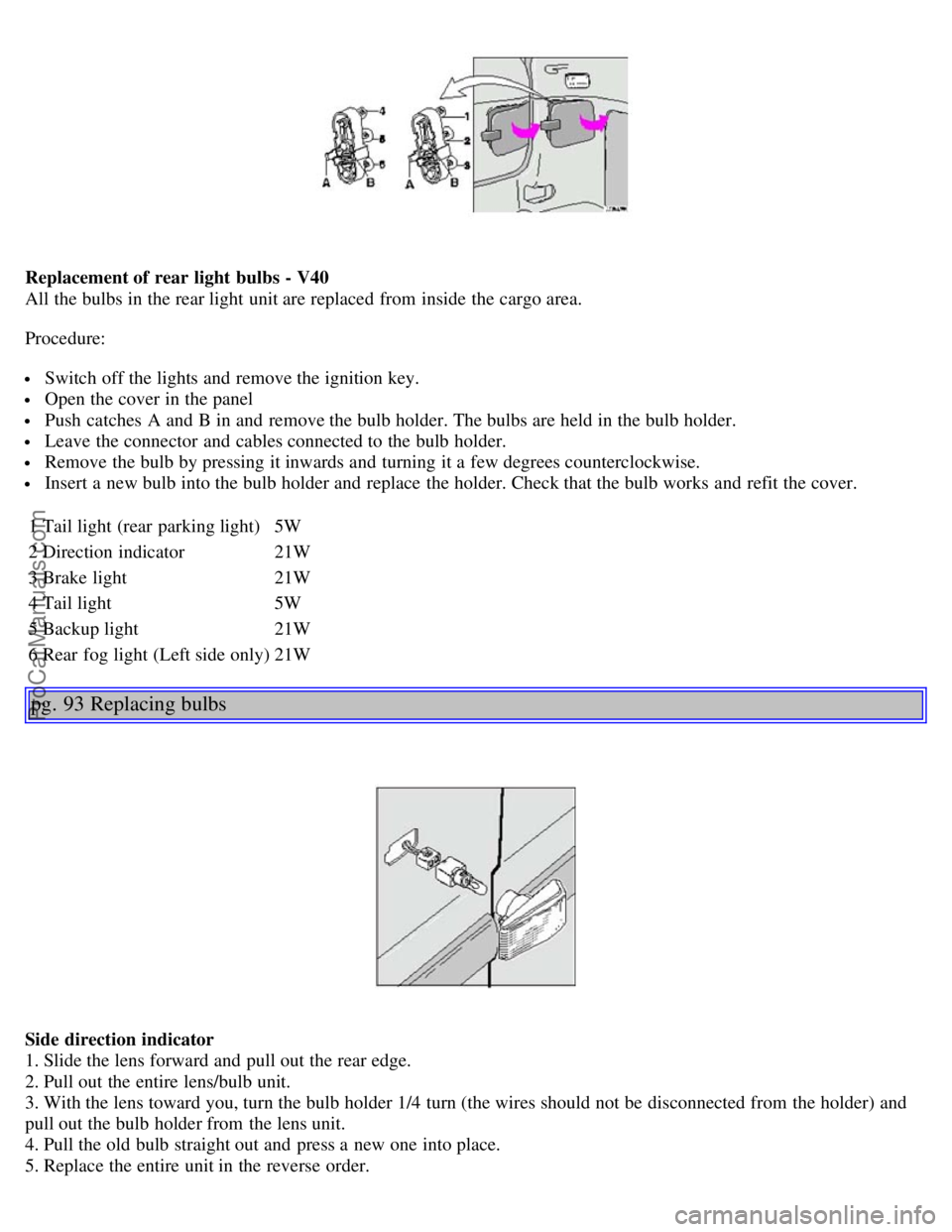
Replacement of rear light bulbs - V40
All the bulbs in the rear light unit are replaced from inside the cargo area.
Procedure:
Switch off the lights and remove the ignition key.
Open the cover in the panel
Push catches A and B in and remove the bulb holder. The bulbs are held in the bulb holder.
Leave the connector and cables connected to the bulb holder.
Remove the bulb by pressing it inwards and turning it a few degrees counterclockwise.
Insert a new bulb into the bulb holder and replace the holder. Check that the bulb works and refit the cover.
1 Tail light (rear parking light) 5W
2 Direction indicator 21W
3 Brake light 21W
4 Tail light 5W
5 Backup light 21W
6 Rear fog light (Left side only) 21W
pg. 93 Replacing bulbs
Side direction indicator
1. Slide the lens forward and pull out the rear edge.
2. Pull out the entire lens/bulb unit.
3. With the lens toward you, turn the bulb holder 1/4 turn (the wires should not be disconnected from the holder) and
pull out the bulb holder from the lens unit.
4. Pull the old bulb straight out and press a new one into place.
5. Replace the entire unit in the reverse order.
ProCarManuals.com