Page 384 of 479
’04 TUNDRA_U (L/O 0309)
375
2004 TUNDRA from Sep. ’03 Prod. (OM34426U)
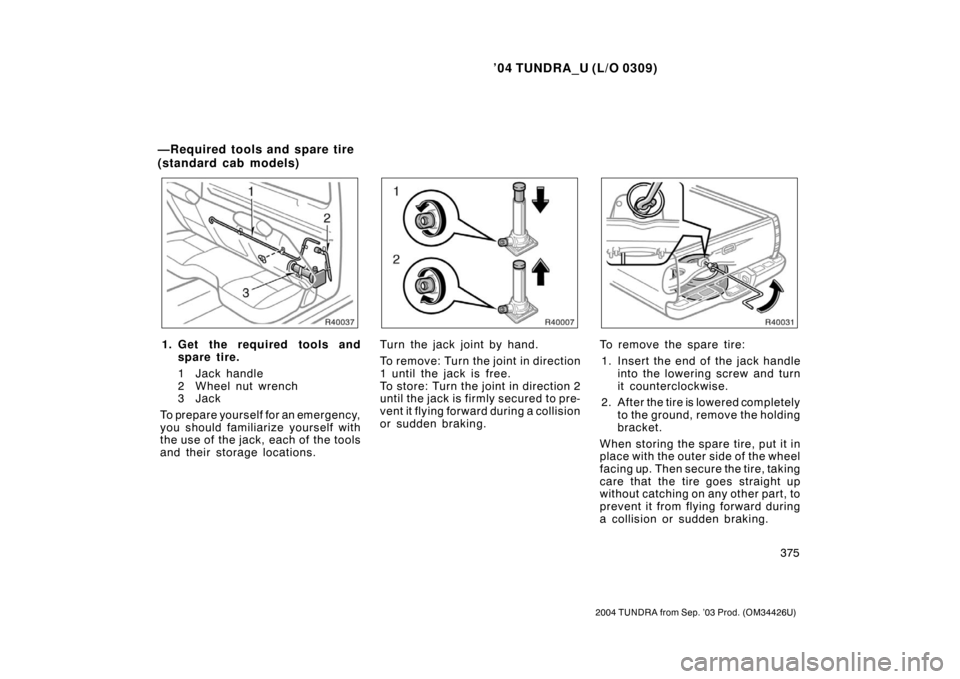
1. Get the required tools and
spare tire.
1 Jack handle
2 Wheel nut wrench
3Jack
To prepare yourself for an emergency,
you should familiarize yourself with
the use of the jack, each of the tools
and their storage locations.Turn the jack joint by hand.
To rem ov e: Tur n the joint in direction
1 until the jack is free.
To store: Turn the joint in direction 2
until the jack is fi rmly secured to pre-
vent it flying forward during a collision
or sudden braking.To remove the spare tire:
1. Insert the end of the jack handle
into the lowering screw and turn
it counterclockwise.
2. After the tire is lowered completely to the ground, remove the holding
bracket.
When storing the spare tire, put it in
place with the outer side of the wheel
facing up. Then secure the tire, taking
care that the tire goes straight up
without catching on any other part, to
prevent it from flying forward during
a collision or sudden braking.
—Required tools and spare tire
(standard cab models)
Page 386 of 479
’04 TUNDRA_U (L/O 0309)
377
2004 TUNDRA from Sep. ’03 Prod. (OM34426U)
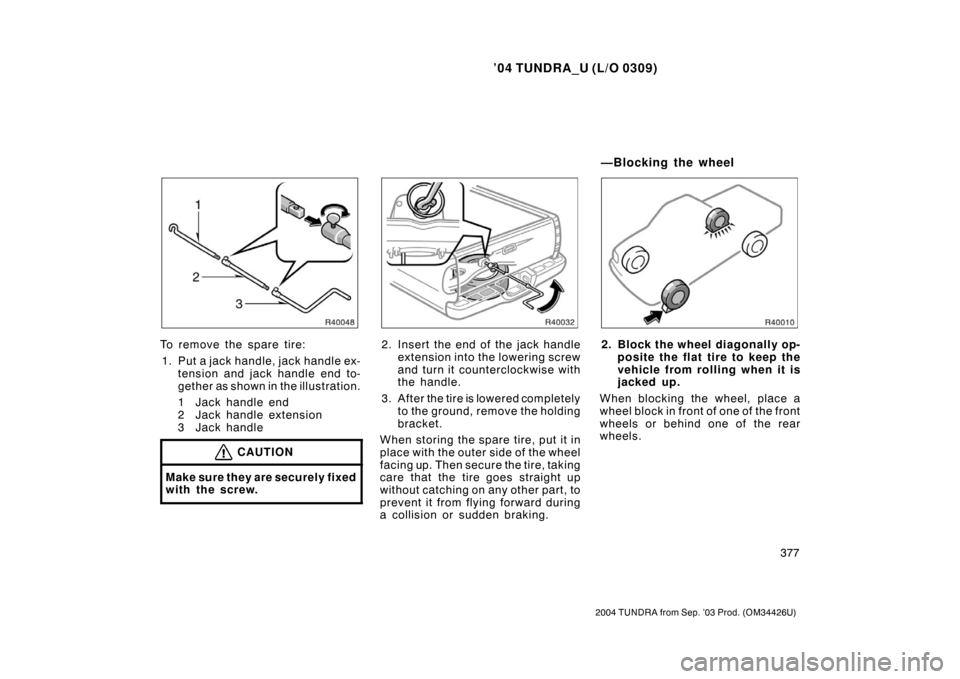
To remove the spare tire:
1. Put a jack handle, jack handle ex- tension and jack handle end to-
gether as shown in the illustration.
1 Jack handle end
2 Jack handle extension
3 Jack handle
CAUTION
Make sure they are securely fixed
with the screw.
2. Insert the end of the jack handleextension into the lowering screw
and turn it counterclockwise with
the handle.
3. After the tire is lowered completely to the ground, remove the holding
bracket.
When storing the spare tire, put it in
place with the outer side of the wheel
facing up. Then secure the tire, taking
care that the tire goes straight up
without catching on any other part, to
prevent it from flying forward during
a collision or sudden braking.2. Block the wheel diagonally op- posite the flat tire to keep the
vehicle from rolling when it is
jacked up.
When blocking the wheel, place a
wheel block in front of one of the front
wheels or behind one of the rear
wheels.
—Blocking the wheel
Page 388 of 479
’04 TUNDRA_U (L/O 0309)
379
2004 TUNDRA from Sep. ’03 Prod. (OM34426U)
CAUTION
Do not try to pull off the orna-
ment by hand. Take due care in
handling the ornament to avoid
unexpected personal injury.
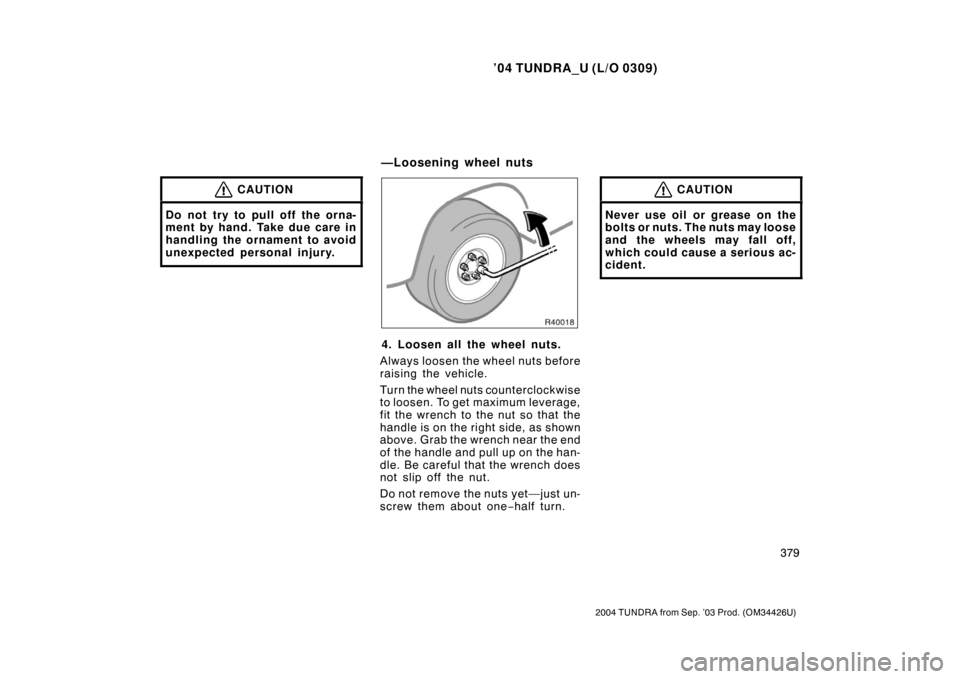
4. Loosen all the wheel nuts.
Always loosen the wheel nuts before
raising the vehicle.
Turn the wheel nuts counterclockwise
to loosen. To get maximum leverage,
fit the wrench to the nut so that the
handle is on the right side, as shown
above. Grab the wrench near the end
of the handle and pull up on the han-
dle. Be careful that the wrench does
not slip off the nut.
Do not remove the nuts yet—just un-
screw them about one −half turn.
CAUTION
Never use oil or grease on the
bolts or nuts. The nuts may loose
and the wheels may fall off,
which could cause a serious ac-
cident.
—Loosening wheel nuts
Page 390 of 479
’04 TUNDRA_U (L/O 0309)
381
2004 TUNDRA from Sep. ’03 Prod. (OM34426U)
6. After making sure that no one
is in the vehicle, raise it high
enough so that the spare tire
can be installed.
Remember you will need more ground
clearance when putting on the spare
tire than when removing the flat tire.
Standard cab models—To raise the
vehicle, insert the jack handle into the
jack (it is a loose fit) and turn it clock-
wise. As the jack touches the vehicle
and begins to lift, double− check that
it is properly positioned.
Access and double cab models—To
raise the vehicle, in sert the jack han-
dle extension into the jack (it is a
loose fit) and turn it clockwise with the
handle, making sure the handle re-
mains firmly fitted onto the jack han-
dle extension. As the jack touches the
vehicle and begins to lift, double −
check that it is properly positioned.CAUTION
Never get under the vehicle when
the vehicle is supported by the
jack alone.
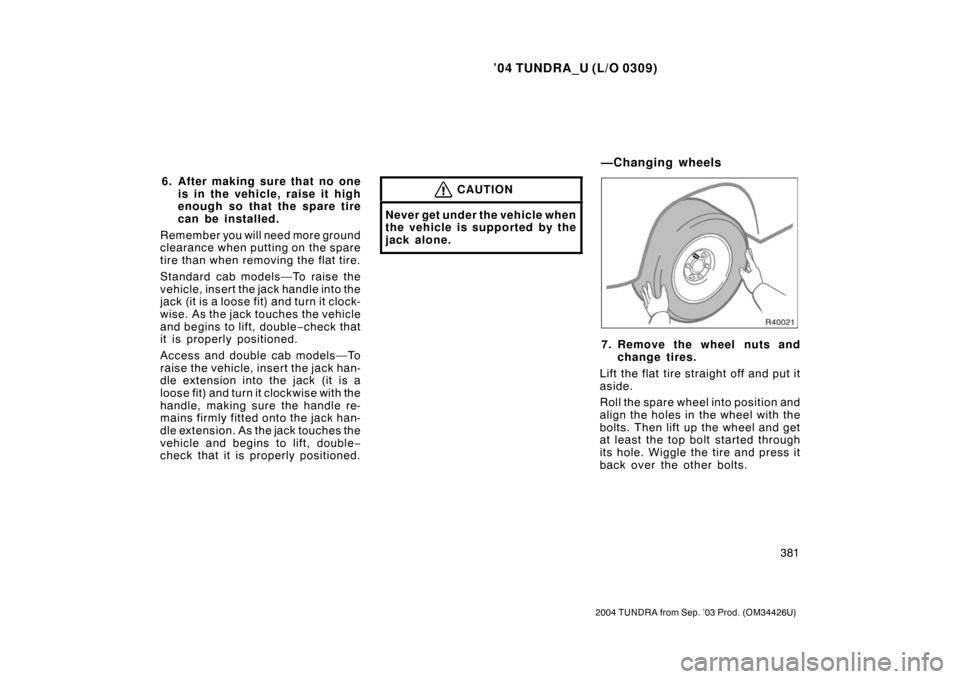
7. Remove the wheel nuts and
change tires.
Lift the flat tire straight off and put it
aside.
Roll the spare wheel into position and
align the holes in the wheel with the
bolts. Then lift up the wheel and get
at least the top bolt started through
its hole. Wiggle the tire and press it
back over the other bolts.
—Changing wheels
Page 392 of 479
’04 TUNDRA_U (L/O 0309)
383
2004 TUNDRA from Sep. ’03 Prod. (OM34426U)
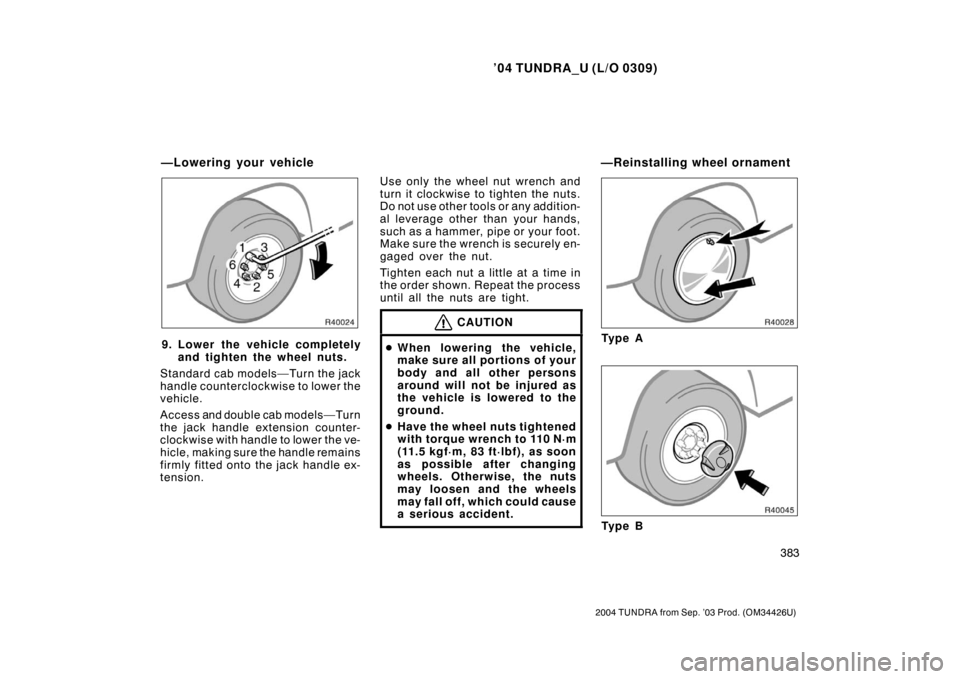
9. Lower the vehicle completely
and tighten the wheel nuts.
Standard cab models—Turn the jack
handle counterclockwise to lower the
vehicle.
Access and double cab models—Turn
the jack handle extension counter-
clockwise with handle to lower the ve-
hicle, making sure the handle remains
firmly fitted onto the jack handle ex-
tension. Use only the wheel nut wrench and
turn it clockwise to tighten the nuts.
Do not use other tools or any addition-
al leverage other than your hands,
such as a hammer, pipe or your foot.
Make sure the wrench is securely en-
gaged over the nut.
Tighten each nut a little at a time in
the order shown. Repeat the process
until all the nuts are tight.
CAUTION
�
When lowering the vehicle,
make sure all portions of your
body and all other persons
around will not be injured as
the vehicle is lowered to the
ground.
� Have the wheel nuts tightened
with torque wrench to 110 N·m
(11.5 kgf·m, 83 ft·lbf), as soon
as possible after changing
wheels. Otherwise, the nuts
may loosen and the wheels
may fall off, which could cause
a serious accident.Ty p e A
Ty p e B
—Lowering your vehicle —Reinstalling wheel ornament
Page 428 of 479
’04 TUNDRA_U (L/O 0309)
419
2004 TUNDRA from Sep. ’03 Prod. (OM34426U)
Refilling brake fluid:
1. Turn the ignition switch off.
2. Depress the brake pedal more than 40 times.
3. Remove the reservoir cover by hand. Add brake fluid up to the “MAX” line.
If you do not follow the procedure above,
the reservoir may overflow.
Use only newly opened brake fluid. Once
opened, brake fluid absorbs moisture from
the air, and excess moisture can cause a
dangerous loss of braking.
CAUTION
Take care when filling the r eservoir
because brake fluid can harm your
eyes and damage painted surfaces. If
fluid gets in your eyes, flush your
eyes with clean water immediately. If
you still feel uncomfortable with your
eyes, go to the doctor.
NOTICE
If you spill the fluid, be sure to wash
it off with water to prevent it from
damaging the parts or paint.
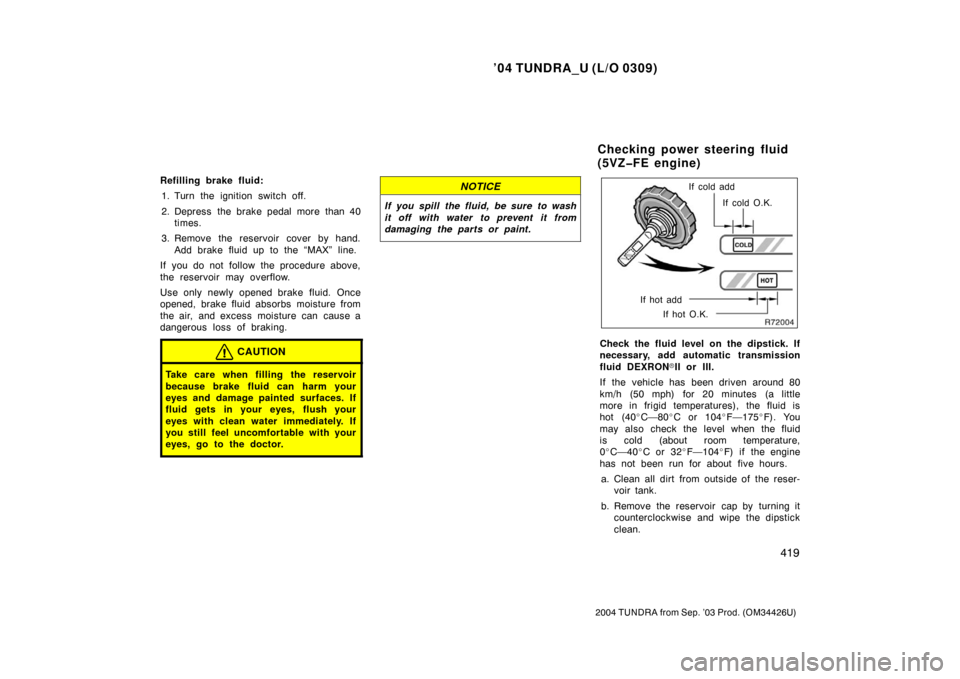
If cold add
If cold O.K.
If hot add If hot O.K.
Check the fluid level on the dipstick. If
necessary, add automatic transmission
fluid DEXRON �II or III.
If the vehicle has been driven around 80
km/h (50 mph) for 20 minutes (a little
more in frigid temperatures), the fluid is
hot (40 �C—80 �C or 104 �F—175 �F). You
may also check the level when the fluid
is cold (about room temperature,
0 �C—40 �C or 32 �F—104 �F) if the engine
has not been run for about five hours.
a. Clean all dirt from outside of the reser- voir tank.
b. Remove the reservoir cap by turning it counterclockwise and wipe the dipstick
clean.
Checking power steering fluid
(5VZFE engine)
Page 429 of 479
’04 TUNDRA_U (L/O 0309)
420
2004 TUNDRA from Sep. ’03 Prod. (OM34426U)
c. Reinstall the reservoir cap.
d. Remove the reservoir cap again and look at the fluid level. If the fluid is
cold, the level should be in the “COLD”
range on the dipstick. Similarly, if it is
hot, the fluid level should be in the
“HOT” range. If the level is at the low
side of either range, add automatic
transmission fluid DEXRON �II or III to
bring the level within the range.
e. After replacing the reservoir cap, visu- ally check the steering box case, vane
pump and hose connections for leaks
or damage.
CAUTION
The reservoir tank may be hot so be
careful not to burn yourself.
NOTICE
Avoid overfilling, or the power steer-
ing could be damaged.
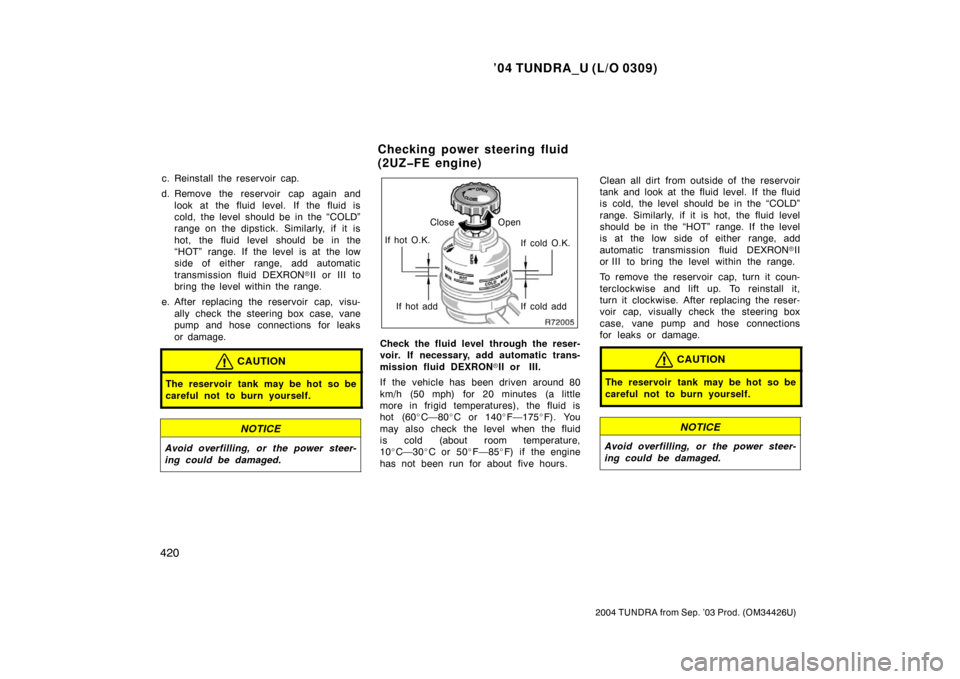
If hot O.K. Close Open
If cold O.K.
If hot add If cold add
Check the fluid level through the reser-
voir. If necessary, add automatic trans-
mission fluid DEXRON �II or III.
If the vehicle has been driven around 80
km/h (50 mph) for 20 minutes (a little
more in frigid temperatures), the fluid is
hot (60 �C—80 �C or 140 �F—175 �F). You
may also check the level when the fluid
is cold (about room temperature,
10 �C—30 �C or 50 �F—85 �F) if the engine
has not been run for about five hours. Clean all dirt from outside of the reservoir
tank and look at the fluid level. If the fluid
is cold, the level should be in the “COLD”
range. Similarly, if it is hot, the fluid level
should be in the “HOT” range. If the level
is at the low side of either range, add
automatic transmission fluid DEXRON
�II
or III to bring the level within the range.
To remove the reservoir cap, turn it coun-
terclockwise and lift up. To reinstall it,
turn it clockwise. After replacing the reser-
voir cap, visually check the steering box
case, vane pump and hose connections
for leaks or damage.
CAUTION
The reservoir tank may be hot so be
careful not to burn yourself.
NOTICE
Avoid overfilling, or the power steer-
ing could be damaged.
Checking power steering fluid
(2UZFE engine)
Page 466 of 479

’04 TUNDRA_U (L/O 0309)
457
2004 TUNDRA from Sep. ’03 Prod. (OM34426U)
Engine compartment
14. ETCS 10 A: Multiport fuel injection
system/s equential multiport fuel injec-
tion system, electronic throttle control
system
15. EFI NO.1 20 A: Multiport fuel injection
system/s equential multiport fuel injec-
tion system, electric throttle control
system
16. HLP RH 15 A (without daytime run- ning light system): Right−hand head-
light
17. TOWING 30 A: Trailer lights (stop
lights, turn signal lights)
18. ALTS 7.5 A: Charging system
Front passenger’s side cowl panel
19. DRL 15 A (with daytime running light
system): Daytime running light system
HLP LH 15 A (without daytime run-
ning light system): Left−hand head-
light
20. AM2 25 A: Starting system
21. TURNHAZ 20 A: Turn signal lights,
emergency flashers
22. RAD NO.3 20 A: Car audio/video sys-
tem
Instrument panel
23. ST 30 A: Starting system, “STA” fuse
24. HORN 10 A: Horns
25. EFI NO.2 10 A: Multiport fuel injection
system/s equential multiport fuel injec-
tion system, electronic throttle control
system
26. DOME 10 A: Center interior and per-
sonal lights, personal lights, gauges
and meters, clock, ignition switch light,
door courtesy lights, step light, vanity
lights