Page 257 of 333
257
50p047a
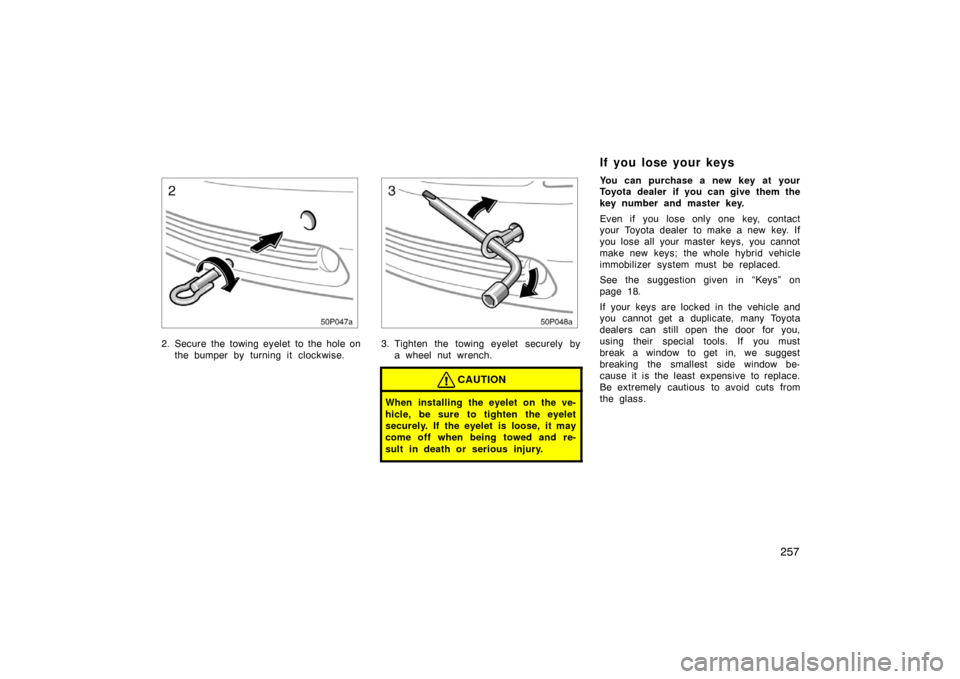
2. Secure the towing eyelet to the hole onthe bumper by turning it clockwise.
50p048a
3. Tighten the towing eyelet securely bya wheel nut wrench.
CAUTION
When installing the eyelet on the ve-
hicle, be sure to tighten the eyelet
securely. If the eyelet is loose, it may
come off when being towed and re-
sult in death or serious injury.
You can purchase a new key at your
Toyota dealer if you can give them the
key number and master key.
Even if you lose only one key, contact
your Toyota dealer to make a new key. If
you lose all your master keys, you cannot
make new keys; the whole hybrid vehicle
immobilizer system must be replaced.
See the suggestion given in “Keys” on
page 18.
If your keys are locked in the vehicle and
you cannot get a duplicate, many Toyota
dealers can still open the door for you,
using their special tools. If you must
break a window to get in, we suggest
breaking the smallest side window be-
cause it is the least expensive to replace.
Be extremely cautious to avoid cuts from
the glass.
If you lose your keys
Page 270 of 333

270
INSIDE THE VEHICLE
Items listed below should be checked
regularly, e.g. while performing periodic
services, cleaning the vehicle, etc.
Lights
Make sure the headlights, stop lights, tail
lights, turn signal lights, and other lights
are all working. Check headlight aim.
Service reminder indicators and warning
buzzers
Check that all service reminder indicators
and warning buzzers function properly.
Steering wheel
Be alert for changes in steering condition,
such as hard steering or strange noise.
Seats
Check that all front seat controls such as
seat adjusters, seatback recliner, etc. op-
erate smoothly and that all latches lock
securely in any position. Check that the
head restraint move up and down smooth-
ly and that the locks hold securely in any
latched position.Seat belts
Check that the seat belt system such as
buckles, retractors and anchors operate
properly and smoothly. Make sure the belt
webbing is not cut, frayed, worn or dam-
aged.
Accelerator pedal
Check the pedal for smooth operation and
uneven pedal effort or catching.
Brake pedal
Check the pedal for smooth operation and
that the pedal has the proper clearance.
Check the brake booster function.
Brakes
In a safe place, check that the brakes do
not pull to one side when applied.
Parking brake
Check that the pedal has the proper travel
and that, on a safe incline, your vehicle
is held securely with only the parking
brake applied.
OUTSIDE THE VEHICLE
Items listed below should be performed
from time to time, unless otherwise
specified.
Fluid leaks
Check underneath for leaking fuel, oil, wa-
ter or other fluid after the vehicle has
been parked for a while. If you smell fuel
fumes or notice any leak, have the cause
found and corrected immediately.
Doors and engine hood
Check that all doors and trunk operate
smoothly and all latches lock securely.
Make sure the engine hood secondary
latch secures the hood from opening when
the primary latch is released.
Tire inflation pressure
Check the pressure with a gauge ev-
ery two weeks, or at least once a
month. See page 289 for additional
information.
Page 314 of 333
314
90p007b
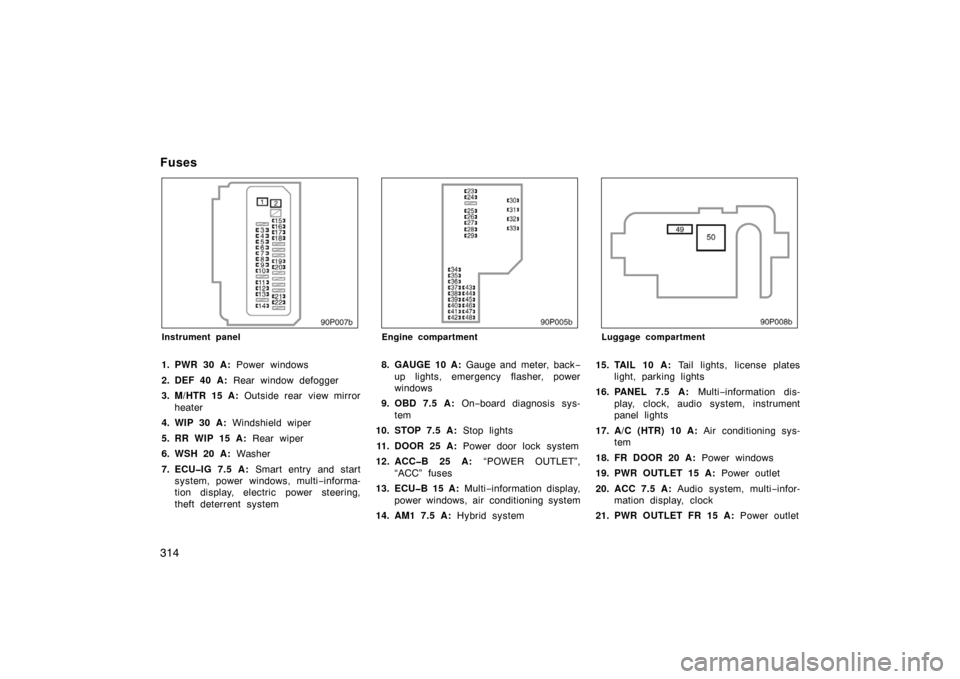
Instrument panel
1. PWR 30 A: Power windows
2. DEF 40 A: Rear window defogger
3. M/HTR 15 A: Outside rear view mirror
heater
4. WIP 30 A: Windshield wiper
5. RR WIP 15 A: Rear wiper
6. WSH 20 A: Washer
7. ECUIG 7.5 A: Smart entry and start
system, power wi ndows, multi−informa-
tion display, electric power steering,
theft deterrent system
90p005b
Engine compartment
8. GAUGE 10 A: Gauge and meter, back −
up lights, emergency flasher, power
windows
9. OBD 7.5 A: On−board diagnosis sys-
tem
10. STOP 7.5 A: Stop lights
11. DOOR 25 A: Power door lock system
12. ACCB 25 A: “POWER OUTLET”,
“ACC” fuses
13. ECUB 15 A: Multi−information display,
power windows, air conditioning system
14. AM1 7.5 A: Hybrid system
90p008b
Luggage compartment
15. TAIL 10 A: Tail lights, license plates
light, parking lights
16. PANEL 7.5 A: Multi−information dis-
play, clock, audio system, instrument
panel lights
17. A/C (HTR) 10 A: Air conditioning sys-
tem
18. FR DOOR 20 A: Power windows
19. PWR OUTLET 15 A: Power outlet
20. ACC 7.5 A: Audio system, multi −infor-
mation display, clock
21. PWR OUTLET FR 15 A: Power outlet
Fuses
Page 321 of 333

321
Occupant restraint sys-tems
Toyota encourages you and your
family to take the time to read
Section 2−2 of this Owner’s Manu-
al carefully. In terms of helping
you understand how you can re-
ceive the maximum benefit of the
occupant restraint systems this ve-
hicle provides, Section 2 −2 of this
Owner ’s Manual is the most im-
portant section for you and your
family to read.
Section 2 −2 describes the function
and operation concerning seats,
seat belts, SRS airbags and child
restraint systems of this vehicle
and some potential hazards you
should be aware of. These sys-
tems work together along with the
overall structure of this vehicle in
order to provide occupant restraint
in the event of a crash. The effect
of each system is enhanced when
it is used properly and together
with other systems. No single oc-
cupant restraint system can, by it-
self, provide you or your family
with the equal level of restraint
which these systems can provide
when used together. That is why it
is important for you and your fam-
ily to understand the purpose and
proper use of each of these sys-
tems and how they relate to each
other.
The purpose of all occupant re-
straint systems is to help reduce
the possibility of death or serious
injury in the event of a collision.
None of these systems, either in-
dividually or together, can ensure
that there is no injury in the event
of collision. However, the more
you know about these systems
and how to use them properly, the
greater your chances become of
surviving an accident without death
or serious injury.
Seat belts provide the primary re-
straint to all occupants of the ve-
hicle, and every occupant of the
vehicle should wear seat belts
properly at all times. Children
should always be secured in child
restraint systems that are ap-
propriate for their age and size.
SRS (Supplemental Restraint Sys-
tem) airbags are, as their names
imply, designed to work with, and
be supplemental to, seat belts and
are not substitutes for them. SRS
airbags can be very effective in
reducing the risk of head and
chest injuries by preventing con-
tact of the head and chest with
interior portions of the vehicle.