Page 243 of 333
243
6. After the coolant temperature hascooled to normal, again check the cool-
ant level in the reservoir. If necessary,
bring it up to half full again. Serious
coolant loss indicates a leak in the
system. You s hould have it checked as
soon as possible at your Toyota dealer.1. Reduce your speed gradually, keeping a straight line. Move cau-
tiously off the road to a safe place
well away from the traffic. Avoid
stopping on the center divider of
a highway. Park on a level spot
with firm ground.
2. Stop the hybrid system and turn on your emergency flashers.
3. Firmly set the parking brake.
4. Have everyone get out of the ve- hicle on the side away from traffic.
5. Read the following instructions thoroughly.CAUTION
When jacking, be sure to observe
the following to reduce the possi-
bility of personal injury:
�Follow jacking instructions.
� Do not put any part of your
body under a vehicle sup-
ported by a jack. Personal inju-
ry may occu r.
� Do not start or run the hybrid
system while your vehicle is
supported by the j ack.
� Stop the vehicle at a level firm
ground, firmly set the parking
brake. Block the wheel diago-
nally opposite to the one being
changed if necessary.
If you have a flat tire—
Page 246 of 333
246
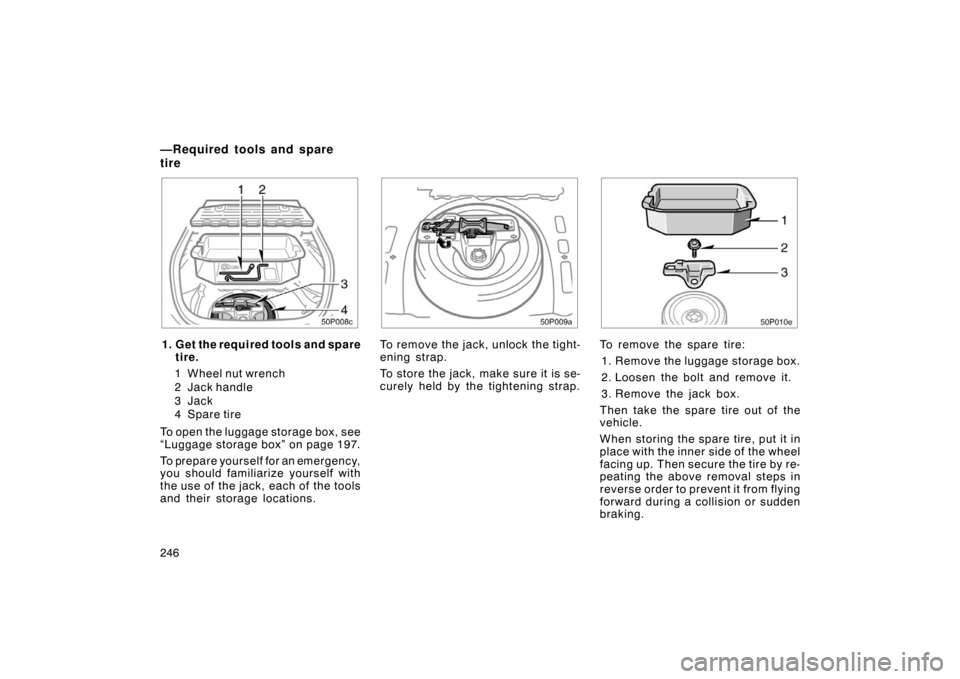
50p008c
1. Get the required tools and sparetire.
1 Wheel nut wrench
2 Jack handle
3Jack
4 Spare tire
To open the luggage storage box, see
“Luggage storage box” on page 197.
To prepare yourself for an emergency,
you should familiarize yourself with
the use of the jack, each of the tools
and their storage locations.
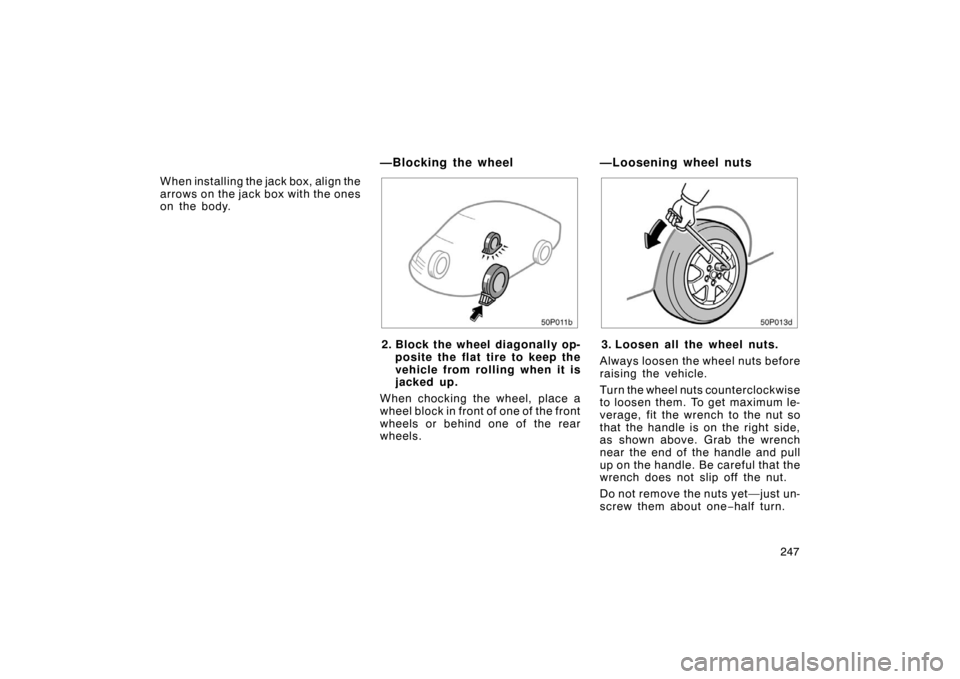
50p009a
To remove the jack, unlock the tight-
ening strap.
To store the jack, make sure it is se-
curely held by the tightening strap.
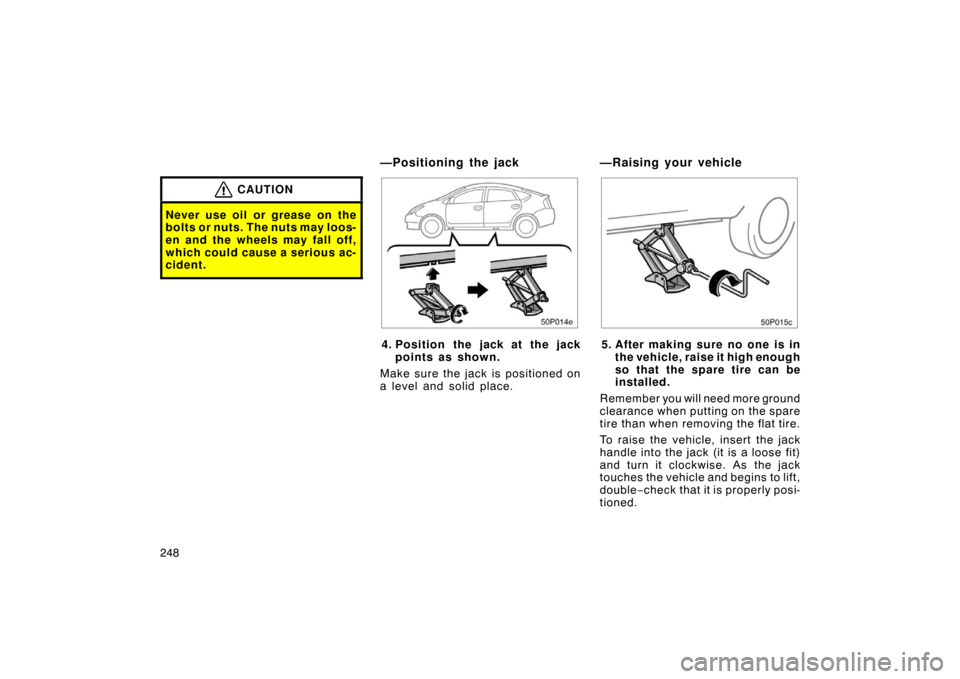
50p010e
To remove the spare tire:
1. Remove the luggage storage box.
2. Loosen the bolt and remove it.
3. Remove the jack box.
Then take the spare tire out of the
vehicle.
When storing the spare tire, put it in
place with the inner side of the wheel
facing up. Then secure the tire by re-
peating the above removal steps in
reverse order to prevent it from flying
forward during a collision or sudden
braking.
—Required tools and spare
tire
Page 247 of 333
247
When installing the jack box, align the
arrows on the jack
box with the ones
on the body.
50p011b
2. Block the wheel diagonally op-
posite the flat tire to keep the
vehicle from rolling when it is
jacked up.
When chocking the wheel, place a
wheel block in front of one of the front
wheels or behind one of the rear
wheels.
50p013d
3. Loosen all the wheel nuts.
Always loosen the wheel nuts before
raising the vehicle.
Turn the wheel nuts counterclockwise
to loosen them. To get maximum le-
verage, fit the wrench to the nut so
that the handle is on the right side,
as shown above. Grab the wrench
near the end of the handle and pull
up on the handle. Be careful that the
wrench does not slip off the nut.
Do not remove the nuts yet—just un-
screw them about one −half turn.
—Blocking the wheel —Loosening wheel nuts
Page 248 of 333
248
CAUTION
Never use oil or grease on the
bolts or nuts. The nuts may loos-
en and the wheels may fall off,
which could cause a serious ac-
cident.
50p014e
4. Position the jack at the jackpoints as shown.
Make sure the jack is positioned on
a level and solid place.
50p015c
5. After making sure no one is in the vehicle, raise it high enough
so that the spare tire can be
installed.
Remember you will need more ground
clearance when putting on the spare
tire than when removing the flat tire.
To raise the vehicl e, insert the jack
handle into the jack (it is a loose fit)
and turn it clockwise. As the jack
touches the vehicle and begins to lift,
double −check that it is properly posi-
tioned.
—Positioning the jack —Raising your vehicle
Page 250 of 333
250
50p018c
7. Reinstall all the wheel nuts fin-ger tight.
Reinstall the wheel nuts (tapered end
inward) and tighten them as much as
you can by hand. Press back on the
tire and see if you can tighten them
more.
CAUTION
Never use oil or grease on the
bolts or nuts. Doing so may lead
to overtightening the nuts and
damaging the bolts. The nuts
may loosen and the wheels may
fall off, which could cause a seri-
ous accident. If there is oil or
grease on any bolt or nut, clean
it.
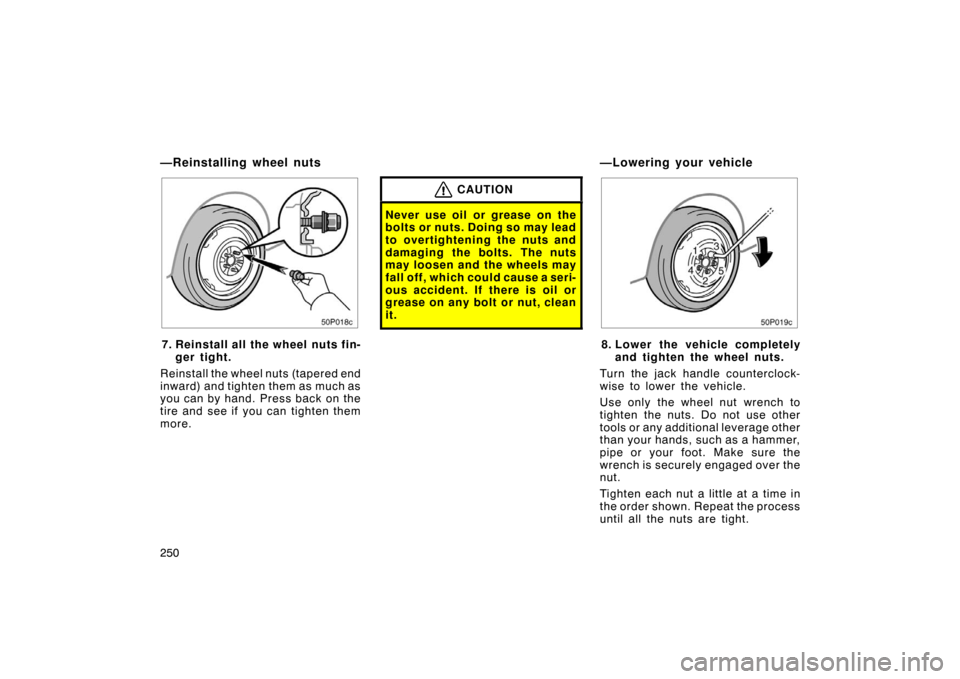
50p019c
8. Lower the vehicle completely and tighten the wheel nuts.
Turn the jack handle counterclock-
wise to lower the vehicle.
Use only the wheel nut wrench to
tighten the nuts. Do not use other
tools or any additional leverage other
than your hands, such as a hammer,
pipe or your foot. Make sure the
wrench is securely engaged over the
nut.
Tighten each nut a little at a time in
the order shown. Repeat the process
until all the nuts are tight.
—Reinstalling wheel nuts —Lowering your vehicle
Page 256 of 333
256
CAUTION
Use extreme caution when towing ve-
hicles. Avoid sudden starts or erratic
driving maneuvers which would place
excessive stress on the emergency
towing eyelet and towing cable or
chain. The eyelet and towing cable or
chain may break and cause serious
injury or damage.
NOTICE
Use only a cable or chain specifically
intended for use in towing vehicles.
Securely fasten the cable or chain to
the towing eyelet provided.
Before towing, release the parking brake
and put the hybrid transaxle in “N”. The
hybrid system must be in the “IG−ON”
mode.
In the following cases, as the front wheels
might be locked by means of the parking
lock mechanism, your vehicle cannot be
towed by another vehicle using a rope.
Have your vehicle carried with the front
wheels or all the wheels raised.
�If the parking mechanism fails.
�If the auxiliary battery is discharged.
CAUTION
If the hybrid system is not running,
the power assist for the brakes and
steering will not work so steering and
braking will be much harder than usu-
al.
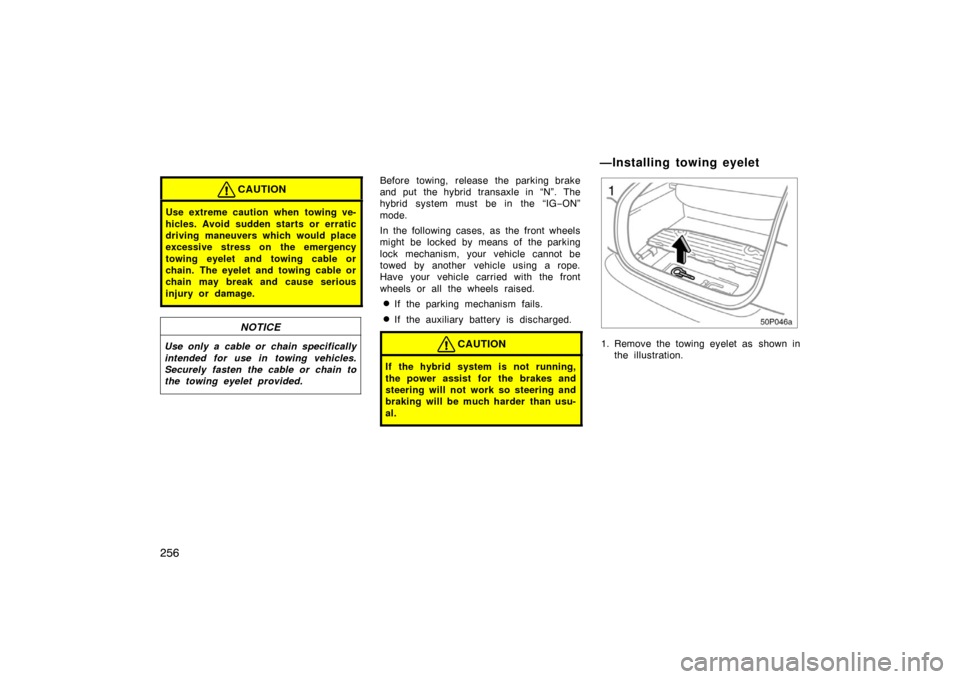
50p046a
1. Remove the towing eyelet as shown in the illustration.
—Installing towing eyelet
Page 257 of 333
257
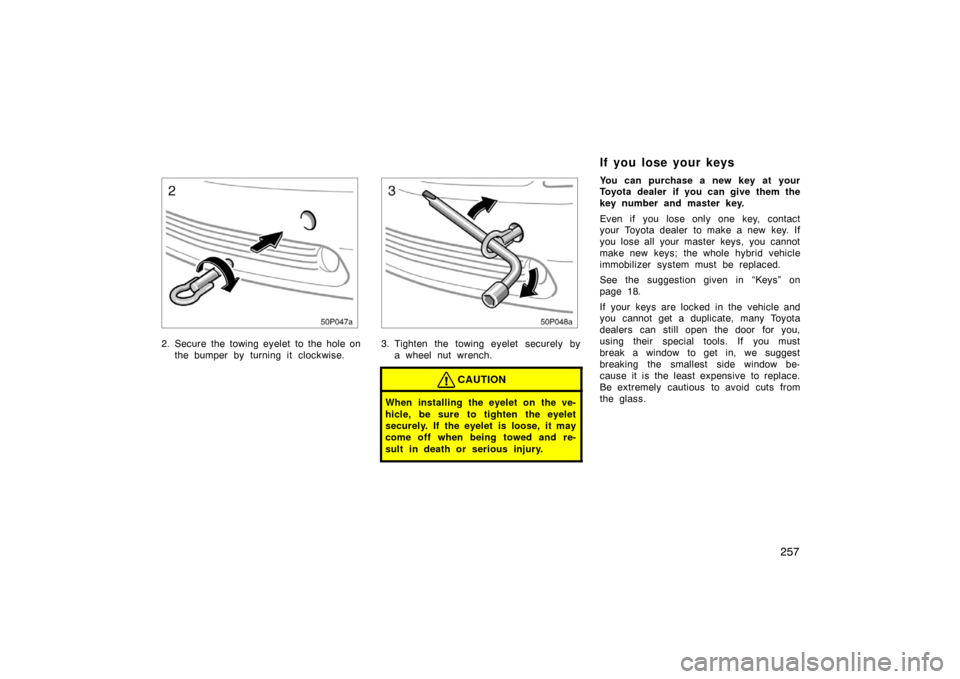
50p047a
2. Secure the towing eyelet to the hole onthe bumper by turning it clockwise.
50p048a
3. Tighten the towing eyelet securely bya wheel nut wrench.
CAUTION
When installing the eyelet on the ve-
hicle, be sure to tighten the eyelet
securely. If the eyelet is loose, it may
come off when being towed and re-
sult in death or serious injury.
You can purchase a new key at your
Toyota dealer if you can give them the
key number and master key.
Even if you lose only one key, contact
your Toyota dealer to make a new key. If
you lose all your master keys, you cannot
make new keys; the whole hybrid vehicle
immobilizer system must be replaced.
See the suggestion given in “Keys” on
page 18.
If your keys are locked in the vehicle and
you cannot get a duplicate, many Toyota
dealers can still open the door for you,
using their special tools. If you must
break a window to get in, we suggest
breaking the smallest side window be-
cause it is the least expensive to replace.
Be extremely cautious to avoid cuts from
the glass.
If you lose your keys
Page 269 of 333
269
If you are a skilled do−it−yourself
mechanic, the Toyota service manuals are
recommended. Please be aware that
do− it−yourself maintenance can affect your
warranty coverage. See “Owner ’s Warranty
Information Booklet” or “Owner ’s Manual
Supplement” for the details.
General maintenance
Listed below are the general maintenance
items that should be performed as fre-
quently as specified. In addition to check-
ing the items listed, if you notice any
unusual noise, smell or vibration, you
should investigate the cause or take your
vehicle to your Toyota dealer or a quali-
fied service shop immediately. It is recom-
mended that any problem you notice be
brought to the attention of your dealer or
the qualified service shop for their advice.
CAUTION
Make these checks only with ade-
quate ventilation if you run the en-
gine.
IN THE ENGINE COMPARTMENT
Items listed below should be checked
from time to time, e.g. each time when
refueling.
Washer fluid
Make sure there is sufficient fluid in the
tank. See page 302 for additional informa-
tion. Coolant level
Make sure the coolant level is between
the “FULL” and “LOW” lines on the see
−
through reservoir when the hybrid system
is cold. See page 284 for additional infor-
mation.
Radiator, condenser and hoses
Check that the front of the radiator and
condenser are clean and not blocked with
leaves, dirt, or insects. See page 286 for
additional information.
Brake fluid level
Make sure the brake fluid level is correct.
See page 286 for additional information.
Engine oil level
Check the level on the dipstick with the
engine turned off and the vehicle parked
on level spot. See page 282 for additional
information.
Exhaust system
If you notice any change in the sound of
the exhaust or smell exhaust fumes, have
the cause located and corrected immedi-
ately. (See “Engine exhaust cautions” on
page 206.)