Page 259 of 310
’04 MATRIX_U (L/O 0307)
251
2004 MATRIX from Oct. ’03 Prod. (OM12861U)
1. Power steering fluid reservoir
2. Engine oil level dipstick
3. Engine coolant reservoir
4. Engine oil filler cap
5. Brake fluid reservoir
6. Fuse block
7. Battery
8. Radiator
9. Electric cooling fan
10. Condenser
11. Windshield and rear window washer fluid tank
�
2ZZGE engine
Page 264 of 310
’04 MATRIX_U (L/O 0307)
256
2004 MATRIX from Oct. ’03 Prod. (OM12861U)
�Do not start or run the engine while
your vehicle is supported by the
jack.
�Stop the vehicle on a level firm
ground, firmly set the parking brake
and put the transmission in “P”
(automatic) or reverse (manual).
Block the wheels on the opposite
side of the jack up point if neces-
sary.
�Make sure to set the jack properly
in the jack point. Raising the ve-
hicle with jack improperly posi-
tioned will damage the vehicle or
may allow the vehicle to fall off the
jack and cause personal injury.
�Never get under the vehicle when
the vehicle is supported by the jack
alone; use vehicle support stands.
�Do not raise the vehicle with some-
one in the vehicle.
�When raising the vehicle, do not
place any objects on top of or un-
derneath the jack.
NOTICE
Make sure to place the jack correctly,
or your vehicle may be damaged.
Page 271 of 310

’04 MATRIX_U (L/O 0307)
263
2004 MATRIX from Oct. ’03 Prod. (OM12861U)
If cold
O.K.Close OpenIf hot
O.K.
If cold
add If hot
add
Check the fluid level through the reser-
voir. If necessary, add automatic trans-
mission fluid DEXRON
�II or III.
If the vehicle has been driven around 80
km/h (50 mph) for 20 minutes (a little
more in frigid temperatures), the fluid is
hot (60 �C—80 �C or 140 �F—175 �F). You
may also check the level when the fluid
is cold (about room temperature,
10 �C—30 �C or 50 �F—85 �F) if the engine
has not been run for about five hours. Clean all dirt from outside of the reservoir
tank and look at the fluid level. If the fluid
is cold, the level should be in the “COLD”
range. Similarly, if it is hot, the fluid level
should be in the “HOT” range. If the level
is at the low side of either range, add
automatic transmission fluid DEXRON
�II or
III to bring the level within the range.
To remove the reservoir cap, turn it coun-
terclockwise and lift up. To reinstall it,
turn it clockwise. After replacing the reser-
voir cap, visually check the steering box
case, vane pump and hose connections
for leaks or damage.
CAUTION
The reservoir tank may be hot so be
careful not to burn yourself.
NOTICE
Avoid overfilling, or the power steer-
ing could be damaged.
CAUTION
Observe the following instruc-
tions. Otherwise, an accident
may occur resulting in death or
serious injuries.
� Keep your tire pressure at the
proper level. (See “Checking
tire inflation pressure” on page
264 in this Section.)
� Do not use tires (including
snow tires) of different brands,
sizes, construction or tread
patterns. (See “Checking and
replacing tires” on page 267
and “Installing snow tires and
chains” on page 271 in this
Section.)
� Do not use tires with different
t read wear. To eq u al i z e th e ti re
wear, rotate tires at the ap-
propriate interval. (See “Rotat-
ing tires” on page 270 in this
Section.)
Checking power steering fluid Precautions for tires of
fourwheel drive models
Page 280 of 310

’04 MATRIX_U (L/O 0307)
272
2004 MATRIX from Oct. ’03 Prod. (OM12861U)
TIRE CHAIN SELECTION
Use the tire chains of correct size and
type.
Use SAE Class “S” type radial tire chains
except radial cable chains or V−bar type
chains.
Regulations regarding the use of tire
chains vary according to location or
type of road, so always check the local
regulations before installing chains.
CHAIN INSTALLATION
Install the chains on the front tires as
tightly as possible. Do not use tire
chains on the rear tires. Retighten
chains after driving 0.5—1.0 km
(1/4—1/2 mile).
When installing chains on your tires, care-
fully follow the instructions of the chain
manufacturer.
If wheel covers are used, they will be
scratched by the chain band, so remove
the covers before putting on the chains.CAUTION
�Do not exceed 50 km/h (30 mph) or
the chain manufacturer ’s recom-
mended speed limit, whichever is
lower.
�Drive carefully avoiding bumps,
holes, and sharp turns, which may
cause the vehicle to bounce.
�Avoid sharp turns or lockedwheel
braking, as use of chains may ad-
versely affect vehicle handling.
�When driving with chains installed,
be sure to drive carefully. Slow
down before entering curves to
avoid losing control of the vehicle.
Otherwise an accident may occur.
NOTICE
Do not attempt to use a tire chain on
the compact spare tire, as it may re-
sult in damage to the vehicle as well
as the tire.
WHEN TO REPLACE YOUR WHEELS
If you have wheel damage such as
bending, cracks or heavy corrosion, the
wheel should be replaced.
If you fail to replace a damaged wheel,
the tire may slip off the wheel or cause
loss of handling control.
WHEEL SELECTION
When replacing wheels, care should be
taken to ensure that the wheels are re-
placed by ones with the same load ca-
pacity, diameter, rim width, and offset.
This must be observed on compact spare
tire, too.
Correct replacement wheels are available
at your Toyota dealer.
A wheel of a different size or type may
adversely affect handling, wheel and bear-
ing life, brake cooling, speedometer/odom-
eter calibration, stopping ability, headlight
aim, bumper height, vehicle ground clear-
ance, and tire or snow chain clearance to
the body and chassis.
Replacing wheels
Page 289 of 310
’04 MATRIX_U (L/O 0307)
281
2004 MATRIX from Oct. ’03 Prod. (OM12861U)
1. Open the hood. Turn the bulb basecounterclockwise to the front of the
vehicle as shown.2. Unplug the connector.
If the connector is tight, wiggle it.3. Install a new bulb and connector into the mounting hole.
Aiming is not necessary after replacing
the bulb. When aiming adjustment is nec-
essary, contact your Toyota dealer.
—Headlights (low beam)
Page 290 of 310
’04 MATRIX_U (L/O 0307)
282
2004 MATRIX from Oct. ’03 Prod. (OM12861U)
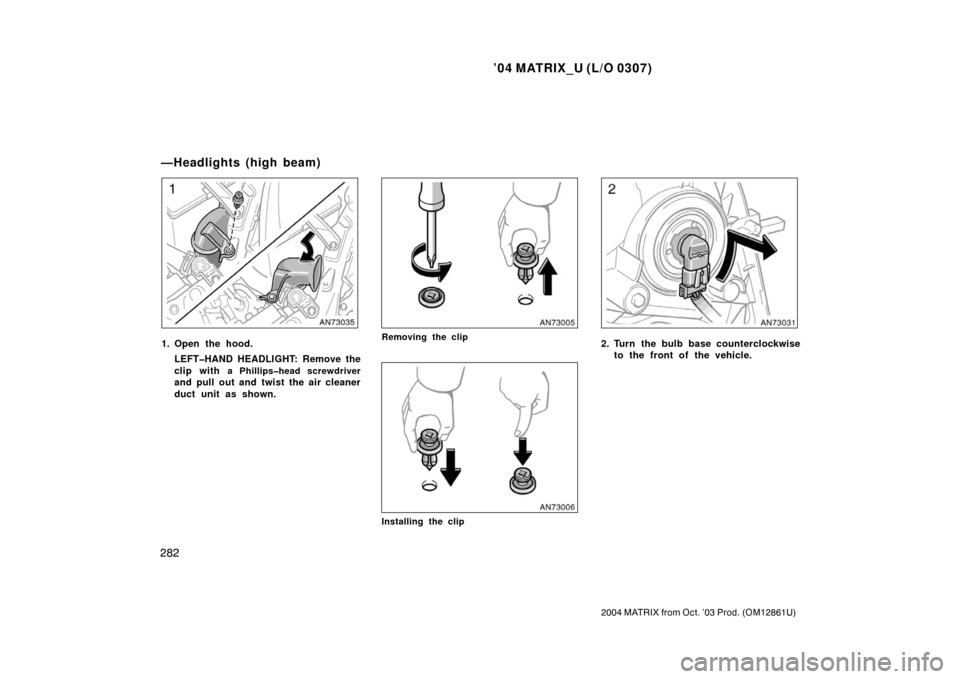
1. Open the hood.LEFTHAND HEADLIGHT: Remove the
clip with
a Phillipshead screwdriver
and pull out and twist the air cleaner
duct unit as shown.
Removing the clip
Installing the clip
2. Turn the bulb base counterclockwiseto the front of the vehicle.
—Headlights (high beam)
Page 291 of 310
’04 MATRIX_U (L/O 0307)
283
2004 MATRIX from Oct. ’03 Prod. (OM12861U)
3. Unplug the connector.
If the connector is tight, wiggle it.4. Install a new bulb and connector into the mounting hole.
Aiming is not necessary after replacing
the bulb. When aiming adjustment is nec-
essary, contact your Toyota dealer.1. Open the hood. Turn the bulb base counterclockwise to the front of the
vehicle as shown.
—Front fog lights
Page 300 of 310

’04 MATRIX_U (L/O 0307)
292
2004 MATRIX from Oct. ’03 Prod. (OM12861U)
COOLING SYSTEM
Total capacity, L (qt., Imp. qt.):1ZZ −FE engine 6.5 (6.9, 5.7)
2ZZ −GE engine 6.7 (7.0, 5.9)
Coolant type:
“Toyota Genuine Long Life Coolant” is
filled in your Toyota vehicle. In order to
avoid technical problems, we strongly
recommend using “Toyota Genuine Long
Life Coolant” or equivalent.
With ethylene− glycol type coolant for a
proper corrosion protection of aluminum
components
Do not use alcohol type antifreeze or
plain water alone.
Please contact your Toyota dealer for
further details.
BATTERY
Open voltage
∗ at 20 �C (68 �F):
12.6—12.8 V Fully charged
12.2—12.4 V Half charged
11.8—12.0 V Discharged
∗: Voltage that is checked 20 minutes af-
ter the key is removed with all the lights
turned off
Charging rates: 5 A max. CLUTCH
Pedal free play, mm (in.):
5—15 (0.2—0.6)
Fluid type: SAE J1703 or FMVSS No.116 DOT 3
MANUAL TRANSAXLE
Oil capacity, L (qt., Imp. qt.): 5−speed 1.9 (2.0, 1.7)
6 −speed 2.3 (2.4, 2.0)
Oil type: Gear oil API GL −4 or GL −5
Recommended oil viscosity: SAE 75W −90
AUTOMATIC TRANSAXLE
Fluid capacity (drain and refill), L (qt.,
Imp. qt.): Tw o −wheel drive models
Up to 3.0 (3.2, 2.6)
Four −wheel drive models
Up to 2.9 (3.1, 2.6) Fluid type:
Toyota Genuine ATF Type T −IV
Change automatic transmission fluid only
as necessary.
Generally, it is necessary to change
automatic transmission fluid only if your
vehicle is driven under one of the Special
Operating Conditions listed in your
“Scheduled Maintenance Guide” or
“Owner ’s Manual Supplement”. When
changing the automatic transmission fluid,
use only “Toyota Genuine ATF Type T −IV”
(ATF JWS3309 or NWS6500) to aid in
assuring optimum transaxle performance.
Notice: Using automatic transmission
fluid other than “Toyota Genuine ATF
Type TIV” may cause deterioration in
shift quality, locking up of your trans-
mission accompanied by vibration, and
ultimately damage the automatic trans-
mission of your vehicle.
Please contact your Toyota dealer for fur-
ther details.