2004 SUBARU IMPREZA WRX ENGINE LIGHT
[x] Cancel search: ENGINE LIGHTPage 302 of 491
7-33
Starting and operating
– CONTINUED –
!Steps to take if EBD system fails
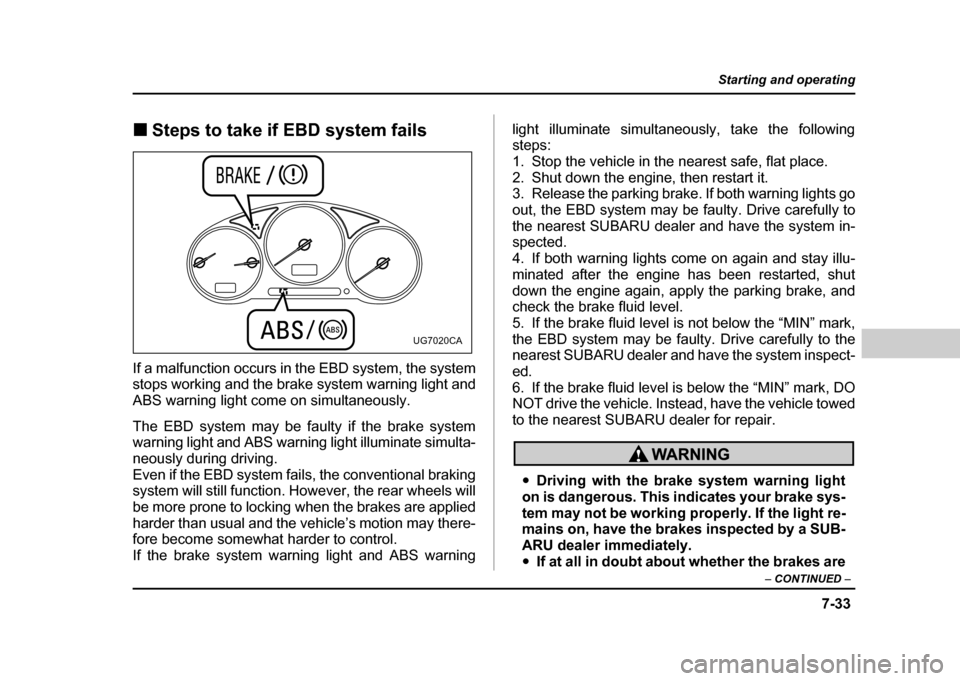
If a malfunction occurs in the EBD system, the system
stops working and the brake system warning light and
ABS warning light come on simultaneously.
The EBD system may be faulty if the brake system
warning light and ABS warning light illuminate simulta-
neously during driving.
Even if the EBD system fails, the conventional braking
system will still function. However, the rear wheels will
be more prone to locking when the brakes are applied
harder than usual and the vehicle’s motion may there-
fore become somewhat harder to control. If the brake system warning light and ABS warning light illuminate simultaneously, take the following steps:
1. Stop the vehicle in the nearest safe, flat place.
2. Shut down the engine, then restart it.
3. Release the parking brake. If both warning lights go
out, the EBD system may be faulty. Drive carefully to
the nearest SUBARU dealer and have the system in- spected.
4. If both warning lights come on again and stay illu-
minated after the engine has been restarted, shut
down the engine again, apply the parking brake, and
check the brake fluid level.
5. If the brake fluid level is not below the “MIN” mark,
the EBD system may be faulty. Drive carefully to the
nearest SUBARU dealer and have the system inspect- ed.
6. If the brake fluid level is below the “MIN” mark, DO
NOT drive the vehicle. Instead, have the vehicle towed
to the nearest SUBARU dealer for repair.
"
Driving with the brake system warning light
on is dangerous. This indicates your brake sys-
tem may not be working properly. If the light re-
mains on, have the brakes inspected by a SUB-
ARU dealer immediately." If at all in doubt about whether the brakes are
UG7020CA
Page 303 of 491
7-34
Starting and operating
operating properly, do not drive the vehicle.
Have your vehicle towed to the nearest SUBA-
RU dealer for repair.
Parking your vehicle !
Parking brake
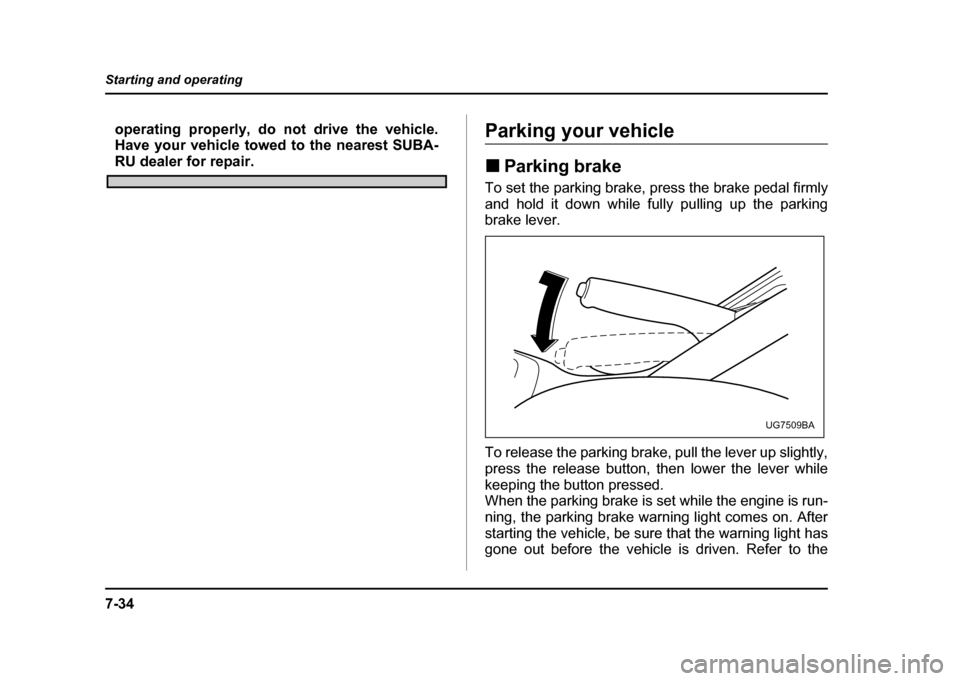
To set the parking brake, press the brake pedal firmly
and hold it down while fully pulling up the parking
brake lever.
To release the parking brake, pull the lever up slightly,
press the release button, then lower the lever while
keeping the button pressed.
When the parking brake is set while the engine is run-
ning, the parking brake warning light comes on. After
starting the vehicle, be sure that the warning light has
gone out before the vehicle is driven. Refer to the
UG7509BA
Page 321 of 491

8-10
Driving tips
shallow streams, first check the depth of the water and
the bottom of the stream bed for firmness and ensure
that the bed of the stream is flat. Drive slowly and com-
pletely through the stream. The water should be shal-
low enough that it does not reach the vehicle’s under-
carriage. Water entering the engine air intake or the
exhaust pipe or water splashing onto electrical parts
may damage your vehicle and may cause it to stall.
Never attempt to drive through rushing water; regard-
less of its depth, it can wash away the ground from un-
der your tires, resulting in possible loss of traction and
even vehicle rollover. "
Always check your brakes for effectiveness immedi-
ately after driving in sand, mud or water. Do this by
driving slowly and stepping on the brake pedal. Re-
peat that process several times to dry out the brake
discs and brake pads. " Do not drive or park over or near flammable materi-
als such as dry grass or fallen leaves, as they may
burn easily. The exhaust system is very hot while the
engine is running and right after the engine stops. This
could create a fire hazard." After driving through tall grass, mud, rocks, sand,
rivers, etc., check that there is no grass, bush, paper,
rags, stones, sand, etc. adhering to or trapped on the
underbody. Clear off any such matter from the under-
body. If the vehicle is used with these materials trapped or adhering to the underbody, a mechanical
breakdown or fire could occur. "
Secure all cargo carried inside the vehicle and make
certain that it is not piled higher than the seatbacks.
During sudden stops or jolts, unsecured cargo could
be thrown around in the vehicle and cause injury. Do
not pile heavy loads on the roof. Those loads raise the
vehicle’s center of gravity and make it more prone to
tip over." If you must rock the vehicle to free it from sand or
mud, depress the accelerator pedal slightly and move
the selector lever back and forth between “D” and “R”
repeatedly. Do not race the engine. For the best pos-
sible traction, avoid spinning the wheels when trying to
free the vehicle.
When the road surface is extremely slippery, you can
obtain better traction by starting the vehicle with the
transmission in 2nd than 1st (both for MT and AT). " Never equip your vehicle with tires larger than those
specified in this manual. " Frequent driving of an AWD vehicle under hard-driv-
ing conditions such as rough roads or off roads will ne-
cessitate more frequent replacement of engine oil,
brake fluid and transmission oil than that specified in
the maintenance schedule described in the “Warranty
and Maintenance Booklet”.
Remember that damage done to your Subaru while
Page 327 of 491
8-16
Driving tips
dent.
Your vehicle is equipped with “summer tires” as origi-
nal equipment, which are inadequate for driving on
slippery roads such as on snow-covered or icy roads.
Compared with winter and all-season tires, summer
tires give significantly less grip on snowy and icy road
surfaces. Therefore, use of winter tires is strongly rec-
ommended when driving with such road conditions.
When you choose to install winter tires on your vehi-
cle, be sure to use the correct tire size and type. You
must install four winter tires that are of the same size,
construction, brand and load range and you should
never mix radial, belted bias or bias tires since this
may result in dangerous handling characteristics.
When you choose a tire, make sure that there is
enough clearance between the tire and vehicle body.
Remember to drive with care at all times regardless of
the type of tires on your vehicle. ! Tire chains
Driving on snowy grades or icy roads may require the
use of tire chains, in which case put the chains on the
front wheels only. Use only SAE class S type chains
that are of the correct size for your tires so as not to damage the vehicle body or suspension.
When driving with tire chains, drive at speeds below
19 mph (30 km/h).
When a temporary spare tire is on a front wheel, re-
place the temporary spare tire with the rear tire on the
same side of the vehicle, and then fit chains on the
front tires.
Always use the utmost care when driving with tire
chains — overconfidence because you are driving
with tire chains could easily lead to a serious accident.
Tire chains cannot be used on tires listed below
because of lack of clearance between the tires
and vehicle body. "
225/45R17 tires for WRX-STi
"Optional 215/45R17 tires for WRX
! Rocking the vehicle
If you must rock the vehicle to free it from snow, sand,
or mud, depress the accelerator pedal slightly and
move the selector lever back and forth between “D”
and “R” repeatedly. Do not race the engine. For the
best possible traction, avoid spinning the wheels when
Page 350 of 491
8-39
Driving tips
– CONTINUED –
tance is required because of the added weight and
length caused by attaching the trailer to your vehicle.
1) Left turn
2) Right turn
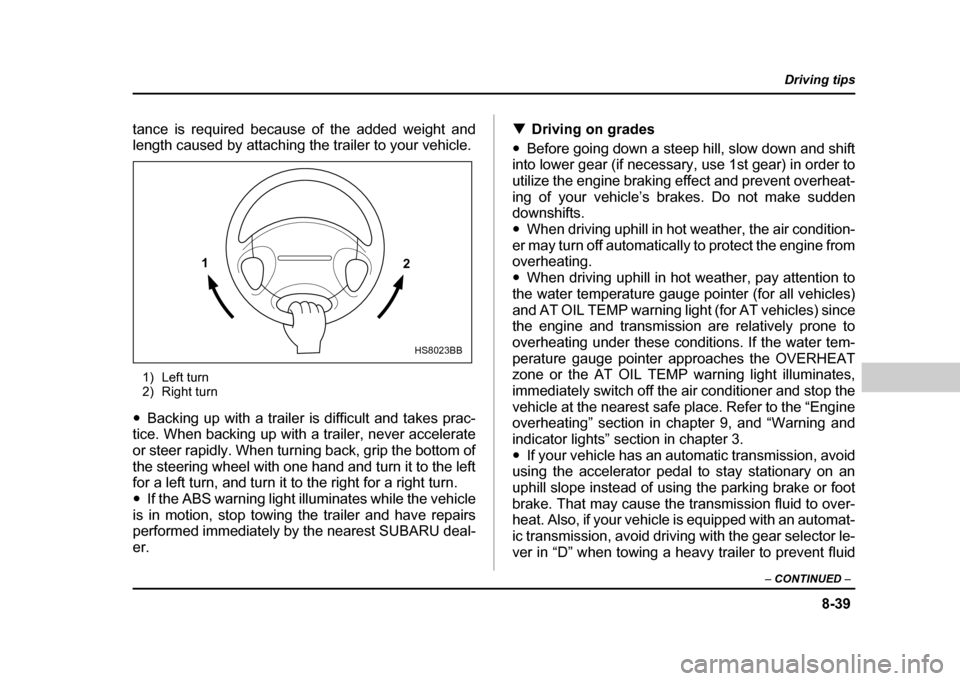
" Backing up with a trailer is difficult and takes prac-
tice. When backing up with a trailer, never accelerate
or steer rapidly. When turning back, grip the bottom of
the steering wheel with one hand and turn it to the left
for a left turn, and turn it to the right for a right turn." If the ABS warning light illuminates while the vehicle
is in motion, stop towing the trailer and have repairs
performed immediately by the nearest SUBARU deal-er. !
Driving on grades
" Before going down a steep hill, slow down and shift
into lower gear (if necessary, use 1st gear) in order to
utilize the engine braking effect and prevent overheat-
ing of your vehicle’s brakes. Do not make sudden
downshifts. " When driving uphill in hot weather, the air condition-
er may turn off automatically to protect the engine from
overheating. " When driving uphill in hot weather, pay attention to
the water temperature gauge pointer (for all vehicles)
and AT OIL TEMP warning light (for AT vehicles) since
the engine and transmission are relatively prone to
overheating under these conditions. If the water tem-
perature gauge pointer approaches the OVERHEAT
zone or the AT OIL TEMP warning light illuminates,
immediately switch off the air conditioner and stop the
vehicle at the nearest safe place. Refer to the “Engine
overheating” section in chapter 9, and “Warning and
indicator lights” section in chapter 3." If your vehicle has an automatic transmission, avoid
using the accelerator pedal to stay stationary on an
uphill slope instead of using the parking brake or foot
brake. That may cause the transmission fluid to over-
heat. Also, if your vehicle is equipped with an automat-
ic transmission, avoid driving with the gear selector le-
ver in “D” when towing a heavy trailer to prevent fluid
1 2
HS8023BB
Page 355 of 491
9-4
In case of emergency
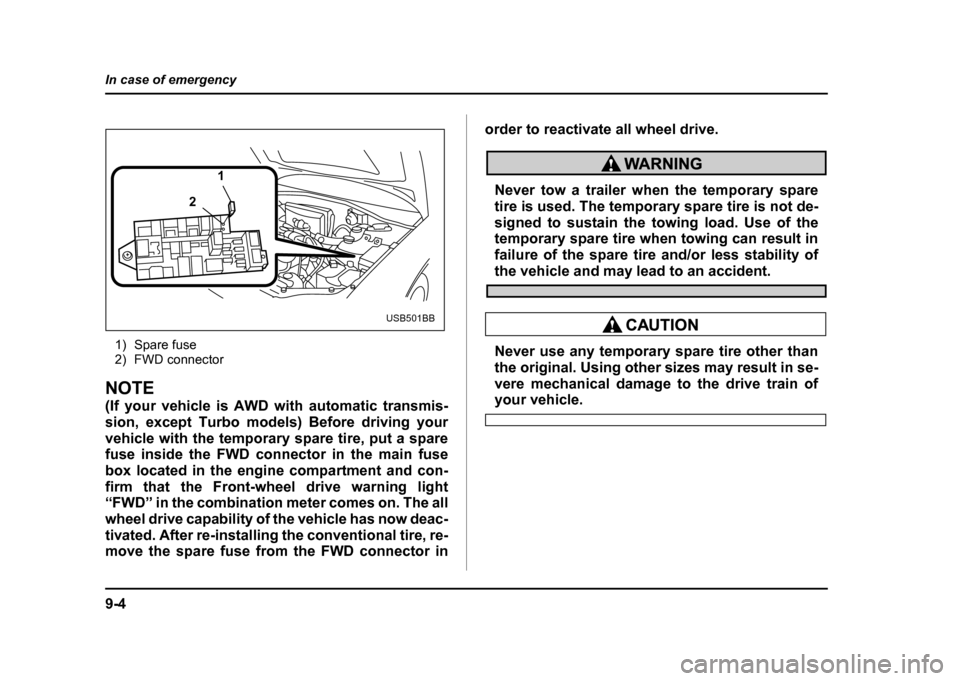
1) Spare fuse
2) FWD connector
NOTE
(If your vehicle is AWD with automatic transmis-
sion, except Turbo models) Before driving your
vehicle with the temporary spare tire, put a sparefuse inside the FWD connector in the main fuse
box located in the engine compartment and con-
firm that the Front-wheel drive warning light
“FWD” in the combination meter comes on. The all
wheel drive capability of the vehicle has now deac-
tivated. After re-installing the conventional tire, re-
move the spare fuse from the FWD connector in
order to reactivate all wheel drive.
Never tow a trailer when the temporary spare
tire is used. The temporary spare tire is not de-
signed to sustain the towing load. Use of the
temporary spare tire when towing can result in
failure of the spare tire and/or less stability of
the vehicle and may lead to an accident.
Never use any temporary spare tire other than
the original. Using other sizes may result in se-
vere mechanical damage to the drive train of
your vehicle.
1
2
USB501BB
Page 365 of 491

9-14
In case of emergency
Jump starting
"
Battery fluid is SULFURIC ACID. Do not let it
come in contact with the hooks, skin, clothing
or the vehicle.
If battery fluid gets on you, thoroughly flush the
exposed area with water immediately. Get med-
ical help if the fluid has entered your hooks.
If battery fluid is accidentally swallowed, imme-
diately drink a large amount of milk or water,
and obtain immediate medical help.
Keep everyone including children away from the battery. " The gas generated by a battery explodes if a
flame or spark is brought near it. Do not smoke
or light a match while jump starting. " Never attempt jump starting if the discharged
battery is frozen. It could cause the battery to
burst or explode. " Whenever working on or around a battery, al-
ways wear suitablehookprotectors, and remove
metal objects such as rings, bands or other
metal jewelry. " Be sure the jumper cables and clamps on
them do not have loose or missing insulation. Do not jump start unless cables in suitable con-
dition are available. "
A running engine can be dangerous. Keep
your fingers, hands, clothing, hair and tools
away from the cooling fan, belts and any other
moving engine parts. Removing rings, watches
and ties is advisable.
When your vehicle does not start due to a run down
(discharged) battery, the vehicle may be jump started
by connecting your battery to another battery (called
the booster battery) with jumper cables.
Jump starting is dangerous if it done incorrectly. If you
are unsure about the proper procedure for jump start-
ing, consult a competent mechanic. ! How to jump start
1. Make sure the booster battery is 12 volts and the
negative terminal is grounded.
2. If the booster battery is in another vehicle, do not let
the two vehicles touch.
3. Turn off all unnecessary lights and accessories.
4. Connect the jumper cables exactly in the sequence
illustrated.
Page 379 of 491
10-2
Appearance care
Appearance careExterior care !
Washing
The best way to preserve your vehicle’s beauty is fre-
quent washing. Wash the vehicle at least once a
month to avoid contamination by road grime.
Wash dirt off with a wet sponge and plenty of luke-
warm or cold water. Do not wash the vehicle with hot
water and in direct sunlight.
Salt, chemicals, insects, tar, soot and bird droppings
should be washed off by using a light detergent, as re-
quired. If you use a light detergent, make certain that
it is a neutral detergent. Do not use strong soap or
chemical detergents. All cleaning agents should be
promptly flushed from the surface and not allowed to
dry there. Rinse the vehicle thoroughly with plenty of
lukewarm water. Wipe the remaining water off with a
chamois or soft cloth.
NOTE
When having your vehicle washed in an automatic
car wash, make sure beforehand that the car wash
is of suitable type. Automatic car wash brushes or
other equipment may damage the rear wiper and
rear/roof spoiler (if equipped).
" When washing the vehicle, the brakes may
get wet. As a result, the brake stopping dis-
tance will be longer. To dry the brakes, drive the
vehicle at a safe speed while lightly pressing
the brake pedal to heat up the brakes. " Do not wash the engine compartment and
area adjacent to it. If water enters the engine air
intake, electrical parts or the power steering flu-
id reservoir, it will cause engine trouble or
faulty power steering respectively.
! Washing the underbody
Chemicals, salts and gravel used for deicing road sur-
faces are extremely corrosive, accelerating the corro-
sion of underbody components, such as the exhaust
system, fuel and brake lines, brake cables, floor pan
and fenders, and suspension.
Thoroughly flush the underbody and inside of the
fenders with lukewarm or cold water at frequent inter-
vals to reduce the harmful effects of such agents.
Mud and sand adhering to the underbody components may accelerate their corrosion.
After driving off-road or on muddy or sandy roads,
wash the mud and sand off the underbody. Carefully