Page 98 of 491
1-71
Seat, seatbelt and SRS airbags
– CONTINUED –
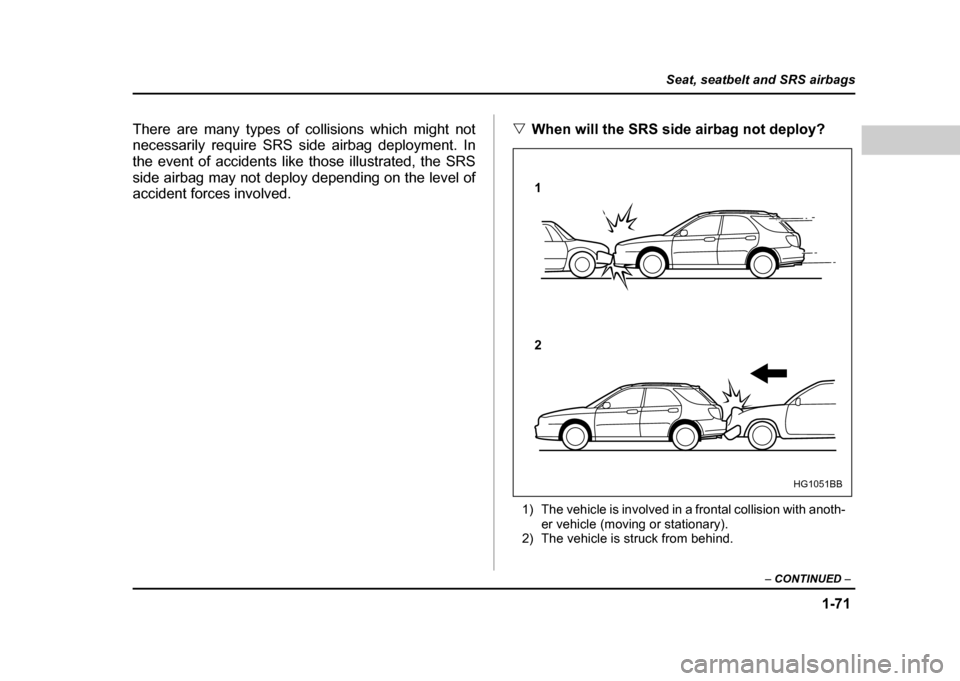
There are many types of collisions which might not
necessarily require SRS side airbag deployment. In
the event of accidents like those illustrated, the SRS
side airbag may not deploy depending on the level of
accident forces involved. "
When will the SRS side airbag not deploy?
1) The vehicle is involved in a frontal collision with anoth- er vehicle (moving or stationary).
2) The vehicle is struck from behind.
1 2
HG1051BB
Page 100 of 491
1-73
Seat, seatbelt and SRS airbags
– CONTINUED –
"Airbag control module (including impact sensors)
" Frontal airbag module (Driver’s side)
" Frontal airbag module (Passenger’s side)
" Side airbag sensor (Driver’s side — if equipped)
" Side airbag sensor (Passenger’s side — if
equipped) " Side airbag module (Driver’s side — if equipped)
" Side airbag module (Passenger’s side — if
equipped)" Seatbelt pretensioner (Driver’s side)
" Seatbelt pretensioner (Passenger’s side)
" All related wiring
In the event of a malfunction indicated by any of follow-
ing, the vehicle should be taken promptly to your near-
est SUBARU dealer to have the system checked. Un-
less checked and repaired, the SRS airbags will not
function reliably: " Flashing or flickering of the indicator light.
" No illumination of the warning light when the ignition
switch is first turned to the “ON” position." Continuous illumination of the warning light.
" Illumination of the warning light while driving. !
SRS airbag system servicing
"When discarding an airbag module or scrap-
ping the entire car damaged by a collision, con-
sult your SUBARU dealer." The SRS airbag has no user-serviceable
parts. Do not use electrical test equipment on
any circuit related to the SRS airbag system.
For required servicing of the SRS airbag, see
your nearest SUBARU dealer. Tampering with
or disconnecting the system’s wiring could re-
sult in accidental inflation of the SRS airbag or
could make the system inoperative, which may
result in serious injury. The wiring harnesses of
the SRS airbag system are covered with yellow
insulation and system connectors are yellow
for easy identification.
If you need service or repair in areas listed be-
low, we recommend that you have an autho-
rized SUBARU dealer perform the work. The
SRS airbag control module, impact sensors
and airbag modules are stored in these areas.
Page 106 of 491
2-3
Keys and doors
– CONTINUED –
The valet key fits only the ignition switch and driver’s
door lock. You can keep the trunk and glove box
locked when you leave your vehicle and valet key at a
parking facility.
Do not attach a large key holder or key case to
either key. If it banged against your knees while
you were driving, it could turn the ignition switch from the ON position to the ACC or OFF
position, thereby stopping the engine.
! Key number
The key number is stamped on the metal plate at-
tached to the key set. Write down the key number and
keep it in another safe place, not in the vehicle. This
number is needed to make a replacement key if you
lose your key or lock it inside the vehicle.
Door locks ! Locking and unlocking from the out-
side
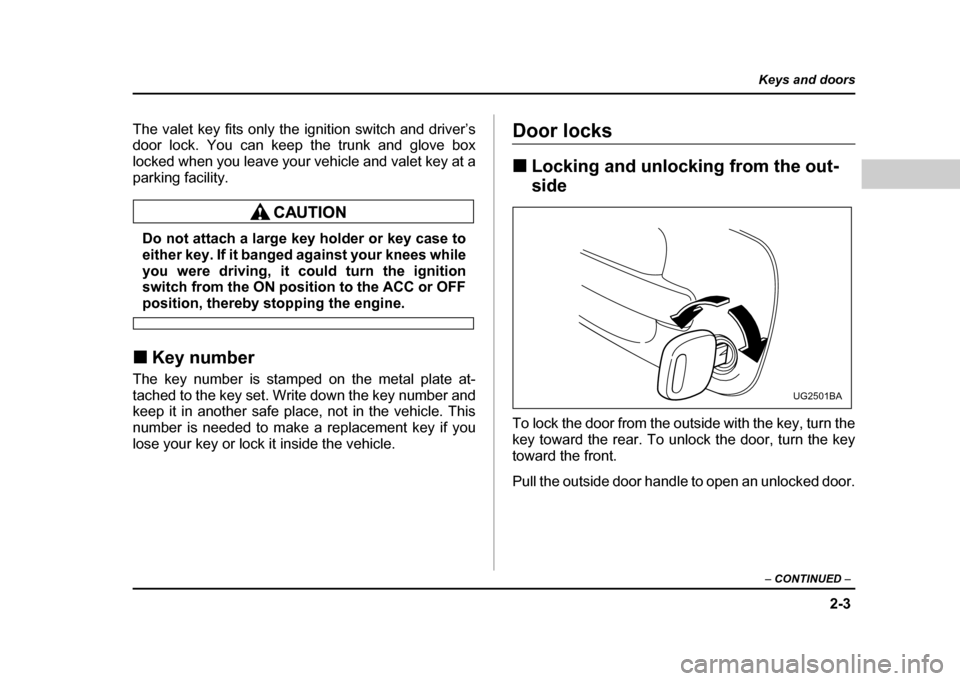
To lock the door from the outside with the key, turn the
key toward the rear. To unlock the door, turn the key
toward the front.
Pull the outside door handle to open an unlocked door.
UG2501BA
Page 107 of 491
2-4
Keys and doors
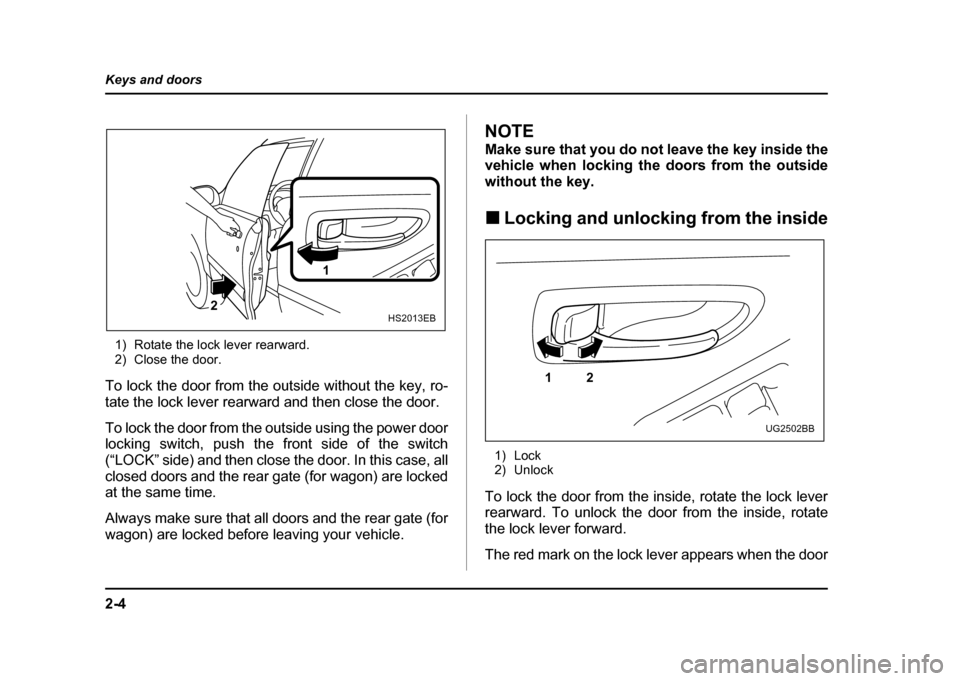
1) Rotate the lock lever rearward.
2) Close the door.
To lock the door from the outside without the key, ro-
tate the lock lever rearward and then close the door.
To lock the door from the outside using the power door
locking switch, push the front side of the switch
(“LOCK” side) and then close the door. In this case, all
closed doors and the rear gate (for wagon) are locked
at the same time.
Always make sure that all doors and the rear gate (for
wagon) are locked before leaving your vehicle.
NOTE
Make sure that you do not leave the key inside the
vehicle when locking the doors from the outside
without the key. ! Locking and unlocking from the inside
1) Lock
2) Unlock
To lock the door from the inside, rotate the lock lever
rearward. To unlock the door from the inside, rotate the lock lever forward.
The red mark on the lock lever appears when the door
HS2013EB
1
2
12
UG2502BB
Page 116 of 491
2-13
Keys and doors
– CONTINUED –
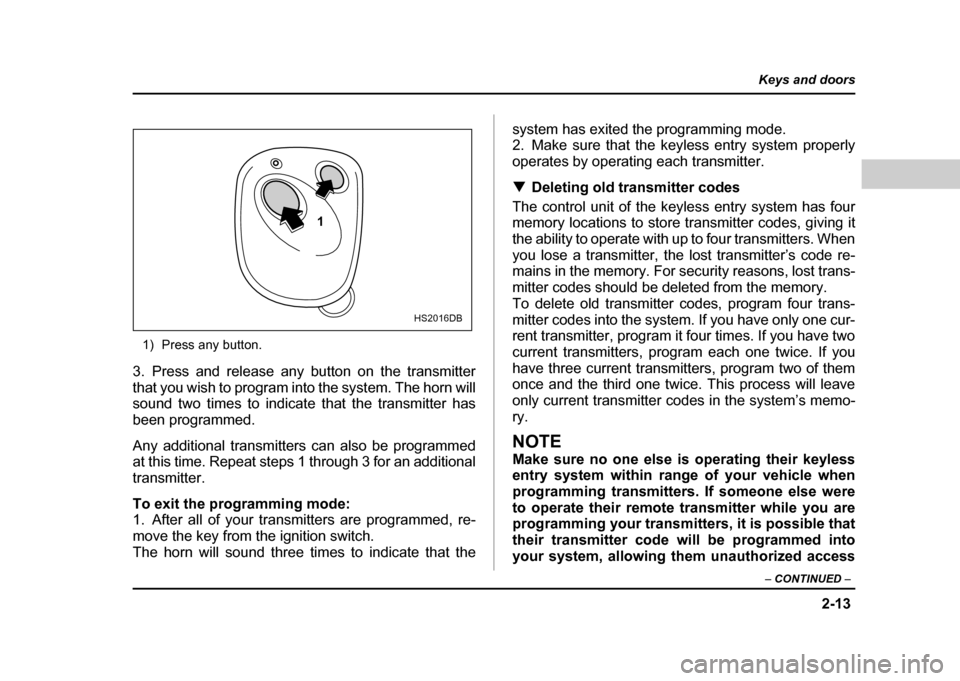
1) Press any button.
3. Press and release any button on the transmitter
that you wish to program into the system. The horn will
sound two times to indicate that the transmitter has
been programmed.
Any additional transmitters can also be programmed
at this time. Repeat steps 1 through 3 for an additional
transmitter.
To exit the programming mode:
1. After all of your transmitters are programmed, re-
move the key from the ignition switch.
The horn will sound three times to indicate that the system has exited the programming mode.
2. Make sure that the keyless entry system properly
operates by operating each transmitter. !
Deleting old transmitter codes
The control unit of the keyless entry system has four
memory locations to store transmitter codes, giving it
the ability to operate with up to four transmitters. When
you lose a transmitter, the lost transmitter’s code re-
mains in the memory. For security reasons, lost trans-
mitter codes should be deleted from the memory.
To delete old transmitter codes, program four trans-
mitter codes into the system. If you have only one cur-
rent transmitter, program it four times. If you have two
current transmitters, program each one twice. If you
have three current transmitters, program two of them
once and the third one twice. This process will leave
only current transmitter codes in the system’s memo-ry.
NOTE
Make sure no one else is operating their keyless
entry system within range of your vehicle when
programming transmitters. If someone else were
to operate their remote transmitter while you are
programming your transmitters, it is possible that
their transmitter code will be programmed into
your system, allowing them unauthorized access
1
HS2016DB
Page 125 of 491
2-22
Keys and doors
Windows !
Power windows
To avoid serious personal injury caused by en-
trapment, you must do the followings. "When operating the power windows, be ex-
tremely careful to prevent anyone’s fingers,
arms, neck or head from being caught in the
window." Always lock the passengers’ windows using
the lock switch when children are riding in the
vehicle." Before leaving the vehicle, always remove
the key from the ignition switch for safety and
never allow an unattended child to remain in
the vehicle. Failure to follow this procedure
could result in injury to a child operating the
power window.
The power windows operate only when the ignition
switch is in the “ON” position. !
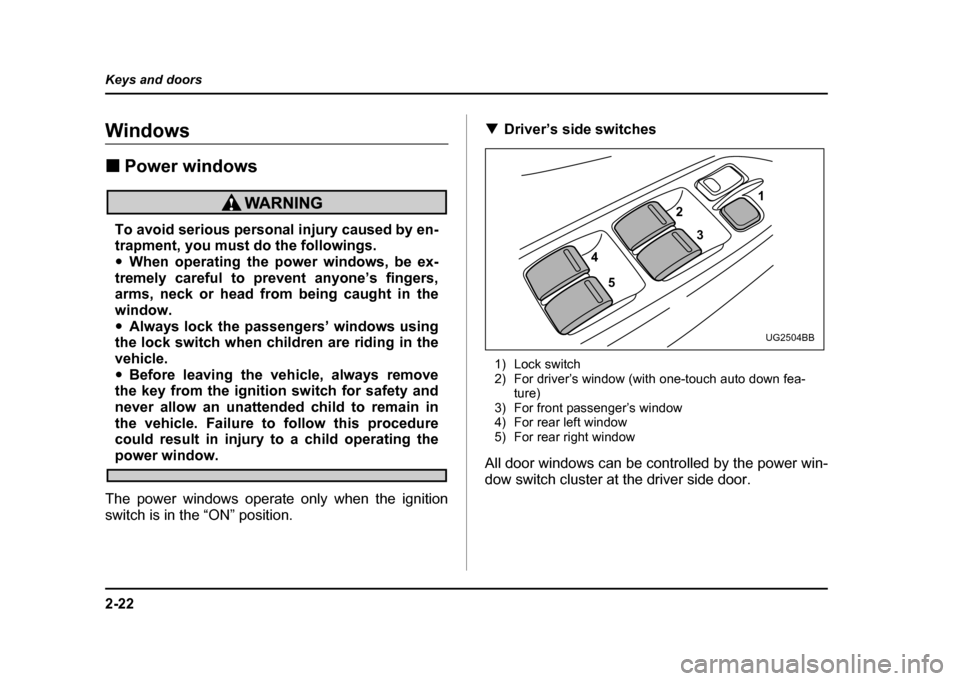
Driver’s side switches
1) Lock switch
2) For driver’s window (with one-touch auto down fea- ture)
3) For front passenger’s window
4) For rear left window
5) For rear right window
All door windows can be controlled by the power win-
dow switch cluster at the driver side door.
2 3
4 1
5
UG2504BB
Page 128 of 491
2-25
Keys and doors
– CONTINUED –
Trunk lid (Sedan)
"To prevent dangerous exhaust gas from en-
tering the vehicle, always keep the trunk lid
closed while driving." Help prevent young children from locking
themselves in the trunk. When leaving the vehi-
cle, either close all windows and lock all doors
or cancel the inside trunk lid release. Also make
certain that the trunk is closed.
On hot or sunny days, the temperature in the
trunk could quickly become high enough to
cause death or serious heat-related injuries in-
cluding brain damage, particularly for small
children. !
To open and close the trunk lid from
outside
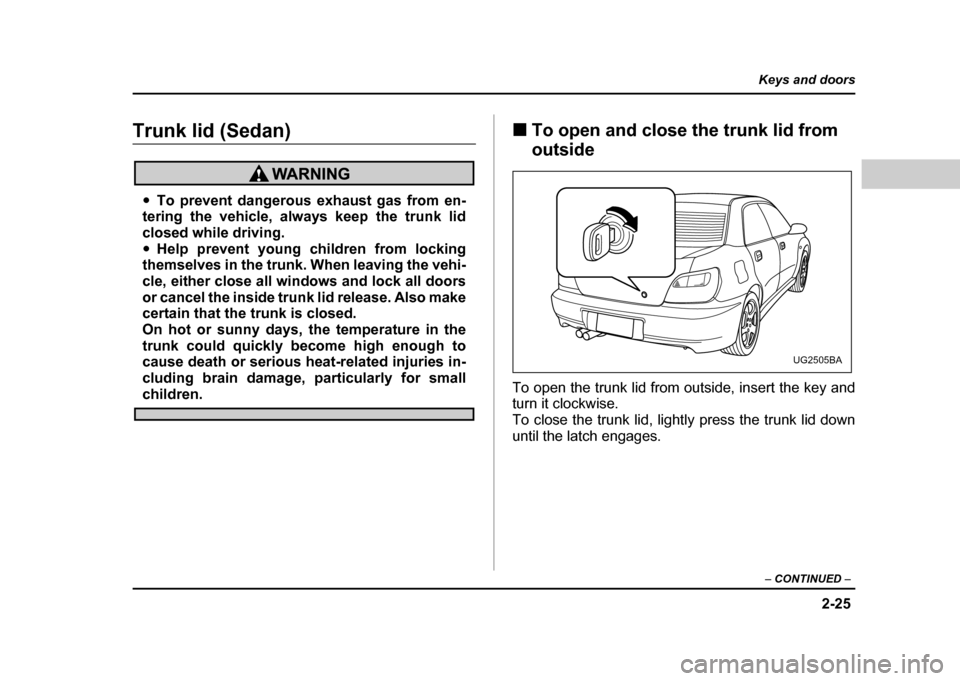
To open the trunk lid from outside, insert the key and
turn it clockwise.
To close the trunk lid, lightly press the trunk lid down
until the latch engages.
UG2505BA
Page 133 of 491
2-30
Keys and doors
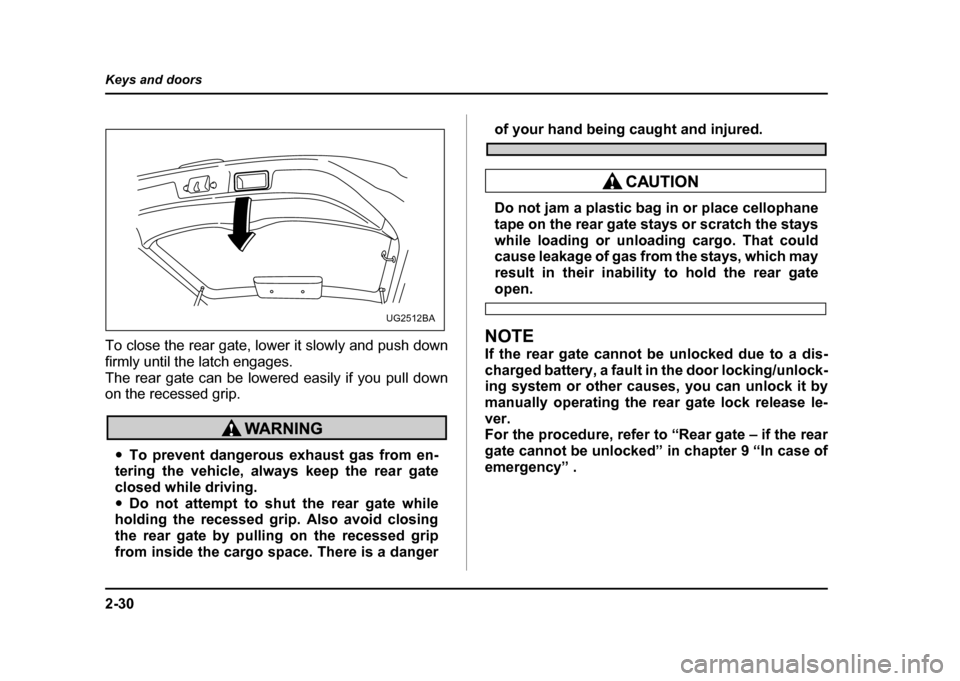
To close the rear gate, lower it slowly and push down
firmly until the latch engages.
The rear gate can be lowered easily if you pull down
on the recessed grip.
"
To prevent dangerous exhaust gas from en-
tering the vehicle, always keep the rear gate
closed while driving." Do not attempt to shut the rear gate while
holding the recessed grip. Also avoid closing
the rear gate by pulling on the recessed grip
from inside the cargo space. There is a danger
of your hand being caught and injured.
Do not jam a plastic bag in or place cellophane
tape on the rear gate stays or scratch the stays
while loading or unloading cargo. That could
cause leakage of gas from the stays, which may
result in their inability to hold the rear gate
open.
NOTE
If the rear gate cannot be unlocked due to a dis-
charged battery, a fault in the door locking/unlock-
ing system or other causes, you can unlock it by
manually operating the rear gate lock release le-
ver.
For the procedure, refer to “Rear gate – if the rear
gate cannot be unlocked” in chapter 9 “In case of
emergency” .
UG2512BA