Page 136 of 491
2-33
Keys and doors
– CONTINUED –
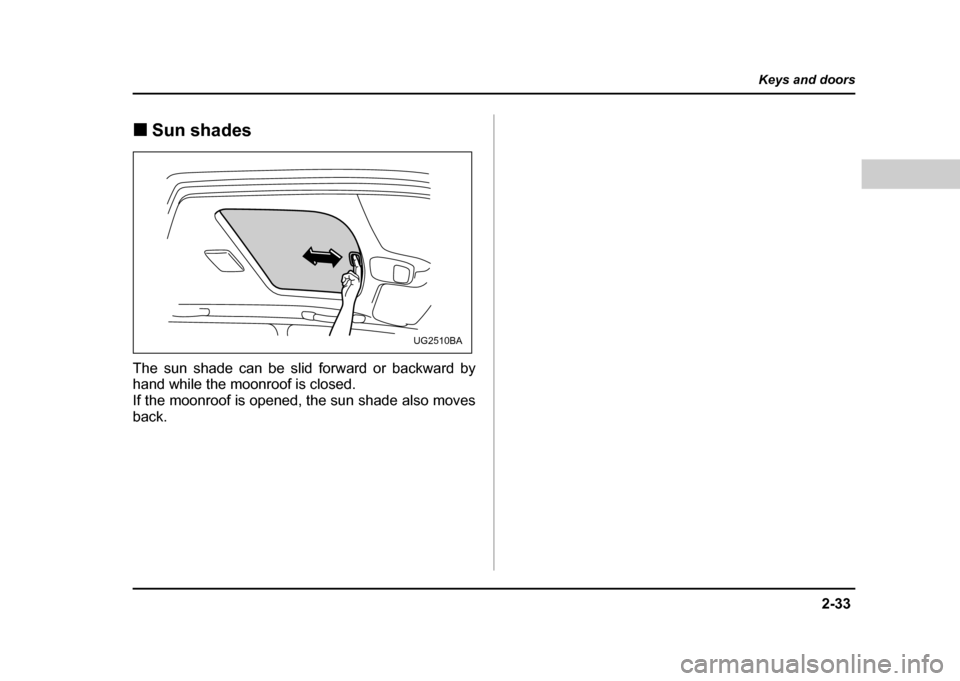
!Sun shades
The sun shade can be slid forward or backward by
hand while the moonroof is closed.
If the moonroof is opened, the sun shade also movesback.
UG2510BA
Page 252 of 491
6-3
Interior equipment
– CONTINUED –
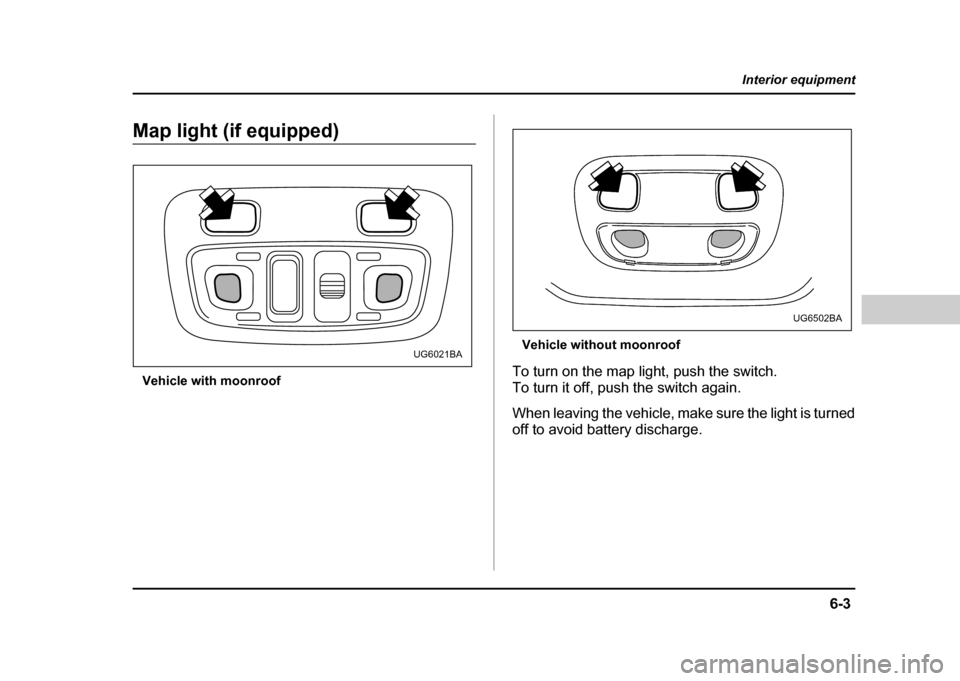
Map light (if equipped)
Vehicle with moonroof Vehicle without moonroof
To turn on the map light, push the switch.
To turn it off, push the switch again.
When leaving the vehicle, make sure the light is turned
off to avoid battery discharge.
UG6021BA
UG6502BA
Page 267 of 491
6-18
Interior equipment
maximum load capacity is 44 lbs (20 kg) per anhook.
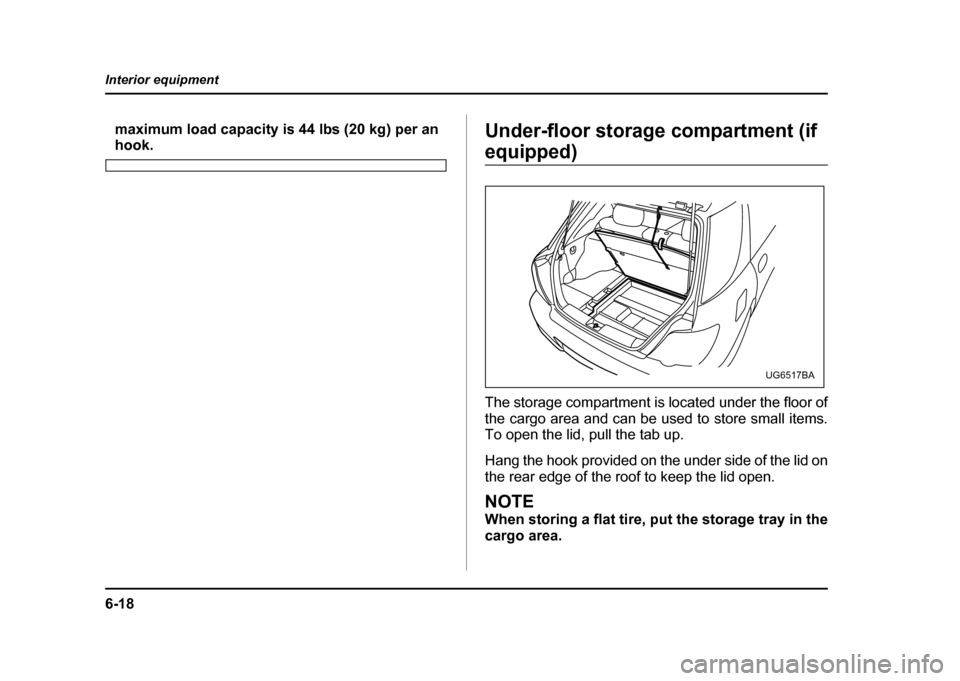
Under-floor storage compartment (if equipped)
The storage compartment is located under the floor of
the cargo area and can be used to store small items.
To open the lid, pull the tab up.
Hang the hook provided on the under side of the lid on
the rear edge of the roof to keep the lid open.
NOTE
When storing a flat tire, put the storage tray in the
cargo area.
UG6517BA
Page 312 of 491

8-1
8
Driving tips
New vehicle break-in driving – the first 1,000 miles (1,600 km) ................ 8-2
Fuel economy hints ...................................... 8-2
Engine exhaust gas (Carbon monoxide) .... 8-3
Catalytic converter ....................................... 8-4
Periodic inspections .................................... 8-6
Driving in foreign countries ......................... 8-6
Driving tips for AWD vehicles ..................... 8-7
Off road driving ............................................ 8-8 All AWD models except OUTBACK SPORT and vehicles with 17 inch tires ..................... 8-9
OUTBACK SPORT ............................................. 8-9
Winter driving ............................................... 8-11 Operation during cold weather ........................ 8-11
Driving on snowy and icy roads ...................... 8-13
Corrosion protection ........................................ 8-14
Snow tires .......................................................... 8-14
Tire chains ......................................................... 8-16
Rocking the vehicle .......................................... 8-16
Loading your vehicle ................................... 8-17 Vehicle capacity weight .................................... 8-19
GVWR and GAWR (Gross Vehicle Weight Rating and Gross Axle Weight Rating) ........ 8-20
Roof rail and crossbar (if equipped) ............... 8-21
Trailer hitch (if equipped) ............................ 8-25 Connecting a trailer .......................................... 8-25
When you do not tow a trailer .......................... 8-28
Trailer towing ................................................ 8-29 Warranties and maintenance ........................... 8-29 Maximum load limits ........................................ 8-29
Trailer hitches ................................................... 8-34
Connecting a trailer .......................................... 8-35
Trailer towing tips ............................................. 8-37
Page 321 of 491

8-10
Driving tips
shallow streams, first check the depth of the water and
the bottom of the stream bed for firmness and ensure
that the bed of the stream is flat. Drive slowly and com-
pletely through the stream. The water should be shal-
low enough that it does not reach the vehicle’s under-
carriage. Water entering the engine air intake or the
exhaust pipe or water splashing onto electrical parts
may damage your vehicle and may cause it to stall.
Never attempt to drive through rushing water; regard-
less of its depth, it can wash away the ground from un-
der your tires, resulting in possible loss of traction and
even vehicle rollover. "
Always check your brakes for effectiveness immedi-
ately after driving in sand, mud or water. Do this by
driving slowly and stepping on the brake pedal. Re-
peat that process several times to dry out the brake
discs and brake pads. " Do not drive or park over or near flammable materi-
als such as dry grass or fallen leaves, as they may
burn easily. The exhaust system is very hot while the
engine is running and right after the engine stops. This
could create a fire hazard." After driving through tall grass, mud, rocks, sand,
rivers, etc., check that there is no grass, bush, paper,
rags, stones, sand, etc. adhering to or trapped on the
underbody. Clear off any such matter from the under-
body. If the vehicle is used with these materials trapped or adhering to the underbody, a mechanical
breakdown or fire could occur. "
Secure all cargo carried inside the vehicle and make
certain that it is not piled higher than the seatbacks.
During sudden stops or jolts, unsecured cargo could
be thrown around in the vehicle and cause injury. Do
not pile heavy loads on the roof. Those loads raise the
vehicle’s center of gravity and make it more prone to
tip over." If you must rock the vehicle to free it from sand or
mud, depress the accelerator pedal slightly and move
the selector lever back and forth between “D” and “R”
repeatedly. Do not race the engine. For the best pos-
sible traction, avoid spinning the wheels when trying to
free the vehicle.
When the road surface is extremely slippery, you can
obtain better traction by starting the vehicle with the
transmission in 2nd than 1st (both for MT and AT). " Never equip your vehicle with tires larger than those
specified in this manual. " Frequent driving of an AWD vehicle under hard-driv-
ing conditions such as rough roads or off roads will ne-
cessitate more frequent replacement of engine oil,
brake fluid and transmission oil than that specified in
the maintenance schedule described in the “Warranty
and Maintenance Booklet”.
Remember that damage done to your Subaru while
Page 329 of 491
8-18
Driving tips
"
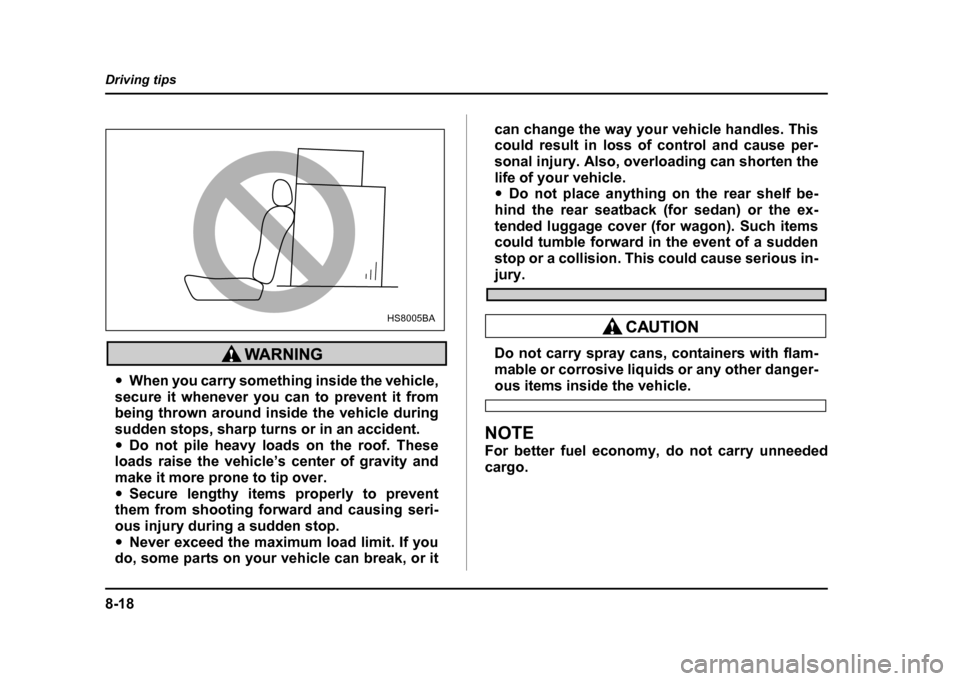
When you carry something inside the vehicle,
secure it whenever you can to prevent it from
being thrown around inside the vehicle during
sudden stops, sharp turns or in an accident." Do not pile heavy loads on the roof. These
loads raise the vehicle’s center of gravity and
make it more prone to tip over." Secure lengthy items properly to prevent
them from shooting forward and causing seri-
ous injury during a sudden stop." Never exceed the maximum load limit. If you
do, some parts on your vehicle can break, or it can change the way your vehicle handles. This
could result in loss of control and cause per-
sonal injury. Also, overloading can shorten the
life of your vehicle. "
Do not place anything on the rear shelf be-
hind the rear seatback (for sedan) or the ex-
tended luggage cover (for wagon). Such items
could tumble forward in the event of a sudden
stop or a collision. This could cause serious in-
jury.
Do not carry spray cans, containers with flam-
mable or corrosive liquids or any other danger-
ous items inside the vehicle.
NOTE
For better fuel economy, do not carry unneeded
cargo.
HS8005BA
Page 330 of 491
8-19
Driving tips
– CONTINUED –
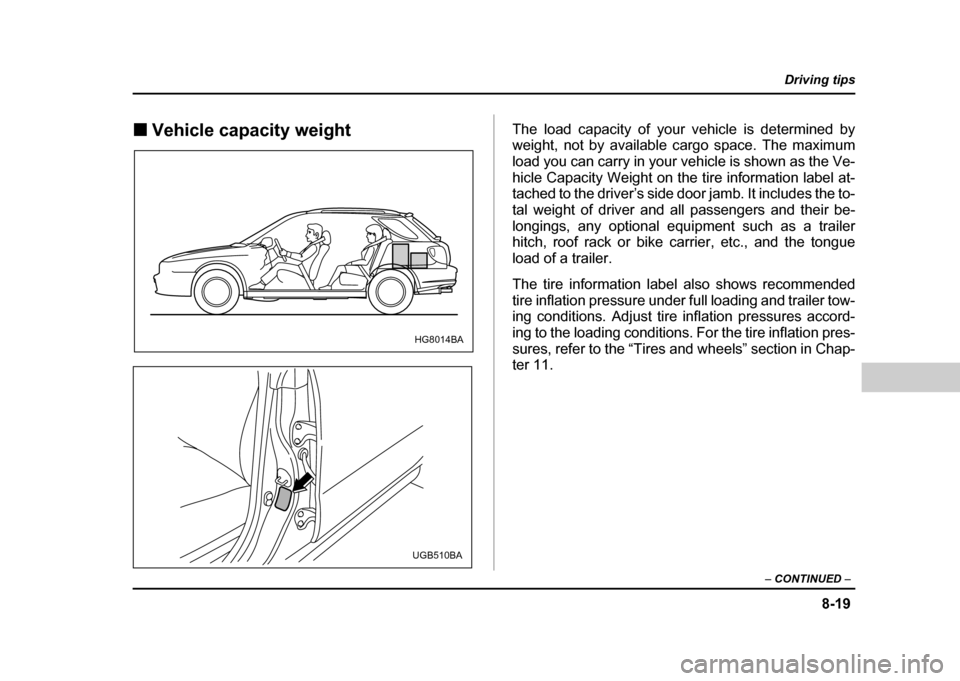
!Vehicle capacity weight The load capacity of your vehicle is determined by
weight, not by available cargo space. The maximum
load you can carry in your vehicle is shown as the Ve-
hicle Capacity Weight on the tire information label at-
tached to the driver’s side door jamb. It includes the to-
tal weight of driver and all passengers and their be-
longings, any optional equipment such as a trailer
hitch, roof rack or bike carrier, etc., and the tongue
load of a trailer.
The tire information label also shows recommended
tire inflation pressure under full loading and trailer tow-
ing conditions. Adjust tire inflation pressures accord-
ing to the loading conditions. For the tire inflation pres-
sures, refer to the “Tires and wheels” section in Chap-
ter 11.
HG8014BA
UGB510BA
Page 332 of 491
8-21
Driving tips
– CONTINUED –
!Roof rail and crossbar (if equipped)
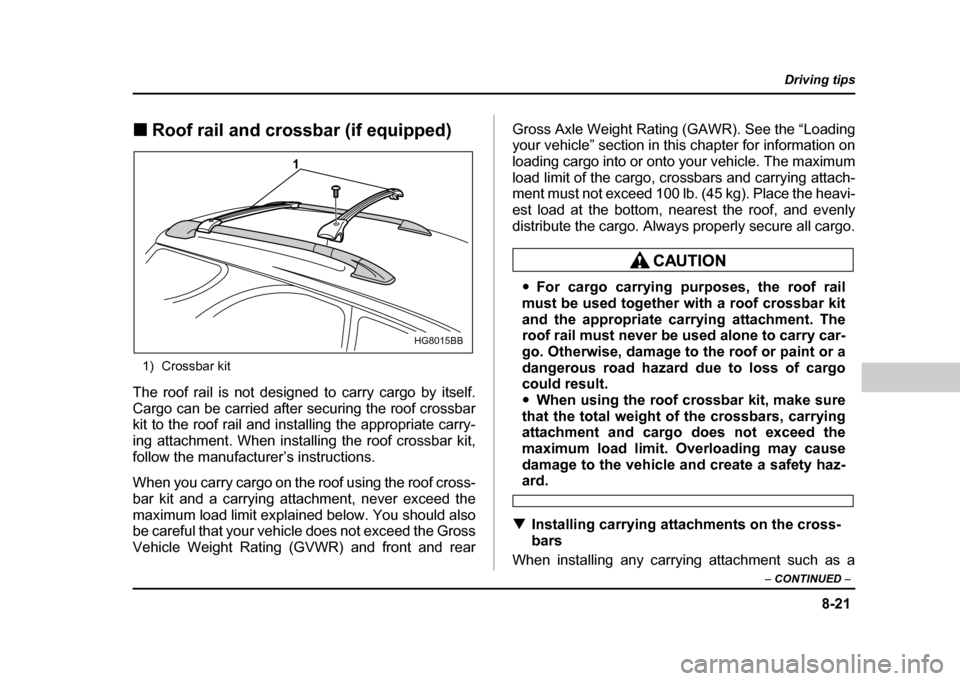
1) Crossbar kit
The roof rail is not designed to carry cargo by itself.
Cargo can be carried after securing the roof crossbar
kit to the roof rail and installing the appropriate carry-
ing attachment. When installing the roof crossbar kit,
follow the manufacturer’s instructions.
When you carry cargo on the roof using the roof cross-
bar kit and a carrying attachment, never exceed the
maximum load limit explained below. You should also
be careful that your vehicle does not exceed the Gross
Vehicle Weight Rating (GVWR) and front and rear Gross Axle Weight Rating (GAWR). See the “Loading
your vehicle” section in this chapter for information on
loading cargo into or onto your vehicle. The maximum
load limit of the cargo, crossbars and carrying attach-
ment must not exceed 100 lb. (45 kg). Place the heavi-
est load at the bottom, nearest the roof, and evenly
distribute the cargo. Always properly secure all cargo.
"
For cargo carrying purposes, the roof rail
must be used together with a roof crossbar kit
and the appropriate carrying attachment. The
roof rail must never be used alone to carry car-
go. Otherwise, damage to the roof or paint or a
dangerous road hazard due to loss of cargo
could result. " When using the roof crossbar kit, make sure
that the total weight of the crossbars, carrying
attachment and cargo does not exceed the
maximum load limit. Overloading may cause
damage to the vehicle and create a safety haz-
ard.
! Installing carrying attachments on the cross-
bars
When installing any carrying attachment such as a
1
HG8015BB