2004 SUBARU IMPREZA lights
[x] Cancel search: lightsPage 348 of 491
8-37
Driving tips
– CONTINUED –
use towing mirrors that conform with Federal, state/
province and/or other applicable regulations. !Trailer lights
Connection of trailer lights to your vehicle’s electrical
system requires modifications to the vehicle’s lighting
circuit to increase its capacity and accommodate wir-
ing changes. To ensure the trailer lights are connected
properly, please consult your SUBARU dealer. Check
for proper operation of the turn signals, the brake
lights and parking lights each time you hitch up.
Direct splicing or other improper connection of
trailer lights may damage your vehicle’s electri-
cal system and cause a malfunction of your ve-
hicle’s lighting system.
! Tires
Make sure that all the tires on your vehicle are properly
inflated to the pressure specified on the tire placard lo-
cated on the left center pillar of your vehicle.
Trailer tire condition, size, load rating and proper infla-
tion pressure should be in accordance with the trailer
manufacturer’s specifications. In the event your vehicle gets a flat tire when towing a
trailer, ask a commercial road service to repair the flat
tire.
If you carry a regular size spare tire in your vehicle or
trailer as a precaution against getting a flat tire, be
sure that the spare tire is firmly secured.
Never tow a trailer when the temporary spare
tire is used. The temporary spare tire is not de-
signed to sustain the towing load. Use of the
temporary spare tire when towing can result in
failure of the spare tire and/or less stability of
the vehicle.
! Trailer towing tips
"Never exceed 45 mph (72 km/h) when towing
a trailer in hilly country on hot days. " When towing a trailer, steering, stability,
stopping distance and braking performance
will be different from normal operation. For
safety’s sake, you should employ extra caution
Page 349 of 491

8-38
Driving tips
when towing a trailer and you should never
speed. You should also keep the following tips
in mind:
! Before starting out on a trip
" Check that the vehicle and vehicle-to-hitch mount-
ing are in good condition. If any problems are appar-
ent, do not tow the trailer. " Check that the vehicle sits horizontally with the trail-
er attached. If the vehicle is tipped sharply up at the
front and down at the rear, check the total trailer
weight, GVW, GAWs and tongue load again, then con-
firm that the load and its distribution are acceptable. " Check that the tire pressures are correct.
" Check that the vehicle and trailer are connected
properly. Confirm that – the trailer tongue is connected properly to the
hitch ball.
– the trailer lights connector is connected properly
and trailer’s brake lights illuminate when the vehi-
cle’s brake pedal is pressed, and that the trailer’s
turn signal lights flash when the vehicle’s turn signal
lever is operated.
– the safety chains are connected properly.
– all cargo in the trailer is secured safety in position.
– the side mirrors provide a good rearward field of view without a significant blind spot.
" Sufficient time should be taken to learn the “feel” of
the vehicle/trailer combination before starting out on a
trip. In an area free of traffic, practice turning, stopping
and backing up. ! Driving with a trailer
" You should allow for considerably more stopping
distance when towing a trailer. Avoid sudden braking
because it may result in skidding or jackknifing and
loss of control." Avoid abrupt starts and sudden accelerations. If
your vehicle has a manual transmission, always start
out in first gear and release the clutch at moderate en-
gine revolution." Avoid uneven steering, sharp turns and rapid lane
changes." Slow down before turning. Make a longer than nor-
mal turning radius because the trailer wheels will be
closer than the vehicle wheels to the inside of the turn.
In a tight turn, the trailer could hit your vehicle." Crosswinds will adversely affect the handling of
your vehicle and trailer, causing sway. Crosswinds
can be due to weather conditions or the passing of
large trucks or buses. If swaying occurs, firmly grip the
steering wheel and slow down immediately but gradu-
ally." When passing other vehicles, considerable dis-
Page 350 of 491
8-39
Driving tips
– CONTINUED –
tance is required because of the added weight and
length caused by attaching the trailer to your vehicle.
1) Left turn
2) Right turn
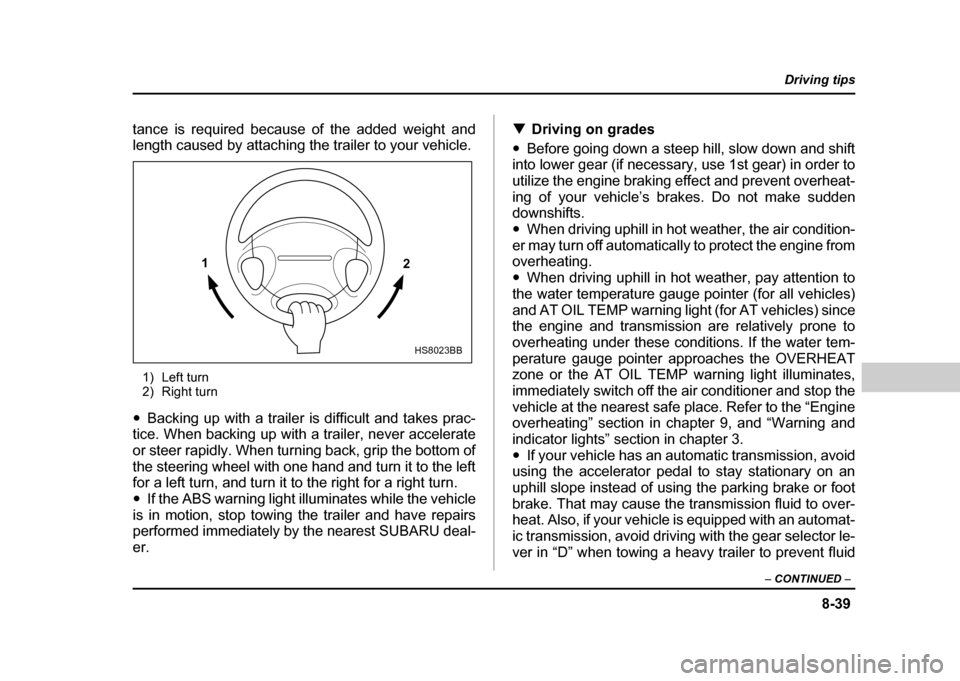
" Backing up with a trailer is difficult and takes prac-
tice. When backing up with a trailer, never accelerate
or steer rapidly. When turning back, grip the bottom of
the steering wheel with one hand and turn it to the left
for a left turn, and turn it to the right for a right turn." If the ABS warning light illuminates while the vehicle
is in motion, stop towing the trailer and have repairs
performed immediately by the nearest SUBARU deal-er. !
Driving on grades
" Before going down a steep hill, slow down and shift
into lower gear (if necessary, use 1st gear) in order to
utilize the engine braking effect and prevent overheat-
ing of your vehicle’s brakes. Do not make sudden
downshifts. " When driving uphill in hot weather, the air condition-
er may turn off automatically to protect the engine from
overheating. " When driving uphill in hot weather, pay attention to
the water temperature gauge pointer (for all vehicles)
and AT OIL TEMP warning light (for AT vehicles) since
the engine and transmission are relatively prone to
overheating under these conditions. If the water tem-
perature gauge pointer approaches the OVERHEAT
zone or the AT OIL TEMP warning light illuminates,
immediately switch off the air conditioner and stop the
vehicle at the nearest safe place. Refer to the “Engine
overheating” section in chapter 9, and “Warning and
indicator lights” section in chapter 3." If your vehicle has an automatic transmission, avoid
using the accelerator pedal to stay stationary on an
uphill slope instead of using the parking brake or foot
brake. That may cause the transmission fluid to over-
heat. Also, if your vehicle is equipped with an automat-
ic transmission, avoid driving with the gear selector le-
ver in “D” when towing a heavy trailer to prevent fluid
1 2
HS8023BB
Page 365 of 491
9-14
In case of emergency
Jump starting
"
Battery fluid is SULFURIC ACID. Do not let it
come in contact with the hooks, skin, clothing
or the vehicle.
If battery fluid gets on you, thoroughly flush the
exposed area with water immediately. Get med-
ical help if the fluid has entered your hooks.
If battery fluid is accidentally swallowed, imme-
diately drink a large amount of milk or water,
and obtain immediate medical help.
Keep everyone including children away from the battery. " The gas generated by a battery explodes if a
flame or spark is brought near it. Do not smoke
or light a match while jump starting. " Never attempt jump starting if the discharged
battery is frozen. It could cause the battery to
burst or explode. " Whenever working on or around a battery, al-
ways wear suitablehookprotectors, and remove
metal objects such as rings, bands or other
metal jewelry. " Be sure the jumper cables and clamps on
them do not have loose or missing insulation. Do not jump start unless cables in suitable con-
dition are available. "
A running engine can be dangerous. Keep
your fingers, hands, clothing, hair and tools
away from the cooling fan, belts and any other
moving engine parts. Removing rings, watches
and ties is advisable.
When your vehicle does not start due to a run down
(discharged) battery, the vehicle may be jump started
by connecting your battery to another battery (called
the booster battery) with jumper cables.
Jump starting is dangerous if it done incorrectly. If you
are unsure about the proper procedure for jump start-
ing, consult a competent mechanic. ! How to jump start
1. Make sure the booster battery is 12 volts and the
negative terminal is grounded.
2. If the booster battery is in another vehicle, do not let
the two vehicles touch.
3. Turn off all unnecessary lights and accessories.
4. Connect the jumper cables exactly in the sequence
illustrated.
Page 387 of 491

11 - 2
Maintenance and service
Types of tires .................................................... 11-44
Tire inspection .................................................. 11-45
Tire pressures and wear .................................. 11-45
Wheel balance ................................................... 11-48
Wear indicators ................................................. 11-49
Tire rotation ....................................................... 11-50
Tire replacement ............................................... 11-50
Wheel replacement ........................................... 11-51
Wheel covers .................................................... 11-52
Aluminum wheels (If equipped) .................. 11-53
Intercooler water spray ................................ 11-53
Windshield washer fluid .............................. 11-54
Replacement of windshield wiper blades .. 11-55
Battery ........................................................... 11-58
Fuses ............................................................. 11-60
Main fuse ....................................................... 11-63
Installation of accessories .......................... 11-63
Replacing bulbs ............................................ 11-64 Headlights (U.S. spec. WRX-STi) .................... 11-66
Headlight (Except U.S. spec. WRX-STi) .......... 11-66
Front turn signal light bulbs ............................ 11-69
Parking light ...................................................... 11-70
Front fog light ................................................... 11-73
Rear combination lights ................................... 11-74
License plate light ............................................ 11-76
Dome light, map light and cargo area light .... 11-77
Trunk light ......................................................... 11-78
High mount stop light ...................................... 11-78
Page 447 of 491
11 - 6 2
Maintenance and service
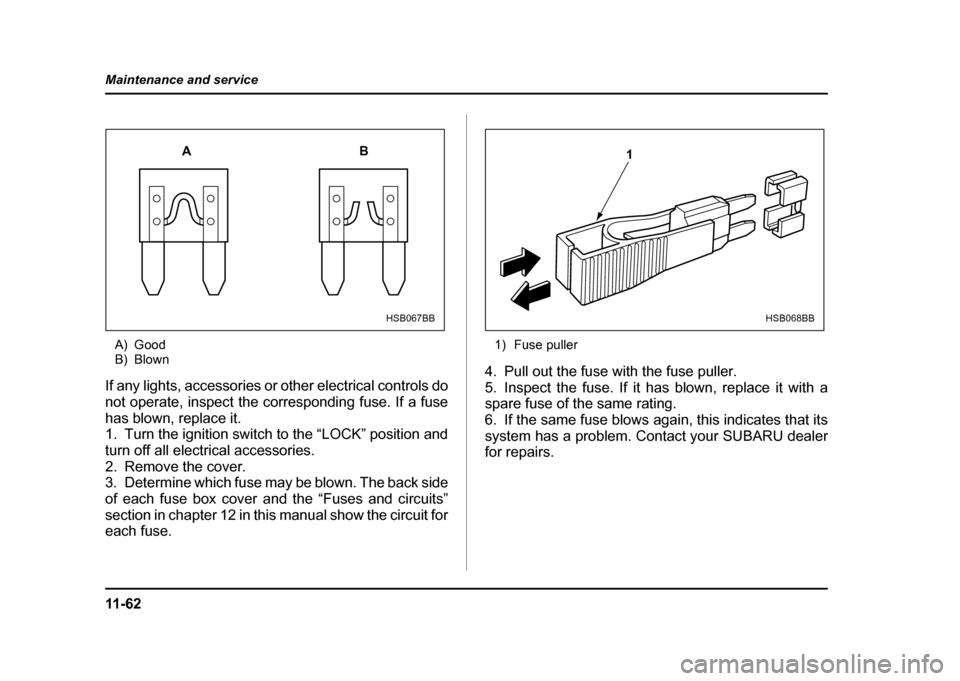
A) Good
B) Blown
If any lights, accessories or other electrical controls do
not operate, inspect the corresponding fuse. If a fuse
has blown, replace it.
1. Turn the ignition switch to the “LOCK” position and
turn off all electrical accessories.
2. Remove the cover.
3. Determine which fuse may be blown. The back side
of each fuse box cover and the “Fuses and circuits”
section in chapter 12 in this manual show the circuit for
each fuse. 1) Fuse puller
4. Pull out the fuse with the fuse puller.
5. Inspect the fuse. If it has blown, replace it with a
spare fuse of the same rating.
6. If the same fuse blows again, this indicates that its
system has a problem. Contact your SUBARU dealer for repairs.
AB
HSB067BB
1
HSB068BB
Page 448 of 491
11 -6 3
Maintenance and service
– CONTINUED –
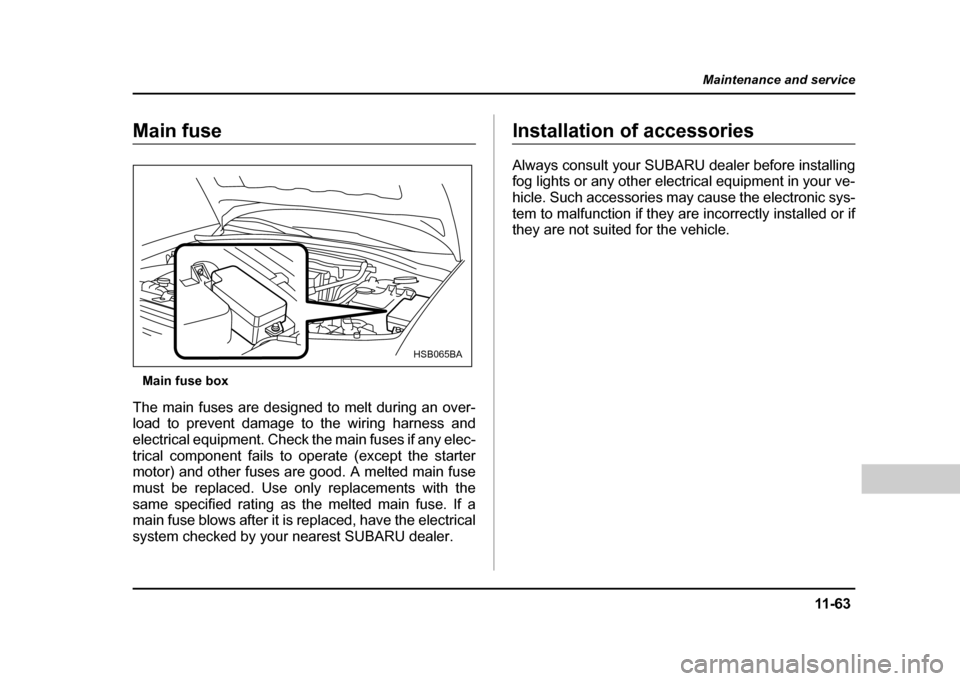
Main fuse
Main fuse box
The main fuses are designed to melt during an over-
load to prevent damage to the wiring harness and
electrical equipment. Check the main fuses if any elec-
trical component fails to operate (except the starter
motor) and other fuses are good. A melted main fuse
must be replaced. Use only replacements with the
same specified rating as the melted main fuse. If a
main fuse blows after it is replaced, have the electrical
system checked by your nearest SUBARU dealer.Installation of accessories
Always consult your SUBARU dealer before installing
fog lights or any other electrical equipment in your ve-
hicle. Such accessories may cause the electronic sys-
tem to malfunction if they are incorrectly installed or if
they are not suited for the vehicle.
HSB065BA
Page 451 of 491
11 - 6 6
Maintenance and service
!
Headlights (U.S. spec. WRX-STi)
High-intensity-discharge (HID) bulbs are used
for the low beams of the headlights on the U.S.
spec. WRX-STi. These HID bulbs use an ex-
tremely high voltage. To avoid the risk of an
electric shock and resulting serious injury, you
should not attempt to replace them. Neither
should you attempt to replace the high-beam
bulbs, remove/refit the headlight assemblies,
or remove any headlight-assembly compo-
nents. For replacement of the headlight bulbs
(low-beam and high-beam), removal and instal-
lation of the headlight assemblies, and removal
of headlight-assembly components, contact
your Subaru dealer.
! Headlight (Except U.S. spec. WRX-STi)
Halogen headlight bulbs become very hot while
in use. If you touch the bulb surface with bare
hands or greasy gloves, finger prints or grease on the bulb surface will develop into hot spots
and cause the bulb to break. If there are finger
prints or grease on the bulb surface, wipe them
away with a soft cloth moistened with alcohol.
NOTE "
If headlight aiming is required, consult your
SUBARU dealer for proper adjustment of the head-
light aim. " It may be difficult to replace the bulbs. Have
your SUBARU dealer replace the bulbs if neces-
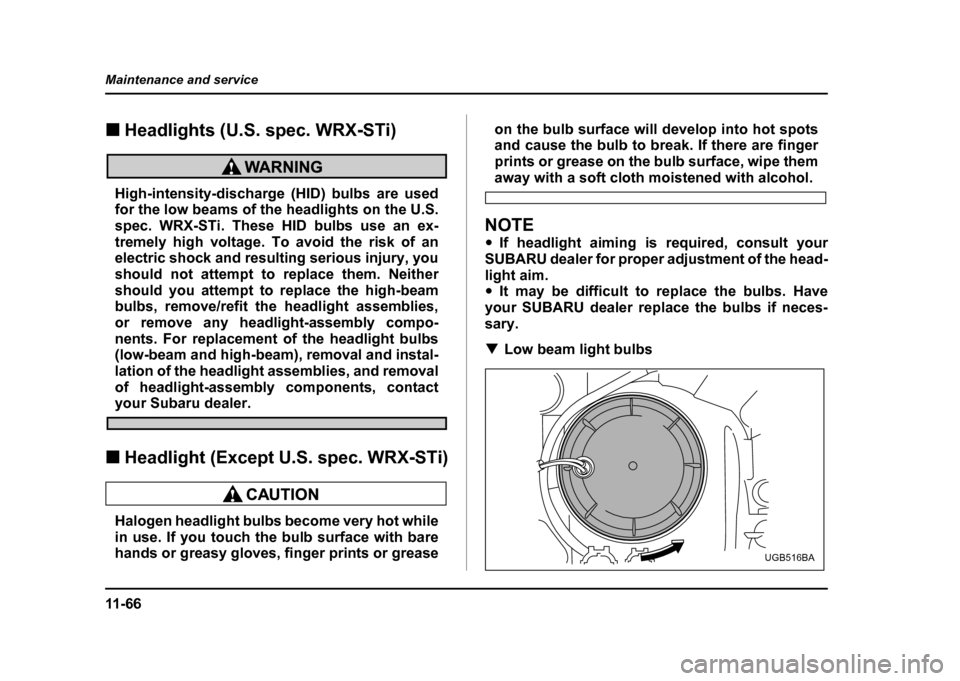
sary. ! Low beam light bulbs
UGB516BA