Page 203 of 491
4-14
Climate control
OFF:
The air conditioner does not operate.
Push the button a second time to select this position.
The indicator light will go off.
NOTE
The air conditioner’s compressor does not oper-
ate with an outside temperature of 32 °F (0 °C) or
lower. ! Operating method
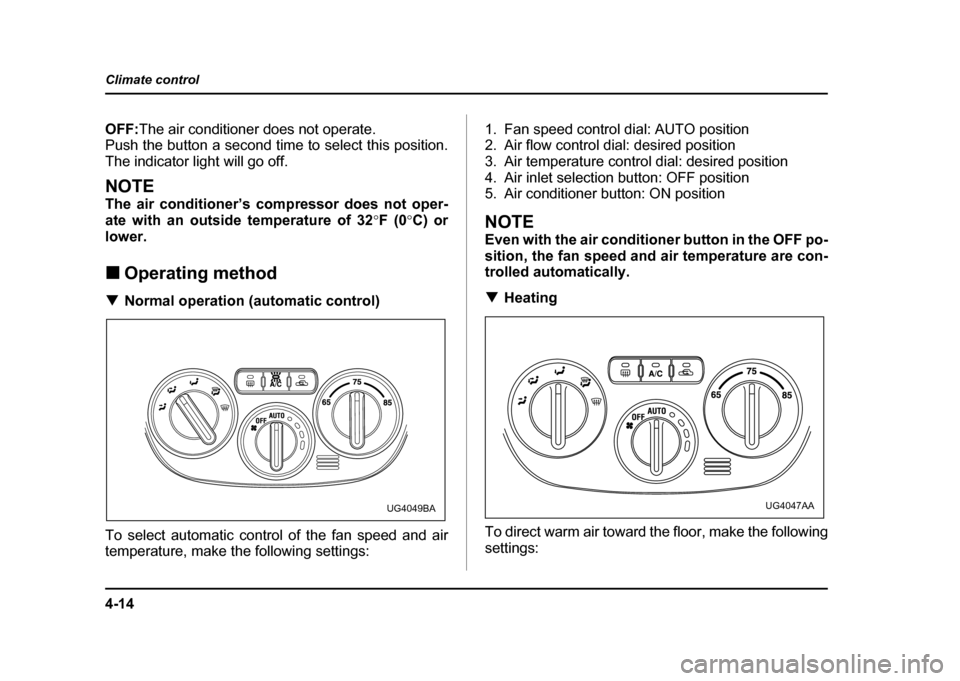
! Normal operation (automatic control)
To select automatic control of the fan speed and air
temperature, make the following settings: 1. Fan speed control dial: AUTO position
2. Air flow control dial: desired position
3. Air temperature control dial: desired position
4. Air inlet selection button: OFF position
5. Air conditioner button: ON position
NOTE
Even with the air conditioner button in the OFF po-
sition, the fan speed and air temperature are con-
trolled automatically. !
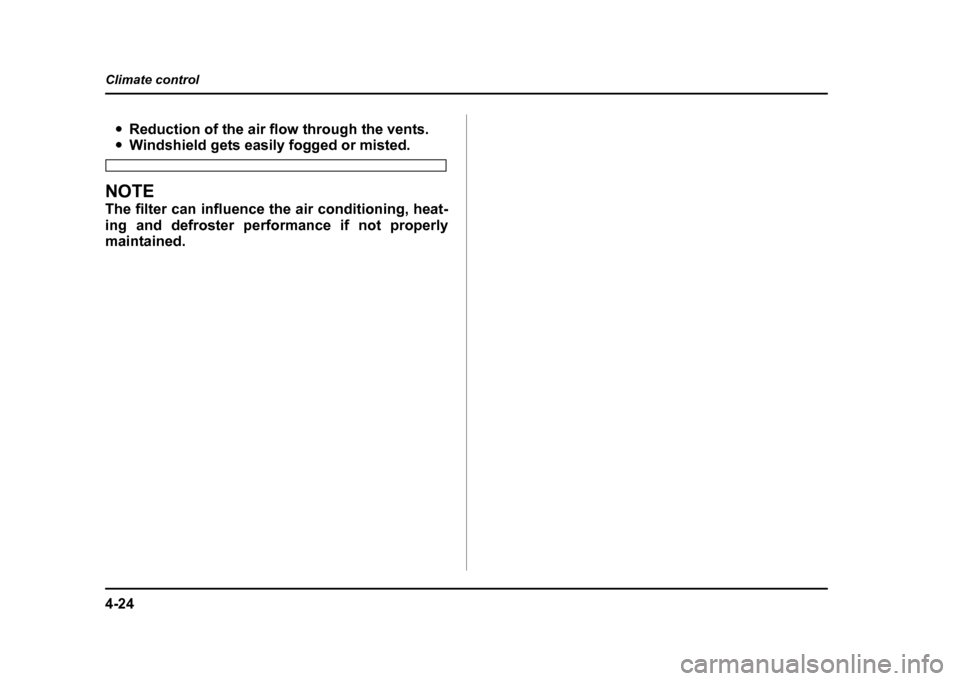
Heating
To direct warm air toward the floor, make the following settings:
UG4049BAUG4047AA
Page 204 of 491

4-15
Climate control
– CONTINUED –
1. Fan speed control dial: AUTO position
2. Air flow control dial: position
3. Air temperature control dial: desired position
4. Air inlet selection button: OFF position
5. Air conditioner button: OFF position
NOTE "To heat the passenger compartment rapidly, set
the air temperature control dial to the 85 (30) posi-
tion and the air inlet selection button to the ON po-
sition. When the passenger compartment has
warmed up sufficiently, return the air inlet selec-
tion button to the OFF position. " Warm air also comes out from the right and left
air outlets. To stop warm air flow from these out-
lets, turn the corresponding knob clockwise. !
Rapid cooling
To cool the passenger compartment rapidly, make the
following settings:
1. Fan speed control dial: All the way to the right
2. Air flow control dial: “ ” position
3. Air temperature control dial: 65 (20) position
4. Air inlet selection button: ON position
5. Air conditioner button: ON position
NOTE
From time to time, return the air inlet selection but-
ton to the OFF position to draw outside air into the
passenger compartment.
UG4041BA
Page 205 of 491
4-16
Climate control
!
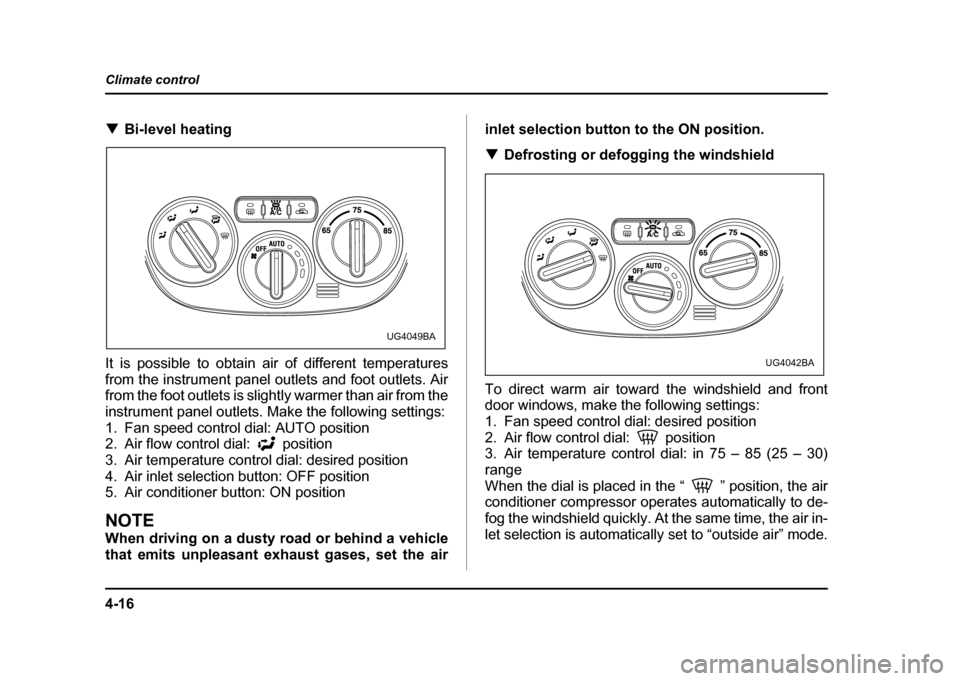
Bi-level heating
It is possible to obtain air of different temperatures
from the instrument panel outlets and foot outlets. Air
from the foot outlets is slightly warmer than air from the
instrument panel outlets. Make the following settings:
1. Fan speed control dial: AUTO position
2. Air flow control dial: position
3. Air temperature control dial: desired position
4. Air inlet selection button: OFF position
5. Air conditioner button: ON position
NOTE
When driving on a dusty road or behind a vehicle
that emits unpleasant exhaust gases, set the air inlet selection button to the ON position. !
Defrosting or defogging the windshield
To direct warm air toward the windshield and front
door windows, make the following settings:
1. Fan speed control dial: desired position
2. Air flow control dial: position
3. Air temperature control dial: in 75 – 85 (25 – 30)
range
When the dial is placed in the “ ” position, the air
conditioner compressor operates automatically to de-
fog the windshield quickly. At the same time, the air in-
let selection is automatically set to “outside air” mode.
UG4049BA
UG4042BA
Page 206 of 491

4-17
Climate control
– CONTINUED –
NOTE "For rapid defrosting or defogging, set the fan
speed control dial to the highest speed position. " If air supplied from the outlets is too cold, the
windshield may become fogged on the outside.
Turn up the air temperature control dial slightly if
this happens." Warm air also comes out from the right and left
air outlets. To stop warm air flow from these out-
lets, turn the corresponding knob clockwise. ! Heating and defrosting
To direct warm air toward the floor and windshield,
make the following settings: 1. Fan speed control dial: desired position
2. Air flow control dial: position
3. Air temperature control dial: in 75 – 85 (25 – 30)
range
When the dial is placed in the “ ” position, the air
conditioner compressor operates automatically to de-
fog the windshield quickly. At the same time, the air in-
let selection is automatically set to “outside air” mode.
However, the air conditioner does not operate auto-
matically when the dial is placed in the “ ” position
after the dial has been placed in the “ ” position
and the air conditioner has been turned off manually.
NOTE "
If air supplied from the outlets is too cold, the
windshield may become fogged on the outside.
Turn up the air temperature control dial slightly if
this happens. " Warm air also comes out from the right and left
air outlets. To stop warm air flow from these out-
lets, turn the corresponding knob clockwise.
UG4043AA
Page 208 of 491
4-19
Climate control
– CONTINUED –
Operating tips for heater and air con-
ditioner !Cleaning ventilation grille
Always keep the front ventilation inlet grille free of
snow, leaves, or other obstructions to ensure efficient
heating and defrosting. Since the condenser is located
in front of the radiator, this area should be kept clean
because cooling performance is impaired by any ac-
cumulation of insects and leaves on the condenser. !
Efficient cooling after parking in direct
sunlight
After parking in direct sunlight, drive with the windows
open for a few minutes to allow outside air to circulate
into the heated interior. This results in quicker cooling
by the air conditioner. Keep the windows closed during
the operation of the air conditioner for maximum cool-
ing efficiency. ! Lubrication oil circulation in the refrig- erant circuit
Operate the air conditioner compressor at a low en-
gine speed (at idle or low driving speeds) a few min-
utes each month during the off-season to circulate its
oil. ! Checking air conditioning system be-
fore summer season
Check the air conditioner unit for refrigerant leaks,
hose conditions, and proper operation each spring.
This check is best performed by your SUBARU dealer.
UG4040BA
Page 209 of 491

4-20
Climate control
!
Cooling and dehumidifying in high hu-
midity and low temperature weather
conditions
Under certain weather conditions (high relative humid-
ity, low temperatures, etc.) a small amount of water
vapor emission from the air outlets may be noticed.
This condition is normal and does not indicate any
problem with the air conditioning system. ! Air conditioner compressor shut-off
when engine is heavily loaded
To improve acceleration and gas mileage, the air con-
ditioner compressor is designed to temporarily shut off
during air conditioner operation whenever the acceler-
ator is fully depressed such as during rapid accelera-
tion or when driving on a steep upgrade. ! Refrigerant for your climate control
system
Your air conditioner uses ozone friendly refrigerant
HFC134a. Therefore, the method of adding, changing
or checking the refrigerant is different from the method
for CFC12 (Freon). Consult your SUBARU dealer for
service. Repairs needed as a result of using the wrong
refrigerant are not covered under warranty.Air filtration system (if equipped)
If your vehicle’s air conditioning system is equipped
with an air filtration system, replace the filter element
according to the replacement schedule shown below.
This schedule should be followed to maintain the fil-
ter’s dust collection ability. Under extremely dusty con-
ditions, the filter should be replaced more frequently. It
is recommended that you have your filter checked or
replaced by your SUBARU dealer. For replacement,
use only a genuine SUBARU air filter kit.
Replacement schedule: Every 12 months or 7,500 miles (12,000 km) whichev-
er comes first
Page 213 of 491
4-24
Climate control
"
Reduction of the air flow through the vents."Windshield gets easily fogged or misted.
NOTE
The filter can influence the air conditioning, heat-
ing and defroster performance if not properly
maintained.
Page 276 of 491

7-7
Starting and operating
– CONTINUED –
State emission testing (U.S. only)
At state inspection time, remember to tell your in-
spection or service station in advance not to place
your Subaru AWD vehicle on a two-wheel dyna-
mometer. Otherwise, serious transmission dam-
age will result.
Some states have started using dynamometers in
their state inspection programs in order to meet their
obligation under federal law to implement stricter vehi-
cle emission standards to reduce air pollution from
cars. A dynamometer is a treadmill or roller-like testing
device that allows your car’s wheels to turn while the
car remains in one place. Depending on the severity of
a state’s air pollution problems, the states must adopt
either a “basic” or “enhanced” vehicle emission in-
spection test. Normally, a portion of the basic emission
test consists of an emission inspector inserting an an-
alyzer probe into the exhaust pipe of an idling vehicle
for a short period of time. States with more severe air
pollution problems are required to adopt an enhanced
vehicle emission test. This test simulates actual driv-
ing conditions on a dynamometer and permits more
accurate measurement of tailpipe emitted pollution
than the basic emission test.
The U.S. Environmental Protection Agency (EPA) and states using two-wheel dynamometers in their emis-
sion testing programs have
EXEMPTED Subaru AWD
vehicles from the portion of the testing program that in-
volves a two-wheel dynamometer.
There are some states that use four-wheel dynamom-
eters in their testing programs. When properly used,
that equipment will not damage an AWD Subaru vehi- cle.
Under no circumstances should the rear wheels be
jacked off the ground, nor should the driveshaft be dis-
connected for state emission testing.
Testing of an All-Wheel Drive vehicle must
NEVER be performed on a single two-wheel dy-
namometer. Attempting to do so will result in
uncontrolled vehicle movement and may cause
an accident or injuries to persons nearby.
Resultant vehicle damage due to improper test-
ing is not covered under the SUBARU Limited
Warranty and is the responsibility of the state