2004 SKODA SUPERB lock
[x] Cancel search: lockPage 172 of 270
Transporting children safely 171
Using the systemSafetyDriving TipsGeneral MaintenanceBreakdown assistanceTechnical Data
•Please comply with any differin g national legal regulations
regarding the use of child safety seats.
Child safety seats in Group 3
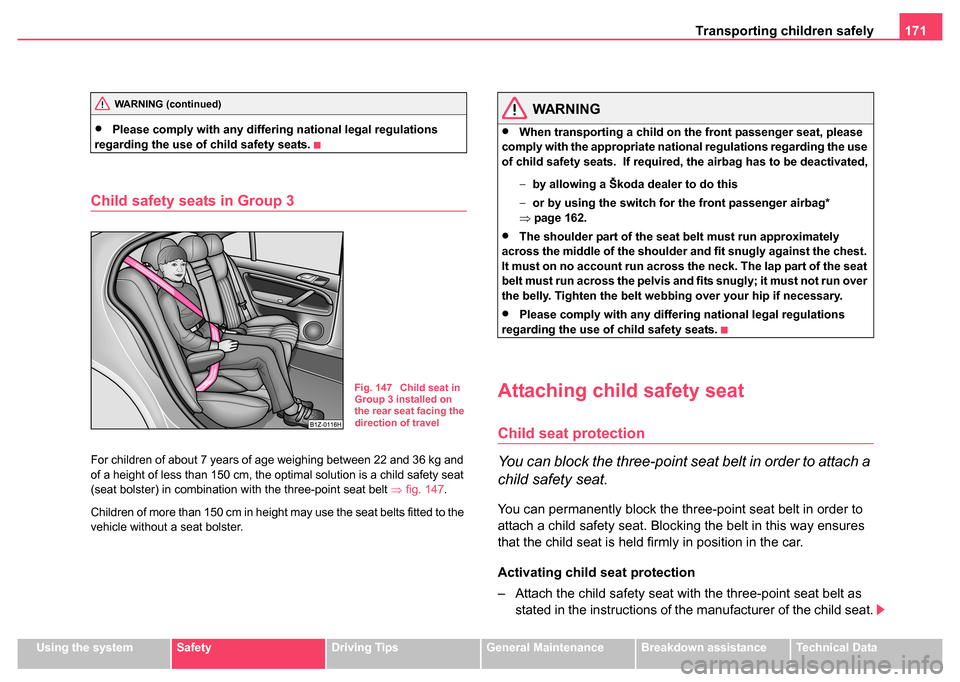
For children of about 7 years of age weighing between 22 and 36 kg and
of a height of less than 150 cm, the optimal solution is a child safety seat
(seat bolster) in combination with the three-point seat belt ⇒fig. 147 .
Children of more than 150 cm in height may use the seat belts fitted to the
vehicle without a seat bolster.
WARNING
•When transporting a child on the front passenger seat, please
comply with the appropriate national regulations regarding the use
of child safety seats. If required, the airbag has to be deactivated,
−by allowing a Škoda dealer to do this
− or by using the switch for the front passenger airbag*
⇒ page 162.
•The shoulder part of the seat belt must run approximately
across the middle of the shoulder and fit snugly against the chest.
It must on no account run across the neck. The lap part of the seat
belt must run across the pelvis and fits snugly; it must not run over
the belly. Tighten the belt webbing over your hip if necessary.
•Please comply with any differ ing national legal regulations
regarding the use of child safety seats.
Attaching child safety seat
Child seat protection
You can block the three-point seat belt in order to attach a
child safety seat.
You can permanently block the three-point seat belt in order to
attach a child safety seat. Blocking the belt in this way ensures
that the child seat is held firmly in position in the car.
Activating child seat protection
– Attach the child safety seat with the three-point seat belt as stated in the instructions of the manufacturer of the child seat.
WARNING (continued)
Fig. 147 Child seat in
Group 3 installed on
the rear seat facing the
direction of travel
Page 173 of 270

Transporting children safely
172
– Now, pull the shoulder part of the belt out fully.
– Insert the tongue of the lock into the seat belt buckle belonging to the seat until it is heard to lock in place.
– Reel up the belt webbing until it is fitted snugly against the child seat. When the belt is reeled up, this can be detected by
a “clicking” noise.
– Pull on the belt in order to check that it is no longer possible to pull out the webbing. The child seat protection is now switched
on.
Deactivating child seat protection
– Press the red button on the seat belt buckle. The tongue of the lock jumps out of the buckle as a result of the spring force
when this is done.
– Guide the belt back with your hand to enable the inertia reel to wind up the belt webbing more easily. The child safety lock is
deactivated after the full reeling up of the belt.
WARNING
It is essential to always switch off ⇒ page 161 the airbag (airbags)
when attaching a child safety seat on the front passenger seat
where the child is seated with its back facing in direction of travel
(in some countries also when the child is facing the direction of
travel). If this is not done, there is a risk of the child suffering severe
or even fatal injuries if the front passenger airbag is deployed. In
certain countries national legal provisions also require that the
side or head passenger airbags be deactivated. When transporting
a child on the front passenger seat, please comply with the appro- priate national regulations regardi
ng the use of child safety seats.
WARNING (continued)
Page 174 of 270

Transporting children safely 173
Using the systemSafetyDriving TipsGeneral MaintenanceBreakdown assistanceTechnical Data
Attaching child seat using the “ISOFIX” system
There are two fixing eyes between the backrest and the seat itself
on both of the outer rear seats for fixing the “ISOFIX” system child
seat in place. – Insert the mounting funnels onto the locking eyes
between the backrest and seat cushion ⇒ page 173, fig. 148.
– Push the notched arms of the child seat over the mounting funnels into the locking eyes, until it is heard to lock
⇒page 173, fig. 149.
– Pull on both sides of the child seat!
One can mount a child safety seat using the “ISOFIX” system quickly,
easily and reliably. Please pay close attention to instructions from the
manufacturer of the child safety seat when installing and removing the
seat.
Child seats fitted with the “ISOFIX” clamping system can only be mounted
and fixed in a vehicle fitted with an “ISOFIX system” when these child
seats have been released for your type of vehicle according to the ECE-
R 44 standard.
You can obtain child seats with the “ISOFIX” attachment system from
Škoda dealers who will also installed it as well.
Complete installation instructions are enclosed with the child safety seat.
WARNING
•The locking eyes have just been developed for child safety
seats which use the “ISOFIX” system. You should therefore never
attach other child safety seats, seat belts or objects to the locking
eyes - hazard!
•Ask a Škoda dealer whether a child seat which you bought for
another vehicle is recommended for use in a Škoda before using an
“ISOFIX” system.
•Certain child seats which use the “ISOFIX” system can be
attached with standard three-point seat belts. Please pay close
Fig. 148 Locking eyes
(ISOFIX system)
Fig. 149 The ISOFIX
child seat is pushed
into the mounting
funnels
AAAB
Page 176 of 270

Intelligent Technology175
Using the systemSafetyDriving TipsGeneral MaintenanceBreakdown assistanceTechnical Data
Driving Tips
Intelligent Technology
Electronic stability programme (ESP)*
General
General
The ESP aids you maintain control of your vehicle in situations in border-
line driving situations such as when negotiating a curve too fast. The risk
of skidding is reduced and your car thus offers greater driving stability
depending on the conditions of the road surface. This occurs at all speeds.
The following systems are integrated into the electronic stability
programme:
•Electronic Differential Lock (EDL)
•Traction control system (TCS)
•Antilock brake system ABS
•Brake Assist
Operating principle
The ESP switches on automatically when the engine is started and then
conducts a self-test. The ESP control unit processes data from the indi-
vidual systems. It also processes additional measurement data which are
supplied by highly sensitive sensors: the rotational velocity of the vehicle
about its vertical axis, the lateral acceleration of the vehicle, the braking
pressure and the steering angle.
The direction which the driver wishes to take is determined based on the
steering angle and the speed of the vehicle and is constantly compared
with the actual behaviour of the vehicle. If differences exist, such as the
car beginning to skid, the ESP will automatically brake the appropriate
wheel.
The car is stabilised again by the forces which take effect when the wheel
is braked. Intervention into the brake system takes place primarily on the
outer front wheel of a vehicle which tends to oversteer (tendency for the
rear of the vehicle to break away) while occurs this is on the inner rear
wheel of a vehicle which tends to understeer (tendency to shift out of the
curve). This braking control cycle is accompanied by noises.
The ESP operates in combination with the ABS ⇒page 179, “Antilock
brake system (ABS)”. If there is a fault in the ABS system, the ESP also
does not operate.
Fig. 150 ESP switch
Page 178 of 270

Intelligent Technology177
Using the systemSafetyDriving TipsGeneral MaintenanceBreakdown assistanceTechnical Data
mitted to the road surface is automatically adapted by reducing the engine
speed. This occurs at all speeds.
The TCS operates in combination with the ABS
⇒page 179, “Antilock
brake system (ABS)”. The TCS will not function if a fault exists in the ABS
system.
The TCS warning light ⇒page 34 lights up in the instrument cluster when
there is a fault on the TCS.
Switching off
You can switch the TCS off and on again as you wish by pressing the
button ⇒page 176, fig. 151 . The TCS warning light ⇒page 34 lights up
in the instrument cluster when the TCS is switched off.
The TCS should normally always be switched on. It may be good practice
to switch the system off only in particular exceptional situations if you
desire wheel slip.
Examples:
•when driving with snow chains
•when driving in deep snow or on a loose surface
•when it is necessary to rock a car free when it has become stuck
then you should switch on the TCS again.
The EDL ⇒page 177, “Electronic Differential Lock (EDL)” is a part of the
TCS. THE EDL operates independently of the TCS (also when the TCS
has been switched off using the TCS button).
WARNING
You should always adjust your style of driving to the conditions of
the road surface and the traffic situation. The increased safety
offered must not tempt you to take greater risks than otherwise -
risk of an accident!
Note
•All four wheels must be fitted with the same tyres in order to achieve
problem-free operation of the TCS. Differing rolling circumferences of the
tyres can lead to an undesirable reduction in the engine output.
•Changes to vehicle (e.g. on engine, on the brakes, on chassis or other
assignment of tyres and wheels) can influence the function of the TCS
⇒ page 233, “Accessories, changes and replacement of parts”.
Electronic Differential Lock (EDL)
The electronic differential lock prevents an individual
wheel from slipping.
General
The EDL makes it much easier, and sometimes at all possible, to start off,
accelerate and climb a steep hill when the conditions of the road surface
are unfavourable.
Operating principle
The EDL is activated automatically, that is without any action on the part
of the driver. It monitors the speeds of the driven wheels with the aid of the
ABS sensors. Should only one drive wheel begin spinning on a slippery
surface there will be an appreciable difference in the speed of the driven
wheels. The EDL function brakes the slipping wheel and the differential
transmits a greater driving force to the other driven wheel. This control
process is also accompanied by noises.
Overheating of the brakes
The EDL switches off automatically if unusually severe stresses exist in
order to avoid excessive heat generation in the disc brake on the wheel
which is being braked. The vehicle can continue to be driven and has the
same characteristics as a vehicle not fitted with EDL.
Page 180 of 270
Intelligent Technology179
Using the systemSafetyDriving TipsGeneral MaintenanceBreakdown assistanceTechnical Data
Low brake fluid level
An insufficient level of brake fluid may result in problems in the brake
system. The level of the brake fluid is monitored electronically
⇒page 35,
“Brake system ”.
WARNING
•Only apply the brakes for the purpose of drying and cleaning the
brake discs if the traffic conditions permit this. Do not place any
other road users in jeopardy.
•When retrospectively mounting a front spoiler, solid wheel hubs
etc. one must ensure that the air supply to the front wheel brakes
is not reduced otherwise the braking system could run too hot.
•Allow for the fact that new brake pads do not achieve their full
braking efficiency until approximately 200 kilometres. New brake
pads must be first “run in” before they develop their optimal fric-
tion force. You can, however, compensate for this slightly reduced
braking force by increasing the pressure on the brake pedal. This
guideline also applies to any new brake pads installed at a future
date.
Caution
•Never allow the brakes to rub by applying slight pressure if you do not
wish to brake the vehicle. This causes the brakes to overheat and can also
result in a longer braking distance and excessive wear.
•Before negotiating a steep downhill section, please reduce your
speed, shift down into the next lower gear (manual gearbox) or select a
lower driving stage (automatic gearbox). This enables you to make full use
of the braking power of the vehicle and reduces the strain on the brakes.
Any additional braking should be done intermittently, not continuously.
Brake booster
The braking force boosts the pressure which you generate with the brake
pedal. The necessary pressure is only generated when the engine is
running.
WARNING
•Never switch off the engine before the vehicle is stationary.
•The brake booster only operates when the engine is running.
Greater physical effort for braking is required when engine is
switched off. Because if you do not stop as normal, this can cause
an accident and severe injuries.
Antilock brake system (ABS)
ABS prevents the wheels locking when braking.
General
The ABS contributes significantly to enhancing the active safety of your
vehicle. Compared to a car not fitted with the ABS brake system, you are
able to retain optimal steering ability even during a full brake application
on a slippery road surface because the wheels do not lock up.
You must not expect, however, that the braking distance will be shorter
under all circumstances as a result of the ABS The braking distance for
example on gravel and fresh snow, when you should anyway be driving
slowly and cautiously, will be longer.
Page 181 of 270

Intelligent Technology
180
Operating principle
As soon as the vehicle speed has increased to about 6 km/hour an auto-
matic test procedure is conducted during which you will be able to hear a
pumping noise for about 1 second.
The brake pressure will be reduced on a wheel which is rotating at a speed
which is too low for the speed of the vehicle and tending to lock. This
control cycle is noticeable from a pulsating movement of the brake
pedal which is accompanied by noises. This is consciously intended to
provide the driver with the information that the wheels are tending to lock
(ABS control range). You must always keep the brake pedal depressed to
enable the ABS to optimally control the brake application in this braking
range. Never interrupt the application of the brakes!
WARNING
•The ABS can also not overcome the physical limits of your
vehicle. Please do not forget this, particularly when driving on icy
or wet road surfaces. If the ABS is operating within the control
range, adapt your speed immediately to the conditions of the road
surface and the traffic situation. The increased safety offered by
the ABS must not tempt you to take greater risks than otherwise -
risk of an accident!
•The normal braking system is still fully functional if there is an
ABS fault. Visit a Škoda dealer as quickly as possible and adjust
your style of driving to take account of the ABS fault in the mean-
time since you will not know how great the damage is.
Note
•A warning light comes on if a fault occurs in the ABS system
⇒ page 34.
•Changes to vehicle (e.g. on engine, on the brakes, on chassis or other
assignment of tyres and wheels) can influence the function of the ABS
⇒ page 233, “Accessories, changes and replacement of parts”.
Brake Assist*
During a severe brake application (e.g. if a hazard exists), the Brake
Assist increases the braking force and thus makes it possible to rapidly
produce the pressure required in the brake system.
The majority of drivers do apply the brakes in good time in dangerous situ-
ations, but do not depress the brake pedal with sufficient pressure. Conse-
quently, it is not possible for the car to achieve its maximum deceleration
and the car covers a greater distance than necessary.
The Brake Assist is activated by the very quick operation of the brake
pedal. In such cases, a much greater braking pressure exists than during
a normal brake application. This makes it possible, even with a relatively
low resistance of the brake pedal, to produce an adequate pressure in the
brake system in the shortest possible time, which is required for maximum
deceleration of the car. You must apply the brake pedal firmly and hold it
in this position in order to achieve the shortest possible braking distance.
The Brake Assist is able to help you achieve a shorter braking distance in
emergency situations by rapidly producing the pressure required in the
brake system. It fully exploits the attributes of the ABS. After you release
the brake pedal, the function of the Brake Assist is automatically switched
off and the brakes operate in the normal way.
WARNING
•The Brake Assist is also not able to overcome the physical
limits of your car in terms of the braking distance required.
•Adapt your speed to the conditions of the road surface and to
the traffic situation.
•The increased safety offered by the Brake Assist must not tempt
you to take a greater safety risk than otherwise.
Page 182 of 270

Intelligent Technology181
Using the systemSafetyDriving TipsGeneral MaintenanceBreakdown assistanceTechnical Data
Power steering
Power steering assists the driver in steering the vehicle and reduces the
physical force needed for steering.
It is still possible to fully steer the vehicle if the power steering fails or if the
engine is not running (vehicle being towed in). The only difference is that
greater physical effort is required.
If the steering is turned to full lock when the car is stationary, you will
place great stresses on the power steering system. Turning the steering
to full lock in such a situation will be accompanied by noises. In addition,
the idling speed of the engine will drop briefly.
Caution
Do not leave the steering at full lock for more than 15 seconds when the
engine is running - risk of damaging the power steering!
Note
•Have the steering inspected as soon as possible by a Škoda dealer if
there is a leak or fault in the system.
•The power steering requires a special hydraulic oil. The oil reservoir is
located at the front left of the engine compartment ⇒page 210. The
correct hydraulic oil level is important for proper operation of the power
steering system.